On the night of November 29, 1963, one week after her husband was shot dead beside her in a moving car, Jacqueline Kennedy sat in a quiet room at the family compound in Hyannis Port and invited a journalist to sit with her. His name was Theodore White. He had a notebook and a pen. She had a word.
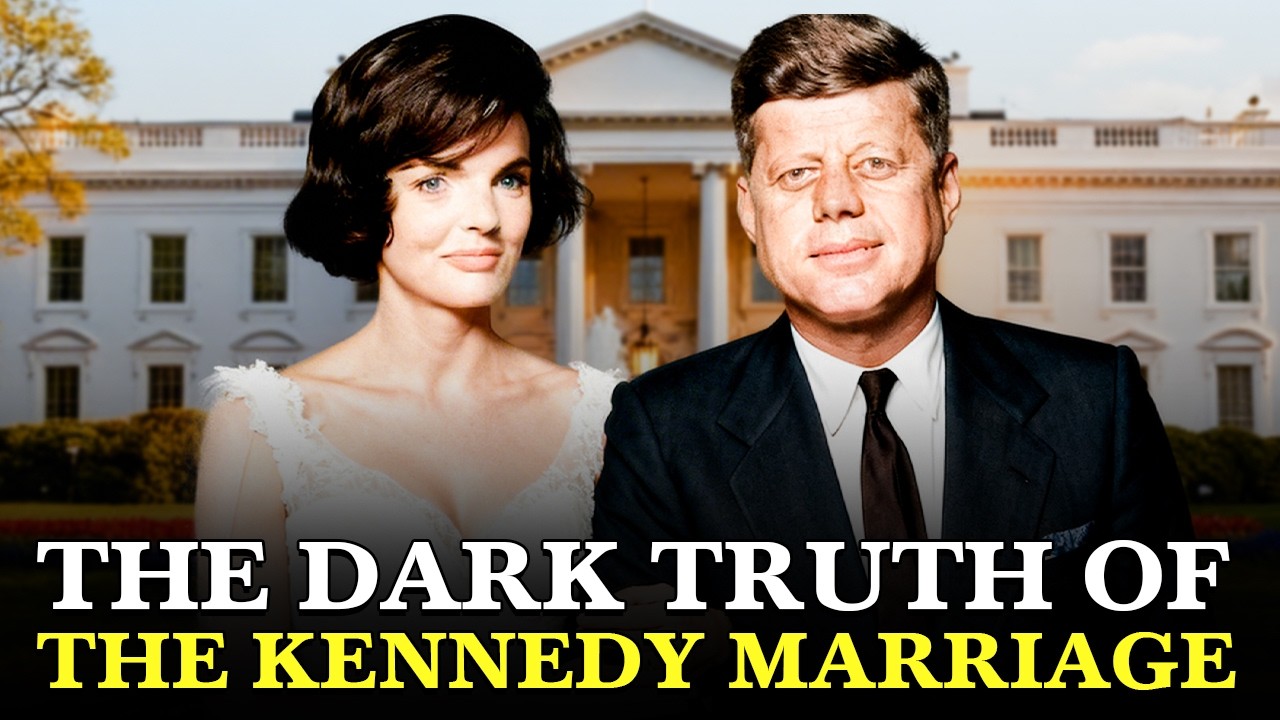
The word was Camelot. She was 34 years old and dressed in black. The funeral was three days behind her. The country was still deep inside its grief.
She spoke for hours, choosing her phrases carefully, telling White what her husband had loved, what the presidency had meant, what the nation should remember. When it was over, she had sealed a marriage that had been fracturing for a decade inside a myth that would make it untouchable. The name Kennedy still carries that myth. The young president, the elegant wife, the children on the White House lawn, the brief shining moment America was never supposed to lose.
But behind the photographs and the legend, there was a marriage that almost ended before it reached the White House, and a capital city that knew it. The story begins with two versions of American ambition. Joseph Patrick Kennedy had assembled a fortune through finance, Hollywood, real estate, and an aggressive business instinct. By the time his children were grown, his primary investment had become political.
He wanted the presidency and intended to get it through his sons. The household he built with Rose Fitzgerald Kennedy was less a family in the ordinary sense than a project. Competition was constant. Achievement was expected.
Vulnerability was managed, not indulged. The eldest son, Joe Jr. , had been groomed for politics. When he was killed on a bombing mission in 1944, the weight shifted to the second son.
John Fitzgerald Kennedy was 27, thin, charming, frequently ill, and not certain the family’s plan was his own. But compliance was required. He stepped into the role his dead brother had vacated. Jack, as the family called him, was witty, well-read, magnetic, and capable of extraordinary warmth in short bursts.
He was also emotionally compartmentalized. His chronic back pain, requiring multiple surgeries and dependence on medication, created a pattern that shaped his relationships. In crisis he could be tender and present. In ordinary life he kept a distance.
He had inherited his father’s appetite for conquest, political, social, and sexual, and his mother’s ability to keep private and public in separate rooms. Jacqueline Lee Bouvier came from a different country within the same country. Born in 1929, she was the elder daughter of John Vernou Bouvier III, known as Blackjack, and Janet Lee Bouvier. Her childhood looked privileged from the outside and fractured from within.
Her father was handsome, charming, alcoholic, and unfaithful. Her mother was socially ambitious, critical, and eventually unwilling to tolerate the humiliation. They divorced when Jackie was ten. She became a watcher.
She developed an early, almost professional understanding of the difference between what a family looked like and what a family was. By her early twenties she was working as the inquiring camera girl for a Washington newspaper, approaching strangers, asking questions, photographing them. She understood images and how to construct a surface. She knew what it cost to maintain one because she had watched her own family surface crack apart.
She met John Kennedy through mutual friends. The courtship moved with a speed that had less to do with passion than trajectory. Their engagement was announced in June 1953, and on September 12 of that year they were married at St. Mary’s Church in Newport, Rhode Island, before roughly 800 guests.
The Archbishop of Boston officiated. The reception was held at the Auchincloss estate. The photographs became founding documents of a mythology neither had yet earned. Jackie was not marrying only Jack.
She was marrying the Kennedy project. And Jack was acquiring the one thing the Kennedy name still lacked, refinement. The French, the art, the understated taste. Each gave the other what they could not produce alone.
The first years unfolded along two tracks. On the public track, the image was exactly what the family needed. In 1954 Jack underwent dangerous spinal surgery, and Jackie stayed at his side during the recovery. She encouraged the research that became Profiles in Courage, the book that would win a Pulitzer Prize.
On the private track, Jack’s behavior with other women was not secret within the Kennedy circle. It was tolerated by the family, managed by staff, insulated by a press culture that treated the private conduct of powerful men as unreportable. Jackie understood the pattern intellectually. Absorbing its emotional cost was another matter.
Then came Caroline, born on November 27, 1957, after a miscarriage in 1955 and a stillbirth the following year. The child became the emotional center of Jackie’s world in a way the marriage never quite managed. By 1960, John Kennedy was running for president. Jackie, pregnant with their second child, was advised to limit travel, but she answered campaign mail, taped television spots, gave interviews in French and Spanish, and wrote a syndicated column called Campaign Wife.
John Jr. arrived on November 25, 1960, barely three weeks after the election. But the period between 1955 and 1956 had brought Jackie closer to leaving than the public would know for decades. Later biographical accounts describe a woman who seriously considered divorce.
The accounts describe Joe Kennedy intervening, not as a comforting father-in-law, but as a chairman protecting the family’s most important asset. One version, repeated across multiple biographies, places the price of Jackie’s continued participation at one million dollars, a direct financial offer to prevent a divorce that would have destroyed Jack’s presidential viability. That claim does not rest on a surviving contract or a memo in an archive. It lives in the space between biography and documented fact.
But the shape of the intervention tells the story. A woman’s marriage was being discussed in electoral terms. Jackie did not leave. The marriage held.
The campaign moved forward. John Fitzgerald Kennedy was inaugurated on January 20, 1961, on a bright, freezing afternoon in Washington. He was 43. Jackie was 31.
Within months, she launched a restoration project that transformed the executive mansion from a building that looked like a department store into something that felt like the home of a civilization. On February 14, 1962, CBS broadcast a televised tour of the White House with Mrs. John F. Kennedy.
Roughly 56 million people watched. It won an Emmy and cemented her as a cultural figure. The fact that her private life bore almost no resemblance to the serenity she projected was understood by a surprisingly wide circle of people, almost none of whom said a word in public. Robert Kennedy, as attorney general, managed the administration’s vulnerabilities.
He knew about Jack’s affairs. He knew the press corps was aware of behavior that would have destroyed a less charismatic politician. The culture of mid-century political journalism made playing along the default. Reporters knew about the women, knew about the medications, and wrote none of it.
Jackie managed her own compartments. The children were hers. The cultural programming was hers. The marriage itself was something she inhabited the way one inhabits a house with a room that stays locked.
In June 1961 the Kennedys traveled to Paris, and Jackie’s reception was so overwhelming that JFK opened a press conference with a line that became one of the most quoted of his presidency. He introduced himself as the man who had accompanied Jacqueline Kennedy to Paris. It was a perfect scene. It was also a performance so polished it had become indistinguishable from sincerity.
On August 7, 1963, Jacqueline Kennedy gave birth to Patrick Bouvier Kennedy, five and a half weeks premature, weighing four pounds ten and a half ounces. He was diagnosed with hyaline membrane disease, a respiratory condition with no reliable treatment in 1963. He lived for 39 hours. Jack flew to the hospital, present in a way the marriage’s ordinary rhythms did not always allow.
When Patrick died on August 9, Jack wept. Jackie was still recovering and could not be there. The days that followed were among the most genuinely intimate the couple had shared in years. Grief dissolved the compartments.
But once the crisis passed, the ordinary architecture of the marriage reasserted itself. By late October 1963 the Kennedys were planning a political trip to Texas. Jackie agreed to come. They arrived in San Antonio on November 21, moved through Houston that evening, and the next morning flew to Dallas, arriving at Love Field just before noon.
The weather had cleared. The motorcade would run with the limousine’s bubble top removed. Jackie wore a pink Chanel-style suit with a matching pillbox hat. Governor John Connally and his wife rode in the same car.
The motorcade moved into Dealey Plaza around 12:30 in the afternoon. The shots came in rapid sequence. The president was struck first in the upper back and throat, then fatally in the head. Jackie climbed onto the trunk of the limousine.
The car accelerated. Secret Service agent Clint Hill pushed her back into her seat. Kennedy was pronounced dead at 1:00 in the afternoon. He was 46.
Jackie was 34. She refused to change out of the pink suit. When asked about the blood, she made clear she wanted them to see what they had done. The surface cracked, and what was underneath was fury.
She was still wearing the suit aboard Air Force One when Lyndon Johnson was sworn in as president. Seven days later, on the night of November 29, she sat with Theodore White and gave him the frame. She told him Jack had loved Camelot, the Lerner and Loewe musical, and quoted the final lyric about a brief shining moment. She asked White to use it.
Not suggested. Asked. White’s article appeared in Life magazine on December 6, 1963. The framing took hold almost immediately.
Camelot became shorthand for the Kennedy presidency and for a particular kind of American nostalgia. You could not question the romance without seeming to desecrate the memory. The state funeral reinforced the construction. On November 25, John Jr.
‘s third birthday, the nation watched Jackie walk behind the casket to St. Matthew’s Cathedral, flanked by Bobby and Ted Kennedy. Outside the cathedral, John Jr. , in his small coat, raised his hand in a salute as the casket passed.
The image became sacred. Bobby Kennedy was shot at the Ambassador Hotel in Los Angeles on June 5, 1968, moments after winning the California primary. He died the following day. For Jackie, it was the loss of the person who had most fully understood both sides of her life after Dallas.
Five months later, on October 20, 1968, she married Aristotle Onassis on the Greek island of Skorpios. Onassis was 62, Greek, enormously wealthy. The reaction in America was swift and harsh. The public that had sanctified her widowhood felt betrayed.
The marriage to Onassis lasted until his death in 1975. Jackie returned to New York and became a book editor, first at Viking, then at Doubleday. She was serious about the work. She raised her children into adulthood.
She maintained a relationship with Maurice Tempelsman that was the closest thing to a genuine partnership she had experienced, private, stable, conducted almost entirely outside the public eye. Jackie was diagnosed with non-Hodgkin lymphoma in early 1994. She died on May 19 of that year at her apartment on Fifth Avenue with her children and Tempelsman at her side. She was 64.
She was buried beside John Kennedy at Arlington National Cemetery, the final act of a mythology she had built and maintained across three decades. The Kennedy marriage was not a fraud. That reading is too simple. It was a structure built for political purpose, maintained through negotiation and endurance, periodically infused with genuine tenderness under conditions of crisis, and ultimately frozen inside a myth that neither partner could have dismantled.
Jackie did not invent Camelot because she was cynical. She invented it because the real story was not one the country was prepared to hear in November 1963. The woman who understood it best was the same woman who decided, on a dark night in Hyannis Port, that the legend would serve her family better than the truth.