Before the Vanderbilts, before Belleview Avenue turned into a corridor of competing marble palaces, one house proved that Newport could be more than a quiet summer retreat. In 1852, when most of Newport’s seasonal visitors were content with modest wooden cottages, William Shepard Wetmore built a granite mansion that announced the arrival of a new kind of American wealth: millions made shipping tea and silk across the Pacific. He called it Chateau-sur-Mer, the castle by the sea. The house that stands there today, however, is not the one Wetmore built.
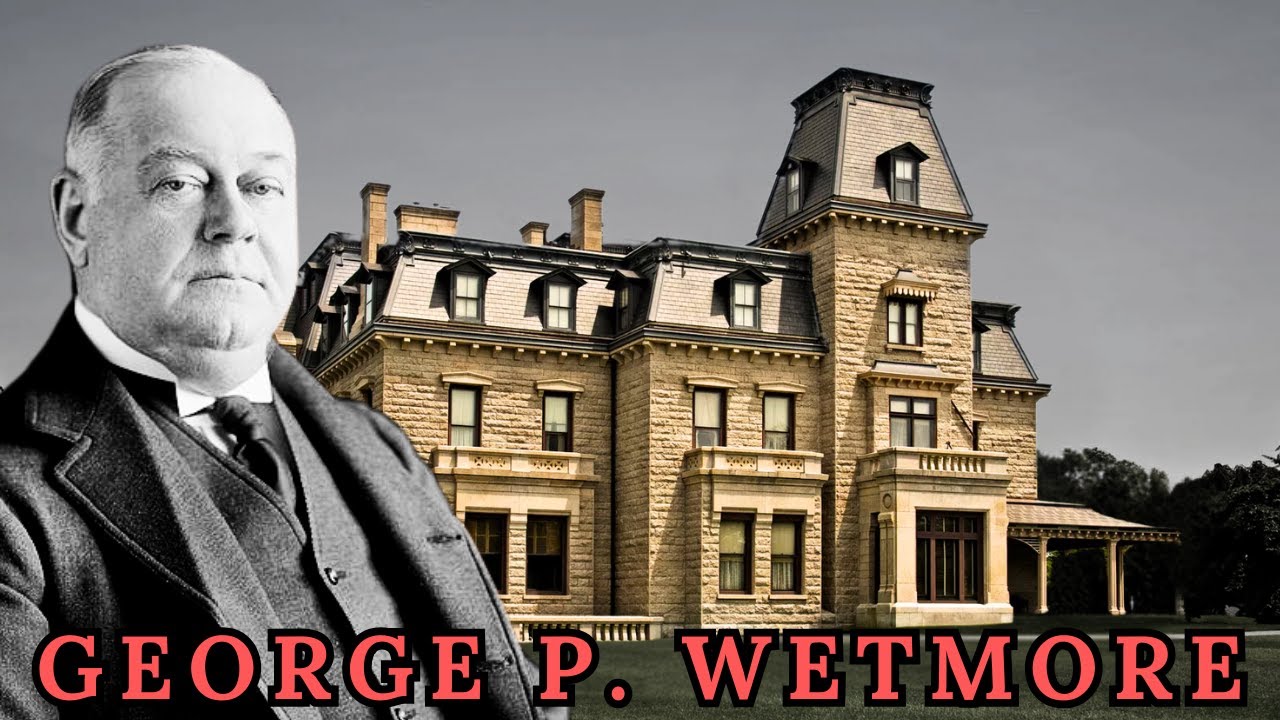
Twenty years after his death, his son George hired the most celebrated architect in America, Richard Morris Hunt, to transform the substantial villa into Newport’s first true palace. The story of that transformation is the story of Newport itself, and it begins with a merchant who saw opportunity where others saw only distance and risk. William Shepard Wetmore did not inherit his fortune; he built it on the most dangerous trade route in the world. Born in New York in 1821, he came from respectable but not wealthy origins.
His path to fortune lay in the China trade, a brutal business of six-month voyages around Cape Horn, voyages that lost ships to storms and crews to disease, fortunes gambled on tea and silk that might arrive worthless if fashions had shifted. For those who survived and succeeded, the rewards were staggering. Wetmore built a business shipping American cotton and ginseng to Canton and returning with tea, silk, and porcelain. By the 1840s, he had accumulated a fortune exceeding one million dollars, an extraordinary sum for a self-made man in his thirties.
Yet the old Knickerbocker families of New York did not care much for China trade money. Money was necessary for social acceptance but not sufficient. Wetmore needed a strategy, and he found it in Newport. In the early 1850s, Newport was a town in transition, once a colonial seaport rivaling Boston and New York, now declining in commercial importance but finding new purpose as a summer retreat.
Southern plantation families came north to escape the heat. Old merchant families from Boston and New York built modest cottages. The atmosphere was genteel and unpretentious. Newport offered social cache without the rigid hierarchies of the great cities.
In 1850, Wetmore purchased property on what would become Belleview Avenue. He hired Seth Bradford, a prominent local architect, and gave him a clear mandate: build a house that announces arrival. Construction began almost immediately. By the summer of 1852, a three-story granite block with a distinctive tower had risen on the coast, a house of thirty to thirty-five rooms with fourteen-foot ceilings, gas lighting, central heating, and running water, conveniences almost unheard of in summer houses.
The cost reportedly exceeded one hundred thousand dollars, an order of magnitude more than his neighbors were spending. Wetmore had applied to social ambition the same calculated risk and impeccable timing that had made his fortune. Wetmore enjoyed his triumph for just over a decade. He died in 1862, only forty years old, leaving behind his wife Annie and two young children.
His son George Peabody Wetmore was just twelve years old when he inherited one of Newport’s finest houses and a fortune estimated at several million dollars. George’s education took him to Europe in his late teens, where he spent years absorbing the art, architecture, and social refinement of Paris, Rome, Florence, and London. He traveled during the height of Second Empire France, when Napoleon III’s architects were transforming Paris into a city of boulevards and monuments. He studied Renaissance palaces that demonstrated how architecture could express both power and refinement.
When he returned to America in the early 1870s, he was no longer simply a wealthy young heir. He was a connoisseur, someone capable of judging serious architectural work, and his father’s house suddenly seemed inadequate. George decided not to tear down the mansion, which might seem disrespectful to his father’s memory, but to transform it into something far grander. For that, he needed the best architect in America, and in the 1870s, that meant Richard Morris Hunt.
Hunt’s background separated him from every other American architect of his generation. He had studied at the École des Beaux-Arts in Paris, the first American ever admitted, and had worked on the expansion of the Louvre. He understood both European tradition and American ambition. The renovation began in 1876 and consumed nearly three years.
Hunt added a full mansard roof, the signature element of Second Empire architecture, extending the house with new wings and raising ceiling heights throughout. He poured ornament across the exterior, carved panels, window surrounds, and a porte-cochère where carriages could deposit guests undercover. The granite solidity of Bradford’s design gained Parisian sophistication. The interior was a complete artistic environment.
The great hall rose nearly forty feet under the tower, its ceiling carved and gilded by Italian craftsmen. Hunt rebuilt the grand staircase as a ceremonial element, allowing arrivals to pause on the landing, visible from the hall below. He created a library with floor-to-ceiling walnut bookcases, a ballroom with silk damask walls and custom crystal chandeliers, a dining room with dark wood paneling and a massive carved fireplace. Every detail, from door hardware to radiator grills, was custom-designed.
The renovation cost between three and four hundred thousand dollars, several times the original construction, and by the early 1880s, the interiors were substantially complete. What Hunt and George had created rivaled anything in Newport, proof that thoughtful transformation guided by a sophisticated patron could achieve what raw expenditure alone could not match. The 1880s brought an explosion of wealth to Newport. The Vanderbilts built the Breakers, a seventy-room Italian Renaissance palazzo costing over seven million dollars.
Alva Vanderbilt commissioned Marble House, its interiors rivaling European palaces. Dozens of other families followed, transforming Belleview Avenue into a showcase of competing ambitions. Chateau-sur-Mer, which had set the standard in the late 1870s, was now merely one of many great houses. But it retained advantages: it had been completed thoughtfully over several years rather than rushed to make a social statement, and Hunt’s design demonstrated genuine architectural understanding rather than simply displaying wealth.
The house felt like a residence where cultured people actually lived. George Peabody Wetmore chose public service. He served as governor of Rhode Island from 1885 to 1887 and in the United States Senate from 1895 to 1913. Chateau-sur-Mer became a retreat from political pressures, a place where Senator Wetmore could entertain friends and escape the compromises of public life.
His tenure spanned the Spanish-American War and the Progressive Era reforms. He retired from politics in 1913 and focused on the house for the first time in decades. He died in 1921 at age seventy-one. His estate passed to his daughters, Edith and Maud, neither of whom married.
The staff required to operate the house numbered in the dozens, and the annual costs were substantial. The great parties ceased. The stock market crash of 1929 strained even substantial fortunes, and World War II accelerated Newport’s decline as a fashionable resort. Edith Wetmore, the last family member to occupy the house, died in 1966.
The economics favored demolition, but a counterforce had emerged. The Preservation Society of Newport County, established in 1945, recognized that the Gilded Age mansions were irreplaceable architectural and cultural heritage. In 1969, three years after Edith’s death, the society acquired Chateau-sur-Mer and opened it to the public. The preservation of the house represents a broader shift in how Americans think about their architectural heritage.
The Gilded Age mansions, once dismissed as vulgar displays, are now recognized as important cultural artifacts. Chateau-sur-Mer survives as one of the finest examples of Second Empire architecture in America. Its granite walls have stood for over 170 years, housing merchants and politicians, private cultivation and public education. The house matters because it came first.
When William Wetmore built his granite mansion, he proved that Newport could support serious architectural ambition. His son transformed it into one of the Gilded Age’s great achievements. Richard Morris Hunt proved that American architects could achieve European standards. The summer colony is gone, and the social structures that sustained it have dissolved, but the architecture remains.
Chateau-sur-Mer stands not as the grandest Newport mansion, but as the bridge between what came before and what followed, the mansion that started the transformation of a quiet resort town into the showcase of Gilded Age America.