In the autumn of 1887, deep in the remote mountains of Western Virginia, a lumber surveyor named Otis Grieve found himself standing at the base of a ridge he had been warned to avoid. He was 39 years old, a solitary man who had drifted south from Pennsylvania after losing his job, and he had spent months walking these mountains alone, marking trees and mapping the old-growth forests. On a foggy October morning, following a wrong turn along a creek bed, he looked up and saw the house they called Brierwood Manor. It was not a manor in any grand sense.
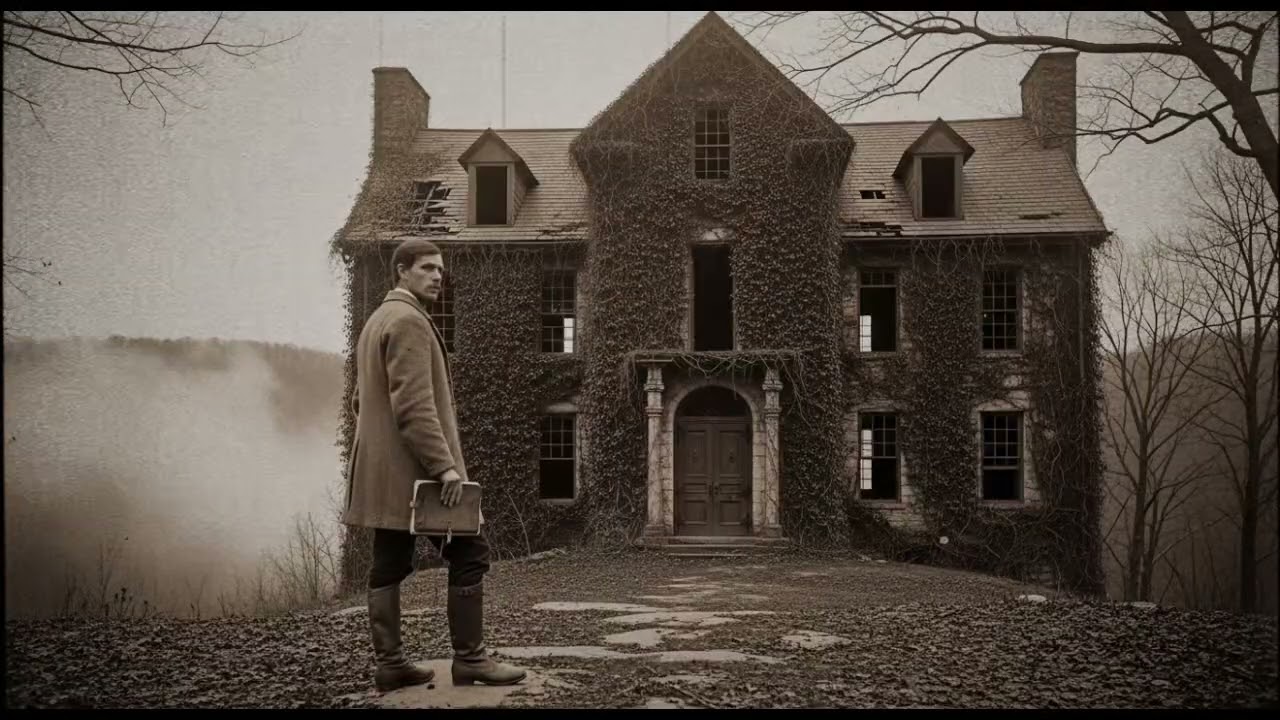
Built in the 1820s on a high ridge overlooking a narrow valley, it was a sagging structure of timber and stone, its roof partially collapsed, its walls thick with vines. The name of the family who built it had been scratched out of every record in the county courthouse, not erased, but deliberately gouged away, as if someone had taken a blade to the paper itself. Otis had asked about the house once at the general store in the nearby town of Saloffield. The shopkeeper, a heavy man named Persing Alcott, had gone very still at the question.
He told Otis that people who went up to that house did not come back the same. Otis, who trusted in weather and gravity and the indifference of nature, dismissed the warning. But something about the look on Persing’s face stayed with him. On that foggy morning, standing at the base of the ridge, Otis decided to climb.
He was not a superstitious man, but he had spent his whole life walking toward things other people walked away from. The ridge was steep and treacherous, covered in loose shale. When he reached the top, the house loomed before him, larger than he had expected. Carved into the stone lintel above the front door were words in an old style of English: What is kept shall be kept.
The door was unlocked. It swung inward with a sound like a long exhale. The first thing that hit him was the smell: fresh wood smoke, as if a fire had burned in the hearth moments before. But there was no warmth in the house.
The air inside was colder than the air outside. The entry hall was dim, lit only by gray light seeping through vine-covered windows. A staircase rose along the left wall. To the right, a doorway led into a parlor.
Otis entered it and found the room furnished, not with ruins, but with usable furniture. A settee, a rocking chair, a table with a dusty lamp. On the mantelpiece above a cold fireplace sat a row of daguerreotypes. He leaned in to look at them.
In every photograph, the faces of the men and women had their eyes scratched out, gouged from the metal plates with something sharp. Someone had taken great care to blind every person in those images. Then he heard it. Footsteps.
Slow, deliberate, moving across the ceiling above him. They stopped directly above where he stood. Otis left the parlor and walked back toward the front door. It was closed.
He had left it open, he was certain of that. He pulled the handle. The door did not move. He threw his shoulder against it.
Nothing. The windows on the ground floor were sealed just as thoroughly. Behind him, from the top of the staircase, came a whisper. Not words exactly, but the shape of words, the breath of language without substance, as if someone were trying to speak through a throat that had forgotten how.
He did not look up the stairs. Instead, he moved deeper into the house, toward a closed door at the far end of the hall. It opened onto a narrow corridor, where the wood smoke smell was overwhelming. At the end, he found a kitchen with a massive iron stove, cold and dead.
On a table in the center sat five place settings, arranged with unsettling neatness, as if a meal had been prepared and the diners had never arrived. On the far wall was a back door. It opened. Cold air rushed in, and Otis stepped out into the fog, descending the slope at a pace just short of running.
He did not stop until the ridge was lost behind him. He made it back to Saloffield by late afternoon. At the general store, Persing was not there. His wife told Otis he was at a meeting at the town hall.
When Otis asked what meeting, she said, with a measuring look: the meeting they have every October about the manor. Inside the meeting hall, about twenty people sat on wooden benches. Meridian Foss, a 63-year-old former schoolteacher who kept to herself at the edge of town, stood at the front. She spoke of the coming of November, of the fog growing worse, and then she said the house was getting stronger.
She could feel it in the ground. The mountain was humming. After the meeting, Otis approached her. She looked at him and said, without hesitation, “You went inside.
” She asked what he had heard. He told her about the footsteps, the whisper, the sealed doors. Meridian listened without expression. Then she said something that lodged itself in his mind.
It had not wanted to hurt him. If it had wanted to hurt him, he would not be standing there. It had wanted to show him something, and he had left before it could. Over the next two weeks, Otis tried to return to his work.
But the mountains felt different now. At night he dreamed of the manor. In the dreams, the faces in the daguerreotypes were whole, and they were looking at him, trying to tell him something he could not quite hear. He would wake with the taste of wood smoke in his mouth.
On the first of November, he went to see Meridian. She told him the story of Brierwood Manor. It had been built in 1822 by a man named Fesus Crane, a surveyor like Otis, drawn to the mountains for the timber and mineral rights. But Crane had been a collector of knowledge, fascinated by the mountain itself, its geology, its caves, the stories local people told about things that lived in the deep hollows where sunlight never reached.
He had explored for years. Then he found something. She did not know what. The records had been scratched out.
Whatever he found changed him. He stopped leaving the manor. His workers quit one by one. By 1827, Fesus Crane had not been seen in over a year.
Men from the valley went up to check on him. They found the house furnished and clean, food on the table, fire in the stove, but no Fesus. His boots were by the door. In the cellar, they found a door carved directly into the mountain rock, covered in markings no one could read.
It was sealed. As they stood trying to open it, they heard something from the other side. Breathing. Something larger than a human, breathing with the slow rhythm of geological time.
The men left and never went back. Meridian told Otis that since then, people had occasionally gone up to the manor. Most came back with nothing but a feeling of unease and the smell of wood smoke. Some came back changed, quieter, as if part of them had stayed behind.
A few did not come back at all. Otis did not believe in spirits. But he believed in the mountains, that they were older than comprehension. And he believed Meridian when she said that whatever was in that house had not wanted to hurt him.
It wanted to show him something. On the seventh of November, Otis went back. He told no one. He packed his surveying kit, his hatchet, a lantern, a rope, and food for two days.
The front door was open. He walked past the parlor and went directly to the staircase. Upstairs, he found bedrooms still made, wardrobes still full of moth-eaten clothes. In one room, on a desk, lay a scatter of hand-drawn maps of the mountain, its tunnels, caves, and underground waterways.
They were Fesus Crane’s maps. In the margins were notes. The early ones were precise and scientific. The later ones were different.
It knows I am here. I can feel it in the walls. The door is changing. I heard my own name from behind the stone.
At the bottom of the stack, one page contained a single sentence, written in letters so large they filled the sheet: It is not behind the door. The mountain is the door. His lantern flickered. From deep beneath the house, he felt it: a vibration, not a sound exactly, but a pulse, like a heartbeat.
The heart was the size of a mountain, and it beat once every thirty seconds. Otis stood very still. It was not frightening. It was sad.
An immense, ancient sadness that had been waiting in the dark longer than the human species had existed. At the top of a narrow staircase leading to the attic, he found a long room with a floor of raw mountain stone. In the center of that floor ran a crack, perfectly straight, about six feet long and an inch wide, like a deliberate seam. From it emanated a faint, colorless light, visible only when he did not look directly at it.
He knelt and pressed his ear to the crack. He heard a voice, clear and resonant, speaking in a language he did not know but somehow understood. It was not speaking to him. It was speaking to itself, the way the wind speaks to itself.
It was the sound of something immeasurably old processing its own existence. Otis felt known. Not watched, but known, as if the mountain had been aware of him since he first set foot on its slopes. He stayed there, kneeling on the stone, for hours.
He saw the mountain as it had been millions of years ago, saw it erode, saw forests grow and die, saw ice sheets crawl down from the north. And beneath all of it, something persisted. A consciousness that had formed like a crystal, slowly, over eons. The mountain had been aware.
And it was lonely. That was the sadness: a loneliness so vast it had become a physical force, drawing in the curious, the solitary, the brave. Fesus Crane had felt it. And now Otis felt it, with tears he did not remember shedding on his face.
When he finally descended, the front door was open. He walked out into a night dense with stars and did not close the door behind him. In the morning, he told Meridian everything. She listened in silence.
Then she said that Fesus could not leave it alone. He went back again and again, each time staying longer, each time coming down a little less himself, until the last time when he did not come down at all. The mountain did not mean harm, but it did not understand how fragile humans were. It reached out the only way it knew how.
Sometimes what it touched broke. In the weeks that followed, the pull of the manor grew stronger. Otis would drift toward the northern ridge without intending to. He would lose time, his mind elsewhere.
The dreams intensified. Meridian warned him to stop thinking about it, then warned him to leave. If he went back, she said, it would keep him. Not out of malice, out of loneliness.
The way the earth keeps a seed. Otis did not leave. On the twelfth of December, in the dead of night, he dressed in his warmest clothes and walked out into deep snow. The climb was brutal, the ridge sheathed in ice.
It took him three hours to reach the top. The manor stood against the sky, the front door open. He went inside, up the stairs, to the attic. The crack was there.
The light was there. He knelt and pressed his hands flat against the stone. This time, the mountain spoke to him in a way he understood. Not in words, but in images and feelings.
It showed him what it wanted. It wanted to be heard. After millions of years of consciousness, it wanted someone to know it was there. Not to worship it, not to fear it.
Just to acknowledge it. To say: I hear you. You are not alone. Otis, kneeling on that cold stone floor, with tears freezing on his face and the mountain humming beneath him, spoke aloud.
“I hear you. ”
The light from the crack flared once, brighter than anything he had ever seen. A light with no heat, but it filled the attic, poured through the windows, and lit the ridge like a second dawn. Then it faded slowly, gently, like someone closing their eyes after being awake for a very long time.
The vibration slowed, and stopped. The silence that followed was not empty. It was the silence of something finally at peace. Otis stood and walked out of the house.
The door closed softly behind him with a click of finality. He left Saloffield three days later, riding east on a borrowed horse. Meridian watched him pass from her cabin window. She did not wave, but she smiled.
The records show he settled in the Shenandoah Valley, married a woman named Corin Driscoll, and worked as a surveyor for the state until retirement. He lived a quiet, unremarkable life. But every year on the twelfth of December, he would step outside at midnight, no matter the weather, and stand very still, listening. Those who knew him well said that in those moments, the loneliness he carried like a scar would ease, and he would smile slightly, as if hearing something no one else could hear.
He never told anyone what happened that night. When he died in the spring of 1929, at the age of 81, they say his last words were not about his wife or his life. He said, “I can still hear it. ” And he smiled, and closed his eyes.
The ridge is still there. And on certain nights in December, when the snow falls silent above the Appalachian ridge line, people in the valley below say they can see a faint, pulsing light coming from somewhere inside the mountain.