Born in Jayton, Texas, in 1939, Weldon Myrick grew up in a landscape of dust and distance, where the radio was the only window to the wider world. The signal from WSM Nashville, carrying the Grand Ole Opry across the plains, shaped his ambitions. But Myrick was not a typical country boy. He thought like an engineer, fascinated by the mechanics of sound as much as the music itself.
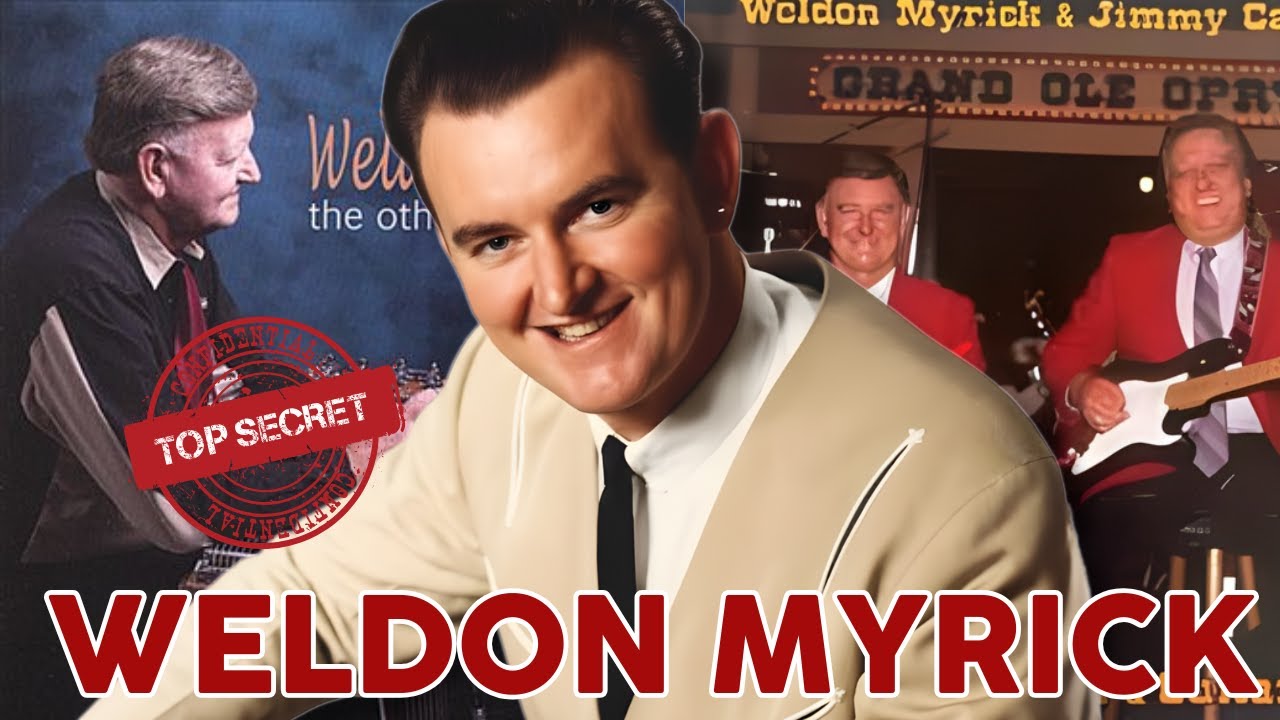
That fascination led him to the steel guitar, a machine of strings, rods, and pedals that demands both hands, both feet, and both knees to play. It is one of the most difficult instruments to master, and Myrick was drawn to that complexity. Unhappy with the limitations of his early lap steel, he began modifying it as a teenager, bending notes and pulling sounds from the instrument that mimicked the human voice. He wanted the machine to cry.
By the early 1960s, he packed his car and drove to Nashville. The city was the capital of country music, but it was also a fortress. The industry was controlled by a tight circle of session players known as the A-Team, and newcomers were not welcome. Myrick had no flashy personality and no smooth talk.
He had only his hands and the dark, thick, crying sound he had engineered back in Texas. The prevailing style in Nashville was bright, fast, and swing-influenced. Myrick played fewer notes, but he made them weigh more. Producers told him his playing was too simple, too sad.
He scraped by on low-paying gigs, eating baloney sandwiches in cheap motels, waiting for the phone to ring. It rang on July 16th, 1964. The call was for a session at RCA Studio B with Connie Smith, a terrified 23-year-old housewife from Ohio who had won a talent contest. She was there to record a song written by Bill Anderson called Once a Day, a weeper about a woman who misses her ex-lover constantly.
The producer, Bob Ferguson, looked at Myrick and asked for an intro that set the mood. Myrick said nothing. He struck the strings and pressed the pedals, but instead of sliding cleanly to the note, he created a crying dissonance that hung in the air for six seconds before resolving downward into a mournful sob. Before Connie Smith sang a single word, the steel guitar had already told the listener what the song was about.
That intro became one of the most recognizable sounds in country music history. Once a Day stayed at number one for eight weeks, a record for a female solo artist that stood for nearly fifty years. But for musicians in Nashville, the song signaled something else: the arrival of the Weldon Myrick sound. Producers across Music Row suddenly wanted the cry, the sustain, the way his notes seemed to hold hands with the singer’s voice.
Myrick became Connie Smith’s phantom singer, filling her silences and supporting her high notes. She later said that he was the author of the Connie Smith sound. The singer was the picture, but he was the frame. In 1966, Myrick was invited to join the Grand Ole Opry staff band.
It was the highest honor in country music, but it was also the hardest gig in show business. The Opry broadcast live every Friday and Saturday night with no rehearsals. Guest stars arrived minutes before airtime, threw chord charts at the band, and said follow me. For more than thirty years, Myrick anchored this chaos.
He knew the entire history of country music, could play a song from 1930 for an aging bluegrass legend, and could learn a new radio hit by ear in real time. He read singers from the way they approached the microphone, leaning in with his sound when they seemed shaky and laying back on the beat when they rushed. He was an invisible musical guide, and most of the audience never knew anything had needed fixing. The Opry was stable, but it did not make him rich.
The pay was union scale. The assumption was that the prestige would lead to lucrative session work during the week, and for a long time it did. Through the 1970s, Myrick worked four sessions a day, seven days a week. But the economics were built on a trap.
He was paid a flat fee for each session, roughly ninety dollars for three hours, and he owned nothing of what he created. He composed the riffs, the intros, and the hooks that made songs into hits, but he was listed as labor, not as a writer. If a song flopped, he kept his ninety dollars. If it sold five million copies and played on the radio for decades, he still kept his ninety dollars.
He was helping build mansions for other people while trading his own ideas for a paycheck. He did not waste the money. He bought a house in the suburbs and raised a family. But he owned no royalties and no copyrights.
He owned only his hands, and hands are mortal. During the mid-70s, Myrick continued to innovate. He drilled holes in his guitar and added an extra string, creating a hybrid tuning that blended the standard E9 with the jazzier C6. The Myrick setup, as it became known among players, gave his playing a depth no one else could replicate.
He was like a Formula 1 driver who was also his own mechanic, re-engineering the instrument to match his soul. The late 1970s brought a new threat. The Nashville Sound was becoming polished into countrypolitan, and synthesizers were creeping into the studios. Producers began asking steel players to sound less like steel guitars.
Myrick adapted, using his volume pedal to create ethereal, organ-like textures. He survived, but the culture of Nashville was shifting. The old camaraderie was fading, and the studios were becoming corporate. He watched his heroes fade into retirement, poverty, and the bottle.
Then a lifeline appeared from the place where he had started. A shy singer from Texas named George Strait arrived in Nashville wanting Western swing and the sound of dusty dance halls. He needed a steel player who remembered how to make the instrument swing. Myrick entered a second golden age.
On Marina Del Rey he played with a restraint that was almost breathable, using his custom tuning to create chord voicings that sounded like jazz piano. On Amarillo by Morning he captured the lonesomeness of the Texas panhandle, a loneliness he had grown up with. These records proved that the steel guitar still had a central place in modern country music, and they made it cool again. But the Opry schedule kept him out of the touring bands of the superstars he recorded with.
When George Strait played stadiums, he took a different steel player. Myrick stayed in Nashville, the voice on the record but not the face on the stage. And his body was paying the price. The pedal steel is an ergonomic nightmare.
Sitting in a position of constant isometric tension for thirty years wrecked his lower back, his circulation, and his wrists. He never complained. He took aspirin, drank coffee, and went to the session. By the late 1980s, the economics of Music Row were changing.
Self-contained bands like Alabama and Restless Heart played their own instruments and needed no session steel player. The rise of Garth Brooks in 1989 brought a new generation of producers and musicians. Myrick was still brilliant, but the industry valued new over good. The four sessions a day became two, then one, then a few times a week.
Younger players learned his licks and got the gigs. By most accounts, he remained gracious and professional as the work thinned out, but quietly, he began to worry. He had saved money, but had he saved enough? The 1990s brought digital recording.
Pro Tools allowed producers to visualize sound on screens and demand mathematical perfection. Myrick, who played by feel, the way a sailor navigates by wind and instinct, found the new environment deeply alien. Worse, producers began using keyboard patches to mimic the steel guitar for demos and even master recordings. The sound was thin and sterile, but it was cheap and easy.
The man who had drilled holes in his own guitar to find new sounds was now competing against a microchip. In 1998, after thirty-two years, Myrick played his final show as a full-time Opry staff band member. There was no parade. He packed up his guitar and drove home.
He was fifty-nine years old. In any other profession he would have been entering his senior partner years. In the music business, he was simply out. He played sporadically, taught seminars, and welcomed steel guitar enthusiasts who traveled from Japan, Sweden, and Germany just to ask him how he did that slide on Once a Day.
These pilgrimages were flattering, but they did not pay the bills. He had no royalties and no ownership of the masters. His pension was modest. Entering his seventies, his health began to fail.
Circulation issues in his legs worsened. There were hospital visits and specialists. In the United States, a serious illness can dismantle a lifetime of savings in a matter of months. The bills piled up.
Around 2013, word circulated in Nashville that Weldon was not doing well. The record labels that had made millions off his backing tracks were owned by multinational conglomerates that did not know him. The Opry family is a brand, not a safety net. And so the unthinkable happened: he began quietly selling his tools.
The custom-built guitars, the carefully tweaked amplifiers, the pedals he had modified himself, piece by piece. There was no public telethon. He did what he had always done. He took the practical steps he needed to keep going.
In June 2014, he suffered a massive stroke. It took away his ability to play and his ability to speak the language he knew best. He was admitted to Saint Thomas Hospital in Nashville. Friends visited.
Bill Anderson wrote touching words. Connie Smith was there in spirit and in prayer. But prayers do not pay the ICU bill. On June 2nd, 2014, Weldon Myrick died at the age of seventy-six.
The tributes were genuine. Connie Smith repeated what she had always said: he was the author of the Connie Smith sound. Bill Anderson spoke of his kindness and his uncanny ability to find the emotional center of a song. But the physical reality of his estate told a different story.
There was no vast fortune in royalties. Only a modest estate and a house that no longer held the instruments which had defined his working life. His story represents a systemic failure in the American music industry. Myrick was a work-for-hire musician, legally no different from a plumber.
Once the job was done and the check was cashed, his relationship to the work ended. But when he created the hook for Once a Day or the oceanic swell on Marina Del Rey, he was creating intellectual property that generated revenue for decades. The record labels built their empires on the backs of men like him, then codified a system that excluded them from the bounty. If Myrick had received a fraction of a penny for every time Amarillo by Morning was played, he would have died a wealthy man.
Instead, the system extracted his genius, monetized it, and left him to face the winter of his life selling his old tools. In the years after his death, a strange thing happened. Younger players who had never set foot in the Opry began discovering his recordings. They heard something no computer could replicate: imperfection.
They heard the way he dragged a note a millisecond behind the beat, creating a tension that felt like heartache. They heard the way his volume pedal swelled like a human lung taking a breath. He was not playing notes. He was playing physics, manipulating tension and release in a way no algorithm can understand.
He has become a musician’s musician, a saint in the church of the analog. Every time a steel player uses the Myrick modification, he is in the room. His legacy is not in the bank. It is in the hands of the next generation.
The gear is sold, the money is gone, the man is buried. But the sound sustains. As long as those old records keep spinning, the steel guitar is still weeping, and Weldon Myrick’s voice is still heard.