On an autumn morning in 1776, British warships bombarded the shore of Manhattan, and landing boats disgorged redcoats and Hessian grenadiers onto the beach. The American defenders did not fight. They dropped their muskets and ran.
One horseman rode into the chaos, tall and broad-shouldered, his face pale with fury. He ordered the men to stand, struck them with his cane, and threw his hat to the ground. When the enemy vanguard approached, he stopped and sat alone on his horse, staring at the advancing bayonets as if he no longer cared for his life.
His aides had to seize his bridle and pull him away.
That rider was George Washington, commander-in-chief of the Continental Army. Behind his clenched jaw was a secret: his teeth were not his own. They were carved from hippopotamus ivory, fitted with human teeth, and hinged with gold springs.
By the time he became president, he had only one natural tooth left.
The Battle of Kip's Bay was not a bad afternoon. It was a pattern. Washington lost at Long Island, lost at White Plains, and lost nearly 3,000 men in a single day at Fort Washington.
The next year, he lost at Brandywine, lost at Germantown, and lost Philadelphia, the capital of the rebellion. Over the course of the war, he lost more battles than he won. By the winter of 1777, a circle of officers and congressmen known as the Conway Cabal whispered about replacing him with General Horatio Gates, the hero of Saratoga.
Today, Washington is the calm face on the dollar bill, the marble statue, the man who never told a lie. We remember the president and forget the soldier. That is unfortunate, because the general who kept losing battles understood something his critics and enemies never did: you do not have to win every battle.
You only have to win the last one.
What set him apart from every other general of his era? Three tactical moves stand above the rest.
The Escape That Saved the Army
The story begins three weeks before Kip's Bay, on the most dangerous night of Washington's career. In the summer of 1776, Britain sent the largest overseas military expedition in its history to crush the rebellion. Hundreds of ships crowded New York harbor.
On August 27, at Long Island, nearly 20,000 British and Hessian troops attacked an American army of about 10,000. The British did not break the American front. They flanked it.
Guided by local Loyalists, General William Howe marched his main column through the night to the Jamaica Pass, which the Americans had left guarded by only five militia officers on horseback. All five were captured without a shot fired.
By morning, the British army was behind American lines. The collapse was swift and brutal. A few hundred Maryland troops bought time by charging the enemy again and again until most were killed or captured.
Their sacrifice allowed the survivors to retreat to the fortifications on Brooklyn Heights. About 9,000 men remained, nearly half the Continental Army's fighting strength.
Their position was dire. In front of them stood a victorious enemy. Behind them lay the East River, nearly a mile of open water between Brooklyn and Manhattan.
In the harbor, the Royal Navy waited. If British warships sailed into the river, the army would be trapped. The capture of 9,000 men in one stroke would have ended the Revolution.
General Howe was in no hurry. The previous year, at Bunker Hill, he had watched his men slaughtered attacking American fortifications. He did not want a repeat.
He ordered his engineers to dig siege trenches, creeping closer to the American lines each day. In Howe's mind, the rebels were under his control. His brother, Admiral Richard Howe, commanded the fleet.
As soon as the weather allowed, the warships would close the river. The Americans could starve or surrender. Either way, the British commander believed the river behind them was a prison wall.
But the weather did not cooperate. A cold northeast wind and heavy rain flooded the American trenches for two days. That same wind trapped the British warships in the lower harbor, unable to force their way up the river.
Everyone in Brooklyn Heights felt the storm as misery. Washington read it as a warning. The northeast wind would not blow forever.
The enemy trenches were advancing slowly. With every hour, the noose tightened.
On August 29, Washington called a council of war. The decision: withdraw. Tonight.
In full.
What followed was one of the most delicate operations of the entire war. Washington sent orders across the river to collect every usable boat. Rowboats, flat-bottomed barges, sailboats.
To keep secrecy, the orders claimed the boats were needed to transport reinforcements from New Jersey. Most of his soldiers were not even told they were leaving.
He turned to an unusual regiment: the 14th Continental Regiment under Colonel John Glover, fishermen and sailors from Marblehead, Massachusetts, men who had spent their lives handling small boats in the North Atlantic. Sailors from Salem joined them, becoming the army's ferrymen.
After dark, soldiers slipped out of their trenches, regiment by regiment, and headed to the Brooklyn ferry landing. Orders were passed in whispers. No talking, no coughing.
Wagon wheels were wrapped in rags. A rear guard stayed in the front lines, keeping fires burning so the rebel position glowed with life from the British side.
Twice, the plan nearly collapsed. First, the wind and currents turned against the sailboats, and only the rowers could cross for hours. Late in the night, the wind shifted, and the sails filled.
Then, in the darkness, a mistaken order sent the entire covering force to the ferry too early. For a moment, the trenches facing the British army stood nearly empty. Washington met the column himself and marched it straight back to the front lines.
Astonishingly, the British never noticed.
Dawn broke before the job was done. Daylight would expose the last boats to every British cannon on the heights. Then a thick fog settled over the water, swallowing the landing, the river, and the rear guard.
Officer Benjamin Tallmadge recalled that he could barely see a man a few yards away. Under that gray fog, the last boats pushed off. Washington himself was among the last to leave.
When the British finally advanced into the American fortifications, they found empty trenches, cold fires, and a few stragglers left to loot. The army was gone. In one night, across a mile of hostile water, under the eyes of the most powerful army on earth, Washington moved about 9,000 men with their horses, most of their cannon, and their supplies.
Not a single soldier was killed in the escape.
This is George Washington's first lesson: a retreat is not a surrender. If executed well, it is a weapon. As long as the army survived, the Revolution survived.
You can capture every city in America, and it will not matter as long as the army is still in the field.
The Crossing That Turned the Tide
Four months later, with his army fading and the enemy certain the war was already decided, the master of disappearance stopped running and did the one thing no one believed he still could.
Winter 1776. The retreat from New York had become a rout. Washington's army was chased across New Jersey, and in early December, the survivors staggered across the Delaware River into Pennsylvania.
The force that had numbered about 20,000 in the summer was down to a few thousand men fit for duty. Many were barefoot. Some left bloody footprints in the frozen mud.
Congress had fled Philadelphia to Baltimore. A deadline loomed: most soldiers had signed up only until the end of the year, and on January 1, they had the right to go home. After this terrible year, most intended to.
On December 18, Washington wrote to his brother Samuel. He did not put a cheerful face on it. "I think the game is pretty near up," he said.
A few days later, officers read aloud to the shivering troops a new pamphlet by Thomas Paine, warning them that these were the times that try men's souls. The pamphlet was inspiring, but it would not hold the army together past New Year's. The only thing that could was victory.
On the other side of the river, the British were settling in for the season. That was how wars were fought in the 18th century. Armies campaigned in good weather, and when the roads froze, they went into winter quarters and waited for spring.
General Howe spread his forces across a chain of outposts in New Jersey, then returned to New York. He saw the rebel army as an exhausted force that would dissolve on its own by January.
Near the end of that chain lay the town of Trenton, held by about 1,500 Hessian troops under Colonel Johann Rall. Rall was brave and experienced, and he despised the Americans. His own officers urged him to build earthworks and fortify the approaches, but he did not bother.
He did not believe the rebels would dare attack, and he certainly did not believe anyone would try to cross an icy river in the dead of winter.
There is a popular myth that the Hessians at Trenton were drunk from Christmas celebrations. They were not. The truth is more interesting.
For days, American militia and raiding parties had been harassing their outposts, setting off repeated alarms through the night. Rall's men were not drunk. They were exhausted.
Here Washington saw what his enemy did not. The British believed winter protected them. Washington realized winter hid him.
No one watches the door in a snowstorm. And the deadline that was draining his army was also a motivator. If he was going to lose these men on January 1 anyway, he had nothing to lose by gambling with them now.
The plan called for three separate crossings of the Delaware on Christmas night, all converging on Trenton. Two failed. Ice choked the river, and those columns turned back.
Only Washington's column made it across.
About 2,400 men and 18 cannon gathered at McConkey's Ferry. Glover's Marblehead sailors, the same men who had saved the army at Brooklyn, did the rowing again. They used heavy Durham boats, long cargo vessels built to carry iron ore down the river.
Henry Knox, the former Boston bookseller now commanding the artillery, stood on the bank shouting orders into the dark. Then a northeast storm hit. Rain, sleet, and hail swept the river.
Ice floes slammed against the hulls, delaying the crossing for hours. The plan was to attack before dawn, but they would not even begin the march until about 4 a. m.
The element of surprise was slipping away, but Washington pressed on anyway.
The password for the night was "Victory or Death." Nine miles stretched between the ferry and Trenton. Two soldiers sat down by the roadside to rest and never got up; they froze to death.
Near the town, the army split into two columns. General Nathanael Greene took the upper road, while General John Sullivan took the river road. They were to attack Trenton from two directions at once.
Word came from Sullivan that the storm had wet his men's muskets, rendering them unable to fire. Washington's reply was simple: "Use the bayonet."
Around 8 a. m. , the two columns attacked almost simultaneously.
Knox dragged his cannon to the head of the two main streets and fired straight down them. Every time the Hessians tried to form ranks in the open road, the guns tore them apart. Americans slipped into houses and fired from windows.
A young lieutenant named James Monroe was badly wounded while charging a Hessian cannon. He would one day become the fifth president of the United States.
Rall tried to rally his men in an orchard east of town, but he fell from his horse, mortally wounded. Within about an hour, the battle was over. The Hessians lost about 22 killed, more than 80 wounded, and nearly 900 captured.
The Americans lost not a single man to enemy fire, with only a few wounded. It was not so much a battle as a regiment-sized ambush.
Washington transported his prisoners to Pennsylvania, then crossed the Delaware again. On the last day of the year, with enlistments running out, he stepped before the regiments and personally asked the men to stay six more weeks, offering a $10 bonus. At first, no one stepped forward.
Then, one by one, the men stepped up. The army survived the new year.
Just in time. In January 1777, General Charles Cornwallis marched from Princeton with several thousand of the Crown's best troops, determined to avenge Trenton. American riflemen under Colonel Edward Hand fought a stubborn delaying action along the road, and it took the British all day to reach the town.
At dusk, Cornwallis faced Washington across a small stream called Assunpink Creek. His men tried three times to storm the bridge, and each time they were driven back. Darkness fell.
Cornwallis decided to finish the job in the morning.
He had reason to be confident. Washington's army was trapped with the Delaware River behind it, and this time there were no boats waiting. It was Brooklyn all over again.
But Washington did not repeat Brooklyn. He improved on it.
Scouts found a back road, a little-used path that looped around the British left flank toward Princeton. That night, about 500 men stayed behind to keep fires burning and dig noisily with picks and shovels, as if the army was entrenching for battle. Meanwhile, everyone else slipped away along the back road, cannon wheels wrapped in rags.
Once again, the weather sided with him. For days, a thaw had turned the roads into thick mud that would have swallowed the cannon. That night, the temperature dropped hard, the mud froze, and the road became a highway.
At dawn on January 3, near Princeton, the American advance column under General Hugh Mercer stumbled into British regiments marching to join Cornwallis. The battle in a frozen orchard was savage. Mercer's horse was shot from under him.
British soldiers surrounded him and bayoneted him repeatedly. He died days later. His men broke and began to flee.
Then Washington arrived. He rode straight through the retreating troops into the open field, positioning himself between the two lines, about 30 yards from the British muskets. Both sides fired.
Smoke covered his body. An aide covered his face, certain he was watching his commander die. When the smoke cleared, Washington was still in his saddle, unharmed, waving his men forward.
The American lines surged ahead. The British collapsed. The last defenders holed up in the stone college building, Nassau Hall, and quickly surrendered.
Back at Assunpink Creek, Cornwallis woke to the sound of distant cannon fire and an empty field before him. In 10 days, Washington had crossed the frozen river three times, fought three battles, outmaneuvered one of Britain's best generals, and forced the enemy to abandon most of New Jersey. A cause declared dead before Christmas was alive by the new year.
The principle of the second move is deadlier than the first. Strike your enemy where he feels safe, at the moment he is sure the fighting is over. His comfort is your opportunity, and his schedule is your weapon.
The Trap That Ended the War
Those ten days saved the Revolution, but they did not decide it. For that, Washington needed something far greater: a lie told to an entire army, a march across half a continent, and a trap sprung from the sea.
Four and a half years later, in 1781, the war had become a stalemate. Congress was bankrupt, the Continental currency was nearly worthless, soldiers had not been paid for months, and in January, troops from Pennsylvania and New Jersey mutinied. Washington warned that the army could not hold out much longer.
His only hope was France.
A French army under the Comte de Rochambeau had been waiting in Newport, Rhode Island, since the previous summer. A powerful French fleet under Admiral de Grasse was operating in the Caribbean, but de Grasse had only a narrow window. He had to return to the West Indies before autumn.
Whatever the allies did, they would get one chance, and they had to use it by fall.
For years, Washington had dreamed of recapturing New York. That summer, the allies probed its defenses. Then, in mid-August, news arrived that changed everything.
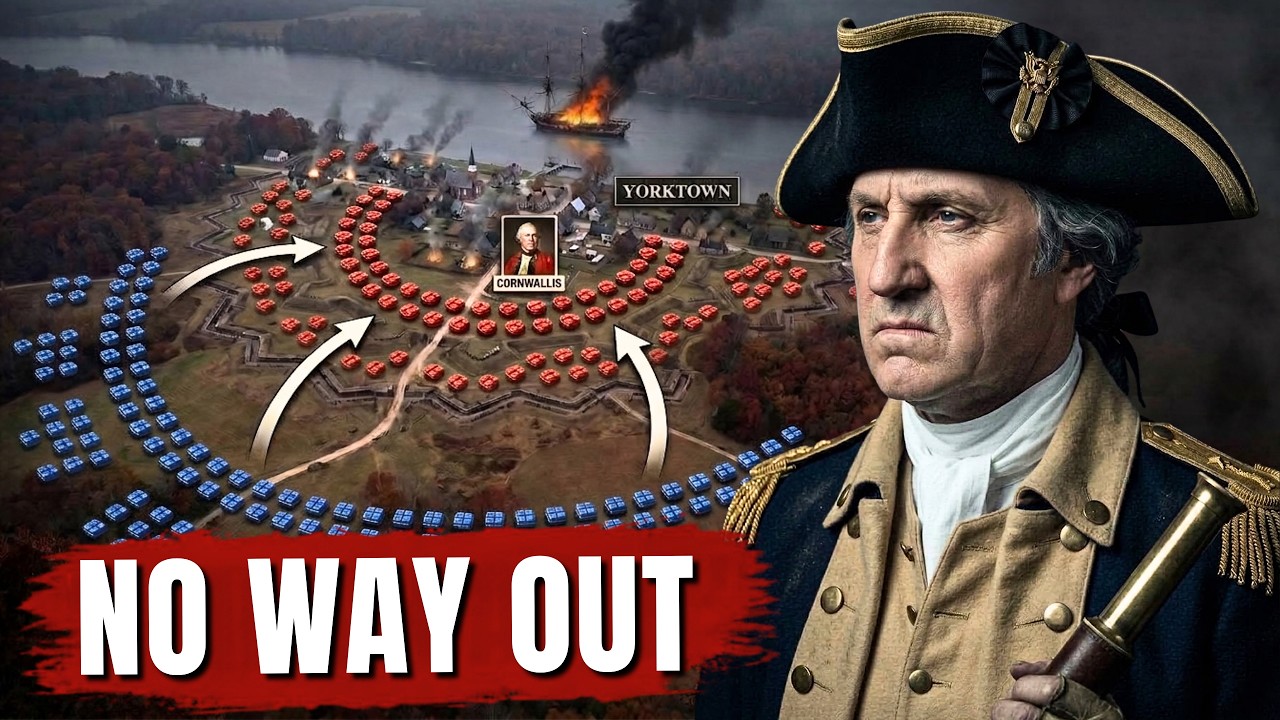
De Grasse was not heading to New York. He was heading to Chesapeake Bay with more than twenty warships and about 3,000 French troops. In Virginia, Cornwallis, the same man Washington had slipped past at Assunpink Creek, had gathered an army of about 8,000 men on a peninsula at a small tobacco port called Yorktown.
Here is the difference between a stubborn general and a great one. Washington abandoned his cherished plan almost overnight and shifted the entire course of the war southward.
The British commander in New York, General Sir Henry Clinton, had every reason to believe New York was the target. British agents had intercepted letters from Washington earlier that year discussing exactly that. The allies were positioned just north of the city.
Clinton tightened his grip on his troops and even asked Cornwallis to send forces north to help defend. In Virginia, Cornwallis felt safe. Britain controlled the seas.
As long as the Royal Navy controlled the water, his base at Yorktown could be supplied, reinforced, or evacuated at will.
Washington realized both British generals were relying on the same argument. Clinton was sure the blow would fall on New York. Cornwallis was sure the sea belonged to Britain.
If that second belief broke, Yorktown would stop being a fortress. It would become a cage.
To deceive Clinton, Washington did not have to invent a lie. He only had to reinforce the lie Clinton already believed. On August 19, the allied armies left their camps along the Hudson River.
At first, their columns moved in directions that seemed to threaten New York. Boats gathered as if preparing an assault on Staten Island. At Chatham, New Jersey, the French built large bread ovens, the kind an army builds when it expects to stay for a long siege.
Only a few senior officers knew the true destination. Even the troops marching south did not know where they were going.
By the time Clinton realized what was happening, the allied armies had already passed Philadelphia and were beyond reach. At Chester, Pennsylvania, a messenger brought Washington word that de Grasse had arrived in Chesapeake Bay. The Virginian, known for his composure, lost it.
French officers watched him on the riverbank waving his hat in the air, and when Rochambeau arrived, Washington embraced him warmly.
At sea, the trap was closing. On September 5, de Grasse's fleet met a British squadron off Cape Virginia and inflicted enough damage to force it back to New York. The mouth of Chesapeake Bay was sealed shut.
Meanwhile, a second French squadron slipped down from Newport carrying the heavy siege cannon the allies needed. On land, the young Marquis de Lafayette had been shadowing Cornwallis all summer, keeping him penned on the peninsula.
In the midst of it all, Washington allowed himself one short detour. He stopped at his home, Mount Vernon. It was the first time he had seen it in six years.
By late September, more than 15,000 American and French troops had surrounded Yorktown. On the night of October 6, the allies dug their first siege trench, known as the "first parallel," within range of the British fortifications. Three days later, the big guns opened fire.
As was customary, Washington himself fired one of the first American shots.
Two fortified British positions, known as Redoubts 9 and 10, blocked the allies from advancing their lines. On the night of October 14, troops stormed both positions in simultaneous bayonet attacks. French forces hit one, while Americans under a young lieutenant colonel named Alexander Hamilton hit the other.
Hamilton's men went in with unloaded muskets, relying on skill and silence. The redoubt fell in minutes.
Now the allied cannon could fire into Yorktown at point-blank range. Cornwallis made one last desperate attempt. On the night of October 16, he began ferrying troops across the York River to escape.
For the last time, the sky intervened. A violent storm scattered his boats, and the escape plan collapsed.
The next morning, a lone British drummer climbed onto the parapet and beat the call for parley. On October 19, 1781, the British army marched out to surrender. Cornwallis claimed illness and sent his deputy, General Charles O'Hara, to surrender the sword.
O'Hara tried to offer it to Rochambeau, who directed him to Washington. Washington, in turn, directed him to his own deputy, General Benjamin Lincoln, the same man the British had forced into a humiliating surrender at Charleston the year before. About 8,000 soldiers and sailors laid down their arms.
Consider the speed that made it possible. In about two and a half weeks, the allied armies had marched nearly 200 miles from the Hudson River to the head of Chesapeake Bay. That is more than 10 miles a day, moving artillery and supply wagons, while the enemy commander waited for an attack that never came.
It was the largest military movement of the entire war.
When word reached London, Prime Minister Lord North reportedly took the news as a shock, crying out that it was all over. Within months, Parliament voted to end the offensive war in America. The Treaty of Paris made peace official in 1783.
The third principle is the highest: let your enemy guard the door he expects you to use. Then aim every soldier, every ship, every weapon you have at the door he forgot. And when the moment demands it, be ready to abandon even your favorite plan.
Here is George Washington, the general who lost more battles than he won. He saved an army from a trap in the fog. He turned a freezing retreat that nearly killed his army into a ten-day lightning counterattack.
He deceived one British general while besieging another, ending the war with a single campaign. Escape, reversal, checkmate.
Years later, Thomas Jefferson, a man who did not always agree with him, put it clearly. In an 1814 letter, Jefferson said no general ever planned his battles with more wisdom. He also admitted that when a plan fell apart in the heat of battle, Washington could be slow to readjust.
That frankness is exactly what makes the praise valuable.
In his own time, Americans called Washington the American Fabius, after the Roman general who saved his republic by refusing to give Hannibal the decisive battle he craved. But Fabius only kept Rome alive. It took another man, Scipio, to finish the job.
Washington did both. He endured like Fabius, then struck like Scipio.
And when it was over, he did something almost no victorious general in history has done. In December 1783, he returned his commission to Congress and went home to Mount Vernon. He lost the battles, won the war, and then gave the power back.