Wyatt Earp once described his closest friend as “a dentist whom necessity had made a gambler, a gentleman whom disease had made a vagabond. ” The man he was speaking of was John Henry “Doc” Holliday, a frail, educated Southerner who had come west to die and instead carved out a place among the most famous gunmen of the American frontier. By the time he reached the boomtown of Tombstone, Arizona, in September 1880, he was already a legend in his own right—a deadly gambler with a physician’s warning hanging over him, certain that his end would come from a bullet or a rope rather than the consumption wasting his lungs. Holliday was born on August 14, 1851, in Griffin, Georgia, the son of Henry Holliday, a pharmacist and Confederate major who had served in the Cherokee Indian War and the Mexican-American War.
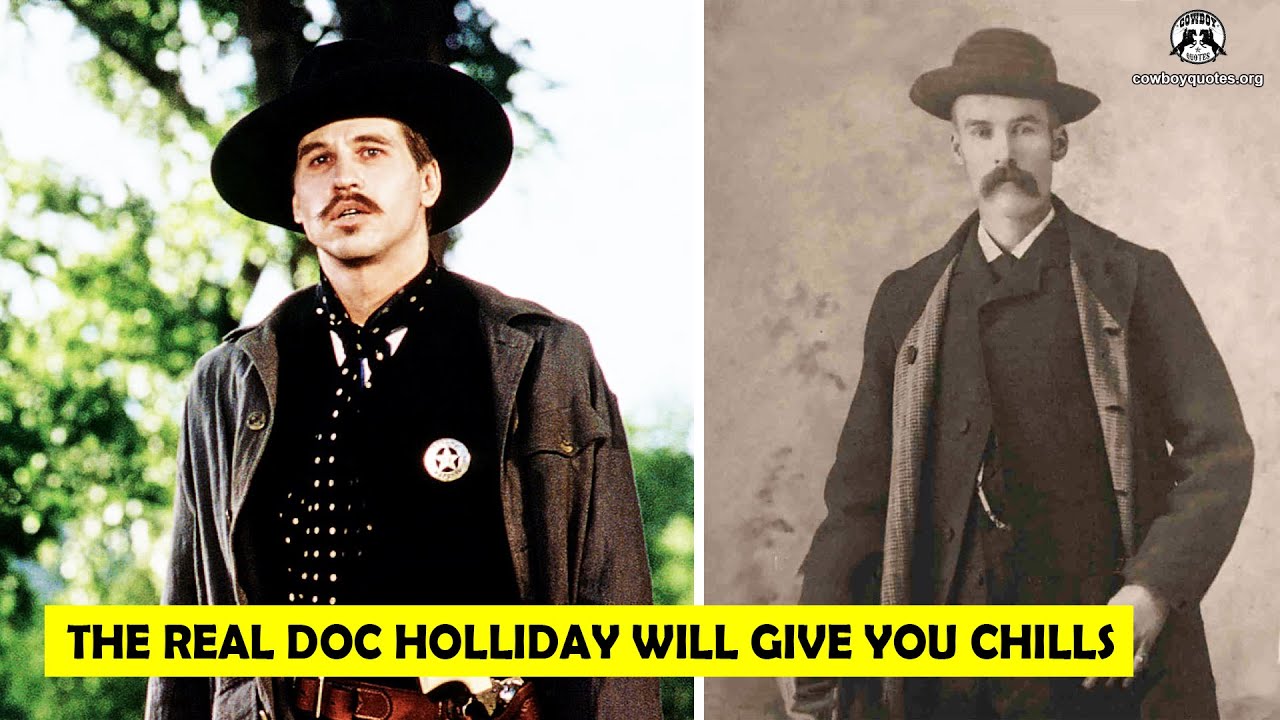
The family moved to Valdosta, where Henry became a leading citizen, serving two terms as mayor. John Henry attended the Valdosta Institute, studying Greek, Latin, and French, and was on a respectable path toward the dental profession—encouraged in part by his cousin, who had founded the Pennsylvania College of Dental Surgery. He enrolled there in 1870 and soon after began practicing dentistry in Atlanta. But tragedy marked his life early.
When John was fifteen, his mother died of consumption, the disease later known as tuberculosis. His father remarried only three months later, and the loss stayed with him. Shortly after starting his dental practice, Holliday discovered he had contracted tuberculosis himself, most likely from his mother. Physicians gave him little time and advised him to move to a drier climate.
In October 1873, he packed up and left Georgia, heading for Dallas, Texas. There was also another reason for the move. According to one account, Holliday had gotten into a shooting incident back in Georgia when African-American men were swimming in his favorite swimming hole. He fired over their heads, one of them shot back, and no one was hurt.
It was an early sign of a hot temper that would define his western years. In Dallas, Holliday tried to continue his dental work alongside another dentist, Dr. John A. Seager.
But the coughing spells that wracked his body during delicate procedures drove his patients away. Forced to find another way to earn a living, he turned to gambling. It suited him well. He was highly educated, fluent in Latin, played the piano, dressed neatly, and carried the manners of a Southern gentleman.
He became a skilled poker and faro dealer, but he was also miserable, knowing his death was coming. He drank heavily and lived recklessly, with no fear of dying. On January 2, 1875, Holliday was involved in his first recorded gunfight, an argument with a local tavern owner during which multiple shots were fired but no one was injured. The Dallas Weekly Herald reported the incident as something of a joke.
A few days later, Holliday got into another disagreement and killed a prominent citizen with two carefully aimed bullets. Fearing for his safety, he fled Dallas with authorities on his trail. He drifted through the lawless cow towns of Texas, dealing faro and carrying a gun in a shoulder holster, another on his hip, and a knife. He was involved in three more gunfights in a short time, leaving one man dead, but no legal action was taken against him.
In the summer of 1876, he killed a soldier from Fort Richardson, which finally brought the United States government into the hunt. A reward was issued, and the Army, Texas Rangers, sheriffs, and ordinary citizens seeking the bounty all pursued him. Aware that capture would likely mean hanging, Holliday fled to Apache country, then Kansas territory, Colorado, and eventually Denver, where he hid under the alias Tom Mackey and dealt faro at a theater on Blake Street. After a knife fight in which he seriously wounded a well-known gambler, public resentment forced him to run again, first to Wyoming, then New Mexico, and finally back to Texas.
It was at Fort Griffin, Texas, while dealing cards at John Shanssey’s saloon, that Holliday met Mary Katherine Horony, the woman known as Big Nose Kate. She was educated but chose to work as a prostitute because of the freedom it gave her. The two developed a deep attachment, and Kate would become the only woman known to have held Holliday’s heart. Around the same time, Holliday met Wyatt Earp.
Earp was on the trail of a train robber named Dave Rudabaugh, chasing him for four hundred miles under an acting commission as a U. S. deputy marshal. He went to Shanssey’s saloon to ask about Rudabaugh, and Shanssey directed him to Holliday, who had played cards with the outlaw.
Earp was wary—Holliday was known to hate lawmen—but Holliday willingly told him that Rudabaugh had likely backtrailed to Kansas. Earp wired the information to Bat Masterson, sheriff of Dodge City, and it helped lead to Rudabaugh’s capture. The unlikely pair formed a friendship that would last for years. During the winter of 1878, Holliday killed a man named Ed Bailey during a poker game.
Bailey, annoyed by Holliday’s reputation, kept picking up the discards, a violation of western poker rules. Holliday warned him twice, but Bailey ignored him. The third time, Holliday raked in the pot without showing his hand. Bailey went for his pistol, but Holliday drew a knife from his breast pocket and caught him below the chest.
Bailey died, and Holliday was detained in his room at the Planter’s Hotel. A vigilante mob formed, and Big Nose Kate devised a plan to free him. She set fire to an old shed, and as the town rushed to fight the flames, she confronted the officer guarding Holliday with a pistol in each hand. The two escaped on stolen horses and headed for Dodge City.
Grateful for Kate’s loyalty, Holliday gave up gambling and hung out his dentist’s shingle again, while Kate promised to give up prostitution. But Kate could not endure the quiet life. She returned to the dance halls and gambling dens, and the two split up—a pattern that would repeat throughout the rest of his life. Holliday went back to gambling, frequenting the Alhambra and dealing cards at the Long Branch Saloon in Dodge City.
In the summer of 1878, a group of cowboys, including Toby Driskill and Ed Morrison, rode into Dodge City and terrorized the town, galloping down Front Street and vandalizing the Long Branch Saloon. Wyatt Earp ran to the scene and found himself facing a large group of armed cowboys. Morrison sneered at him, challenging him to draw. Before Earp could respond, a voice sounded from behind Morrison: “No friend, you draw or throw your hands up.
” It was Holliday, his revolver pressed to Morrison’s temple. Holliday had been in the back room, his card game interrupted by the chaos. He told the cowboys that if any of them pulled a gun, their leader would lose what was left of his brains. They dropped their arms.
Earp clubbed Morrison over the head with his Colt and marched the cowboys to jail. Earp always credited Holliday with saving his life that day. In late August 1879, Holliday argued with a gunman named Mike Gordon in Las Vegas, New Mexico. The two took the argument to the street, where Holliday invited Gordon to start shooting whenever he felt like it.
Gordon did, and died with three shots in his belly. Another lynch mob formed, and Holliday returned to Dodge City, only to find that Earp had left for a new silver strike in Tombstone, Arizona. Holliday joined the Earps in Tombstone in September 1880. Some accounts say Earp sent for him to help deal with the outlaw Cowboys who ran roughshod over the territory.
When Holliday arrived, he found Wyatt, along with his brothers Morgan, James, and Virgil, who had just been appointed a deputy U. S. marshal. Virgil appointed Wyatt as acting city marshal and swore in Morgan as an officer.
The Clanton gang—Old Man Clanton, his sons Ike, Finn, and Billy, the McLaury brothers, Curly Bill Brocius, John Ringo, and their followers—resented the Earps’ arrival and made no secret of it. On October 26, 1881, Virgil Earp received reports that the Cowboys, with whom they had had repeated confrontations, were armed in violation of a city ordinance requiring them to deposit their weapons at a saloon or stable. Fearing trouble, Virgil temporarily deputized Holliday and gathered his brothers. Virgil retrieved a short coach gun from the Wells Fargo office, and the four men went to find the Cowboys on Fremont Street.
They met them about ninety yards down an alley from the O. K. Corral, between Fly’s photo gallery and the Jersey Livery stable. Virgil announced they were under arrest for disturbing the peace.
He showed only a walking stick, giving Holliday the shotgun to conceal under his long coat. The shooting started when Billy Clanton and Frank McLaury cocked their pistols. It remains unknown who fired first, but Holliday’s bullet was the first to hit, tearing through Frank McLaury’s belly. Billy Clanton fired at Virgil but was hit by Morgan’s shot through his rib cage.
Ike Clanton panicked, threw down his gun, and ran, ignoring Wyatt’s order to fight or get out. Tom McLaury fired a bullet into Morgan’s side, and Holliday instantly countered, blowing Tom away with both barrels of his shotgun. Dying Billy Clanton fired blindly into the gun smoke, striking Virgil in the leg. Wyatt responded with several rounds into Billy.
Then it was silent. The thirty-second shootout left Billy Clanton, Frank McLaury, and Tom McLaury dead. Virgil was wounded in the leg, Morgan in the shoulder. The Earps and Holliday were tried for murder, but it was determined they had acted within the law.
On March 18, 1882, the Cowboys struck again. While Morgan Earp played pool at Campbell and Hatch’s saloon, a shot fired from the darkness of an alley struck him in the back. Morgan’s body was dressed in one of Holliday’s suits and shipped to his parents in California for burial. Wyatt and Holliday sought revenge, and over the next year they eliminated many outlaws, including Frank Stilwell and Curly Bill Brocius.
Wyatt and Holliday left Tombstone for good, vowing revenge on John Ringo, Ike Clanton, Pete Spence, and Hank Swilling. They took a train to Colorado. On July 14, 1882, John Ringo was found dead in West Turkey Creek Valley near Chiricahua Peak, Arizona, with a bullet hole in his right temple and a revolver hanging from his finger. The popular story holds that Holliday stepped in for Earp and shot Ringo, but the Pueblo Daily Chieftain reported that Holliday was in Salida, Colorado, on July 7, more than 550 miles from where Ringo’s body was found, and in Leadville on July 18.
Holliday biographer Karen Holliday Tanner noted that an outstanding murder warrant in Arizona made it unlikely he would return. Ringo’s death remains a mystery. Holliday’s health continued to decline. In May 1887, hoping the hot springs and sulfur vapors might improve his condition, he went to Glenwood Springs, Colorado, and registered at the fashionable Hotel Glenwood.
He grew steadily worse, spending his last fifty-seven days in bed, delirious for fourteen of them. On November 8, 1887, he awoke clear-eyed and asked for a glass of whiskey. He drank it down with enjoyment. Then, looking down at his bare feet, he said, “This is funny,” and died.
He had always figured he would be killed with his boots on. Doc Holliday had come west years before knowing his days were numbered, expecting his end to come from lead poisoning, a rope, a knife, or drink. Instead, the tuberculosis he had carried for over a decade finally caught up with him in a hotel bed. He was buried in Glenwood Springs Cemetery, on a steep hillside overlooking the valley below.
Despite his reputation, he had narrowly escaped death nine times, including four attempts to hang him and five gunshot wounds. The exact number of men he killed is unknown. What remains is the story of a dying man who chose to live hard, play cards, and stand beside a friend when it mattered most.