On the morning of May 6th, 1950, roughly three thousand fans pressed against the wrought iron fence outside the Church of the Good Shepherd in Beverly Hills, waiting for an eighteen-year-old MGM contract player to step out of a studio limousine in a gown the studio had paid for. The dress had been designed by Helen Rose, the same costume designer who would later make Grace Kelly’s wedding gown. The bridesmaids were under contract to MGM. The press call sheet had been arranged by MGM.
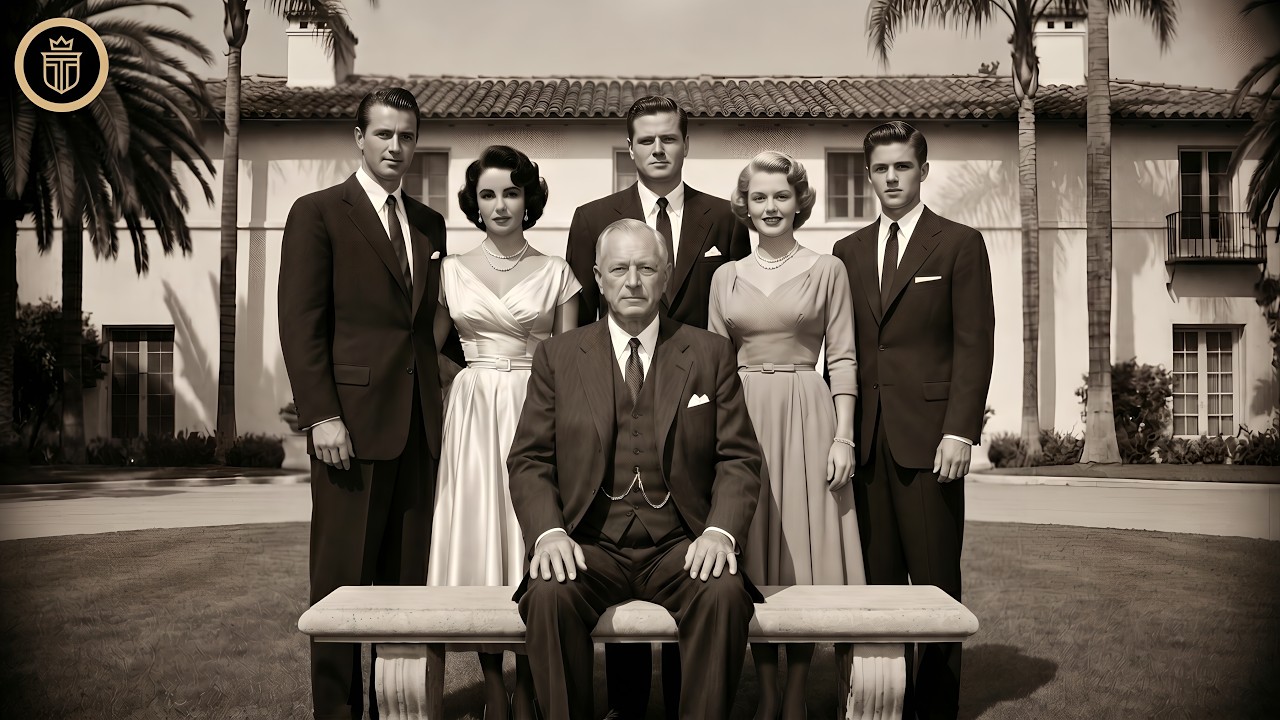
And the film whose release was three weeks away, Father of the Bride, in which the same teenager played a character preparing for the same kind of wedding, had been calibrated scene by scene against a publicity calendar that ended at the steps of this church. Inside, a twenty-three-year-old hotel heir waited at the altar. Catholic, slim, well-dressed, and already drinking heavily by mid-morning, according to the later reporting of journalist J. Randy Taraborrelli.
The bride was Elizabeth Taylor. The groom was Conrad Nicholson Hilton Jr. , known to his family and the gossip columns as Nicky. The wedding produced a magazine spread, a movie tie-in, and one of the highest-grossing comedies of 1950.
Within seven months, it produced a separation. Within eight, a divorce action filed in Santa Monica. And within sixty-four years, a hardcover biography in which the most prolific celebrity biographer in America described what he reported happened years later in a room at one of the groom’s father’s hotels to a maid named Virginia Larson. The wedding was an event MGM organized.
Almost everything that came after, the family did not. Conrad Nicholson Hilton Sr. had been born on Christmas Day 1887 in the New Mexico Territory, years before the territory became a state. His father, a Norwegian immigrant, ran a dry goods store in a town the census still listed as fewer than five hundred souls.
His mother, a German Catholic from a family of ten, said the rosary daily and would, by Conrad’s own later account in his 1957 autobiography Be My Guest, be the single most important moral influence of his life. When the Panic of 1907 left the family broke, the adobe home was reorganized as a boarding house, and Conrad, then in his late teens, had his first lesson in the economics of selling a bed by the night. After serving two terms as a Republican in the first New Mexico State Legislature and completing officer training during World War I, he returned from Paris in 1919 to find his father had been killed in a car accident. The death redirected the family business onto his shoulders.
He intended to buy a small bank in Cisco, Texas, with five thousand dollars raised from family and friends, and walked away from negotiations when the seller raised the price at the last minute. He crossed the street to rent a room at the Mobley Hotel and discovered that rooms there were being rented out in eight-hour shifts to oil field workers, beds turning over as many as three times a day. He bought the forty-room Mobley for forty thousand dollars and converted the dining room into guest rooms that week. By 1925, he had opened the Dallas Hilton, the first hotel in the world to bear his name.
By 1943, he had acquired the Roosevelt and the Plaza in New York, making Hilton the first coast-to-coast hotel operator in the country. In 1946, he incorporated the Hilton Hotels Corporation under Delaware law and listed it on the New York Stock Exchange, the first hotel company ever to list on a major U. S. exchange.
In 1948, he launched the world’s first multi-hotel centralized reservation network. In December 1949, the Caribe Hilton opened in San Juan, the first international hotel built outside the continental United States by an American chain. That same year, he appeared on the cover of Time, the first hotelier to do so. The crowning acquisition came in October 1949: the Waldorf-Astoria, which Conrad called the greatest of them all and whose photograph he kept on his desk for the rest of his life.
He was sixty-two years old and had built the most institutionally visible hospitality operation in the American century. Six months and eight days after the Waldorf came under his name, his eldest son walked down the aisle at the Church of the Good Shepherd. Nicky Hilton was born in Dallas on July 6th, 1926, the firstborn son of Conrad Sr. and his first wife, Mary Adelaide Barron.
The marriage lasted nine years and ended in divorce in 1934, and the three boys were raised primarily by their devout Catholic mother. Nicky was eight. His formal preparation for the hotel business was thin. He attended Loyola High School, briefly enrolled at Loyola University, and dropped out to join the Navy during World War II.
He was sent to the most prestigious hospitality school in Europe and was suspended after six months. He worked at his father’s hotels in his late teens and early twenties, was given titles, but was never seriously deployed as a core executive. By the time he met Elizabeth Taylor in October 1949 at the Mocambo nightclub in Los Angeles, he was twenty-three and had a reputation as a wealthy playboy with a drinking problem. He had begun by his early twenties to mix Seconal, a prescription sleeping pill, with hard liquor.
Elizabeth Taylor was born February 27th, 1932, in London. By seventeen, she had already starred in National Velvet and A Date with Judy and was, by any reasonable measure, the most photographed teenager in the American film industry. Her studio contract with MGM, signed when she was eleven, gave the studio extensive control over her public schedule and the timing of major life events that could be made into press copy. She was seventeen when she met Nicky.
She was eighteen when, on February 21st, 1950, the engagement was announced. The wedding date was set against the theatrical release calendar of Father of the Bride, the Vincente Minnelli comedy in which Taylor played a young woman preparing to be married. The studio’s promotional calendar required a real wedding before the fictional one reached theaters. What MGM organized was not a private family event.
It was a calibrated piece of publicity. Approximately six hundred guests attended the ceremony. Approximately three thousand fans gathered outside. The reception was held at the Bel Air Country Club.
Taylor’s gown cost approximately three thousand five hundred dollars in 1950 dollars. The studio paid for it. The honeymoon was the European trip MGM had already publicized. The couple sailed on the Queen Mary and traveled across the continent.
Taylor’s own published accounts vary on its duration. In her 1965 memoir, she wrote, “The honeymoon in Europe lasted 2 weeks. I should say the marriage lasted for 2 weeks. Then came yours sincerely, disillusionment, rude and brutal.
” In her 1988 memoir, she described Nicky as having become sullen, angry, and abusive, physically and mentally, and added, “I had no idea that he drank because we were engaged for 9 months and he was on the wagon that whole time. So, 2 weeks after our marriage, when he started drinking, I had no idea that that person existed. ”
The most direct account, however, is the one Taylor recorded privately in 1964 during a long-form taped interview with journalist Richard Meryman for a book that was never published. The tapes, comprising some forty hours of audio, were sealed for six decades and released in August 2024 as the documentary Elizabeth Taylor: The Lost Tapes.
In one conversation, Taylor told Meryman of being kicked in the stomach and forced to have a miscarriage. She continued, in a passage cited by ABC News Australia, “The wedding was lovely, but then came disillusionment and also a couple of split lips. I had left because Nick was always in a temper. I couldn’t really go back to that life of such mental and physical abuse.
” People magazine reported that Taylor disclosed she had attempted suicide during the marriage by taking a large quantity of sleeping pills, telling Meryman, “I did it deliberately, calmly. I was fed up with living. I would rather be dead than face another divorce. ”
The marriage formally ended in stages.
Taylor announced the separation on December 14th, 1950, approximately seven months after the wedding. She filed for divorce and appeared in court in Santa Monica on January 29th, 1951. Under sworn testimony, as the Los Angeles Times reported, she told the court that her husband had been “indifferent to me and used abusive language. ” The divorce was granted on grounds of mental cruelty, the standard legal euphemism in California in 1951 for both physical violence and emotional abuse.
She refused alimony. Taylor’s biographer, Alexander Walker, would later note that MGM’s response to the divorce was to cast her in a B picture as a kind of professional reprimand for divorcing too quickly and producing a public scandal that complicated the studio’s image of her. Within seven months of his divorce from Taylor, Nicky Hilton was engaged again, this time to actress Betsy von Furstenberg. The wedding was planned for spring 1952.
The marriage never occurred. In May 1954, he was arrested in Los Angeles for drinking in public and received two years’ probation. In November 1958, eight years after the wedding at the Church of the Good Shepherd, Nicky married Patricia “Trish” McClintock, an Oklahoma heiress. They had two sons.
On February 10th, 1964, McClintock filed for divorce. The grounds, as recorded in court documents, were that Nicky had caused her extreme mental and physical suffering. That action did not produce a divorce; the couple reconciled. In August 1967, McClintock filed a second time.
The grounds were that Nicky had committed repeated acts and threats of violence. That filing also did not produce a final decree. The couple were separated at the time of his death, but legally still married. There is also the corroborating account given on camera in 2024 by Joan Collins, who dated Nicky around 1957.
Collins, then ninety-one, told the BBC documentary Elizabeth Taylor: Rebel Superstar, “He was nuts. It was quite volatile. Once we were lying in bed and he took out this gun from the side table and shot it to the ceiling. ” She added that Nicky Hilton had a problem with being too good-looking and too rich and that she didn’t think he got a lot of love from his father.
Behind all of this, the empire held a consistent posture. Conrad Sr. kept Nicky formally inside the company as director and chairman of the executive committee of Hilton’s international operations and president of the Conrad N. Hilton Foundation.
By 1969, his operational authority had been transferred quietly to his younger brother, Barron. In the twenty-eight years between his son’s first divorce in January 1951 and his own death in January 1979, no public statement has been located in which Conrad Hilton Sr. acknowledged, condemned, or even referenced what his eldest son was reported in court papers and biographies to have done. He said nothing publicly.
The institution he had built spoke for him. Conrad Nicholson Hilton Jr. died on February 5th, 1969, in Los Angeles. He was forty-two.
The official cause of death was a heart attack. The underlying cause, as biographers and obituary writers have consistently described it, was alcoholism complicated by Seconal dependence. Conrad Nicholson Hilton Sr. died on January 3rd, 1979, at age ninety-one.
His will, filed in court on January 16th, valued the estate at approximately one hundred million dollars. His specific bequests to family read, on their face, as a documented disinheritance. Each of his two surviving sons received five hundred thousand dollars. His daughter received one hundred thousand.
The bulk of the estate, 13. 5 million Hilton Hotels shares, went to the Conrad N. Hilton Foundation, the trust he had established in 1944. The estate’s executor told the court that Conrad Sr.
wanted to do it to the exclusion of members of his own family, to whom he made very modest bequests. Conrad Sr. had drafted thirty-five wills in his lifetime. Each new draft, the Los Angeles Times noted, consistently reduced the amount of money he left to his children and grandchildren.
What followed was the litigation the Los Angeles Times nicknamed “Hilton versus the nuns. ” Barron Hilton contested the will, arguing that an option clause in the 1972 draft gave him the right to purchase the 27. 4% stake at January 1979 market value rather than allow it to pass to the foundation at its higher subsequent value. The foundation, backed by the California Attorney General and the named beneficiary orders of Catholic nuns, fought back.
After years of litigation, a settlement was announced on November 26th, 1988. Barron received four million shares outright, worth approximately one hundred ninety-five million dollars, and gained voting control over roughly a quarter of the company. The foundation received millions of shares directly and through a charitable trust. The Conrad N.
Hilton Foundation went on to become one of the largest private charitable organizations in the country, holding approximately $7. 36 billion as of December 2023 and dispensing hundreds of millions in grants each year to programs for foster youth, refugees, homeless people in Los Angeles, Catholic sisters, and safe water projects in Africa. The Hilton name, by the foundation’s own filings, has done more documented charitable work than almost any private American foundation outside the Gates and Ford organizations. That is the public legacy.
The other one, the one the older son left in court papers, in audiotapes, in a single biographer’s chapter, is the one the foundation does not finance. It exists in the form Taylor described to Meryman in 1964, and in the form Patricia McClintock described in her 1967 filing, and in the form Joan Collins described to the BBC in 2024, and in the form a hotel maid is reported in a single biographer’s account to have described to her colleagues at a Hilton hotel in a year no one has documented. The Virginia Larson account appears in J. Randy Taraborrelli’s 2014 book The Hiltons, published by Grand Central Publishing.
Taraborrelli’s prior credentials include eighteen books, fourteen of them New York Times bestsellers. According to his reporting, Larson was a hotel maid employed at a Hilton family property. According to his reporting, Nicky followed her into a guest room she was cleaning and sexually assaulted her. According to his reporting, her colleagues encouraged her to report the encounter to Conrad Sr.
When Nicky learned of her intent to report, he confronted her, they argued, and he struck her across the face. Before she could complete a report, Nicky wrote her a check in exchange for her silence. Larson never reached Conrad Sr. , never filed a police report, and the matter never produced a civil suit.
There is no police report, no court filing, no contemporaneous press coverage. No member of the Hilton family has publicly denied the allegation or acknowledged it. The book remains in print. Outside the Church of the Good Shepherd in Beverly Hills on the morning of May 6th, 1950, three thousand fans waited at the iron fence for an eighteen-year-old in an MGM gown.
Inside the church, an empire that had been built on the principle of selling beds by the night was about to be asked in private to sell something else by the check. The wedding was lovely. Then came disillusionment. The empire did not, in any documented way, intervene.
And the architecture of the silence held.