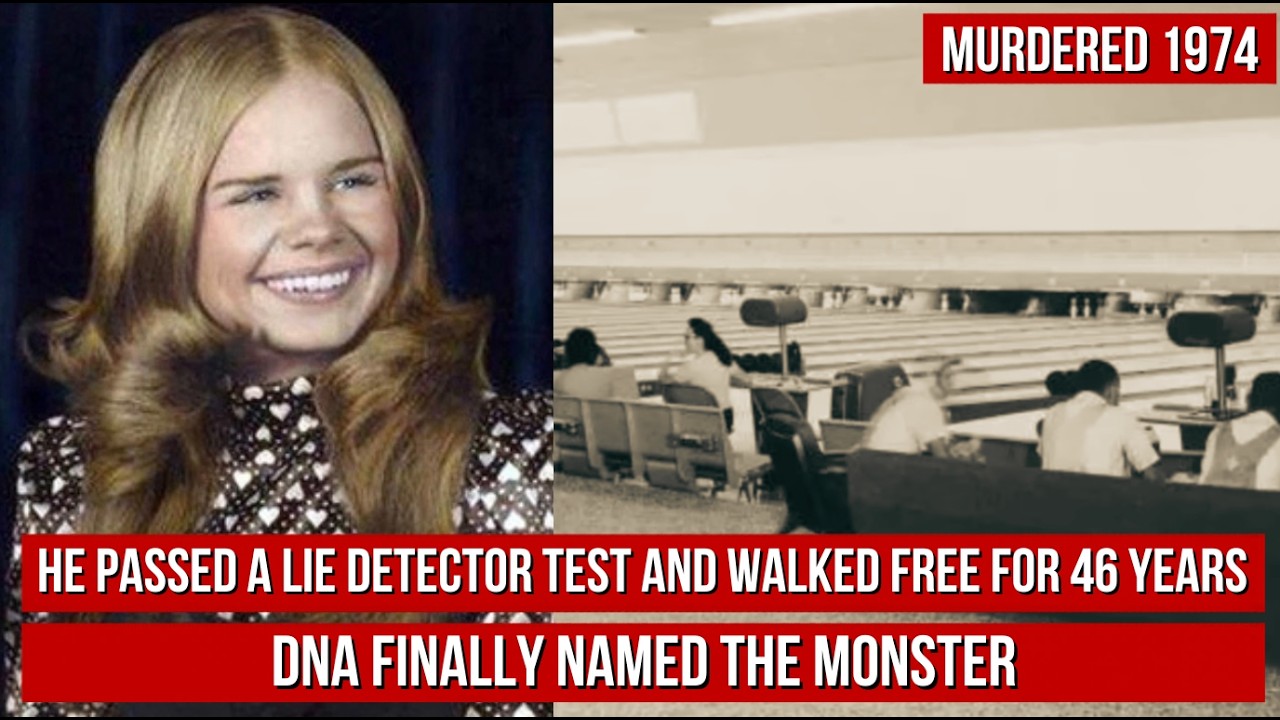
In the early hours of February 17, 1974, seventeen-year-old Carla Walker and her boyfriend, Rodney McCoy, parked in the quiet lot of the Brunswick Ridglea Bowl in Fort Worth, Texas. They were high school sweethearts, fresh from the Valentine’s dance, wearing his promise ring and planning a future together. As they kissed, the passenger door was violently jerked open. A figure emerged from the darkness and struck Rodney repeatedly in the head with a pistol.
Carla screamed for the attacker to stop. When Rodney tried to hold onto her, the man pointed the gun at his face and pulled the trigger three times. All Rodney heard were hollow clicks. The gun had misfired.
As he faded from consciousness, Carla was dragged from the car, calling back to him to go get her father. Then everything went black. When Rodney woke, the lot was empty. Carla was gone.
For three days, her family and police searched frantically. On February 20, hope died. Carla’s body was found in a desolate culvert about thirty minutes south of Fort Worth. The autopsy revealed a horrific sequence of suffering: she had been kept alive for roughly two days, sexually assaulted, injected with morphine, and finally strangled.
A vibrant, petite four-foot-eleven cheerleader with a bright personality had been stolen in the most brutal way imaginable. The investigation focused almost immediately on the only witness, Rodney McCoy. He had survived, and for that he became a suspect. He was questioned and given a polygraph, which he passed.
Even after being cleared, whispers followed him in the community for years. Decades later, he described the ordeal in court: the cloud of suspicion hung over him, a torment he had to live with. But clues existed that pointed elsewhere. The killer had dropped a magazine from a Ruger .
22 caliber pistol during the attack. Investigators identified a local man who had recently purchased that exact type of weapon: Glen Samuel McCurley, who lived just a mile from the bowling alley. When questioned, McCurley had a story ready. His gun had been stolen from his truck during a fishing trip weeks before the murder.
He said he hadn’t reported it because he was an ex-convict and wanted no trouble. He agreed to a polygraph. He passed. With that, he was officially eliminated as a suspect and walked out of the police station, blending back into the city.
The investigation noted other pieces that never quite fit together. McCurley’s wife had been away visiting family in West Texas that weekend, leaving him alone with no one to verify his whereabouts. Not long after the murder, someone sent an anonymous handwritten letter to authorities: the killer’s name was written in, alongside a short message that he had killed Carla Walker in Benbrook, and that it was hard to say but it was true. Detectives never identified the sender or understood the fear behind the letter.
It sat in the case file for decades. The forensic limits of the 1970s, combined with a convincing lie, allowed the killer to slip through. The case grew cold. The files were boxed.
A small, degraded DNA sample on Carla’s clothing sat in an evidence locker, waiting for technology that did not yet exist. Carla’s parents died without knowing who had killed their daughter. The original detectives retired. Only her younger brother Jim, who had been twelve at the time, kept pushing for justice over the years.
In 2020, the case was featured on an episode of the Oxygen Network show The DNA of Murder with Paul Holes. Holes, a seasoned cold case investigator, connected Fort Worth police with Othram, a private DNA laboratory in Texas. The lab specialized in forensic grade genome sequencing, a method that could piece together a full genetic profile from tiny, fragmented remains of DNA that older testing methods found unusable. The network helped fund the testing.
Othram scientists extracted the minuscule, 46-year-old sample and built a comprehensive profile. For the first time, a clear genetic picture of the killer existed. The profile was uploaded to public genealogy databases, and the search began to build a family tree. Soon, Detective James Bennett received the call: the DNA pointed to a family with the surname McCurley.
A name from the dusty 1974 file jumped out. Glen Samuel McCurley. The man with the matching gun. The man who said it had been stolen.
The man who passed the polygraph and walked away. For 46 years, McCurley had lived a life of remarkable normalcy. He was a husband, a father of two, and a grandfather. In his quiet Fort Worth neighborhood, he and his wife were known as ordinary, church-going people.
One neighbor even wrote a letter to the newspaper praising them for returning a lost wallet. By all appearances, he was just another retiree. While Carla’s family carried the endless pain of not knowing, her killer lived unremarkably, practically in their backyard. Detectives began watching the 77-year-old.
They discreetly collected items from his trash and sent them for DNA testing. The results were a direct match to the profile built from evidence on Carla Walker’s clothing. When they moved in, the arrest was heavy-handed. Officers in bulletproof vests from the elite Delta team of the US Marshals North Texas Fugitive Task Force surrounded his home, with some circling to the backyard in case he tried to flee.
To neighbors, he was a harmless retiree. To law enforcement, he was a dangerous fugitive. Only one of those assessments was accurate. During questioning, McCurley was calm at first, denying everything.
He repeated his old story: he had never known Carla Walker, and his gun had been stolen from his truck. But this time, the evidence could not be argued away. As detectives laid out the DNA match, his composure broke. He began to cry.
His confession was a twisted, self-serving version of events. He claimed he had been saving Carla from Rodney and that the sex had been consensual. He said he accidentally killed her when he feared she would report him. Eventually, he admitted the truth plainly.
When asked how he killed her, his voice was barely a whisper: he just choked her. In September 2020, Glen Samuel McCurley was arrested and charged with the capital murder of Carla Walker. During a search of his home, officers found a Ruger . 22 caliber pistol hidden inside the ceiling, the very weapon he had sworn was stolen all those years ago.
In August 2021, McCurley, now 78, stood trial. For two days, prosecutors presented the case 47 years in the making, including the video of his confession. Rodney McCoy took the stand and relived the most traumatic night of his life, this time not under suspicion but as a victim whose story was finally fully heard. On the third day, facing the mountain of evidence, McCurley stopped the proceedings and changed his plea to guilty.
The courtroom erupted in emotion. After 46 years, 8 months, and 7 days, it was over. The judge immediately sentenced him to life in prison without the possibility of parole. Carla’s sister, Cindy Stone, spoke directly to him in her victim impact statement.
She wished he had done this a long time ago. She pointed out how his confession tried to deny what he had done. She reminded him she had shared a room with Carla for 17 years and knew her sister well: four-foot-eleven, one hundred pounds. He had choices that night, many choices.
Instead, she said, he went out to kill somebody. Glen McCurley died in a Texas prison in July 2023 at the age of 80, taking with him the full truth of his crimes. Detectives believed Carla Walker was not his only victim. In his recorded interview after arrest, they had asked directly whether he had killed before or after Carla.
He never gave a straight answer. Fort Worth investigators looked into at least three other unsolved killings of young women from the 1970s and 1980s, considering McCurley a person of interest in each. None were definitively closed. How many lives he actually destroyed may never be fully known.
The scale of the problem was staggering. At the time her case was solved, Fort Worth alone had nearly 1,000 unsolved murders on the books. Thousands of families lived with the same silence and unanswered questions. But Carla’s story did not end with McCurley’s death.
The successful use of forensic genetic genealogy in her case inspired the bipartisan Carla Walker Act. The bill passed the US Senate in June 2026 and would create a pilot program to direct federal funds toward advanced DNA testing for cold cases across the country. The technology that brought Carla’s killer to justice could soon give answers to countless other families who have waited years or even decades. The murder of Carla Walker remains a story of profound tragedy, but also one of unwavering persistence and the power of science.
Her brother Jim refused to let her memory fade. Her boyfriend endured decades of unjust suspicion. Glen McCurley built a life on a foundation of lies and hid a monstrous secret behind a mask of normalcy for 46 years of undeserved freedom. In the end, time, once his greatest ally, became his enemy.
Carla’s legacy is twofold: the memory of the vibrant young woman she was, and the hope she now represents for thousands of other cold cases that even after decades of silence, the truth can still be brought to light.