In the fall of 1993, a jury in Missouri handed down a verdict that permanently changed the delivery business. Domino’s Pizza was ordered to pay seventy-eight million dollars. The case was not about contaminated food. It was not about pricing.
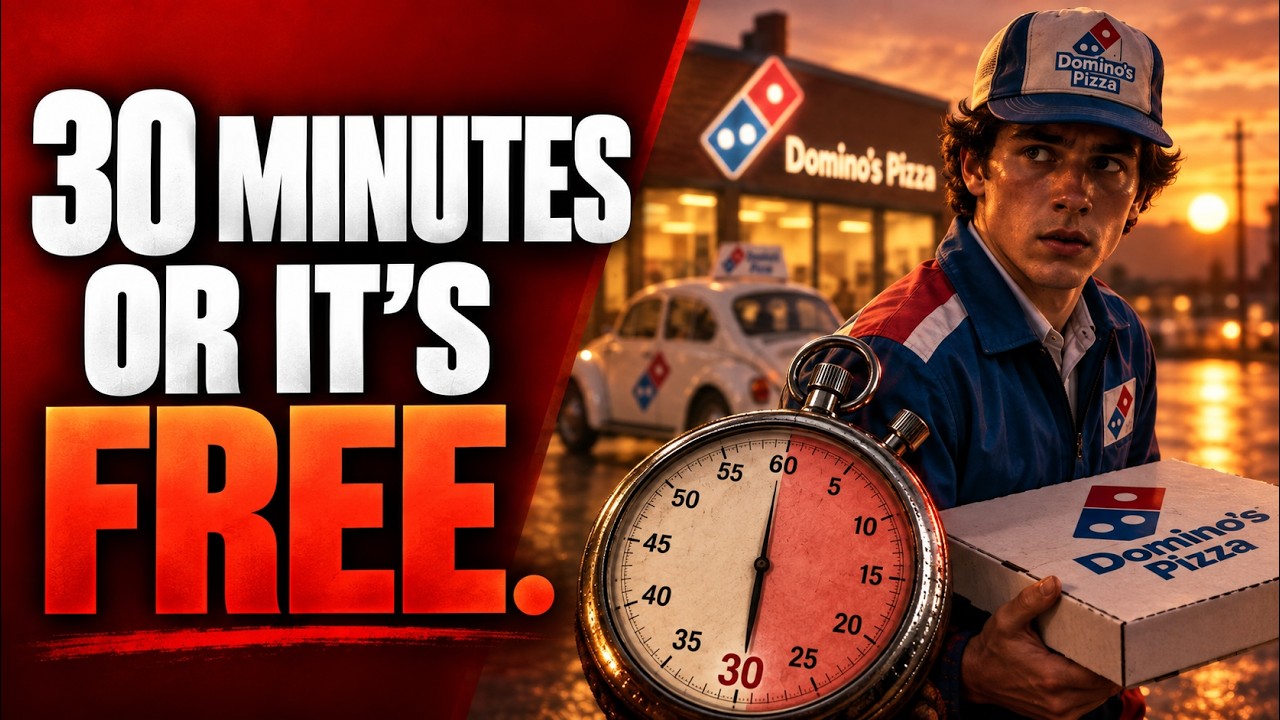
What stood in the dock was a single line of advertising: thirty minutes or free. Racing against the clock, teenage drivers had run red lights, collided with other cars, and struck pedestrians. The slogan that had earned the company millions had turned ordinary streets into death traps. But thirty years before that courtroom decision, the company’s founder had made a deal that everyone thought was madness.
His own brother sold him half of a future global empire in exchange for a used Volkswagen Beetle. How did a second-hand car turn into an empire? And why did the promise of hot pizza become a cause of death? To understand a man who could stake other people’s lives on thirty minutes, you have to go back to Michigan in the 1940s.
Tom Monaghan was four years old when his father died on Christmas Eve. His mother was left destitute with two sons. She tried to raise them alone, but two years later she gave up and placed the boys in a Catholic orphanage in Jackson, Michigan. The nuns raised Tom and his younger brother James.
After six years there, Tom moved through foster homes and a seminary, from which he was expelled for fighting and talking in class, before returning to foster care. At eighteen, Tom Monaghan had no home, no family, and not a dollar to his name. He joined the Marine Corps. After three years of service, he returned with two thousand dollars saved, a significant sum at the time.
Within weeks, he handed his entire savings to a man selling shares in oil land. The land did not exist. The man vanished. Monaghan returned to Ann Arbor empty-handed.
He had one dream, and it had nothing to do with food. He wanted to be an architect. He enrolled at the University of Michigan and searched for any job to pay the tuition. In 1960, he learned of a small pizza shop for sale in the nearby town of Ypsilanti.
The shop was called Dominick’s, named after its owner. It was a garage-sized room near the campus. The owner was tired and wanted out. The price was nine hundred dollars.
Tom did not have nine hundred dollars. He did not even have ninety. So he brought in his brother. James was working as a mail carrier in Ann Arbor.
They borrowed five hundred dollars from a bank. Without any idea how to make pizza, they bought a pizza shop. The previous owner showed them how to raise the dough. It took about fifteen minutes to learn.
Tom planned to work at night and attend classes during the day. Within weeks, he dropped out of school. How many weeks can a man work a hundred hours before he breaks? There were no days off.
Tom opened the shop at four in the afternoon and closed at one or sometimes two in the morning. Then he mopped the floor, cleaned the pans, prepared the dough for the next day, and slept in the back room. A hundred hours a week, not as a figure of speech. James could not do it.
He had a mail route that started at six in the morning and a steady paycheck. Running a route all day and a pizza shop all night was physically impossible. After eight months, he told his brother he could not continue. That left a question.
What would he get for his share? Tom still had no money. The only valuable thing the business owned was parked outside, an old Volkswagen Beetle they used for deliveries. James said, give me the car and we are square.
Tom gave him the car. That Beetle was several years old. Even brand new, it was worth less than two thousand dollars. For that price, James Monaghan handed over half of a company that, thirty-eight years later, sold for nearly a billion dollars to a private equity firm.
Today, Domino’s is valued at more than fifteen billion dollars on the stock market. James later said calmly that he never regretted it. He did not want that life. He wanted to sleep peacefully at night.
Tom was now alone, and almost immediately he ran into a problem with the name. The previous owner, Dominic, had allowed them to keep the sign as long as his name was on the paperwork. When Tom opened a second and third store, that permission ended. The name Dominick’s was not his.
The new name came from a delivery driver. He returned from a run and said the name out loud. Domino’s. Tom liked it.
He drew a logo, a domino tile with three dots, one for each store. The plan was to add a dot for every new location. He quickly abandoned that idea. By then Monaghan understood what his company was really selling, and it was not pizza.
To turn a pizza shop into a machine, he stripped things from the menu. He cut the sandwiches. Submarine sandwiches sold well. Students bought them.
They brought in good money. But watching the kitchen during peak hours, Monaghan saw the problem. When a man makes a sandwich, he cannot make a pizza. Every sandwich order stopped the main line.
So he removed them entirely. Then he cut the sizes. Only two remained, twelve inches and sixteen inches. No crust options, no exotic toppings, only Coca-Cola for drinks.
That was it. And he removed the tables. That was the real decision. No dining room, no waitresses, no extra space to rent.
The store only needed to be big enough for an oven, a counter, and a phone. People who wanted to sit down could go to a restaurant. Monaghan’s customer was at home, waiting for a hot pizza box at the door. The box itself had its own story.
Early on, pizzas were sent out on flat cardboard trays, stacked in the car. The weight of the top boxes flattened the pizzas below, mixing them into the cheese. There was no room for steam to escape, so the crust became like a wet rag. Customers opened the lid to a mess.
Monaghan began using a corrugated cardboard box with two layers. It could withstand the weight without collapsing. Then he put holes in the side so steam could escape instead of soaking into the dough. That design became the industry standard.
Pizzas are still delivered in that same box around the world. Then he calculated the time. The dough was prepared in identical trays in advance. The sauce was applied in one motion, spiraling from the center outward.
The cheese was measured, not estimated by eye. The oven stayed hot all night instead of being reheated for every order. He timed each step and rearranged the tables so the path from the phone to the front door was as short as possible. By the late 1960s, Monaghan had several stores and the first franchises.
He opened them near college campuses, on the principle of thousands of hungry people with no kitchens, no cars, and no interest in going anywhere at eleven at night. The company grew. He took on debt to open stores faster. Then, in one night, he almost lost everything.
In 1968, the headquarters in Ypsilanti burned to the ground. Everything was in that one building. The offices, the warehouse, and the kitchen where dough was made for all the stores. All of it burned.
The loss was around one hundred fifty thousand dollars. Insurance paid only thirteen thousand. That was the first blow. The second came from a direction he had not watched.
Monaghan was expanding too fast. He had signed leases, taken loans, and opened stores that never turned a profit. Some partnership agreements had been written in a hurry, and they later became the basis for lawsuits. By 1970, the company owed more than one and a half million dollars.
The bank did what any bank does. It took control. An outside manager was put in charge. The founder of Domino’s Pizza effectively stopped running it and spent nearly a year as an ordinary employee in his own company, with no power to make decisions.
Some stores were closed, some were sold. After ten months, he regained control. He spent years paying off that debt. Then Domino Sugar sued him over the name.
The fight went from court to appeal. Domino’s Pizza won and kept the name, but it cost several more years and a great deal of money in legal fees. By 1973, he was out from under the debt. He had about forty stores and a kitchen that ran like clockwork, but no money for advertising.
The big chains were buying television time. He could not. He needed a promise, something people would remember the first time they heard it and pass along for free. He found it, and twenty years later that promise put him in the courtroom.
The words were simple. If your pizza does not arrive at your door in thirty minutes, you do not have to pay for it. No discount, no apology, completely free. In 1973, that sounded insane.
No chain in the country guaranteed delivery time. Monaghan’s reasoning was practical. A customer cannot test whether your pizza tastes good before buying it. But he can look at the clock.
Everyone has a clock. The company was not selling food. They were selling certainty. It worked immediately.
Students understood it first. Thirty minutes became a game. Bets were placed on delivery drivers. Whole dormitory floors ordered together and sat watching the second hand.
The company did not lose often, but when it lost, the story of the free pizza spread across the entire campus. It was advertising that cost nothing. Business soared. By the late 1970s, there were over two hundred stores.
In 1983, the thousandth store opened. By the late 1980s, including overseas locations, the chain passed five thousand stores. Domino’s became the second largest pizza company in America, and the first true delivery empire. Tom Monaghan became very rich.
The orphan boy bought the Detroit Tigers for fifty-three million dollars. The next year, the team won the World Series. He built the world’s largest private collection of Frank Lloyd Wright furniture and objects. Wright became the architect Monaghan had once dreamed of becoming.
He built his headquarters in the Wright style on open land near Ann Arbor and named it Domino’s Farms. He bought planes, helicopters, boats, and classic cars. But on the street, that guarantee was not working as advertising. The promise was carried on the shoulders of one person, an eighteen-year-old teenager driving his own old car.
What happened to that kid if he could not make it in thirty minutes? The company’s official position never changed. Drivers were not punished for being late. Those who did the job told a different story.
Late deliveries were tracked. The numbers were kept for every store and affected managers’ performance. The manager then spoke to the driver. Sometimes it was just a conversation.
Sometimes the shift was cut. Sometimes the cost of the free pizza was deducted from the driver’s tips or wages. Legally, the company was correct. No such rule was written into company policy.
But in practice, the entire pressure of the system fell on that one teenager. Now look at who was behind the wheel. Domino’s drivers were mostly young men between eighteen and twenty-two. Minimum wage plus tips.
They drove their own old cars, with worn brakes and smooth tires, because that was all they could afford at that age. They had a year or two of driving experience and a watch in their pocket. Thirty minutes did not mean thirty minutes of driving. It included everything.
Taking the order, making the pizza, baking it, boxing it. The oven alone took seven or eight minutes. Preparation took several more. That left fifteen or twenty minutes on the road, and the address might be across the neighborhood.
So that teenager stopped calculating miles and started calculating traffic signals. Drivers ran red lights. They crossed double yellow lines. They cut across two lanes to make a turn.
They drove on the wrong side of the road. They double-parked with the engine running and sprinted to the door. Accidents increased. By the late 1980s, the number of deaths in accidents involving Domino’s drivers reached the dozens.
That was a statistic the company itself did not deny. Some of the dead were drivers. Some were in other cars. Some were on the sidewalk.
People began to speak out. Traffic safety organizations publicly demanded the guarantee be dropped. Newspapers wrote that the company was selling pizza at the price of human lives. In some cities, officials threatened to close the stores.
Domino’s gave the same answer every time. The guarantee was about service, not about speeding. No one was ever told to break traffic laws. Technically, all of it was true.
The lawsuits kept coming anyway. Families of the dead won hundreds of thousands of dollars. The company paid, settled, and kept running the slogan. The guarantee made so much money that it was not worth dropping over a few court cases, until twelve jurors in Missouri saw things differently.
It began at an intersection in St. Louis County. A Domino’s driver ran a red light and hit the car of a woman named Jean Kinder. She was severely injured.
Cases like this usually ended in settlement. This one went to a jury, and her lawyers took a step that changed the entire case. They did not put the driver on trial. They put the slogan on trial.
The argument in court was not whether a boy had driven carelessly. No one denied that. The argument was whether the company had created a system in which the boy had no choice but to drive fast. The jury was shown how late deliveries were tracked, how that pressure fell on store managers, what the job was like with only fifteen minutes on the road, and how old the people doing the work were.
The defense held its position. We never told anyone to break the law. The jury did not believe it. They awarded the injured woman about seven hundred fifty thousand dollars in compensation.
Punitive damages were seventy-eight million dollars. In American law, punitive damages are not compensation for harm. They are a punishment meant to stop a company and warn everyone else. That number was the jury’s verdict on the principle, not on the accident.
Seventy-eight million dollars for one line of advertising. Both sides later reached a settlement, and the amount actually paid was lower than the verdict. By then, it did not matter. Within days of the verdict, Domino’s Pizza announced that the thirty-minute guarantee was permanently discontinued nationwide.
The company’s biggest marketing asset for twenty years ended at a press conference. They replaced it with a satisfaction guarantee. Did not like the pizza? We will make it again or refund your money.
Not a word about time. Competitors celebrated. Analysts predicted a collapse in sales. And Tom Monaghan was thinking about something entirely different.
A few years later, he sold the whole company, and the reason had nothing to do with money or lawsuits. A man who had built an empire from a garage-sized pizza shop decided to give it up. He had read a book, a work by C. S.
Lewis about Christianity. One chapter touched him, the one that presented pride as the root of all sins. He looked at his collections, his planes, his baseball team, and stopped seeing them as business assets. He saw them as displays of his own ego.
So he began to sell. The baseball team went to the founder of Little Caesars. One pizza founder sold the Detroit Tigers to another pizza founder. The collections, the planes, the cars, all of it went.
In 1998, he sold the company itself. Bain Capital bought a controlling stake for nearly a billion dollars. Monaghan donated the money to Catholic causes. He founded a university in Florida and built a town around it, centered on a church.
The town is still there. The man who wanted to be an architect eventually built an entire town, but not the one he had imagined. The company he left behind was in trouble. By the late 2000s, Domino’s had become a chain everyone knew but no one liked.
Fast delivery, low prices, and a joke when it came to taste. Here Monaghan’s own reckoning arrived. He had stripped everything from the business that slowed it down. Sandwiches, tables, sizes, choices.
He designed the box, calculated every second of production, and built the best logistics system in the industry. One thing he never touched was the food. The dough, sauce, and cheese stayed the same for decades. It was not terrible.
It simply was not the point. For forty years, speed came first. In 2009, the company finally paid the price. Management did something corporations rarely do.
They conducted research, and the results showed their own product ranked at the very bottom in taste among the major chains. Customers wrote that the crust tasted like cardboard and the sauce like ketchup. So the company put those comments on television. In the advertisements, Domino’s employees read real customer complaints out loud.
Cardboard. Ketchup. The worst pizza anyone had ever eaten. Then the company’s leader came on screen and said, you are right, and we have recreated the recipe.
The dough, the sauce, and the cheese. Everything has been changed. It worked in a way no other marketing had. Sales rose, and over the next decade Domino’s stock became one of the best performers on the American market, outperforming most technology giants.
The company that had been sued for deaths on the road and mocked for the taste of its food came back stronger from both. There are three endings here. James Monaghan traded half of a future empire for a used Beetle and said for the rest of his life that he never regretted it. He delivered mail, slept peacefully at night, and died a quiet man.
Tom Monaghan received a billion dollars, bought everything a man could buy, and then gave it all away. And in between are the people no one ever treated as the main characters. Eighteen-year-olds in old cars running red lights because the clock on the dashboard showed twenty-six minutes. The thirty-minute guarantee was a brilliant idea.
It solved a real problem for the customer. It built an entire industry. Every delivery app in the world runs on that principle today. And it had a price that the man who invented it never paid.
The question is this. The company never wrote a policy telling anyone to break traffic laws. They only started a clock and connected it to wages. So who was responsible for the accident at that intersection?
The eighteen-year-old behind the wheel, or the boardroom that started the clock?