The nicknames carried by the men of Easy Company were more than casual labels. They were tools of survival, markers of belonging, and shields against the unbearable weight of loss. In the years before World War II, nicknames were common in neighborhoods, on playgrounds, and in factories across America. But in the army, they took on a far more serious purpose.
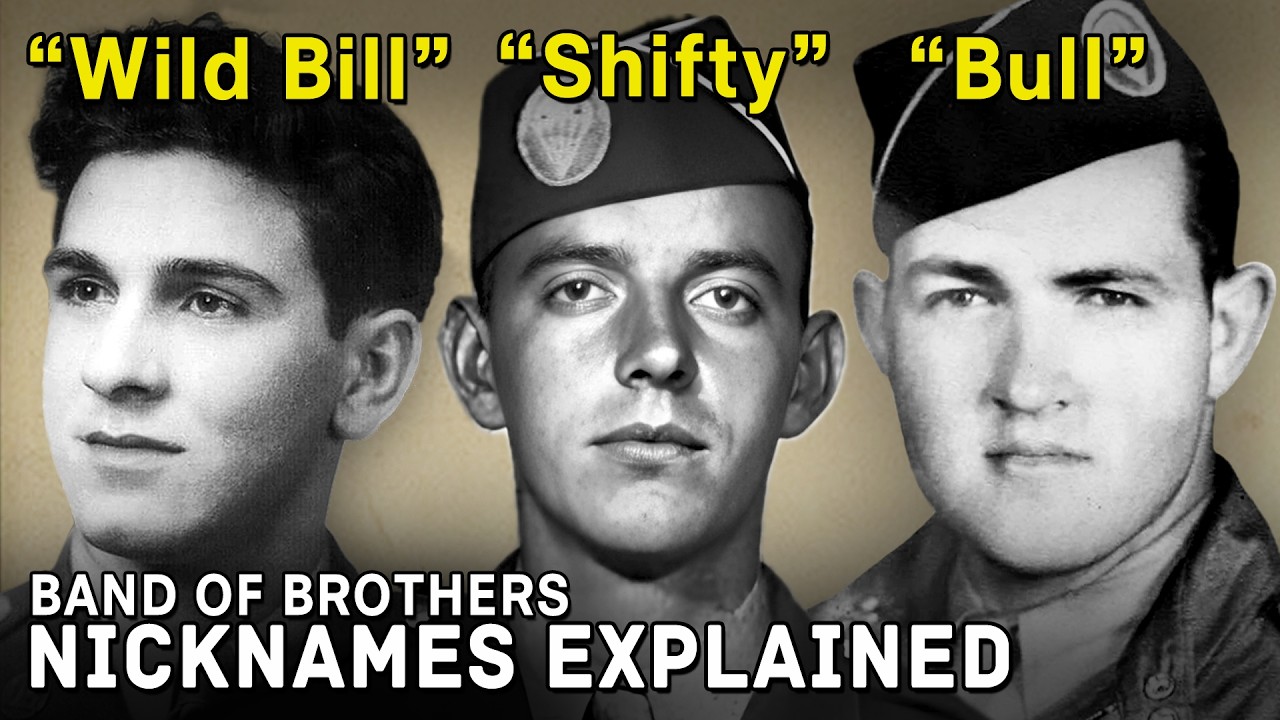
Easy Company alone counted multiple Joes, Bills, Johns, and Jims among its ranks. A nickname ended the confusion of similar names, and it was far easier to shout across the noise of engines and artillery than a longer surname. Earning a nickname also meant acceptance, a sign that a man was no longer a replacement or a rookie but part of the group. Perhaps the most famous nickname belonged to Bill Guarnere, known as Wild Bill.
Before D-Day, Guarnere learned that his older brother Henry had been killed fighting in Italy at Monte Cassino. Consumed by vengeance, Guarnere landed in Normandy determined to kill as many enemy soldiers as possible before being killed himself. He wrote in his memoirs that he emptied his anger and revenge on those men, shooting everything he saw that day. When asked whether the first kill was difficult, he said it was as easy as crushing a bug.
His fellow soldiers also joked about another nickname, Gonorrhea, which according to his memoirs was coined by John Martin because it sounded similar to Guarnere. In the Band of Brothers series, this nickname was dramatized when Guarnere complained to Doc Roe about painful urination. The show never explicitly stated the cause, but earlier scenes suggested he may have picked up an infection after a visit to a place called Lulu. In reality, Guarnere never mentioned contracting a venereal disease during the war, and the storyline appears to have been invented by the series.
The nickname likely stuck simply because it amused a group of young men in their late teens and early twenties. Darrell Powers, better known as Shifty, rarely discussed his background until the third episode, when he joked that his father was the real marksman, capable of hitting a fly on the wing. Many assumed his nickname came from his skill as a sharpshooter, but it actually had nothing to do with soldiering. In his memoir, Shifty explained that he earned the name in high school basketball because he was quick and elusive on his feet.
All the boys on the team had nicknames, and his stayed with him for life. Buck Compton hated his given first name, Lynn, because it sounded too feminine to him. He was named after his mother’s father, who came from Lynn, Massachusetts. Growing up, he was a devoted fan of the Los Angeles Angels and admired a star catcher named Truck Hanna.
Deciding he wanted a nickname of his own, he considered Truck Compton but settled on Buck, which felt strong and original. He told his friends he would answer only to Buck, and they accepted without complaint. Bull Randleman, born Denver Randleman, was a massive, powerful man who pushed soldiers out of Dick Winters’ plane on D-Day, leaving last in case anyone hesitated. Winters called him extremely reliable and one of the best non-commissioned officers in Easy Company.
His nickname came from his fellow soldiers during training at Camp Toccoa in 1942, inspired by his huge build, deep hoarse voice, and commanding presence. His actual enlistment record lists him at five feet eleven inches and two hundred pounds, not quite the giant portrayed by the actor who played him. The name came from the sum of his qualities rather than his size alone. Warren Muck, called Skip, was remembered fondly by everyone who knew him.
His niece recalled that veterans of Easy Company could barely speak of him without tears filling their eyes. He was killed on January 10, 1945, outside Foy, Belgium, during the Battle of the Bulge, when a German artillery shell made a direct hit on the foxhole he shared with Alex Penkala. His nickname came from his childhood habit of skipping everywhere he went instead of walking. It stayed with him into adulthood.
Edward Heffron, known as Popeye, grew up in Philadelphia with friends who all carried nicknames. As a baby, his older brother Jimmy tried to say the word baby and instead said beb, and the name stuck. In the series, Doc Roe calls him Edward, which Heffron bristles at, insisting only nuns called him that. When Roe finally calls him Popeye near the end of the episode, Heffron is overjoyed.
The real Heffron explained in his memoir that his nickname was one of many among his childhood friends, including a boy called Skip-a-Beat Nelson, who had a heart condition, and Anthony the Brain, who was the most educated of the group. Robert Wynn, known as Popeye, earned his nickname because of his resemblance to the cartoon sailor, with his squinty eye and prominent jaw. He was shot in the buttocks during the attack on Brécourt Manor on D-Day. Instead of complaining, he apologized to Dick Winters, saying he was sorry for letting him down.
Winters recalled the moment with admiration, noting that here was a soldier wounded by enemy fire behind German lines, more concerned about failing his comrades than about his own injury. In the series, Popeye is shown being dropped off at the airfield by Captain Sobel, but in reality it was Rod Strohl who hitched a ride and encountered Sobel. Popeye returned to the company on his own. Floyd Talbert, called Tab, likely received his name as a shortened version of his surname.
He was stabbed by a fellow soldier, George Smith, who mistook him for an enemy because Talbert was wearing a German coat for warmth when he woke Smith for guard duty. Despite this reckless mistake, Dick Winters considered Tab the best soldier in the unit, saying that if he had to choose one man for a mission, it would be Talbert. Frederick Heyliger, known as Moose, did not get his nickname from his size, though he stood about six feet and weighed two hundred ten pounds. Growing up in Concord, Massachusetts, he once grabbed his older brother’s boots by mistake on a winter day.
As he walked through the snow, one of his brothers noticed his large tracks and said, look at the moose tracks. The name stuck, and he eventually grew into it. Terrence Harris, called Salty, arrived at Camp Toccoa with the nickname already attached. Before joining the army, he had attended the United States Naval Academy, which likely explained the name.
He later served as a merchant sailor before volunteering for the paratroopers. Veterans remembered him running his squad with nautical terms, ordering men to starboard instead of right and to swab the deck instead of cleaning the floor. Salty Harris was killed by a German sniper near Carentan at just twenty-three years old. Burton Christensen, known as Pat, was played by Michael Fassbender in his first professional acting role.
The show depicted him being caught drinking water from his canteen during a night march, but the real Pat held the physical fitness record at Camp Toccoa, and veterans denied that he ever got in trouble for such an infraction. He was the company artist, keeping a diary and making sketches of soldiers and combat scenes during the war. Winters wrote that Pat was always the most handsome man in the front carrying the company flag in parades. When the time came for the jump into Normandy, Winters wanted his best and most dependable man directly behind him, and that man was Pat again.
Wayne Sisk, called Skinny, was short and thin, standing only about five feet seven inches. His older brothers toughened him up, and he made up for his lack of size with hardness and ferocity. On the flight into Normandy, he broke the tense silence by shouting whether anyone wanted to buy a good watch. The men laughed, and the mood lightened.
In the final episode, Skinny and other soldiers dealt with a camp commandant near a remote farm. After the war, Skinny struggled with haunting memories and turned to drinking. A four-year-old niece told him that Jesus loved him and that God would forgive him if he repented. He later became a preacher and wrote to Winters that he had forgiven himself for the war and the bad things he had done over the years.
Walter Gordon, called Smoky, got his nickname not from cigarettes but from his habit of chewing tobacco. He was shot by a sniper in Bastogne, the bullet entering one shoulder and exiting the other, severing his spine and paralyzing him from the neck down. He spent six weeks lying helpless in an English hospital before feeling returned to his limbs. The army tried to delay his discharge, hoping he would recover further to avoid a large disability payment, but his father intervened, threatening to take his son to Washington and strip him naked in the Senate chamber if necessary.
The doctor relented, and Smoky was sent home with a ninety percent disability rating. He lived in pain for the rest of his life and walked with difficulty. Earl McClung, called One Lung, was a Native American from the Colville Reservation who learned hunting as a boy. He landed thirteen miles from his drop zone in Normandy and was repeatedly sent into Sainte-Mère-Église as a scout because of his skills.
As he recalled, if they discovered you had Indian blood, you were assigned as a scout. A sergeant once asked who the machine gunner was, and his friends James Alley and Paul Rogers placed a machine gun beside him while he slept, pointing him out when the officer turned around. Rogers wrote a poem that included a line about McClung and his one lung, and the nickname stuck purely because it rhymed. Ronald Speers, called Sparky by a select group of officers, was more often feared by the men he led, who used darker nicknames like Killer.
The name Sparky came from Lieutenant Duruwood Cann, and Speers apparently smiled when he heard it, though it was never used by the enlisted soldiers. The deeper purpose of these nicknames was emotional protection. They created a barrier between the soldier and his civilian self, allowing him to do things his peacetime identity might not have been able to endure. In units with heavy casualties, men learned quickly not to become too attached to new replacements.
A full name raised questions, about family, about home, about a mother or a child. A nickname let a man avoid all of that. It was a form of emotional rationing, keeping grief contained within the unit alone. The name on the dog tags was for the telegram sent home.
Many veterans shed their nicknames after the war, leaving them overseas once they had served their purpose. Only their comrades in arms continued to use them, as a reminder of the bond they shared as a company of brothers.