North of San Francisco, across the Golden Gate Bridge, along the Marin County coast, a cluster of pale buildings stands behind a wall on a low point of land overlooking the bay. A clock tower rises above the roofs. Seagulls circle. From the highway, the place could pass for a monastery or a seaside college.
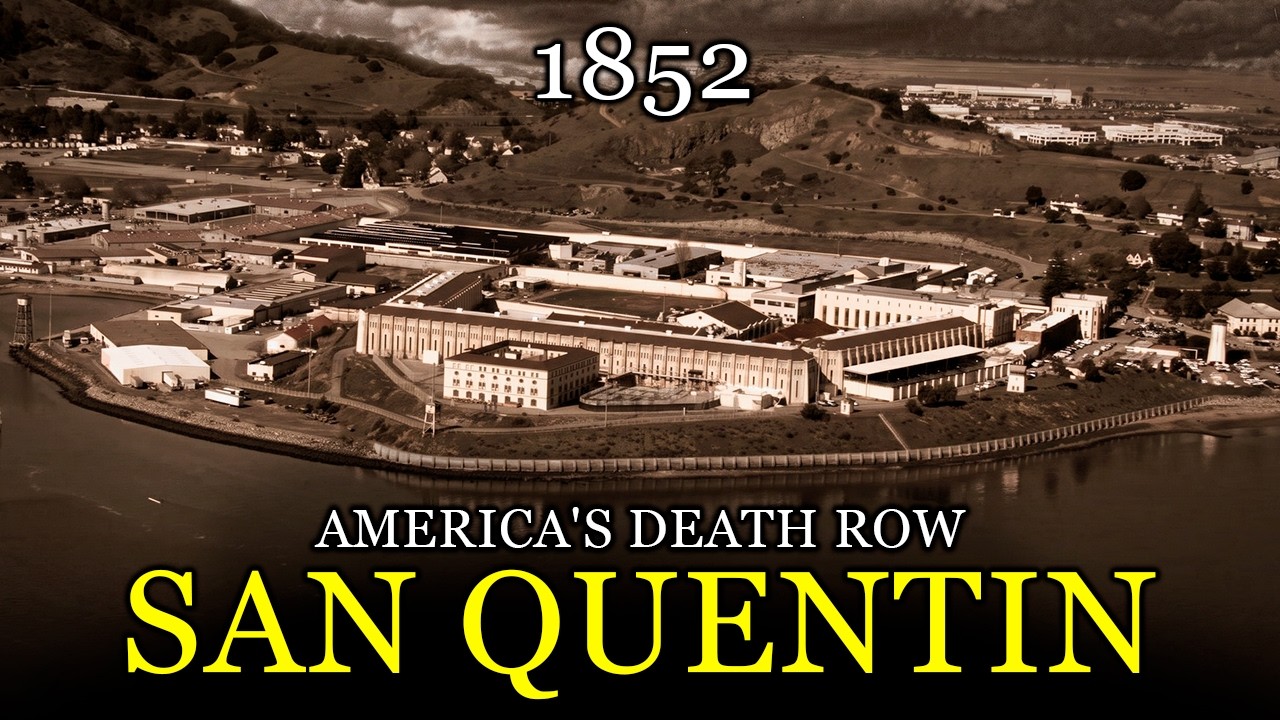
It is San Quentin State Prison, opened in 1852, older than the transcontinental railroad, older than the telephone, older than the state prison system itself. San Quentin was built for execution. Four hundred twenty-two people have been put to death there. Two hundred fifteen were hanged.
One hundred ninety-four died in a small octagonal chamber of steel and glass that the men confined inside it called the Green Room, for the color of its painted walls. For most of the past seventy years, San Quentin held the largest death row in the United States, larger than those of Texas and Florida combined. At its peak, nearly seven hundred condemned men were held in a single cell block. Inside those walls, a prison surgeon spent thirty-eight years operating on living inmates and implanting tissue taken from the bodies of men he had watched hanged.
In August 1971, six people were killed within ninety minutes in a single housing unit, three of them correctional officers whose throats were cut. In 1960, a man who had killed no one died in the Green Room while a telephone rang in an office at the end of the hall, carrying news of a stay of execution. What sets San Quentin apart from other prisons is that it is not abandoned. It is not ruins.
It is not a place to wander looking for ghosts. As of this writing, the prison is still open, holding roughly three thousand men. And the state of California is spending hundreds of millions of dollars to turn it into something else entirely. To understand San Quentin, one must go back before the walls existed, before the clock tower, before California was even a state, to a rotting sailing ship anchored in San Francisco Bay, crowded with men held by a private businessman for profit, because the state had nowhere else to put them and no intention of paying to build anywhere.
California became a state on September 9, 1850. It was rich with gold, receiving ships daily from every port in the world, its population doubling from a few thousand to over a hundred thousand in under two years, yet it had no functioning institutions. The only prison in San Francisco was a wooden building. There was no state prison, no state prison system, no real courts.
In January 1851, the legislature passed a largely useless law directing that county jails serve as state prisons until a better solution could be found. The counties could not cope. Sacramento used an abandoned ship called the La Grange as a floating jail. San Francisco used a sailing vessel called the Euphemia, which for a time also served as a holding center for psychiatric patients.
The first man officially received into the California state prison system boarded the La Grange on January 25, 1851. His name was Charles Currier, twenty-two years old, a carpenter by trade. Into this vacuum stepped a man named John Coffin Hays, known as Jack, a former Texas Ranger with a reputation for violence who had recently become sheriff of San Francisco. Looking at the hundreds of abandoned ships in the bay, whose crews had fled to the gold mines, he saw an opportunity.
He bought one, a sailing ship called the Waban, and fitted it out as a prison. In December 1851, with some forty inmates held below deck, the Waban was towed to Angel Island, where there was a quarry that could be worked. Charles Currier was transferred there that same month. The Waban established the moral foundation for everything San Quentin would become.
It was a commercial wooden ship that had sat in salt water so long it was useless. Below deck, men were held four or five to a cabin of roughly eight square feet. With no modern sanitation, the hold dried out in summer. In winter, when the weather made shore work impossible, men stayed below for days at a time.
Historians who have read the surviving accounts describe mornings when guards refused to descend until the hold was aired out, because the accumulated stench of waste, sweat, and rot was unbearable. The ship may have had a capacity of fifty men. Within a short period, that number tripled. This was not a government operation.
Hays and his partner, Major John Caperton, subcontracted the guarding of California convicts as a commercial arrangement. When Hays’s contract collapsed amid repeated escapes and mutinies, the state did not take the prisoners back. It handed the contract to General James Estell, a state senator, briefly in partnership with General Mariano Vallejo, one of California’s largest landowners. In 1851 and 1852, the state of California entrusted the actual custody of every convicted criminal it had to a state senator permitted to profit from their labor.
San Quentin did not begin as a public institution that later went wrong. It began as a private prison, and the profit motive was built into its foundation before the first stone was laid. Estell needed a permanent location for the prisoners, preferably one where he could make money. Angel Island was ideal because of its quarry, but the federal government claimed ownership of it, along with Alcatraz and Goat Island.
Benjamin Buckelew, a land speculator from Marin County, owned a coastal parcel he was eager to sell. Buckelew took the state prison commissioners on a tour, wined and dined them, and by the time they left, they were convinced. In 1852, the state paid ten thousand dollars for twenty acres. It was estimated that Buckelew cleared a profit of about 145 percent.
The press called the price exorbitant. The name of the place came from a land grant recorded in 1834 as Punta de Quentin, or Quentin Point. The common assumption in a state where nearly every town and landmark is named for a Catholic saint is that San Quentin must be named for Saint Quentin. It is not.
The point was named for a Coast Miwok warrior named Quentin, sometimes spelled Quinton, who fought under a chief named Marin, born Miwok, who was captured and held in that area. Later American settlers, hearing a place name of Spanish character, added San, assuming all Spanish place names in California began that way. There is no saint. The largest prison in the United States, a symbol of American punishment rivaled only by Alcatraz, was named after an Indigenous man who was captured, whose people were nearly wiped out of the county that now bears his chief’s name.
That he was made a saint was a clerical error committed by people who never bothered to ask. On July 14, 1852, Bastille Day, the Waban was towed across the bay to Point San Quentin carrying between forty and fifty convicts. The date gave the place a nickname that stuck for a century: the Bastille of the Bay. On October 12, 1852, a contract was signed for the first cell block.
San Quentin built itself from its own inmates. Every morning, men were taken off the ship and brought to shore. They quarried stone, dug clay, and fired it into bricks, because Estell noticed the nearby clay deposits and realized the real profit was in bricks. They laid foundations and raised walls.
At the end of the day, they were returned to the ship and locked below in darkness and stench. In the morning, they were brought back to work on the building that would replace the ship. Charles Currier, prisoner number one, the twenty-two-year-old carpenter, helped build San Quentin. The first permanent cell block was completed in 1854 and is known simply as the Stones.
Parts of it still stand today, more than 170 years later. A cell built in 1854 beneath the prison is believed to be the oldest surviving public building in the state of California. Of everything California built in its early years as a state, roads, halls, churches, schools, the oldest thing still standing is a hole in the ground designed to hold a man in darkness. In the 1860s and 1870s, San Quentin expanded into something like a small industrial town behind walls.
It had a hospital, workshops, a bakery, a laundry, a shoe shop, a foundry, a farm, a church. The prison kept its own small fleet of boats to move supplies, prisoners, and stone across the water. Until the opening of the women’s prison at Tehachapi in 1933, San Quentin held men and women in one prison, in a separate section but inside the same walls, under the same administration. For eighty-one years, California’s answer to what to do with a convicted woman was to put her in San Quentin.
The jute mill was the industrial heart of the place. Since the 1880s, San Quentin operated a jute mill weaving coarse fiber into grain sacks consumed by the millions by California’s immense wheat industry. It was the largest factory in the state. The noise inside was a constant mechanical roar.
Under the leasing system, the contractor’s income depended on the labor of the men held there, and his costs depended on the minimum he could spend to keep them alive. Every dollar spent on food was deducted from the accounts. Every dollar spent on medical care, clothing, heat, and space was deducted from the accounts. There was no incentive in this system to treat a prisoner as anything but a machine fed the minimum required to keep it working.
California eventually took direct control, and reformers spent decades trying to drag the place toward something resembling a philosophy of rehabilitation. But the founding logic never left the building. San Quentin was designed on the principle that inmates were an economic resource, so it was constantly full. By the early decades of the twentieth century, it was by some measures the largest prison in the world, its population peaking at around six thousand men.
Six thousand prisoners in cell blocks designed in the nineteenth century, with plumbing and ventilation from an era before the germ theory of disease. Cells built for one man held two; cells built for two held four. Men slept on the floors of corridors and in converted workshops. The dungeon dug in 1854 remained in use for generations.
There were other tools. There was a punishment the prison called the rack, a narrow ledge on which a man was forced to stand for long periods with restraints preventing him from sitting or lying down. There was a restraint jacket cinched so tightly that men lost circulation in their arms. There were floggings that California had outlawed in the 1880s but which older inmates and staff described as continuing in various forms long after.
There was head shaving as routine humiliation. There was a rule of silence imported from eastern prisons, under which men were forbidden to speak to one another and punished for whispering. In 1913, the prison hired a young physician from Oregon, twenty-seven years old, with no surgical experience, and assigned him responsibility for the bodies of six thousand men. His name was Leo Leonides Stanley.
Born in Buena Vista, Oregon, in 1886, the son of a country doctor, Stanley received his degree from Stanford and attended Cooper Medical College in San Francisco, spending part of his training at San Quentin. In 1913, he was appointed chief surgeon of the prison. He held that position, with a gap for military service, until 1951, for thirty-eight years. Stanley’s early work was genuinely useful.
He arrived at a prison hospital closer to a nineteenth-century dispensary than a modern medical facility and modernized it. He improved sanitation and raised the level of equipment and procedure. He also believed something that would determine the course of everything he did later. Stanley believed crime was a disease, not a metaphor but a real physiological condition rooted in the body, specifically in the endocrine system.
If a man’s glands could be repaired, Stanley reasoned, he would be cured of criminality and return to society whole. Stanley was a eugenicist, a position hardly marginal in American medicine in 1913. His solution was surgical intervention at both ends of the equation: sterilize those who should not reproduce, and rejuvenate those who should. Stanley began sterilizations in 1918.
He called the procedure asexualization and asked for volunteers, advertising it as an improvement to health and vitality. By 1940, roughly six hundred inmates at San Quentin had undergone the procedure. The other half of Stanley’s program made national headlines. He followed the work of a French surgeon named Serge Voronoff, who had built an international reputation implanting monkey testicular tissue into human men as a rejuvenation treatment.
Stanley realized San Quentin offered him something Voronoff never had. San Quentin executed men, and when a man was executed, the chief surgeon performed the autopsy. So Leo Stanley began removing the testicles of executed inmates and implanting them, or preparations made from them, into living prisoners. He called this gland surgery.
When executed bodies were unavailable, he used animals: goats, wild boars, rams, deer. The case that made headlines concerned a twenty-three-year-old man named Clarence Kelly, known as Buck, hanged at San Quentin in May 1928 for shooting three people during a series of drunken robberies. His body went to the prison surgeon for autopsy, as was routine. Stanley removed his testicles for implantation into an aging inmate.
This time, the case became a scandal. The Los Angeles Times ran the story under the headline Gland Scandal in San Quentin, and demands for investigation followed. Stanley did not lose his job. He kept it for another twenty-three years.
The total number of these operations is genuinely disputed. Claims of more than ten thousand testicular transplants at San Quentin by 1940 trace mostly to Stanley’s own account, a man with a clear interest in inflating his numbers, counting preparations and injections derived from tissue alongside actual transplants. What is documented from his published writings, his records and papers held in the California archives, and contemporary press coverage is that he performed these operations on hundreds of men over decades; that the tissue came from executed inmates and from livestock; that he sterilized hundreds more; and that he encouraged trainees working under him to conduct their own experiments on inmates. The exact number is not the point.
For thirty-eight years, the men inside San Quentin were not merely prisoners of the state of California. They were raw material. Stanley retired in 1951 and died in 1976 at the age of ninety, in the same county where he had worked. No one was ever tried.
No one was ever punished. His papers, including scrapbooks documenting his transplant work in his own handwriting, are held in an archive, available to any researcher who asks. The executions are what made San Quentin famous. Before 1891, executions in California were the responsibility of counties, and a condemned man was hanged in his own county, sometimes before a crowd that had bought tickets.
The legislature ended that in 1891, deciding that executions would thereafter take place inside state prisons under the warden’s supervision. Men condemned in northern counties were hanged at San Quentin; men from southern counties went to Folsom. The first execution under the new law took place at San Quentin in 1893. Between then and the end of the hanging era, 215 men were hanged inside San Quentin, and 92 more at Folsom during the same period.
The hanging is not a reliable method. Done correctly, with the distance calculated for the condemned man’s weight, it breaks the neck and he loses consciousness quickly. Done incorrectly, with too short a drop, it strangles the man slowly over several minutes under observation. With too long a drop, it separates his head from his body.
In the 1930s, California decided there was a more modern way. The state adopted lethal gas, and in 1937 San Quentin received the chamber that would define its identity for the rest of the century. The chamber was built by the inmates themselves. It was octagonal, with bolted steel walls and thick glass windows through which witnesses standing outside could see inside.
Inside were two chairs bolted to the floor, made of perforated metal to allow gas to pass through from below. They were labeled A and B. Beneath each chair was a shallow pan into which sulfuric acid mixed with water was poured. Above it, in a mechanism operated from outside the chamber, hung a gauze bag containing sodium cyanide pellets.
When the warden gave the signal, a lever was pulled. The bag dropped into the acid. The reaction produced hydrogen cyanide gas, which rose through the holes in the chair and filled the room. The condemned man spent his last night in a holding cell next to the execution chamber, under constant watch.
In the morning, he was led a short distance inside, seated on chair A or B, and strapped at the chest, waist, arms, and ankles. A stethoscope was placed on his chest, with a long tube running through the wall so a physician standing outside could hear his heartbeat without being inside the room. The heavy door was closed and sealed. Witnesses stood at the windows.
Guards had fixed instructions they relayed to condemned men as a kind of kindness: breathe deeply, and it will be over faster. But most men did not. Most held their breath, because holding the breath is what the body does when it knows what is coming. So the process took longer than official accounts suggested.
Witness testimony from the period describes men straining against the straps, convulsing. The interval between the lever and the end of the heartbeat on the stethoscope was measured in minutes, not seconds. Between 1938 and 1967, 194 people died in that chamber, four of them women. One of the men was executed in 1960 while a telephone rang in an office at the end of the hall, carrying news of a stay of execution that came too late.
His name was Caryl Whittier Chessman. Born in Michigan in 1921 and raised in California, he had a criminal record by his early twenties, beginning with car theft and escalating to armed robbery. In January 1948, Los Angeles newspapers began reporting on a criminal they called the Red Light Bandit, whose method was specific: he found couples parked in secluded lanes, approached the car flashing a red light of the type police used, and when the occupants rolled down their window thinking an officer had stopped them, he robbed them. In several cases, he forced women out of their cars, drove them a short distance, and sexually assaulted them.
Chessman was arrested and charged. He initially confessed, then spent the rest of his life insisting the confession had been beaten out of him by Los Angeles police, a claim not implausible given that department’s documented conduct in that period. He defended himself at trial, a disastrous decision. In July 1948, he was convicted on seventeen counts.
Caryl Chessman never killed anyone. He was never charged with killing anyone. He was sentenced to death under California’s Little Lindbergh Law, passed in 1933 after the kidnapping and murder of Charles Lindbergh’s infant son. The law provided that kidnapping accompanied by bodily harm was a capital crime.
The prosecution succeeded in arguing, and the court affirmed, that Chessman moving a woman a few feet from her car to assault her constituted kidnapping, and that the assault constituted bodily harm. A few feet. That was the distance between life in prison and the gas chamber. Chessman was sent to San Quentin’s death row, cell 2455.
There, he did something almost no one in the history of American capital punishment has done. He fought. He taught himself law inside death row. He filed appeal after appeal, more than forty in one account.
He won eight stays of execution over twelve years, some hours before the scheduled time. He wrote four books from that cell, the most famous of which, titled after the cell itself, became a worldwide bestseller. By 1960, Chessman was one of the most famous people in the world. His case became a rallying point from South America to the Vatican.
Aldous Huxley signed petitions for him. Albert Schweitzer spoke on his behalf. Millions of people, even those who could not place California on a map, knew that the state intended to execute by gas a man who had killed no one, under a law the state had already repealed, because the repeal had not been made retroactive. On the morning of May 2, 1960, after eight stays and twelve years, Chessman was led into the chamber and strapped to the chair.
A federal judge had issued a stay. The order was issued. Someone in the courthouse picked up the telephone to call San Quentin. According to the accounts that have come down to us, the call was connected wrongly.
The seconds it took to correct the number and get through were the decisive seconds. By the time the telephone rang in the prison, the pellets had already dropped into the acid beneath chair A. No one could open the door. Once the reaction had begun, the chamber was lethal to anyone who entered.
The warden, the witnesses, and the man on the telephone waited for Caryl Chessman to die. The protests that followed were worldwide. In the United States, the Chessman case did more to turn public opinion against the death penalty than any other event of the twentieth century. It did not stop the executions at San Quentin, but it ignited the debate that eventually would.
Eleven years later, on an August Saturday afternoon, San Quentin experienced ninety minutes of violence that changed the American prison system. A unit called the Adjustment Center functioned as what every prison in America eventually builds: a prison within the prison, a small maximum-security wing where men deemed most dangerous or most politically troublesome were held in near-total isolation. In cell AC of that unit was a twenty-nine-year-old man named George Lester Jackson. Jackson had entered California prisons at eighteen, in 1961, sentenced to life with parole possible after one year for a seventy-dollar gas station robbery.
Under California’s then-indeterminate sentencing law, the parole board decided when a prisoner would be released, and the board’s decision did not favor Jackson. Jackson spent ten years in prison. During that time he read, embraced Marxist thought, co-founded the Black Guerilla Family, and in 1970 published a book of letters from prison, Soledad Brother, making him one of the most famous prisoners in the world. He was also charged, with two other men, with killing a correctional officer at Soledad prison, hence the name Soledad Brothers.
The events of August 21, 1971, have been disputed for more than fifty years. What is not disputed is that when Jackson returned to the Adjustment Center after meeting with his attorney, Stephen Bingham, he was in possession of a . 38 caliber pistol. Around three in the afternoon, the gun came out.
What followed took roughly half an hour. Officers were overpowered and taken into cells. Some were shot. Others had their throats cut.
When it was over, three correctional officers were dead. Sergeant Jere P. Graham, forty-one, who had worked at San Quentin since 1964. Officer Frank DeLeon, forty-four.
Officer Paul Krasenes, fifty-two. Two other officers were seriously wounded. Two inmates were also killed: John Lynn, twenty-nine, and Ronald Kane, twenty-eight, both white men housed in the unit. Both were killed inside it.
George Jackson ran out of the Adjustment Center into the yard, pistol in hand. A tower guard shot him. He died there on the ground in the open, in front of the building. Six dead in roughly ninety minutes.
The aftermath lasted for years. Six inmates were charged in connection with the events of that day, becoming known as the San Quentin Six. Their trial in Marin County Superior Court lasted sixteen months, then the longest criminal trial in California history. The prosecution’s case relied heavily on conspiracy theories rather than direct evidence linking specific men to specific killings, and the verdicts reflected that.
Three of the six were acquitted of all charges. Two were convicted of assault on officers. One was convicted of murder. Attorney Stephen Bingham fled the country the day after the killings and stayed away for thirteen years.
When he returned in 1984, a jury acquitted him in 1986. His defense argued a claim still raised today: that prison officials themselves arranged for Jackson to obtain the gun, expecting him to be killed using it. No one ever proved it. No one ever disproved it either.
The significance extends far beyond California. Three weeks after George Jackson’s death at San Quentin, inmates at Attica Correctional Facility in western New York seized the prison. George Jackson’s death was one of the immediate sparks of the uprising. On the day word of Jackson’s death reached Attica, hundreds of men wore black armbands as they went to the mess hall and silently refused their food.
Four days after the uprising began, the state of New York retook Attica by force. Thirty-nine men were killed in the assault, ten of them hostages killed by the state’s own gunfire. The deadliest prison riot in American history began partly in a yard in Marin County. After all of that, little changed.
The Adjustment Center continued to operate. Solitary confinement units expanded across the American system during the 1970s and 1980s instead of contracting. California eventually built Pelican Bay, where men spent decades in windowless cells until a lawsuit and a hunger strike involving thousands of prisoners forced partial reconsideration in 2015. Hugo Pinell, one of the San Quentin Six, spent forty-five years in California custody, most of it in solitary confinement.
In August 2015, four days after release to a general yard at Folsom prison for the first time in decades, he was killed by other inmates. He was seventy-one. The Adjustment Center at San Quentin was finally closed. Not in 1971, and not in the 1980s, but in 2023.
The legal foundations for what happened next came from an unexpected direction. In 2016, California voters passed Proposition 66, an initiative promoted as a way to speed up executions. It included a requirement that condemned inmates work to pay restitution to their victims. To work, a condemned man must leave his cell.
He cannot be kept in an isolated death row unit for twenty-three hours a day. The practical effect of a law written to accelerate the death penalty was to make the isolated death row system legally unworkable. A pilot transfer program began quietly in 2022. In January 2024, the program became official regulation, and on February 26, 2024, large-scale transfers began.
Condemned inmates, who had spent years in the East Block, in some cases decades, were moved to roughly twenty high-security prisons across California, placed among the general population with access to jobs, programs, and yard time. The youngest was twenty-four, the oldest ninety-three. By May 28, 2024, the East Block was empty. All condemned inmates had left San Quentin.
Nine remained in the inpatient psychiatric unit and medical treatment center, to be moved when their health permitted. All of them remain under sentence of death. No one was pardoned. No one was released.
The sentence has become a piece of paper without a building. In March 2023, Governor Newsom announced that San Quentin would be renamed the San Quentin Rehabilitation Center, and that California would seek to rebuild it on the Scandinavian model, treating prison as preparation for return to society rather than mere storage. An advisory council was formed to guide the project, including prison staff, criminal justice academics, victims’ advocates, and formerly incarcerated people. A new building is the centerpiece.
Over eighteen months, contractors built an 80,000-square-foot education complex at a cost of $239 million, funded through lease revenue bonds. It nearly triples the classroom space at San Quentin and includes a media production facility, vocational training space, and a comprehensive rehabilitation center. Danish firms were among those involved in design, a statement of intent. On February 20, 2026, the San Quentin Education Center opened, a day late due to a technical fault in the alarm system.
The surrounding area is changing too. In the East Block, the death row itself is being converted into rehabilitation housing. Parts of the upper yard are being repurposed as recreational and community space. Murals are going up.
There are plans for a library, a grocery store, and a café inside San Quentin. Reports from inside are more complicated than a ribbon-cutting. To build the new center, the old education annex had to be removed, which housed long-running programs some inmates had relied on for decades. Many of those groups came out of the transition without a home.
Staff raised objections, some about sharing restrooms with inmates, some about the principle of inmates moving freely to the café. The warden has spoken publicly about budget pressure and conflicting expectations. The state devotes roughly 5 percent of its $14. 2 billion budget to rehabilitation programming, a figure worth comparing with the $239 million spent on a single building.
In January 2026, the prison’s own advisory council recommended redirecting part of the development money toward immediate improvements in living conditions, a polite way of saying that the cells men actually sleep in remain the same ones built in the nineteenth century. The Green Room still exists. The octagonal steel structure built by inmates in 1937, with its bolts and thick glass windows and chairs labeled A and B, is now an empty space inside a prison legally called a rehabilitation center. The equipment is gone.
The acid pans are gone. One hundred ninety-four people died by gas in that room. Then the machinery was removed and the state left the structure. A few hundred meters away, there is now a media lab, a library, and a café where a man can buy coffee.
Both are part of San Quentin. Both are inside the same walls, on the same day, in the same year. California does not choose between them. It operates them together and asks us to accept that the second undoes the first.
Four hundred twenty-two people were executed on that piece of land. Hundreds more underwent surgery in the prison with no medical justification. Twenty-nine people died in a single summer because of an administrative decision a federal appeals court described as a stark example of deliberate indifference. California is spending a fortune to turn San Quentin into a place where people can be reformed.
The institution never spent anything to account for the people it consumed there. When the last of its old walls comes down and something new stands in its place, with the sailboats behind it, what exactly are we agreeing to forget?