Behind a park on the southern edge of Waupun, Wisconsin, stands a long red-brick building surrounded by a winding road and old trees. A concrete wall runs behind it around an athletic field, but look closely: the wall barely touches the grass. In the winter of 1957, a maintenance worker from Plainfield named Ed Gein was sent behind that wall. Within a few years, the world was watching Psycho, and rumors spread that he was the real Norman Bates—a claim the novel’s author later denied.
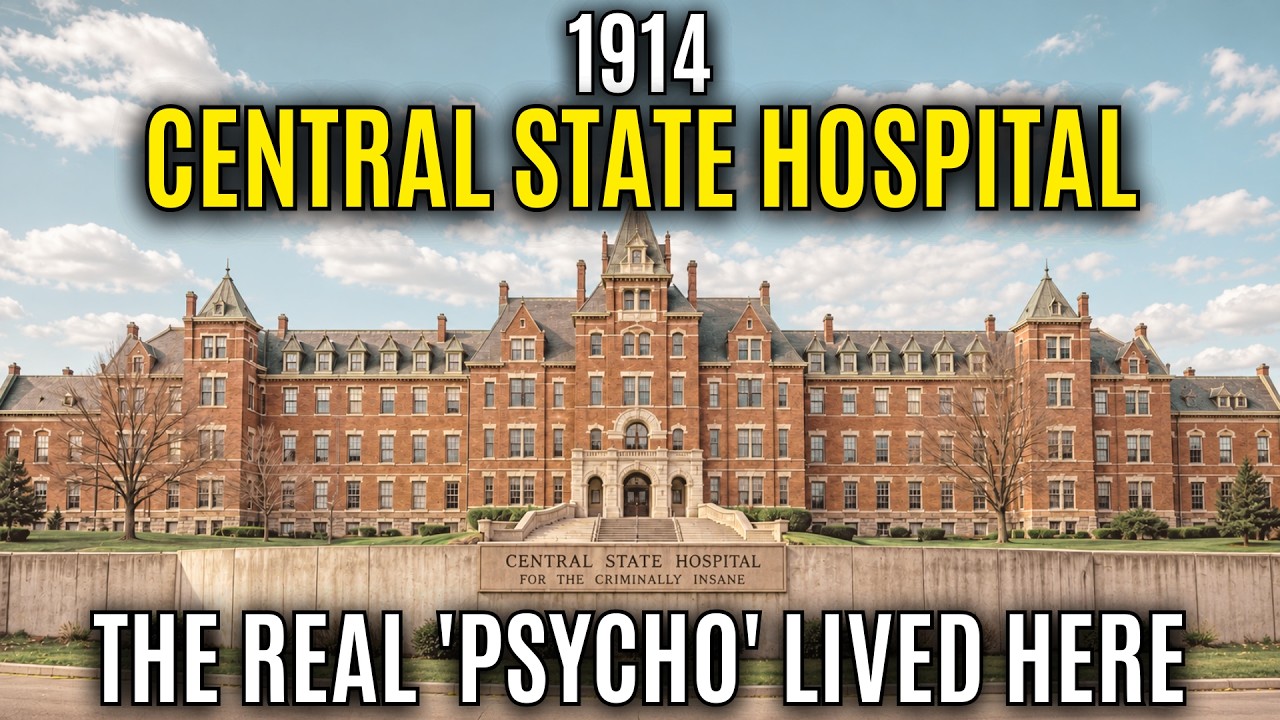
Gein remained inside for nearly twenty years. This is the story of the Central State Hospital for the Criminally Insane, the asylum that held the real man described as a madman, and the prison it quietly became. To understand how a hospital designed to look nothing like a prison became a jail for the man Americans called a monster, and then became a jail itself, one must begin with the prison that was already there. In 1851, Wisconsin searched for a site for a new penitentiary.
Three commissioners inspected locations in Madison, Portland, Janesville, Horicon, Kaukauna, and Waupun. On July 4 of that year, two of them voted for Waupun. A local man named Seymour Wilcox, who had founded the town in 1839, donated twenty acres of his land for the prison. The town itself carried an accidental name: settlers had intended to call the place Waupun, a local word meaning dawn, but they misspelled it.
And so dawn became Waupun, and Waupun became the prison. The location was chosen for its railroad access and abundant limestone. The first cell block contained 288 cells, built by the inmates themselves at a cost of 325 dollars per cell. That detail matters, because the men inside those limestone walls would reappear later in this story, carrying their shovels.
At the same time, the state had no special place for the people at the center of this account. Since 1838, a territorial law allowed county judges to imprison anyone they considered dangerous to the public or to themselves. Such people were placed in poorhouses, or in county jails where no poorhouses existed, alongside ordinary criminals. They endured filthy rooms, foul air, and vermin.
Often they were chained or handcuffed and mistreated by other inmates. In 1854, Governor William Barstow reported that the number of insane people in Wisconsin called for a state asylum. A committee described men and women held in cells lacking light and heat. Even after the state built its public psychiatric hospitals, one group remained without care: the dangerous and the criminal.
No one wanted them. As early as 1875, a reformer named Mrs. William P. Lynde, the first woman appointed to the state board of charities, pushed for a separate hospital for insane criminals with specially trained staff.
Prison wardens repeatedly asked to transfer their mentally ill inmates because they disrupted order. In 1900, the state board declared it time to press the governor and legislature. Nothing happened for years. In 1909, the legislature appropriated 100,000 dollars for a new hospital at Winnebago, but the board decided the sum was insufficient and built nothing.
In 1911, the site was moved to Waupun, next to the prison, for the same reasons that had drawn the prison there: central location, railroad lines, and fertile farmland. The board purchased 72 acres, land it described as the best farm soil the patients could work, roughly two buildings away from the prison. The man who would turn that farmland into a hospital had grown up in the town. Rock Sleyster was born in Waupun on June 14, 1879.
He earned his medical degree from the University of Illinois in 1902, returned home, and became the physician at the state prison. Between 1912 and 1914, he also served as mayor of Waupun. On July 1, 1913, he was appointed the first superintendent of the new hospital, although one biographical dictionary dates his administration to 1909. Sleyster did something unusual for his job: he went to see what others had done.
At that time, only five states had hospitals for the criminally insane. New York, which built the first two, was followed by Michigan, Illinois, Pennsylvania, and Ohio. New York had opened its first hospital in 1859 in Auburn, on land adjacent to the state prison. Sleyster visited them to avoid the mistakes their superintendents admitted.
What he brought back was a conviction recorded in the state report of 1914: the criminally insane needed specially trained people and specially designed residences, residences that maintained prison safety while removing the appearance and influence of a prison. The law then defined insanity narrowly. After an English ruling of 1843, Wisconsin adopted a single test: could the accused tell right from wrong? If he failed, he was not legally a criminal but a patient.
So treatment at Waupun was supposed to match any other state hospital, which in those years meant moral treatment: a smaller institution, kind specialized care, work, religious services, recreation, all organized in a self-contained environment meant to rehabilitate the disturbed mind. Physicians believed a healthy body produced a healthy mind, so tonics, laxatives, and good food were prescribed. Sleyster’s specifications were precise: rooms painted light pink, light green, or light blue; window bars running horizontally instead of vertically, another way to hide the prison look; trees, shrubs, climbers, and perennials planted throughout. A state that had once chained its asylum inmates and paupers was now choosing paint colors.
Most accounts of this place skip over its infamous inmates and ignore this part, but the fall means nothing unless we understand how high the idea stood at the start. The walls meant to make the place look nothing like a prison were dug out of the ground by convicts. The architect was Henry A. Fueller of Green Bay.
Born in Wittersheim, Alsace, on February 27, 1871, he crossed to America alone at fourteen. His major works included St. Nicholas Hospital in Sheboygan, the public library in Waupun, the Central State Hospital, and the southwest wing of the Waupun State Prison. The same architect designed a prison wing and a hospital that did not look like a hospital.
In 1913, before any patient arrived, the legislature made the new place an independent institution with its own name, the State Hospital for the Criminally Insane, under a medical superintendent. Then the money ran out again. The full design included a three-story administration building in the middle with two-story hospital wings on each side of a central corridor. What was actually built at first was a power plant, one ward, one administration wing, and the entire corridor waiting for wings that did not yet exist.
The board considered connecting the hospital to the prison’s heating and power plant next door. It would have been cheaper that year, but more expensive every year after. So the state built a separate plant. Inmates did the digging.
According to the report, men from the prison next door excavated the foundations and supplied the crushed stone used in the concrete. Look at the wall again. It looked like a low garden wall, but it was a concrete wall about eighteen feet high, roughly the height of three grown men standing on each other’s shoulders. It stood at the bottom of a dry trench about fifteen feet deep, dug out on both sides, so that only its top showed from the garden.
The state reported that the stone excavated from that trench was enough for concrete foundations for four or five future buildings. Prisoners from one institution dug a hole so the wall of the next institution would not look like a prison wall, and the stones they removed became the foundations of the wings that wall would surround. The central corridor was completed in 1913, running the full east-to-west length of the building without interruption. Below it ran a concrete tunnel for supplies, with large pipes in the middle so the tunnel could not be crossed end to end except at its far end.
The corridor floors were terrazzo, the walls beige glazed tile, the corners rounded. Railroad tracks ran straight over a concrete coal storage bin at the power plant, allowing coal cars to be unloaded from above. The wings were built one after another along the corridor: Wings A and B in 1914, Wing C in 1918, Wings D and E in 1923, Wings F and G in 1931, later Wings H, I, J in 1952, and Wing K in 1967. The historic district today covers 23 acres.
The hospital received its first patients on July 12, 1914. Keep in mind the materials, because they are the only elements in this story never replaced: concrete, brick, terrazzo, tile. Concrete does not care what the sign over the door says. It will outlast any name this place was given.
For a brief moment, the idea worked as drawn. Each patient was assigned a private room in the first ward, Building B. The capacity is unclear, but the report suggests the ward held between 35 and 60 patients. In the carpentry shop, patients made toys that were sold to visitors, with the proceeds going to the makers.
In those early years one could see a small dairy farm being built, then an icehouse, a barn, a chicken coop. In 1916 and 1917, a root cellar, a machine shed, a smokehouse, and a hog barn were added. Sleyster’s first report in 1914 sparked debate over a single word. He argued that the description criminal served the state no purpose and stigmatized every patient, angering families.
New York and Michigan, he noted, had already recognized this error and legally changed their hospital names to ones that said nothing about the patients. In 1917, Wisconsin followed, and the State Hospital for the Criminally Insane became the Central State Hospital. That was the golden age, with all its details: private rooms, token wages, a farm, and a warning that arrived almost immediately. The new facility filled to capacity within one week of opening, according to the nomination records.
The legislature moved quickly, and a new wing opened on January 26, 1915. Within ten days, it too was full of patients transferred from other institutions. The golden age of the Central State Hospital had a specific duration: about a week. Who filled the rooms so fast?
The 1934 report of the board of control details the law. Three types of people could be committed to the Central State Hospital: persons accused of a crime but acquitted for insanity or feeble-mindedness at the time of the offense; persons found insane or feeble-minded at trial or conviction; and persons sentenced for insanity or feeble-mindedness with a criminal record. The term feeble-minded, an institutional term for people with intellectual disabilities, appeared in the law beside insanity as if they were the same thing. The hospital also received a category the law did not classify as criminals at all: civil patients from other institutions who had shown suicidal, aggressive, or violent tendencies.
Men only. Violent women stayed where they were because the hospital did not believe it could separate the sexes. The commitment was indefinite. In April 1929, a Milwaukee man named Dolley Cash was charged with theft.
Mid-trial, his mental condition drew the court’s attention. Three physicians examined him and found him insane. The court ordered him committed to the Central State Hospital until he recovered from his insanity. That phrase is institutional language for an indefinite sentence.
For Cash, the end came quickly. On April 28, 1930, the court was notified of his recovery. It then sentenced him to eight to nine years in the state prison without hearing further testimony, for a crime a doctor said he had committed while insane. In 1934, the Wisconsin Supreme Court upheld the lower court’s decision.
From the patient’s point of view, recovery sounded like good news. At Central State, recovery was not an exit but a transfer. The hospital also became the place courts sent people just for examinations. In 1953, a court referred a defendant named Goodchild there for mental and physical examination because another state hospital could not complete it.
In 1964, a man named Woodrow Gautier was committed for observation, and after three months the hospital’s physicians reported he was competent to stand trial. By the early 1970s, the law required that anyone convicted of a sex offense be committed for a pre-sentence examination of up to 60 days, longer if a physician recommended it. The hospital’s population was determined by laws, courts, and transfers from other institutions, not by the physical capacity of its wards. In the winter of 1957, the courts began sending the man mentioned at the start of this story.
Ed Gein was charged with murder, and three psychiatrists testified about his mental state. In January 1958, the judge found him incompetent to stand trial, describing it as the hardest decision of his career. The date of Gein’s commitment varies by source: one references January 6, another January 16, and a third says he was first admitted for 30 days of observation in late November 1957. Inside the walls, conditions told their own story.
The tenth report of the Central State Hospital board, covering the two years ending June 1932, gives the numbers. On July 1, 1931, two new ward buildings opened with 81 beds, raising capacity from 125 to 206. On the day those wards opened, 278 inmates were on the rolls. The new beds filled before they were equipped.
By June 30, 1932, the count stood at 362, an excess of 75. 73 percent over declared capacity. The superintendent projected 385 by 1933, 427 by 1934, and 470 by 1935, more than double capacity. The 1934 report lists an average daily population of 366 for the year ending June 1933.
Two patients were placed in rooms built for one. Basements and storerooms were turned into dormitories. Beds were set up in the corridors on the terrazzo floors, against the rounded tile. The superintendents knew.
Dr. J. F. Brown II complained in 1924 that the hospital had exhausted any margin of safety years before because every ward held many dangerous men who should have been isolated.
His successor, Dr. W. A. Derhake, repeated the case.
Most of those patients needed private rooms for their own safety and that of others. Storerooms were not dormitories. When the occupational therapy rooms filled with beds, the men lost the indoor work that helped them through a Wisconsin winter and sat idle. There was a ward for the physically ill.
Infectious disease could spread through the corridors, and a man needing surgery had to be taken to an outside hospital where escape was far easier. Derhake even made the argument in language legislators understood: an overcrowded hospital cost more per patient to supervise, not less. The medical staff did not keep pace with growth. The 1932 report lists 56 employees serving 260 patients one year, and 70 employees serving 342 the next.
By 1935, the medical staff for over 300 patients was limited to three physicians, including the superintendent. There were no nurses. Every physician supervised more than 100 patients. Construction stopped entirely, except for the machine and carpentry shop built in 1938, no new building went up until 1951.
The warnings had been recorded since the first week of 1914. The concrete hardened. The state had found its solution to overcrowding on the payroll. When a hospital like this fails, the easy explanations become clear.
It was not just the Depression, though money was scarce. It was not just the lack of new buildings, though you have heard how long that lasted. It was not even the shortage of doctors. The governing factor was the staff standard.
The nomination describes the attendants who actually ran the wards, based on a 1934 national study of state mental hospitals applied to Central State. The report says they were chosen for their physical build and courage, not for medical knowledge or compassion. Few had any medical training at all. Their approach was control.
The attendants reported patient conditions to the physicians, so the doctors often did not see the patients during their rounds. The men most in need of care, the violent, loud, and troublesome, received the least, and were often mistreated by the staff precisely because of their violence, noise, and trouble. Several tools appeared in sequence. The first was restraint and drugs: the use of restraints and medication was common, often administered by attendants who never consulted a physician.
The second was water, though the hydrotherapy room was too small for the population. The third was insulin, and the fourth was electricity. The nomination records that insulin and electroshock were used for a time in the 1940s, 1950s, and 1960s. The fifth tool was the knife.
Above the long one-story corridor between Building C and Building G, a second floor was added in the 1950s. When the state survey team recorded the site in 1990, it classified that floor as non-contributing, meaning not historic enough to count. According to the survey itself, it was used as a surgical ward for lobotomies. No document records how many operations were performed there, on whom, by whom, or with what results.
The sixth tool was the classification system. In the late 1960s and early 1970s, hospital reports described a classification system as the primary method of behavior management. Wards were arranged by degrees of restriction. Good behavior moved a man to a freer ward; bad behavior moved him to a lower ward with more restraint, possibly physical restraint, possibly sedation, possibly solitary confinement.
The nomination concluded that behavior was managed rather than treated. The hospital was still receiving men at the end of the 1970s. On January 2, 1980, a Wisconsin court committed a man named Lawrence Dalton to Central State for specialized treatment for sexual disorders. Dalton attempted suicide many times, was restrained at various times, and was put on a feeding tube at others.
The records prove enough: treatments were used, the surgical ward existed, no count was ever published, and the men who underwent these treatments, almost all of them, are unknown. That is why the two men whose names were recorded matter so much. Ed Gein’s crimes need only a few sentences. On November 16, 1957, the first day of deer hunting season, Bernice Worden, owner of a hardware store in Plainfield, was killed, and her body was found on Gein’s farm.
Gein also confessed to killing Mary Hogan, whose death was likely on December 8, 1954. Gein was only tried for Worden’s murder. Inside Central State, he was diagnosed with schizophrenia, with sources differing between paranoid schizophrenia and chronic undifferentiated schizophrenic reaction. After that, by all available accounts, Gein almost disappeared from view.
According to the Associated Press, he worked in the hospital as a carpenter, mason, and medical assistant. Judge Robert Gollmar, who would later try him, visited Gein at Central State. From Gollmar’s book, we learn ordinary details. Gein worked in the power plant with carpenters and on roofing.
He taught other patients to make rugs. He liked newspapers and the radio. He cared nothing for novels, which he considered suitable for children but not for a grown man. The supervisor, Dr.
Edward Schubert, told Gollmar that Gein was naive and undeveloped, cautious and withdrawn with staff and patients alike. During his personal visit, Gollmar wrote, Gein was friendly and talkative, smiling or laughing almost the whole time. In January 1968, Schubert told a newspaper that Gein’s paranoia had eased and that he was aware of his surroundings. He was found mentally competent.
The trial, heard by Gollmar alone without a jury, lasted about a week in November 1968. Gollmar convicted him of first-degree murder. Then, in a separate hearing, he found Gein legally irresponsible and returned him to Waupun. Staff later testified that Gein caused no problems in the hospital, though he interacted poorly with other patients.
He was a model patient, which seems like success until you realize it meant no one had any reason to look at him again. In February 1974, Gein petitioned for release. The evaluating psychiatrist, Dr. Thomas Malloy, wrote that Gein did not understand how society would respond to him, believed everyone had forgotten him, and had unrealistic plans to go to Australia.
The petition was denied. In 1978, Gein was transferred to the Mendota Mental Health Institute in Madison. He died there on July 26, 1984, of respiratory failure at age 77. Officials said he was also diagnosed with cancer.
He was buried in Plainfield beside his mother, in the same cemetery where he had once dug a grave. The other man was John Schrank. Born Johann Schrank in Erding, Bavaria, on March 5, 1876, he came to America as a boy of nine, and his parents died shortly after. An uncle and aunt who ran a New York tavern raised him, and when they died, he inherited their property.
In 1904, the woman he loved died in the General Slocum steamship disaster on New York’s East River. After a brief time running a tavern, he withdrew from the world, writing poetry and seeking comfort in religion. On September 15, 1912, he wrote a letter describing a dream in which the murdered President William McKinley named Theodore Roosevelt as his killer. On October 14, 1912, outside the Gilpatrick Hotel in Milwaukee, Schrank shot Roosevelt in the chest.
The bullet passed through a steel eyeglass case and a folded fifty-page speech. Roosevelt stopped the crowd from harming him and delivered his speech. In court, Schrank pleaded guilty, but Judge August Backus rejected the plea and appointed a commission. It concluded he was insane.
On November 25, 1912, he was committed to the Northern Hospital in Winnebago. Sources say he was transferred to Waupun in February 1914, though the report says the first patients were not admitted until July. There, Schrank wrote to his former doctor for years, expressing gratitude and commenting on the war in Europe. Staff called him Uncle John.
By all accounts, he was a model patient. During his entire confinement, according to one historical account, he received no visitors and no letters. The state held him for 31 years. Roosevelt himself wrote in December 1912 that Schrank was not insane at all.
Schrank died at Central State on September 15, 1943, at age 67, of bronchopneumonia. No one claimed his body, so it was donated to Marquette University’s medical school for dissection. Compare the two men. One shot America’s most famous figure in front of a crowd.
The other harmed himself secretly on a farm most people ignored. Opposite in almost everything, identical in the end. Strangers dissected Schrank’s body for study. Souvenir hunters chipped away at Gein’s gravestone until most of it was stolen.
Neither man was allowed to remain in place. Money moved through this place in ways that began small. The 1932 report estimates the two new ward buildings cost 118,645. 28 dollars.
The weekly cost per patient was 9. 08 dollars one year and 8. 65 the next, compared to 6. 75 dollars at the older Mendota hospital.
Each new bed cost the state about 1,465 dollars for a building full from its opening day. Patients were part of the budget. Every able man worked: farm and garden work, landscaping, housekeeping, kitchen, dining room, unloading coal from trains. When the Depression cut operating funds in the 1930s, the hospital opened a sewing room, a tailor shop, and a small furniture factory making lawn furniture, chairs, and benches.
The factory employed 15 to 20 men trusted with tools. The board acknowledged that most people enjoy working with tools. All of it, the nomination stated, helped the institution support itself and relieve the burden on the state and counties. Ed Gein worked too.
At one point, he told Judge Gollmar he made stone jewelry and sterling silver bracelets worth hundreds of dollars by his estimate. A volunteer sold the entire collection in one lot for 50. 50 dollars. Outside the hospital walls, a profit market flourished.
Gein’s property was scheduled for public auction in March 1958. The auction company planned to charge 50 cents just to walk through the farm, then dropped the fee. The land sold for 3,000 dollars. His 1949 Ford sold for 760 dollars to a carnival showman named Bunny Gibbons, who charged 25 cents to sit in what he called the ghost car.
In July 1958 at the Seymour County Fair, over 2,000 people paid, though accounts differ on whether that took two days or the entire fair. That was the money one patient’s crimes earned others in a single year while he sat imprisoned. On March 20, 1958, days before the scheduled auction, Gein’s farmhouse burned to the ground. The fire was believed to have been set.
The local fire chief was Bernice Worden’s son. According to a later book on the case, no investigation was conducted. The cause was never officially determined. Inside that house, investigators had found remains that Judge Gollmar believed grave robbing could not explain.
In his writings, he referenced two missing girls: Evelyn Hartley, who disappeared in La Crosse in October 1953, and Georgia Jean Weckler, abducted in Fort Atkinson in May 1947. Neither case was ever solved. No body of either girl was ever found. Gollmar reasoned that if Gein had not killed those two girls, he had killed two other young people who were never identified, because the graves he robbed did not match what was found in that house.
In addition to the two recorded murders, he was suspected of at least four others. Gollmar also wrote that Gein may have killed two men who disappeared after visiting a Plainfield tavern. No charges were ever brought, and nothing was ever proven. There was also Henry, Gein’s brother, who died in 1944 while fighting a fire near their home.
Some investigators speculated about his death, but no one proved anything. There were also the people recorded only once. Outside Waupun, in the town of Chester, a cemetery was used from 1871 to 1975 for the unknown dead from the state prison and the Central State Hospital. Each grave once had a marker with a number.
In the 1980s, metal signs were placed bearing each person’s name, number, institution, and date of death. Those signs were later replaced with one large plaque. That plaque omits the names of all who died before 1898. How many are buried there?
The sources consulted do not say. In 1958, the Joint Commission on Accreditation of Hospitals examined Central State and recommended against accreditation, mainly for its lack of medical staff. The hospital continued operating anyway. Its administrative home kept shifting.
In 1939, it passed to the new Department of Public Welfare. In 1941, its name was shortened to Central State Hospital. In 1967, it moved to the Department of Health and Social Services, remaining in the Division of Mental Hygiene until 1977, then the Division of Community Services until 1982, finally the Division of Care and Treatment Facilities until the end. The names changed; the departments did not.
In the late 1960s, an effort was announced to shift the hospital’s focus from custody to treatment, and it looked like a turning point. According to the nomination, the effort produced little if any change. Psychotropic drugs were used as needed, very few patients received individual or group therapy, and behavior remained managed rather than treated. In 1972, the state appointed a committee to study the hospital and recommend its fate.
The clinical director, Dr. Marvin Chapman, looked at the gap in staffing and programs between Central State and the other state hospitals and concluded that the institution had completely failed as a hospital and was by every measure a penal institution. He wanted it closed. He was not alone.
But one influential committee member, the state representative from the Waupun district, pressed hard against closure, citing the jobs that would be lost. The hospital remained open and began transferring patients to Winnebago or Mendota where possible, yet the population did not decline. In the same years, mandatory evaluations for sex offenses began, a task the state transferred from the corrections system to the mental health division. Men arrived for evaluations and left, then others came.
In 1977, Chapter 29 of the Laws of 1977 authorized public debt bonds of 2,470,000 dollars to convert the Central State Hospital into an adult correctional facility. That was the state’s official announcement. On May 15, 1978, the first two prisoners arrived, transferred from the old state prison next door. If you were a patient that summer, you now shared a campus with a prison.
There was no riot, no fire, no deaths, no charges. The hospital ended the way a budget line ends: quietly, over years. The last patients were transferred in 1983, to Winnebago or Mendota, where high-security wards had been built for them. Six years passed between the state’s notice and the last patient’s departure.
And here is an important correction for anyone who has seen this place described as an abandoned asylum: it was never abandoned. The prison moved in while the hospital was still operating, and the hospital continued receiving men after the first inmates arrived. There was never an empty period. There were no years of broken windows, no trespassers, no ghost hunters, no folklore born in an empty ward, because there was never an empty ward.
Where did the idea of the real Psycho come from? It came from about 35 miles away. Robert Bloch, a pulp thriller writer, lived in Weyauwega, Wisconsin, when the Gein case broke. One account says he wrote his novel in six weeks in 1958.
Another says he was nearly finished when Gein was discovered and Bloch referenced him in one line. The sources differ on which came first. In 1959, Simon and Schuster published Psycho. Shortly after, an anonymous buyer offered to purchase the film rights.
Bloch himself, in his 1993 autobiography, set the price at 9,500 dollars and said he kept about 6,250 after his agent, publisher, and taxes took their shares. Other sources cite 9,000 and 6,000. The buyer was Alfred Hitchcock. The story that Hitchcock bought every copy of the novel to protect its ending circulates widely but rests on no document found in the records.
In 1960, the film was released. It cost 800,000 dollars to produce and earned over 40 million dollars, according to a library catalog summary. The common claim is simple: Ed Gein was Norman Bates, and Psycho was his story. You can see where the idea came from: the timing, the geography, the mother.
But Bloch’s own words in his 1993 autobiography say the opposite. He based his story on the situation, on a monster no one suspected in a small town full of gossip, rather than on any person. At the time, he knew almost nothing about Gein himself. Only years later, he wrote, did he discover how similar his imagined character was to the real man.
The second claim is the word serial killer. The established record is two murders. A 1968 newspaper spoke of 11 bodies’ remains on the farm. Other counts vary.
The real number remains horrifying: two dead women, opened graves, remains turned into objects. But that is not the story the posters tell. There are also smaller confusions. An article from 2026 says John Schrank died at an Oshkosh hospital.
He did not. Many accounts say Ed Gein died at Central State Hospital. You already know he did not. One blog says Jeffrey Dahmer was inside this building in 1991.
No official record supports that claim. And if you search for the Central State Hospital for the Criminally Insane, you will also find a hospital in Tennessee, plus other Central State hospitals in Georgia, Indiana, Virginia, and Kentucky. Here is the cost of the popular version. Every hour of Psycho is an hour not spent on Bernice Worden, or Mary Hogan, or the tavern owner who received no visitors, or the hundreds of men in those corridors whose names were never recorded.
If you are sentenced to prison in Wisconsin today and you are a man, this is where you will arrive. The address is 1 West Lincoln Street, Waupun. Dodge Correctional Institution is a maximum-security prison, the central intake for every adult male sentenced to prison in Wisconsin, and the central medical center for the state’s prisons. On October 29, 1993, a 45-million-dollar expansion project began, more than doubling the prison’s floor space.
On June 17, 1996, the prison received its first woman. For eight years it held all women committed to the state, until the female intake unit moved to Taycheedah on December 1, 2004. As of June 30, 2025, the department counted 1,753 inmates. Capital capacity by other sources is 1,165, roughly three people for every two places.
The prison receives about 6,500 inmates annually. When the state survey team inspected the old wards in 1990, Building B, the first ward with the private rooms, still held inmates in individual cells. All its windows had been covered with vertical bars, while Sleyster’s horizontal bars had been turned vertical. Building C had become a library and meeting rooms.
Building D, the old dining hall, had become a visitor center. The wall still stands, though impossible to see from the road. Aerial photos show the original wall and its trench intact, inside the modern metal fence. The concrete the prisoners mixed has outlasted the hospital it was poured to hide.
Since September 13, 1991, the site has been listed on the National Register of Historic Places for its significance as a hospital. It is now used as a prison. According to the records consulted, this has provoked no public controversy. The closest to it is a 2024 call by Dale Schmidt, Dodge County sheriff, to restore or demolish the state’s two oldest prisons in Waupun and Green Bay.
That debate concerned the building next door, not this one. Compare what happened to the other hospitals. The Central State Hospital of Georgia at Milledgeville held nearly 12,000 people in the 1960s and now serves about 200. The Indiana State Hospital closed in 1994 after patient deaths, and the city bought its 160-acre campus in 2003.
The Kentucky State Hospital, built for 1,600, held over 2,400 by 1940 and is now a 192-bed hospital. Those hospitals shrank, closed, or passed to their cities. This one became a prison. Rock Sleyster left Waupun in 1919 to run a private Milwaukee sanitarium.
On May 16, 1939, he was installed as president of the American Medical Association, the first psychiatrist to hold that office. He titled his inaugural address The Mind of Man and Its Security, noting that 47 percent of America’s hospital beds were occupied by people with mental illness. He died in March 1942. Compare that figure with another from the Department of Corrections fact sheet for his old hospital, dated June 30, 2025.
Of the people held in the building intended to treat them, 46 percent have mental health diagnoses. Forty-seven percent of American hospital beds then, 46 percent of prison inmates now. The two numbers are almost identical, 86 years apart. The patients did not disappear.
They moved to other addresses, and then the names of those addresses changed. Central State was not an anomaly. New York, which built the first of these hospitals, had overcrowded Matteawan and Dannemora with 3,000 people by the 1960s, men admitted and discharged on the warden’s certificate without judicial review. After the Supreme Court’s 1966 decision in Baxstrom v.
Herold, about a thousand of them were released. If you want to hear an echo of this fact, you do not have to leave town. At the Waupun Correctional Institution, the old state prison whose inmates had dug this hospital’s foundations, Cameron Williams, age 24, died of a stroke in October 2023 and remained in his cell for nearly 12 hours before being found. In February 2024, Donald Maier, age 62, a man with severe mental illness who had refused or not received his medication for 8 days, died of dehydration and malnutrition in solitary confinement after guards shut off water to his cell.
His death was classified a homicide. The warden, Randall Hepp, was charged along with eight staff members. On April 28, 2025, Hepp pleaded guilty to a misdemeanor and was fined 500 dollars. Seven people have died in that prison since 2023.
The state built a prison in 1851, and its inmates built it. The state built a hospital next door and made prisoners dig its foundations. The state sank the hospital wall in a trench so no one inside would feel imprisoned. The hospital filled to capacity in one week and stayed that way for decades.
The state converted the hospital into a prison and gave its inmates a new name. For over a century, this land was the State Hospital for the Criminally Insane, then the Central State Hospital for the Insane, then the Central State Hospital, then the Dodge Correctional Institution. Now, in the department’s own fact sheet, it is a place for what it calls persons in our care, institutional language for prisoners. The wall still stands.
Still at the bottom of its trench. Still showing only its top to the grass. Without a window and without a name. Every patient who walked past it is gone.
Every superintendent is gone. But the concrete remains. The story is not about a building. It is about a state that closed its old hospitals one by one, and a state that still sends its patients through this gate.
How many hospitals must a state convert into prisons before it admits that its prisons are where it holds the mentally ill? The building does not answer. It simply stays where it is.