Lady Godiva lived through one of the most turbulent periods in English history, but the story that made her famous almost certainly never happened. The legend tells of a noblewoman riding naked through the streets of Coventry to force her husband to lower his oppressive taxes, witnessed only by a tailor named Tom who was struck blind for his curiosity. That tale has endured for centuries, yet the real woman behind it was something different entirely: a wealthy benefactress of churches and monasteries whose life was overtaken by the Norman Conquest of 1066. She was probably born around the year 1000, though her parents are unknown.
She was known to be the sister of Thorold of Bucknall, sheriff of Lincolnshire, and her name appeared in at least seventeen different spelling variations across contemporary sources. Godiva is the most common form today, but she was also recorded as Godgifu and Godgife. In her youth, sometime around 1020, she married Leofric, who was in line to become Earl of Mercia, one of the most powerful earldoms in pre-Norman England. Leofric took the title around 1032, making him one of the most powerful men in Britain after Earl Godwin of Wessex and King Cnut, who ruled England, Denmark, and Norway.
The couple had one known child, a son named Ælfgar, and held estates including one at King’s Bromley in Staffordshire. They may also have spent considerable time at Coventry, where the Earls of Mercia long had a villa or castle of some kind. In the early eleventh century, however, there was no real town at Coventry. An old Saxon nunnery had stood there in the early Middle Ages but had long been abandoned.
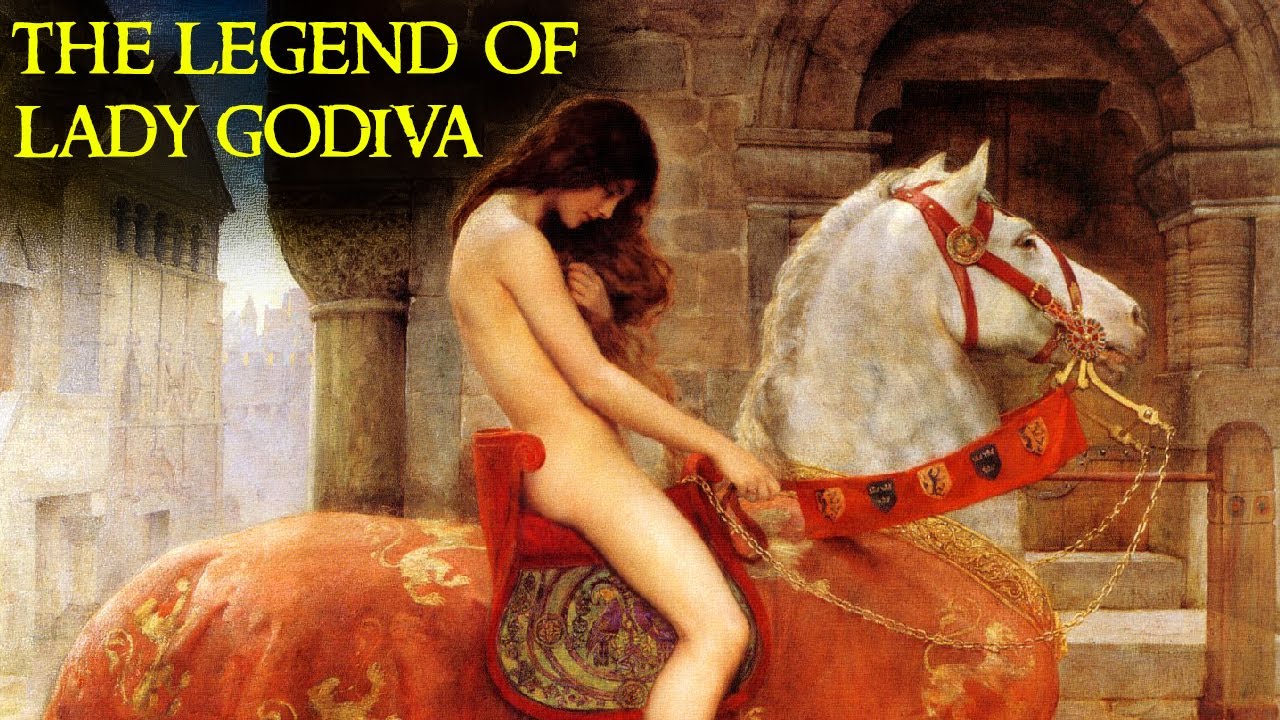
Leofric and Godiva gave this abandoned land to a group of Benedictine monks to establish a monastery, and in time a small service village grew up around it. That village would only become a market town in the twelfth and thirteenth centuries, which matters when considering the legend of Godiva’s ride: the Coventry she supposedly rode through did not really exist in her own lifetime. The legend itself is simple on its surface. One day in the eleventh century, Godiva rode through the streets of Coventry on horseback, naked apart from her long hair falling over her.
According to the story, she had chosen this action in protest against her husband’s oppressive taxes, which the people of Coventry and the surrounding area could not afford. She had argued with him repeatedly to reduce the burdens and show mercy to the common people, but he stubbornly refused each time. On one occasion, perhaps jokingly, he said he would lower the taxes once she rode naked through the streets. Godiva took him at his word.
She issued a directive that on the designated day everyone in Coventry should stay inside their homes and shutter their windows and doors so that nobody could see her. As she rode through the streets, she fulfilled her husband’s requirement, and the idea was that no one actually witnessed her. But one person did: a local tailor named Tom, who disobeyed the proclamation and looked outside. According to the legend, he was struck blind, or deaf depending on the version, and the story became the origin of the term “peeping Tom.
”
Modern scholars largely doubt that this ride ever took place. But there is one historical event that may have given rise to something similar. In 1041, King Harthacnut of England and Denmark ordered Leofric and other earls to plunder and burn the city of Worcester in response to the murder of two tax collectors by angry locals who were being heavily taxed. Leofric carried out the king’s orders, and Worcester was laid to waste.
There is a possibility that Godiva rode through the small hamlet of Coventry as an act of contrition concerning her husband’s actions, though Coventry was not well established at the time. The Domesday Book lists the farming village as having only sixty-nine families in 1086, so there may have been a reasonable population during Godiva’s life. A ride could have occurred, but it would have been very different from the popularized legend. During her life, Godiva was significant as a benefactress of religious houses.
As early as the 1020s, when she was still young and seriously ill and believed she might die, she bequeathed lands at Embarking in Suffolk to the Bishop of Elmham and Dunwich and to the Abbot of Ely. She recovered, and after that she continued her patronage of the Church. She and Leofric granted the Benedictines land to establish their monastery at Coventry, and she gave the monks there several valuable gold and silver items, including a silver necklace valued at one hundred marks, a very substantial sum in the eleventh century. She also donated a gold-fringed chasuble, a liturgical vestment, to Saint Paul’s Cathedral in London, among numerous other gifts.
This pious charity would only benefit these institutions for a short time. When the Normans arrived in 1066 to conquer England from its Anglo-Saxon and Danish rulers, they systematically stripped the country of its wealth over the following five years. Many of the items Godiva and Leofric had given to churches and monasteries were likely requisitioned by Norman knights as religious houses up and down the country were looted during the conquest. The Anglo-Saxon Chronicle records that Leofric died on 30 September 1057, so he did not live to see the Norman Conquest.
But Godiva did. The Domesday Book, the record the Normans produced of every landowner in England in 1086, makes clear that she was still alive at the time of the initial conquest. It also suggests she managed to retain possession of some of her and her husband’s estates after the conquest, which would be remarkable, as the Normans conducted a vicious land grab in the late 1060s and 1070s that saw nearly every major Anglo-Saxon or Danish landholder dispossessed. The Domesday Book also makes clear that she had died by the time it was composed in 1086, though some sources state she died in 1067.
She was buried next to her husband at Saint Mary’s Priory and Cathedral in Coventry, the establishment she and Leofric had patronized years earlier. At the time of her death, she was believed to be among the richest women in England, with her estates valued at one hundred and sixty pounds of silver. Yet all her wealth and lands were forfeited to the new king, William, at her death. The question remains: where did the legend come from?
The answer is that it came from many sources and was gradually embellished over centuries. The origins of the story can be traced to the thirteenth century, when Roger of Wendover composed his Flores Historiarum. Roger was a somewhat gullible collector of fables, and he recorded a story about Godiva riding through Coventry naked, attended by two knights. There was no mention of Peeping Tom at that point.
The story probably arose as some form of acknowledgment that Godiva and Leofric were effectively the founders of what became the town of Coventry. Historians have also discerned that the story of Godiva’s nudity may have reflected a popular pagan fertility tale absorbed into Christian storytelling. Three hundred years later, Richard Grafton, a member of Parliament for Coventry and a pious Protestant, wrote about the legend in his Chronicle of England in 1569. He was inclined to remove some of the impropriety from the story, so he added the details about Godiva insisting that townspeople stay inside and shutter their windows and doors.
This inserted a plot device meaning nobody actually saw her naked. Still, there was no Peeping Tom. The unfortunate Tom did not appear in versions of the legend until the eighteenth century, well after William Dugdale wrote an extensive account of Coventry in the mid-seventeenth century without him. In the early eighteenth century, numerous versions of the legend appeared in print that added the story of Tom, his prying eyes, and his subsequent blindness or deafness.
The character probably arose independently in Coventry folklore. By 1732, a local history included his story, with further references following in the decades after. Some suggest that rather than being miraculously struck blind or deaf, Tom actually had his eyes put out by the townspeople when they learned he had disobeyed Godiva’s command. The legend of Lady Godiva riding naked through Coventry was likely a myth, though its basis lay in the historical Godiva and her husband Leofric.
The story was added to substantially at various points over the centuries, becoming more spectacular and unrealistic in the process. The real Lady Godiva, less astonishingly but more genuinely, was a notable benefactress of religious houses and churches throughout England in the mid-eleventh century. She lived through the Norman Conquest and possibly the years after, and her later years were likely spent watching a conquering class of Norman knights overthrow the very society she and her husband had patronized. In the seventeenth century, Coventry began holding an annual event in her honor, the Godiva Procession, which reenacted her story.
In the twentieth century it was replaced by the Coventry Carnival, though in recent years the procession was revived and combined with the carnival to become the Godiva Carnival Procession, associated with a three-day Godiva Festival held in the city’s War Memorial Park.