Spirit Lake is still there. That is the part almost nobody understands. The eruption of Mount St. Helens did not drain it or boil it away.
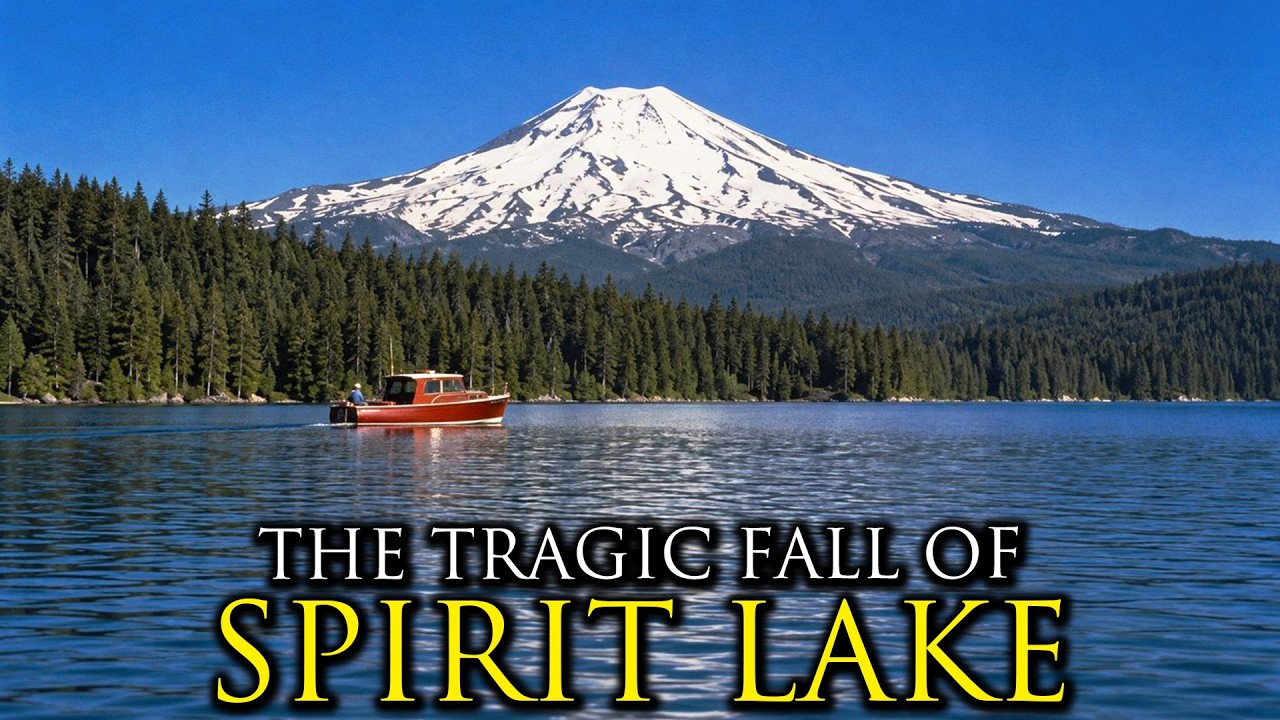
The lake rose two hundred feet, swallowing every dock, every lodge, every campfire ring, every trail where children learned to swim. It all sits buried beneath volcanic debris and cold gray water. A hiker can reach the shore today and stand at the edge, but no one is allowed to swim in it, fish in it, or set a boat on its surface. By federal law, Spirit Lake belongs to science now.
Before May 1980, the lake was one of the most popular recreation destinations in the Pacific Northwest. It sat deep in the Cascades of Washington, at the foot of what was then the most perfectly shaped volcano in the continental United States. The road in was State Route 504, which locals called the Spirit Lake Highway. It ran fifty-two miles from Interstate 5 at Castle Rock, climbing through switchbacks and old-growth forest until it reached the shore.
On summer weekends the highway was thick with station wagons packed with kids and camping gear. Tens of thousands of people visited every season. Six camps crowded the shoreline, including the Boy Scout camp, a Girl Scout camp, two YMCA operations, Harmony Falls Lodge, and another for the general public. The water was cold and crystalline, fed by glacial runoff from the mountain towering directly to the south.
On still mornings, Mount St. Helens reflected on the surface like a postcard that did not need retouching. The local tribes had never shared the settlers’ enthusiasm. The Cowlitz people called the mountain Loo-wit, one from whom smoke comes.
The Klickitat called it Loowit, keeper of the fire. Both names acknowledged what settlers chose to forget: the mountain was an active volcano. The tribes avoided Spirit Lake entirely. According to their traditions, the fish in the lake had heads like bears and carried the souls of the wicked.
The shores, they said, were populated by rogue demons. The name “Spirit” came from settlers translating those warnings and then building summer camps on top of them. The volcano itself had created the lake about three thousand years ago, when mudflows damned two river valleys on the mountain’s north side. Snowmelt filled the basin over centuries.
The whole thing existed at the volcano’s pleasure, on land the volcano had built and could reclaim whenever it chose. Nobody talked about that. The mountain had been dormant since 1857, a silence long enough for entire generations to forget what the ground under their sleeping bags was made of. By the 1920s, Spirit Lake had become a premier outdoor destination.
Rainbow trout drew anglers from across Oregon and Washington. The surrounding forest was some of the oldest and densest old-growth timber left in the Cascades. The economy was modest but real: boat rentals, cabin fees, camp tuitions, fishing licenses, a general store. It sustained a way of life that people returned to generation after generation.
The Boy Scout camp was accessible only by canoe. Scouts paddled across from Harry Truman’s Lodge, where they rented motorboats and transport vessels refurbished from surplus World War II lifeboats. Camp Loowit, the Longview YMCA camp on the north shore, celebrated its fiftieth anniversary reunion in September 1979. Former campers came from across the Northwest to walk the trails one more time, sit on the familiar docks, and look across the water at the mountain they had known since childhood.
It was the last YMCA program ever held at Spirit Lake. Eight months later, the camp was under two hundred feet of rock and water. And then there was Harry. Harry Randall Truman arrived at Spirit Lake in the 1920s.
He had been a bootlegger during Prohibition, a prospector, a drifter. He took over the Mount St. Helens Lodge near the lake’s south shore and operated it for fifty-two years. He kept sixteen cats and told stories to anyone who would listen.
He described the mountain and the lake as his arms and his legs. He meant it plainly, stubbornly, completely. On March 20, 1980, a magnitude 4. 2 earthquake struck beneath Mount St.
Helens, the first significant seismic activity in well over a century. Within a week, more than a hundred tremors had been recorded. On March 27, the mountain emitted steam and ash for the first time since the 1850s. A carnival-like atmosphere developed.
Sightseers gathered, T-shirts were printed, bumper stickers appeared. Scientists saw something more frightening. A bulge was growing on the north face, the face that looked directly down at Spirit Lake. Instruments measured the deformation at five feet per day, then more.
By April 30, geologists publicly announced that a landslide of the bulge was the greatest immediate danger and that such a slide could trigger an eruption. Governor Dixy Lee Ray established a restricted zone around the mountain. Roads were blockaded. Residents were ordered to evacuate.
Most did. But as days turned into weeks and the mountain kept rumbling without blowing, frustration built. Timber interests had enormous financial stakes in getting workers back into the forest. The political pressure was intense.
The zone was drawn based on models that assumed the primary danger was a vertical ash column and localized mudflows. The models were wrong. Harry Truman refused to leave. He was eighty-three years old, alone at the lodge with his cats.
He told reporters the mountain was not going to chase him off. He became a national celebrity almost overnight. Schoolchildren wrote him letters. Network anchors flew in.
What almost no one understood was that Truman did not believe he was going to die. His family later explained he thought the eruption would go straight up, that someone would come and pluck him off, that the lake sat between him and the mountain as a buffer. On Saturday, May 17, two young USGS researchers stopped at the Coldwater 2 observation post to visit volcanologist David Johnston and his student Harry Glicken. Glicken had been camped there for weeks.
Johnston had come up to cover the Sunday shift. The two women planned to camp overnight. Johnston insisted the danger was too great. Around 8 p.
m. they drove down the mountain, leaving Johnston alone. In sending them away, he saved their lives. He did not save his own.
On Sunday, May 18, 1980, at 8:32 a. m. , a magnitude 5. 1 earthquake struck directly beneath the mountain.
The entire north face collapsed in one piece, the largest landslide ever recorded on Earth. Roughly two-thirds of a cubic mile of rock, ice, and debris slid off at speeds exceeding one hundred miles per hour. Part of that mass plunged directly into Spirit Lake. The leading edge slammed into the lake like an avalanche hitting a swimming pool.
The water surged northward in a wave estimated at six hundred feet high, crashing up the surrounding hillsides. The retreating water sloshed back, dragging millions of shattered trees with it. The landslide deposited roughly 295 feet of new debris above the old lake bed. The surface of the newly reformed lake sat about two hundred feet higher than the old one.
Every dock, every cabin, every campfire ring was buried, sealed under hundreds of feet of material. The landslide was only the first act. The sudden removal of the north face exposed superheated magma and pressurized gas. The result was a lateral blast sideways to the north, a wall of scorching gas, pulverized rock, and ash traveling at roughly three hundred miles per hour.
It killed virtually every living thing across 230 square miles of forest. An estimated ten million trees went down. At Coldwater 2, six miles north of the crater, Johnston grabbed his radio. His transmission to USGS headquarters was the first report of the eruption and the last thing he ever said: “Vancouver, Vancouver, this is it.
” The blast reached him in under a minute. His body was never recovered. The ridge where he stood now bears his name. The mountain had been 9,680 feet tall.
It was now 8,363 feet, replaced by a horseshoe-shaped crater open to the north. The eruption lasted nine hours and sent an ash column to 75,000 feet. Ash fell across eleven states. The eruption killed fifty-seven human beings.
Harry Truman was among them. The landslide buried the site of his lodge under 150 feet of debris. He was in the basement with his cats. The mountain he called his body came down and buried him exactly where he had said he wanted to be buried, at Spirit Lake, under the mountain, forever.
He became the eruption’s most enduring human symbol. But the landslide had another consequence. It blocked Spirit Lake’s natural outlet, burying it under as much as six hundred feet of debris. With no way out, the lake began to rise.
If it rose above a critical level, the unstable debris dam would fail, releasing a catastrophic flood down the Toutle River Valley. An estimated fifty thousand people lived in the flood path. The Army Corps of Engineers brought in barge-mounted pumps to remove water while engineers designed a permanent solution: an 8,500-foot tunnel drilled through the volcanic bedrock of a ridge west of the lake, connecting the basin to South Coldwater Creek. The tunnel was completed in 1985.
For the first time since the eruption, Spirit Lake had a controlled outlet. The lake had gone from a self-regulating alpine lake to an engineered reservoir requiring permanent human management. The tunnel is still operating, and it is still in trouble. Earth movement has pushed its floor upward in places.
It has closed multiple times for repairs. In 2023, a major landslide destroyed the bridge on Route 504, cutting road access entirely. As of 2025, the Forest Service outlined a plan to lower Spirit Lake’s surface by forty feet, construct a second drainage tunnel, and repair the existing one, at an estimated cost of nearly $300 million. That is the inheritance of the eruption, not destruction, but obligation.
Spirit Lake did not disappear. It became a permanent engineering responsibility, a ticking hydrological threat masked by the surface beauty of water and drifting logs. On August 26, 1982, President Ronald Reagan signed the bill creating the Mount St. Helens National Volcanic Monument, setting aside 110,000 acres including Spirit Lake and the entire blast zone.
The key decision was the designation of the Spirit Lake Basin as a Class One research area, where human interference would be minimized to preserve the most valuable natural laboratory in American volcanology. In the weeks after the eruption, the lake was a toxic stew, essentially a warm, mineral-rich bacterial culture with no higher life. Then, slowly, it came back. Phytoplankton returned.
Amphibians appeared. Water clarity improved decade by decade. The biofilm on the floating logs proved to be doing extraordinary things, feeding the lake’s recovery from a platform most people assumed was just wreckage. The logs, it turns out, are not debris.
They are infrastructure. They feed the lake, shelter organisms, and cycle nutrients. Every few years, someone tries to change the lake’s status. The most concrete attempt came in 2009, when a bill was introduced to establish a limited recreational fishery for rainbow trout.
It did not pass. The scientific establishment opposed it. The argument was simple: any recreational use would introduce variables that could compromise data stretching back to 1980. The lake’s value depended on its isolation.
Science has won every time. And every time, the people who used to fish Spirit Lake got a little older. There is exactly one trail to Spirit Lake. The Harmony Falls Trail descends about six hundred feet over a mile and a half to the northeastern shore, crossing fields of pumice before reaching a shoreline littered with bleached driftwood.
A hiker can stand at the edge and look across the surface. The log mat drifts in the distance. Mount St. Helens rises to the south, not the symmetrical cone that once reflected on the water, but the jagged, cratered ruin of a mountain that blew 1,300 feet off its own summit.
No swimming, no fishing, no boating, no camping. The Forest Service states plainly that restricting access protects opportunities for long-term research. A hiker who walks down, sits on the volcanic rock, and watches the log mat drift across the water in silence is doing the most that federal law allows any civilian to do at Spirit Lake. Look at it, then climb back up.
The people who grew up on that lake are in their sixties and seventies now. They are the last generation that will ever have those memories as firsthand experience. There is no one making new memories at Spirit Lake. The cruelty of the place is that it is not a ruin.
It is not an absence. It is still there, right there, gray-blue, log-strewn, alive with whatever is growing in its depths. The camps are right there under the surface. Harry Truman is right there under the debris, under the water, under the silence.
The distance between a living memory and the physical place where it was made is two hundred vertical feet and a federal research designation. The lake the Cowlitz and Klickitat warned about is doing exactly what they said it would. Holding spirits, keeping the dead, resisting the living. The settlers who turned the warnings into a scenic name and built their camps on the shore were borrowing a place that was never theirs.
The government that sealed the lake after the eruption recognized, consciously or not, what the tribes had always understood: that some places are not meant to be recreational, that some water is not meant to be swum in. Whether the Forest Service would put it in those terms is doubtful. They would say it is about protecting a globally significant natural laboratory and preserving data integrity. All of that is true.
But walk the Harmony Trail on a quiet morning, stand on the pumice shore with the log mat drifting past and the crater staring down, and the place feels like what it is. A place that remembers everything, forgives nothing, and belongs to no one who is still alive to claim it.