On December 31, 1985, a fire broke out aboard a DC-3 flying from Guntersville, Alabama, to Dallas, Texas. The plane crashed near De Kalb, Texas, around 5:45 in the evening. All seven people on board died, including Ricky Nelson, the former teen idol who had once been the most famous young man in America. He was forty-five years old, engaged to a woman named Helen Blair, and traveling with his band for a New Year’s Eve performance.
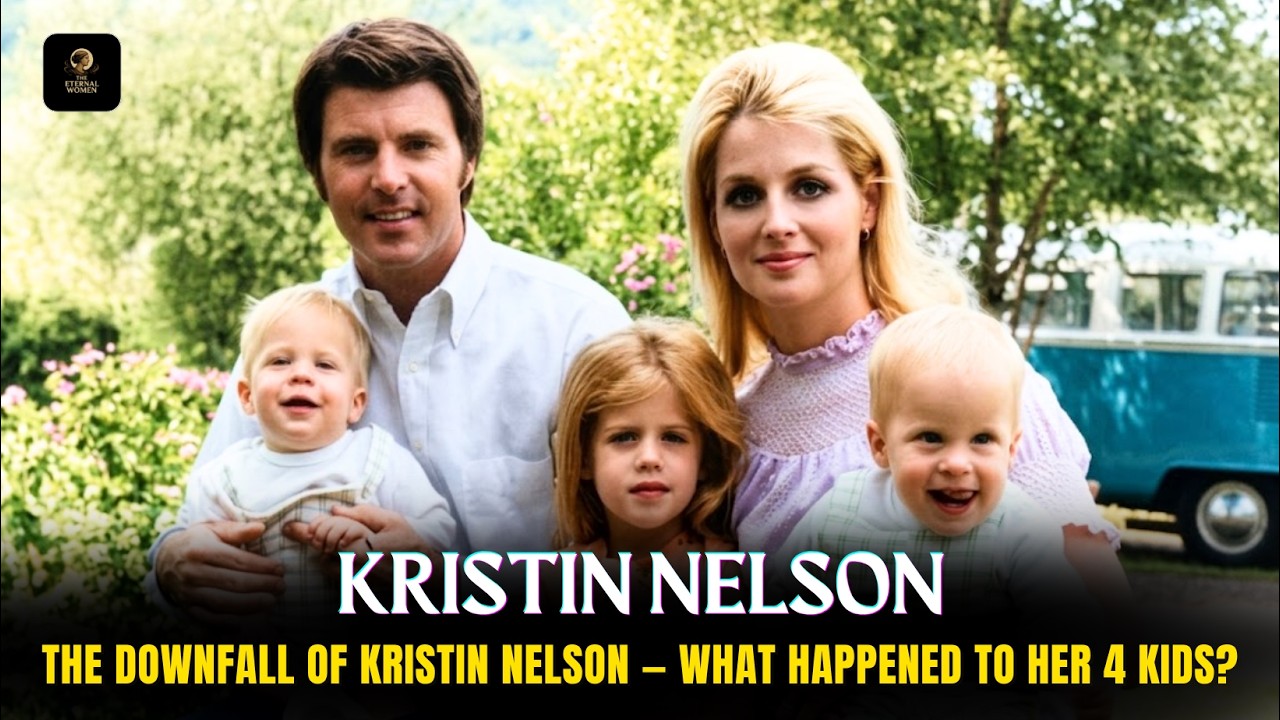
Investigators later determined that a faulty heating system had ignited leaking fuel inside the cabin. There were early rumors of drug use, fueled partly by the discovery of paraphernalia at the crash site, but the final report settled on mechanical failure. The woman who had been Ricky Nelson’s wife for twenty-two years learned the news at age forty. She was Kristin Nelson, born Sharon Kristin Harmon on June 25, 1945, in Burbank, California.
She had been divorced from Ricky for three years by then. But no legal document could erase the fact that he was the father of her four children, the boy she had first met when she was twelve, and the man whose life had been tangled with hers since her teenage years. Her family had once seemed to embody the American dream. Her father, Tom Harmon, was a University of Michigan halfback who won the Heisman Trophy in 1940 and finished second in the Associated Press Athlete of the Year voting that same year.
He served as a military pilot in World War II and survived being shot down twice, once over Venezuela in April 1943, where he walked out of the jungle after eleven days, and again over China in November 1943 after Japanese fire brought him down. After the war, he became one of California’s most famous sportscasters. Her mother, Elyse Knox, was an actress and model whose face appeared in films throughout the 1940s. Kristin grew up surrounded by famous figures and high expectations, attending the elite Catholic girls’ school Marymount High School in Bel Air, where Mia Farrow was among her close friends.
Her sister, Kelly Harmon, later became a model and actress, famous for the Tee-Pak commercial campaign. Her brother, Mark Harmon, would become one of the most watched actors in American television history, playing Leroy Jethro Gibbs on NCIS for eighteen seasons. When Kristin was twelve, she was part of a studio audience for a television program and met Ricky Nelson for the first time. He was seventeen.
Five years later, on Christmas Day 1961, they began dating. She was sixteen; he was twenty-one. A year later they were engaged. Then she became pregnant.
On April 20, 1963, at age seventeen, she walked down the aisle of Saint Martin of Tours Catholic Church in Los Angeles and married the twenty-two-year-old rock star, with her parents’ consent. Ricky later described the marriage, with a bluntness that must have been painful to hear, as a forced one. He took Catholic instruction before the ceremony and signed a pledge to raise their children in the faith. Ricky Nelson had grown up inside a carefully manufactured image.
He was born Eric Hilliard Nelson on May 8, 1940, in Teaneck, New Jersey, to bandleader Ozzie Nelson and singer Harriet Hilliard. The family moved to Hollywood when Ricky was young. In 1944, when he was four, the family began The Adventures of Ozzie and Harriet on radio, which moved to television in 1952 and ran for fourteen seasons until 1966. The show was unprecedented: a family that was simultaneously real and fictional, playing idealized versions of themselves for nearly two decades.
The television version was the embodiment of the American dream, so polished it seemed to reflect light. Ricky was the lovable, slightly mischievous younger son, growing up week after week before an audience that felt it knew him personally. When he played guitar on camera, the reaction was that of a genuine pop star. He began recording music in 1957 at sixteen.
The story of his start became famous: he wanted to impress a girl and casually mentioned he recorded at the same studio as Elvis Presley. A session was arranged, one of his songs was played on the show, and the response was immediate and overwhelming. His first single reached number four on the Billboard chart; his second hit number one. By seventeen, he was one of the most commercially successful artists in America, competing seriously with Elvis while playing the perfect son on the nation’s most popular television show.
His father managed his career with the same controlling instinct he used for the show, shaping and packaging Ricky to serve the family brand. Ricky was genuinely talented, later recording some of the most respected folk rock and country rock of his era, but he was also a product manufactured before he was old enough to make anything himself. He never lived outside the image his father built. Into that world stepped Kristin Harmon.
She joined the cast of The Adventures of Ozzie and Harriet immediately after the wedding, appearing in an episode titled “Rick’s Wedding Ring,” becoming overnight another member of one of America’s most beloved entertainment families. She later said, plainly, that she spent her whole life fighting the fairy tale. First she tried to be part of it, then she tried to tell the truth. The truth was that she married a brand, and the brand had rules.
Their first child, Tracy Kristin Nelson, was born on October 25, 1963, six months after the wedding, premature at four pounds one ounce. Twins Gunnar Eric Nelson and Matthew Gray Nelson followed on September 20, 1967. The youngest, Sam Hilliard Nelson, arrived on August 29, 1974, into a marriage that had been in crisis for years. The public story of the marriage was television.
The private story was different. Ricky toured constantly, absent from home for long stretches, surrounded by the rock and roll environment of the sixties and seventies, with its drugs, women, and freedom. Reports of infidelity circulated through the marriage. By 1975, according to multiple accounts, the marriage was essentially over.
Kristin, meanwhile, ran the household and raised four children largely alone, while struggling with addiction, particularly to cocaine and alcohol, that would consume the next decades of her life. In 1977, when Ricky returned from a tour, he found that Kristin had moved his belongings to a rental house. She filed for divorce in October of that year, seeking support, custody, and a share of the property. They reconciled briefly, a common pattern in marriages complicated by history, children, and finances.
The reconciliation did not last. In April 1980, in what seemed like one of the last public gestures of the marriage, they bought a property on Mulholland Drive that had once belonged to Errol Flynn, for $750,000, a staggering sum for a couple whose marriage was collapsing and finances deteriorating. In October 1980, Kristin filed for divorce again. This time she did not withdraw it.
The divorce proceedings were destructive. Kristin wanted Ricky to give up music and focus on acting and family life; Ricky had no intention of abandoning his tours. The dispute over his career, along with finances and custody arrangements, produced two years of bitter, highly publicized conflict. In February 1981, Kristin received temporary custody of the four children and $3,600 monthly support.
She claimed Ricky was hiding assets; his representatives countered that he was nearly bankrupt. The divorce was finalized on December 27, 1982. Lawyers and accountants collected more than a million dollars. Both parties emerged financially worse than before.
During the divorce, the family structure fragmented. Tracy, the eldest, lived with her father for a time. The twins moved in with Ricky almost exactly three months before his death. Sam, the youngest and most vulnerable, was shuffled among relatives.
During the custody fight, his aunt Kelly cared for him, then he spent eighteen months with his maternal grandparents, Tom and Elyse Harmon, before moving in with Mark Harmon and his wife, Pam Dawber. Sam was eight when the second divorce proceedings began and eleven when they concluded. Ricky’s death in the plane crash ended any possibility of eventual peace between the former spouses. His funeral, by many accounts, was tense and painful.
Kristin attended knowing her relationship with the Nelson family was complicated. A dispute broke out between Kristin and Tracy that escalated into a physical fight, with accounts describing Kristin throwing her daughter to the ground and using her handbag as a weapon. The court denied Kristin any share of the estate beyond what had been settled in the divorce. The four children inherited what remained of their father’s legacy.
By 1987, two years after Ricky’s death and now forty-two years old, Kristin was in rehabilitation for her addiction. Her brother Mark Harmon and his wife, Pam Dawber, petitioned a California court for custody of thirteen-year-old Sam, arguing that Kristin was unable to provide adequate parental care due to her addiction and unstable life. Sam’s own psychiatrist testified on the boy’s behalf, describing how Sam depicted his mother as a dragon, not in the sense of strength but of danger and unpredictability. The thirteen-year-old described his mother’s mood swings as frightening and complained that she kept him from spending time with his siblings.
Kristin’s response was complex. She later acknowledged that Mark had been instrumental in getting her into rehabilitation and credited him with saving her life. At the same time, she fought the custody case fiercely, publicly claiming that Pam Dawber used cocaine. The accusation was serious enough that Mark Harmon dropped the custody petition rather than allow it to proceed.
The court awarded Kristin custody of Sam, granted Mark visitation rights, and ordered all three to undergo family therapy together. Kristin was also ordered to remain two hundred yards away from Mark and Pam’s home, and from Pam’s workplace. In 1988, the year after the custody battle was resolved, Kristin married producer and director Mark Tinker, a respected television professional whose work was mainly in dramatic series. The marriage lasted twelve years, ending in separation in 2000.
After that divorce, Kristin moved to Santa Fe, New Mexico. There she returned seriously to painting, something she had done since age seventeen. She had held her first solo exhibition in 1967, in the middle of her marriage to Ricky. In Santa Fe, painting became the center of her life.
Her works were exhibited in galleries and purchased by collectors. One painting, titled “When the Kennedys Were in the White House,” was bought by Jacqueline Kennedy. She also wrote and published a book. On April 27, 2018, Kristin Nelson died of a heart attack at her home in Santa Fe.
She was seventy-two years old. Her daughter Tracy announced the news on Facebook four days later, describing the death as sudden and unexpected. The reaction was muted compared to what it might have been for a more famous figure. By that point, she was remembered primarily as Ricky Nelson’s ex-wife.
Her own artwork, decades of painting, exhibitions, and the Kennedy purchase, were largely unknown to the public. Their four children each built lives from the inheritance of that marriage. Tracy became a professional actress and dancer with a steady career spanning decades. The twins formed the band Nelson shortly after their father’s death.
Their 1990 debut album, After the Rain, went platinum, and their single “(Can’t Live) Without Your Love and Affection” reached number one on the Billboard Hot 100, making them the first artists in history to hit number one in the same era as their father, whose “Poor Little Fool” had topped the chart in 1958. Sam became a singer and songwriter, rarely speaking publicly about his childhood. Kristin Nelson spent her life fighting a fantasy. The fantasy had a specific address: a television show that ran fourteen seasons, a Mulholland Drive estate that once belonged to Errol Flynn, a Catholic church in Los Angeles where a seventeen-year-old girl married a twenty-two-year-old rock star with her child on the way and the American public watching.
The truth was addiction, divorce, custody battles, a funeral where she fought with her daughter, a judge who denied her claim to the estate, and years of rehabilitation that came through her brother’s intervention but cost her the fight to keep her youngest child. She was not a villain in the story, and she was not a passive victim. She entered a life of immense pressure at seventeen, before she had the maturity to handle it, and that pressure shaped her in ways that were sometimes destructive and sometimes creative. She painted, she wrote, she built a body of work respected by serious collectors.
She raised four children who became successful in their own fields. She survived rehabilitation, survived the custody battle, survived the death of the man with whom she had spent most of her life, and moved to New Mexico, where she built a quieter, more honest life than anything she had in Los Angeles. The tragedy in her story is real, but it is not the whole story. The final chapter, in Santa Fe, where she painted works purchased by collectors and focused on her own art, became the chapter that was finally, unmistakably hers.
She had fought the fantasy her entire life. She never fully won, but she never stopped fighting. At the end, she was doing it on her own terms, creating work that expressed who she truly was.