Fifty thousand years ago, in the cold vastness of Siberia, a small bone tool was shaped by hands that were not quite human. The needle found in Denisova Cave, carved from a bird’s bone, had a carefully smoothed eye meant to carry thread without breaking it. It was the oldest needle ever discovered, and its existence suggests that the Denisovans, a separate human species who were not direct ancestors of modern people, had already mastered the art of advanced sewing. That single discovery rewrites the old story of survival: the ability to create fitted, protective clothing was not a unique achievement of Homo sapiens alone.
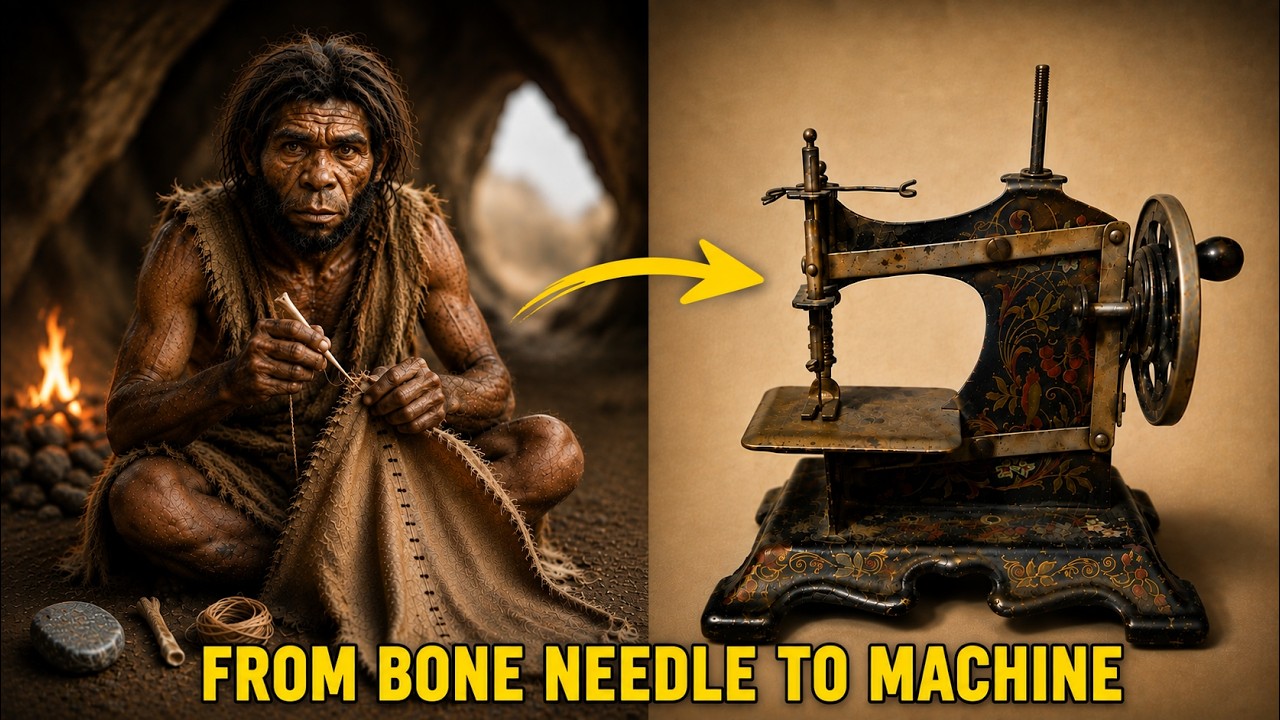
Before such tools existed, early humans faced a brutal problem. As they moved out of warmer regions into colder climates, their bodies could not withstand the cold. They had animal skins, but only in their rawest form, wrapped around the body and tied with strips of leather so they would not fall off. It worked poorly.
The hides hung loose, gaps let in freezing air, and warmth escaped. Survival demanded a better solution, and necessity produced the first breakthrough: the bone awl, a pointed instrument used to punch holes into leather. Through those holes, humans passed plant fibers or animal sinew to join pieces of hide together. But the process was painfully slow, one hole at a time, one thread pull after another.
What was needed was a tool that could pierce the material and carry the thread through in a single motion. That need produced the first needle, and with it, humanity took a decisive step away from mere survival and toward craft. The needle alone was not enough. Thread had to be made, and here ancient people proved their skill ran deeper than simple necessity.
In Dzudzuana Cave in Georgia, researchers found flax fibers dated between 22,000 and 32,000 years old. These fibers were not just spun into thread; they were also dyed, which means that thousands of years before the invention of agriculture, humans had already learned to create colored, plant-based cordage. The common image of prehistoric people draped in crude animal hides is incomplete. They were skilled artisans working by hand with materials and techniques that still demand respect.
Making a single garment remained an ordeal of immense physical cost. Preparing animal hide required hours of hunched labor, scraping away meat and hair from the leather, often leaving permanent damage to backs and joints. To soften the hide, people boiled animal brains into a gelatinous mixture and worked it into the leather by hand. Then the treated hide was hung over smoke to dry so it would not be ruined by water.
The smoke contained chemicals that damaged the lungs. Every step of the process left a toll on those who performed it, and for most of human history, the people who made clothing paid for it with their bodies. As civilizations developed, the suffering did not disappear. It became more organized and more toxic.
In the Roman Empire, arsenic-laden stones were used to create orange and yellow dyes, and the slaves who ground and handled those stones typically died within months from lung disease. Red dye required grinding cinnabar, a mineral rich in mercury, which caused trembling hands and fading memory. Wool cleaners stood for weeks in stone vats filled with stale urine, trampling the fabric with their bare feet to remove grease, leaving their feet wounded and infected. The most infamous case was Tyrian purple, a color extracted from the bodies of thousands of sea snails.
The snails were boiled until they rotted, releasing a stench so powerful it could be detected across entire cities. The beautiful clothing admired today carried a long chain of hidden pain, and that pain was concentrated in the working bodies of the poor, the enslaved, and the overlooked. Eventually, humans learned to produce actual woven fabric. Spinning came first, using a drop spindle, a small wooden tool rotated to twist raw fibers into thread.
The thread was then loaded onto a loom. In Greece, weavers used a warp-weighted loom, hanging stones from the threads to keep them straight. Egyptians drove two stakes into the ground to create a horizontal loom. Each civilization adapted its methods to its local environment and needs.
Because fabric was so labor-intensive to produce, it was rarely cut. Garments were woven in straight, square shapes so that not a single piece of cloth would go to waste. When the weaving was complete, sewing began. People used the running stitch for speed, the backstitch for strength, and the overcast stitch to secure edges.
Special buttonhole stitches were developed for durability. These techniques proved so effective that they remain in use, essentially unchanged, thousands of years later. As cities expanded and demand for clothing grew, home sewing could no longer supply the need. Large workshops and factories emerged, where artisans spent years learning the craft of cutting and stitching before they could work independently.
This system endured for centuries, until the 18th century brought the Industrial Revolution to Europe. Machines like the spinning jenny and the water frame increased textile production a thousandfold. But one bottleneck remained: fabric was being made at unprecedented speed, yet sewing was still done by hand. Making a simple shirt took fourteen to twenty hours.
The race was on to invent a machine that could replace hand stitching entirely. The first attempts were incomplete. Charles Wiesenthal invented a needle with an eye in the middle, but it could not form a true seam. Thomas Saint designed a machine for leather, but it was never commercially produced.
In 1830, Barthélemy Thimonnier of France built the first machine that actually worked. He secured a contract to sew uniforms for the French Army and opened a factory in Paris with eighty machines in operation. When the city’s hand-sewing tailors realized their livelihoods were threatened, they reacted with rage. A mob of roughly two hundred tailors attacked the factory, smashed every machine, and set the building on fire.
Thimonnier narrowly escaped with his life. It was a brutal reminder that new technology does not arrive peacefully; it is often met first with fear and violence. The invention race continued across the Atlantic. In 1832, Walter Hunt created the first lock-stitch machine, using a needle that brought thread from above while a shuttle carried a second thread from below, locking the two together into a strong seam.
But Hunt was so concerned about the unemployment that the machine would cause among tailors and seamstresses that he refused to patent it. It was one of the most costly decisions in the history of invention. In 1846, Elias Howe patented a similar lock-stitch machine with a needle carrying the eye at one end and operating with horizontal motion. The machine worked, but it had a serious flaw: the fabric-feeding mechanism was so small that sewing long, continuous seams was nearly impossible.
That was the gap Isaac Singer stepped into. In 1851, he built a machine with a vertical needle, a presser foot to hold the fabric in place, and a continuous treadle pedal to drive it. It worked so well that it spread into factories and homes across the country. But Singer’s success triggered a bitter legal war with Elias Howe over patent rights.
The conflict dragged on for years until 1856, when the major inventors agreed to form the Sewing Machine Combination, a patent pool that ended the litigation and cleared the way for large-scale production. The sewing machine was finally free to transform the world. Speed followed quickly. By the late 19th century, steam-powered machines could produce a shirt in one hour and sixteen minutes, a garment that had once required fourteen hours of hand labor.
In 1889, Singer introduced the first electric motor-powered machine, freeing the operator from the pedal and allowing full attention on guiding the fabric. Machines now made more than 1,500 stitches per minute. In the 1960s, microprocessors entered the industry, and machines learned to perform repetitive tasks on their own, sewing pockets, collars, and cuffs without human hands. Some machines changed stitch patterns using electronic cards.
Others memorized the operator’s hand movements and repeated them endlessly. Today, industrial sewing machines produce thousands of stitches per minute, and robotic systems assemble clothing with minimal human involvement. Yet even now, the finest and most expensive garments in the world are still sewn by hand. Some tasks simply cannot be replaced by machines.
The story of clothing is not merely a story of fabric and thread. It is a story of human perseverance, of finding a new solution to every problem, of a journey that began with a sharpened bone in the cold and now reaches the automated factories of the present. The pain, the invention, the resistance, and the triumph are all stitched into everything we wear.