In the summer of 1988, inside Tehran’s Evin prison, a 20-year-old man stood blindfolded before a wooden table. The cloth was tied so tightly it cut into his skin. The only sound was the scratching of a fountain pen on cheap paper. There was no trial, only an assembly line.
The man behind the table did not look up. He asked a single question: Are you still loyal to your beliefs? The prisoner hesitated, unaware of what waited two rooms away, unaware of the forklift idling in the courtyard. Believing this was just another interrogation, he whispered, “Yes.
” The judge nodded. The pen stopped. The process had taken ninety seconds. Twenty minutes later, the young man hung from the hydraulics of a yellow construction crane, his feet dangling above a dusty courtyard.
Five others hanged beside him. This scene was repeated thousands of times within a few weeks. In that period, the Iranian regime systematically murdered between 2,800 and 5,000 political prisoners, erased by a single sheet of paper. To understand how this apparatus was built, one must look back to July 8, 1988.
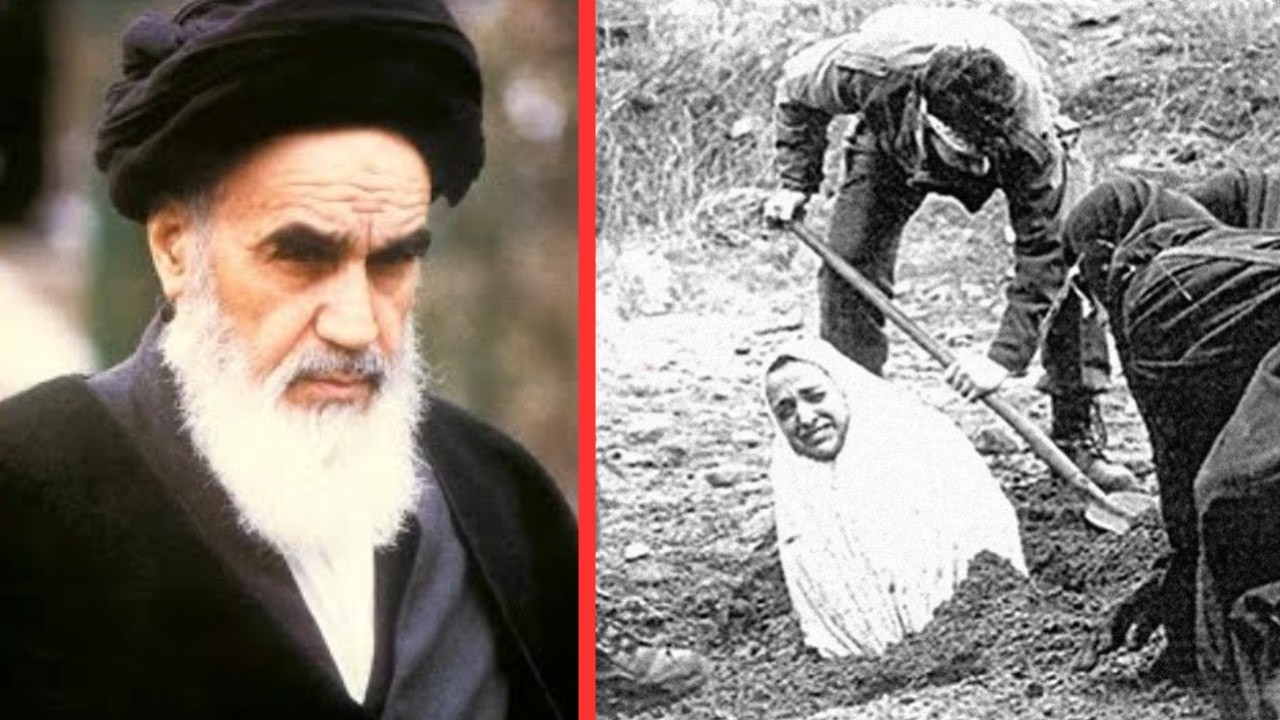
Ayatollah Khomeini, the terminally ill supreme leader of the Islamic Republic, issued a fatwa. The decree was less than one hundred words long, but it was absolute. Any imprisoned dissident who remained steadfast in their beliefs was declared an apostate. The punishment was death.
With that single document, the regime formed death commissions across thirty-two cities. Each commission consisted of three men: a religious judge, a prosecutor, and an intelligence officer. They decided life and death at lightning speed. Most victims had already served their official prison sentences years earlier.
They remained behind bars only because the regime refused to release them. Now they were executed based on a ninety-second conversation. Even Khomeini’s designated successor, Ayatollah Montazeri, was horrified. In his memoirs, he wrote that thousands were slaughtered in the very first weeks.
This system did not appear overnight. It dated back to the 1979 revolution. When Khomeini returned from exile in Paris, he promised democracy. That promise lasted just a few weeks.
Then the purging began. In the first eighteen months alone, human rights groups reported roughly 30,000 executions. To cement power, the new regime turned public executions into street theater. Tehran was undergoing a construction boom then, and heavy-duty yellow cranes imported from Western companies were everywhere.
The Revolutionary Guard saw these cranes as highly visible gallows. They moved executions to public squares. Prisoners were not dropped to break their necks. They were tied to the cranes and hoisted into the air agonizingly slowly, suffocating in full view of commuters, shopkeepers, and children walking to school.
Fear became the regime’s primary currency. By 1981, after massive anti-regime protests, the execution apparatus went fully industrial. Guards operated the cranes in rotating shifts like assembly line workers. But the summer of 1988 surpassed everything that came before.
Realizing public hangings caused too much international outrage, the regime moved the assembly line behind the concrete walls of Evin and Gohardasht prisons. The logistics were meticulous. Guards rounded up prisoners, telling them it was just a routine check before release. In front of the commission, the blindfold was removed, the single question was asked, and the blindfold went back on.
If the answer was wrong, guards pushed the prisoner down a long hallway straight into the prison warehouse. Survivors recalled a monotonous sound echoing through the walls day and night: the low hum of forklift engines. Guards tied ropes to the heavy metal forks of industrial forklifts and lifted six people at a time. Thirty minutes later, the next group was lined up.
At night, refrigerated trucks backed up to the loading docks. The bodies were stacked inside, driven to the Khavaran wasteland outside Tehran, and dumped into mass graves. Bulldozers flattened the dirt. There were no names, no markers.
For months, families were left in the dark. Eventually, parents were summoned to the prison. A guard handed them a plastic bag containing their child’s watch or a ring. His words were simple: “They’re dead.
Do not ask where they are buried. ”
The infrastructure built in 1979 and perfected in 1988 was never dismantled. The death commissions of the eighties are what are today called the revolutionary courts. Recent numbers show the scale.
Human rights organizations documented at least 853 executions in Iran in a single twelve-month period, the highest number in nearly a decade. The victims have included political activists, ethnic minorities, women, and even juvenile offenders. Whenever the regime feels threatened, whether during the 2009 Green Movement or the Woman, Life, Freedom protests after the death of Jina Mahsa Amini, it uses the same playbook. The charges remain “enmity against God.
” The trials still last mere minutes. And the tool of choice in Tehran’s public squares remains the yellow construction crane. Some of these machines still bear the manufacturer labels of Western companies from the 1970s. The same steel, the same hydraulics, just four decades later.
For hundreds of thousands of Iranians in exile, these are not historical statistics. It is the uncle who went into Evin prison in August 1988 and vanished. It is the sister dragged out of a university lecture whose grave was never found. The regime is still actively trying to erase the evidence.
For over twenty years, bulldozers have repeatedly plowed over the Khavaran cemetery, paving it over and planting trees, ensuring that forensic DNA testing of the bones beneath the soil is impossible. The most agonizing part of this story is the absolute lack of justice. The men who sat in those rooms in 1988, sending people to the gallows every ninety seconds, were rewarded. They rose to the very top of the Islamic Republic.
One became Minister of Justice. Another, Ebrahim Raisi, rose to become president of Iran, ruling the country until his death in 2024. The killers of yesterday became the lawmakers of today. Khomeini has been dead for decades, but the machine he built is still running.
As the story of that summer recedes into the past, another prisoner is likely being led into a quiet, windowless room in Iran, wearing a blindfold, standing before three men. The question is exactly the same, and the machine is waiting.