In February 1657, Laura Mancini died from complications following the birth of her third child. She was just twenty years old. Her widower, a grandson of King Henry IV of France, was so overcome that he abandoned his secular life, took holy orders, and rose swiftly to become a cardinal. The care of Laura’s three young sons passed to her sisters.
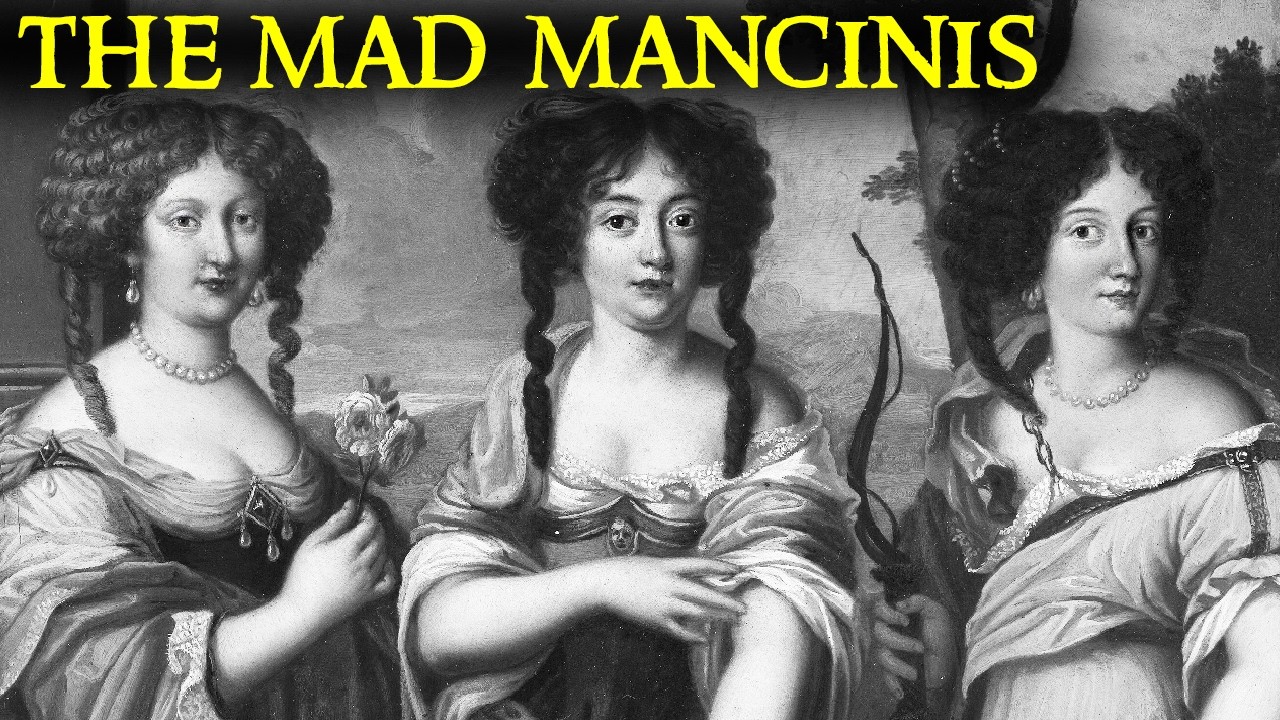
It was a tragic end for the eldest of the five Mancini sisters, yet their story was far from over. The surviving sisters would go on to shape—and scandalize—the royal courts of Europe for decades to come. The Mancini sisters were born in Rome between 1636 and 1649, daughters of Baron Lorenzo Mancini, of one of the city’s most ancient noble houses, and his wife, Girolama, who came from far humbler stock. Their mother’s marriage to Lorenzo in 1634 owed everything to her brother, Giulio Mazarini.
Once a papal servant in Rome, Mazarini had risen to the crimson robes of a cardinal, placing him just a breath below the Pope himself. But his greatest stage lay not in Italy but in France, where he became chief minister to the young King Louis XIV. By the 1650s he wielded near-absolute power, and it was his relentless scheming that would shape the lives of his nieces. Lorenzo and Girolama had ten children: three sons and seven daughters.
Two of the boys died in their teens, leaving only Philippe, who made a career in France as a nobleman and a musketeer. Of the seven daughters, five survived to adulthood: Laura, Olimpia, Marie, Hortense, and Marie Anne. Together, they would shatter conventions and scandalize Europe. Laura, born in May 1636, was the eldest.
She spent her childhood in Rome, among an aristocracy that had grown more settled than in the violent centuries before. Her education was designed to produce a cultivated young woman of the court. In 1651, at just fifteen, she was married to Louis de Bourbon, Duke of Mercoeur, a second cousin of King Louis XIV. The match had been arranged by her uncle in Paris.
Laura and her husband had three sons, but her life was cut short barely six years later. Not long after Laura’s marriage, the entire Mancini family relocated to the French court. Their father had died, and Girolama looked to her brother, Cardinal Mazarini, for support. His command was simple: abandon Rome and take their chances in France, where Laura’s new union had tied the family’s fate to the Bourbon crown.
In Paris, Laura was granted the title of Serene Highness as a princess of the blood. The sisters’ arrival in France was anything but smooth. Anti-Mazarine pamphlets mocked them as “dirt princesses” and “stinking snakes. ” Two cousins, Anna Maria and Laura Martinozzi, were also under the cardinal’s protection.
Together the seven young women formed a notorious troop nicknamed the “Mazarinetes. ” When they were presented at court, one marshal remarked to the king’s uncle, Gaston, Duke of Orléans, that here were young ladies who presently had nothing, but who would soon command beautiful castles, good incomes, precious stones, and substantial silver plate. The second sister, Olimpia, was born in the summer of 1638. As a cardinal, Jules Mazarini could not have a legitimate family of his own, so with Lorenzo Mancini dead, he seized his sister’s children as a surrogate dynasty to build political power.
Olimpia became a key piece in that game. In 1657 she was married to Prince Eugène Maurice of the House of Savoy, a leading aristocratic line that ruled over the duchy of Savoy, straddling the border between France and Italy. They had eight children, six of whom lived to adulthood. Olimpia was a skilled schemer.
At the French court, she was said to have been the king’s mistress for a time, and she aligned herself closely with his sister-in-law, the Duchess of Orléans. Her intrigues intensified after her husband’s death in 1673. They peaked in 1679, when she was implicated in the Affair of the Poisons. She was accused of plotting to have a fortune teller poison Louise de La Vallière, a former mistress of the king.
It was one small part of a massive scandal that implicated hundreds in alleged plots. Dozens were executed. Olimpia’s life was spared, but she was exiled from France. A later stint at the Spanish court brought a fresh accusation of poisoning, though whether there was any truth to it is unclear.
She spent her final years in Brussels, where she died at seventy in 1708. The middle sister, Marie, was born on the 28th of August 1639. She was a dark-haired beauty, and King Louis XIV was said to have been genuinely in love with her. When a suggestion arose that he might marry her, his counselors brushed it aside, insisting he must wed a European princess from one of the continent’s leading royal houses.
The king wept over losing her, putting his kingdom before his heart. To keep Marie away from him, she was swiftly married off, much to her own dismay, to Prince Lorenzo Colonna of Paliano. They wed in Italy in 1661, when she was twenty-two. Marie was never happy in the marriage.
She and Lorenzo had three children, born between 1663 and 1665, after which she became reluctant to have more. In the early 1670s, as the marriage deteriorated, she was sent to a religious house in a seventeenth-century version of being committed, and then she left Italy altogether to spend much of her time with her sister Hortense. Together they became noted memoirists. Marie only returned to Italy when her husband died in 1689, where she found her children fully grown.
She continued to travel and write through a long life, dying in Italy in 1715 at seventy-five. Perhaps the most renowned sister was Hortense, born in June 1646. She was little more than an infant when the family set off for France. Talk of a possible marriage emerged early.
In the 1650s, Queen Henrietta Maria, widow of England’s executed King Charles I, was living at the French court in exile, and talk arose of marrying Hortense to her eldest son, the future King Charles II of England. That union never materialized, and when Cardinal Mazarini died in 1661, the family’s influence declined. The same year, Hortense, aged fourteen, was married to Armand Charles de La Porte, Duke of La Meilleraye, one of France’s wealthiest men. The marriage was troubled.
The duke was fourteen years older, psychologically unstable, and constantly believed his attractive young wife was unfaithful. He ordered his servants to conduct random night-time searches of her apartments to locate alleged lovers. They had four children quickly after marrying in the mid-1660s, but Hortense fled the union in 1668. By then her husband had taken to defacing his family’s vast art collection, condemning the display of flesh as immoral, and was even rumored to have ordered the removal of teeth from some female servants to prevent them from attracting male attention.
His mental decline was well known, and Louis XIV offered Hortense a protected place at the French court after she left him. She was also granted a large pension by her former suitor, the Duke of Savoy, which made her financially independent. In the mid-1670s she took up residence at the English court, where she renewed her acquaintance with King Charles II, who had been restored to the throne in 1660. Charles, a noted philanderer who acknowledged more than two dozen illegitimate children, took Hortense as one of his mistresses—two decades after a marriage to her had been suggested in Paris.
But her time in England was not smooth. During a period of anti-French and anti-Catholic hysteria in the midst of the Popish Plot, Hortense was loathed by many at court, viewed as an agent of the French court despite her Italian heritage. She was also seen as extremely promiscuous, having affairs not only with a European royal but also with one of King Charles’s own daughters. When this came to light, she fell out of favor.
They eventually reconciled, and she and Charles remained friends. Hortense lived out the remainder of her life in England, becoming a diarist like Marie. Their memoirs provide key insights into how aristocratic women of the early modern era, whose marriages had proved problematic, perceived their place in the world. She died in 1699 in her mid-fifties.
Bizarrely, her husband reemerged at that point, took possession of her remains, and carried them around France on a tour in a cart before eventually having her buried in the Mazarini family tomb. The youngest sister, Marie Anne, was born in 1649 and was not even speaking when the family moved to Paris. She was the spoiled darling of the group, recalled as the wittiest and most vivacious of the sisters. After Laura died in 1657, Marie Anne, still a child herself, took on a maternal role for her nieces.
Famously, her marriage to Godfrey Maurice de La Tour d’Auvergne was agreed in 1661, a day before her uncle Cardinal Mazarini died. They wed in April 1662, and it was said he loved her so much he turned a blind eye to her love affairs. They had seven children together, nearly all of whom lived long lives—unusual at a time when around thirty percent of children died in infancy. Like Olimpia, Marie Anne was implicated in the Affair of the Poisons in the late 1670s.
Placed on trial at the beginning of 1680, she successfully defended herself against the charges, though she was still asked to leave court. Her valiant defense won her the acclaim of the French people, and before long she was invited back to court, which by then had moved to Versailles. When things soured again in the mid-1680s, she left and chose to spend much of the rest of her life quietly on her country estates. The Mancini sisters’ descendants carried their legacy forward.
Laura’s surviving sons became dukes within the French nobility, and one, Louis Joseph, served as Marshal of France with distinction during the War of the League of Augsburg. Olimpia’s son, Prince Eugène of Savoy, became one of the most renowned generals in Europe, beginning with his role in the wars against the Ottoman Empire in the Balkans in the 1680s and 1690s and culminating in a successful partnership with the Duke of Marlborough during the War of the Spanish Succession—against France, the very court that had exiled his mother. Marie’s son Filippo became a noted patron of the arts in Italy as Prince of Paliano. The most striking story concerning their descendants, however, belongs to Hortense’s line.
Her great-grandchildren were the famous five Nail sisters, who in a bizarre overlap with their Mancini ancestors became known for their marriages and relationships with King Louis XV of France in the middle of the eighteenth century. The scandalous legacy of the five Mancini sisters had echoed across a century and a half of European history.