In the late autumn of 2025, Prince Andrew, the son who had once been protected by the most powerful woman in Britain, formally surrendered the last meaningful things he had. He announced he would stop using his titles, including the dukedom of York that had been granted to him on his wedding day nearly four decades earlier. Within two weeks, Buckingham Palace confirmed that the king had begun formal proceedings to remove his brother’s titles, honours, and royal style. Andrew Mountbatten-Windsor, as he would now be known, prepared to leave the grand Royal Lodge in Windsor Great Park for a smaller private home on the Sandringham estate.
The man who had been the second in line to the throne at birth, the favourite son of a reigning queen, had been systematically stripped of nearly everything. The story of how this happened begins not in a courtroom or a palace corridor, but in the particular quality of a mother’s love. Prince Andrew was born on 19 February 1960, the first child born to a reigning British monarch in over a century. From the moment of his birth, he was treated as exceptional.
Biographers who studied the royal family closely returned again and again to one conclusion: the queen was warmer, more forgiving, and more delighted with this son than with any of her other children. While the eldest son was raised as a project, a future king to be shaped and corrected, the second son was simply enjoyed. A child who is never refused anything learns a dangerous lesson about the world. He learns that walls move when he leans on them, that problems are carried away before they reach him, that the word no does not truly apply to him.
That privilege shaped everything that followed. In 1982, when Argentina seized the Falkland Islands and Britain sent a naval task force to the other side of the world, Andrew went with it. He flew Sea King helicopters from the carrier HMS Invincible, including missions designed to draw enemy fire away from the fleet. The danger was real, and the nation noticed.
When he returned, he was a genuine hero, the fighting prince who had answered the call of duty. It was the peak of his public standing, a height he would never approach again. Four years later, in 1986, he married and was created Duke of York, the title traditionally held by the second son of the monarch. The dukedom carried special weight within the crown, but it was never truly his.
It was a loan from the crown, a title that historically reverted to the throne when its holder died without an heir or succeeded as king himself. His own grandfather had been Duke of York before his unexpected accession as George VI. The title, like so much else in Andrew’s life, was borrowed. The marriage produced two daughters but collapsed in the early 1990s.
Yet he kept his ex-wife under his roof for decades after, an early sign of a defining trait: he did not give up what he considered his. The machinery that surrounded him was vast. From 2001 to 2011, he served as the UK’s special representative for international trade and investment. He drew no salary but travelled the world on the authority of his mother’s crown, opening doors for British companies.
For a decade he moved among the wealthy and powerful, and that access, and the relationships it produced, would one day become the thread that the law itself would pull. He lived in Royal Lodge, a thirty-room listed mansion on crown land, reportedly on a lease said to extend for seventy-five years, having paid around one million pounds initially and spent roughly 7. 5 million of his own money on renovations in exchange for a negligible rent. The details came from press reports rather than official accounts, but the shape of the arrangement was unmistakable.
The police protection that surrounded him was paid for by taxpayers, assigned by the state based on his role and risk. The income he received came through institutional channels, a share of a pooled fund granted at the discretion of whoever stood at the top. The charities and patronages that filled his schedule depended on his status. Nearly everything he had was given to him, and what is given can be withdrawn.
For sixty years, the giver did not withdraw anything, because the giver was his mother, and she never refused him. The first sign that this shelter might not be permanent came through Andrew’s association with the American financier Jeffrey Epstein, a convicted sex offender. In December 2010, after Epstein had served his sentence, a photograph was taken of the two men walking together in Central Park in New York. That image would haunt Andrew for the next decade.
It made no argument and explained nothing, but it simply showed the two men together at a time when, by any reasonable judgment, they should not have been near each other. It could not be managed away with quiet words or rearranged schedules. A photograph, once taken, belongs to everyone except its subject. The crisis came to a head in November 2019.
In an attempt to end the controversy, Andrew sat for an interview with the BBC programme Newsnight, recorded inside Buckingham Palace and broadcast on 16 November. He denied the allegations against him and insisted the central accusation had never happened. But the interview was, by nearly unanimous agreement, a disaster. Critics described it as a car crash.
Within days his public roles began to disappear. On 20 November, the palace announced that he would step back from public duties for the foreseeable future, a phrase that deliberately left the door open. The institution wanted him gone, at least for now, but his mother did not. In January 2022 the institution moved decisively.
The queen stripped Andrew of his remaining military affiliations and royal patronages, and it was confirmed that he would no longer use his HRH style in any official capacity. He would now defend the civil case brought against him as a private citizen. But his home did not change, nor did his place within the family. The institution was protecting itself, while the mother was still protecting her child.
In February 2022 the civil lawsuit brought by Virginia Giuffre was settled out of court. The terms were not disclosed. The settlement contained no admission of liability and no factual findings. No court had weighed the evidence, and no jury had ever been convened.
Andrew had consistently denied the allegations, and he continued to do so. Reports later circulated that the queen herself had helped cover the costs of the settlement. The figures varied from account to account, and no official source confirmed the amount or the mechanism. It could be reported only as a report, not as established fact.
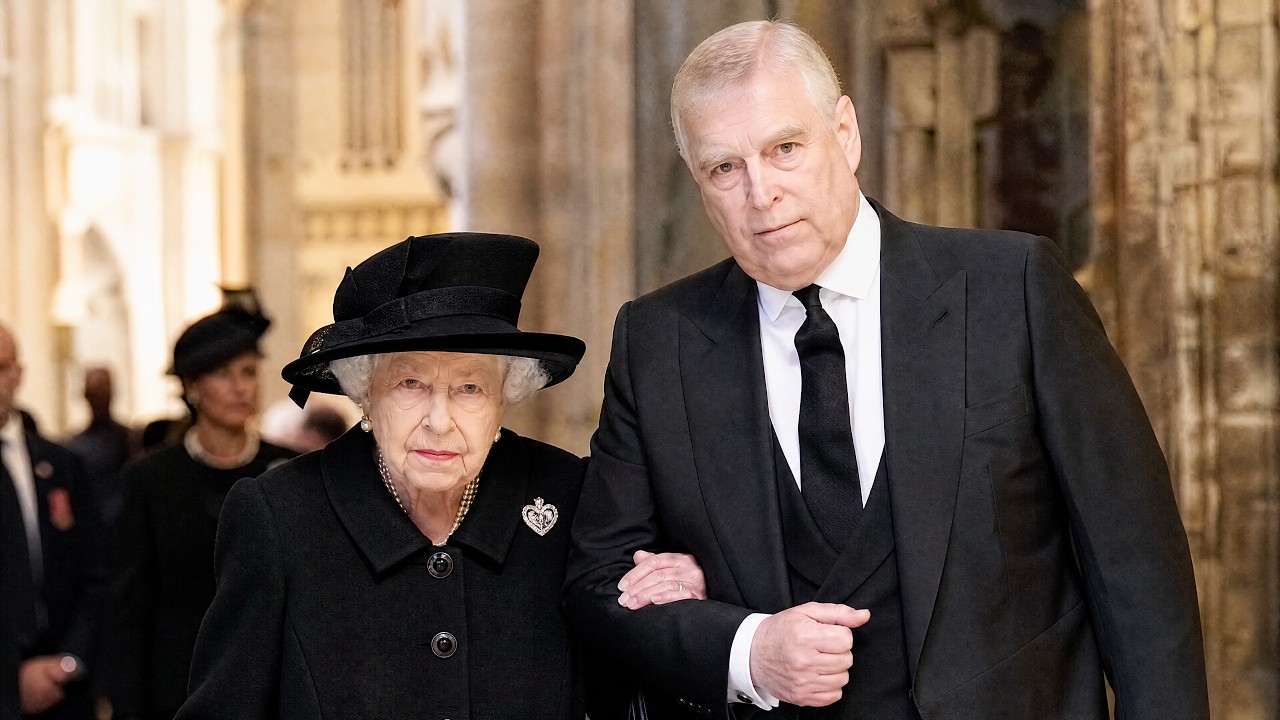
But if true, it was the clearest possible example of the shelter that defined his entire life. The clearest evidence came on 29 March 2022. At a service of thanksgiving for her late husband at Westminster Abbey, the ninety-five-year-old queen, frail and struggling to walk, entered the abbey leaning on Andrew’s arm. It was his first public appearance since the settlement.
The institution had spent the winter carefully distancing itself from him. Now, in the most visible setting the year could offer, the queen reached across that distance and pulled him toward her, physically, before every camera in the building. It was a public shield, raised where no one could ignore it. She had issued no statement, made no announcement.
She simply let the country watch who she chose to support her. The mother had made her decision for sixty years, and nothing had changed her mind. The shelter had a lifespan measured in months. On 8 September 2022, at Balmoral, the queen died.
The reign of seventy years ended, and with it went the only protection Andrew had truly possessed. The institution he belonged to now had a new head: his brother, Charles. The new king had spent his entire adult life planning for a smaller, more efficient monarchy with fewer people drawing on public money. Within that vision there was no comfortable place for a brother who had become the most damaging figure the family had carried.
Charles did not hate his brother. He was calculating. The queen had been free to love without accounting because that is what mothers do. A king, by contrast, is a trustee who must hand on something intact.
In that calculation, Andrew was a problem to be solved. The dismantling over the following three years was gradual and patient. The roles were not restored. The funding was withdrawn.
The police protection, the circle of officers that had surrounded him his entire adult life, was removed. The guard at the gate, the daily tangible symbol of belonging, was simply sent away. Then came the battle over Royal Lodge. Charles wanted his brother gone.
Andrew refused to leave. He held one real card: a long lease, a legal document with genuine terms, and millions of pounds of his own money reportedly spent on the property. For a time the lease was the wall he hid behind, the only part of his royal life that was not a revocable favour. But the wall was only as strong as the ground beneath it, and the ground had shifted on the day his mother died.
On 17 October 2025, Andrew announced he would stop using his titles, saying the continued accusations against him had become a distraction for the king and the royal family. Less than two weeks later, the crown made the renunciation official. On 30 October, Buckingham Palace announced that the king had begun formal proceedings to remove his brother’s title, style, and honours. A full legal stripping of a peerage historically requires an act of parliament, which is why the king began the official process rather than simply erasing the dukedom by decree.
In daily use, Andrew Mountbatten-Windsor lost his royal style. The palace statement also directed the crown’s sympathy not to the fallen prince but to victims and survivors of abuse, and it noted that Andrew continued to deny the allegations. The institution was no longer protecting him at all. The final turn came on 19 February 2026.
Police arrived to arrest Andrew Mountbatten-Windsor on suspicion of misconduct in public office. He was taken in for questioning, and properties linked to him in Norfolk and Berkshire were searched. The suspected misconduct reportedly concerned his years as trade envoy, the decade from 2001 to 2011, and specifically alleged correspondence suggesting the sharing of sensitive material connected to that public role with Jeffrey Epstein. It was an allegation, unproven, and he had not been charged.
He remained presumed innocent. But the arrest revealed more clearly than any conviction could what had already been lost. The man who had once been protected by the full machinery of the crown, by courtiers and lawyers and a mother who would spend her own resources to ease his burdens, faced the police as a private citizen, stripped of status and protection, answering questions alone. Compare the two images.
The ninety-five-year-old queen leaning on her son’s arm in the abbey, choosing him before the world with her last remaining strength. And the ordinary man in a house on his brother’s estate, answering the door to police with no one standing between him and the law. The same man, only years apart, judged twice by whoever happened to be wearing the authority. Royal favour is not property.
It is permission. It lasts as long as the giver chooses to sustain it, and no longer. Andrew never owned his status. He borrowed it from a mother who could not refuse him anything while she lived.
He thought the loan was his, as a man believes a warm room is his if he has never been asked to leave it. When the lender died, the loan was called in, and underneath it there was almost nothing he had built himself. The indulged child who was given everything was left with nothing of his own making.
The mother who had kept the door open for sixty years was gone, and the brother who inherited the crown chose not to hold it open any longer.