It is just past noon on January 22, 1879. The plain beneath Isandlwana mountain is trembling, not from wind or artillery, but from the feet of 15,000 Zulu warriors pouring down from the hills in a formation their grandfathers used to hunt buffalo. Two enormous horns sweep wide across the grassland, closing like a jaw around a shrinking rectangle of red coats and smoke. Inside that jaw are 1,300 British soldiers.
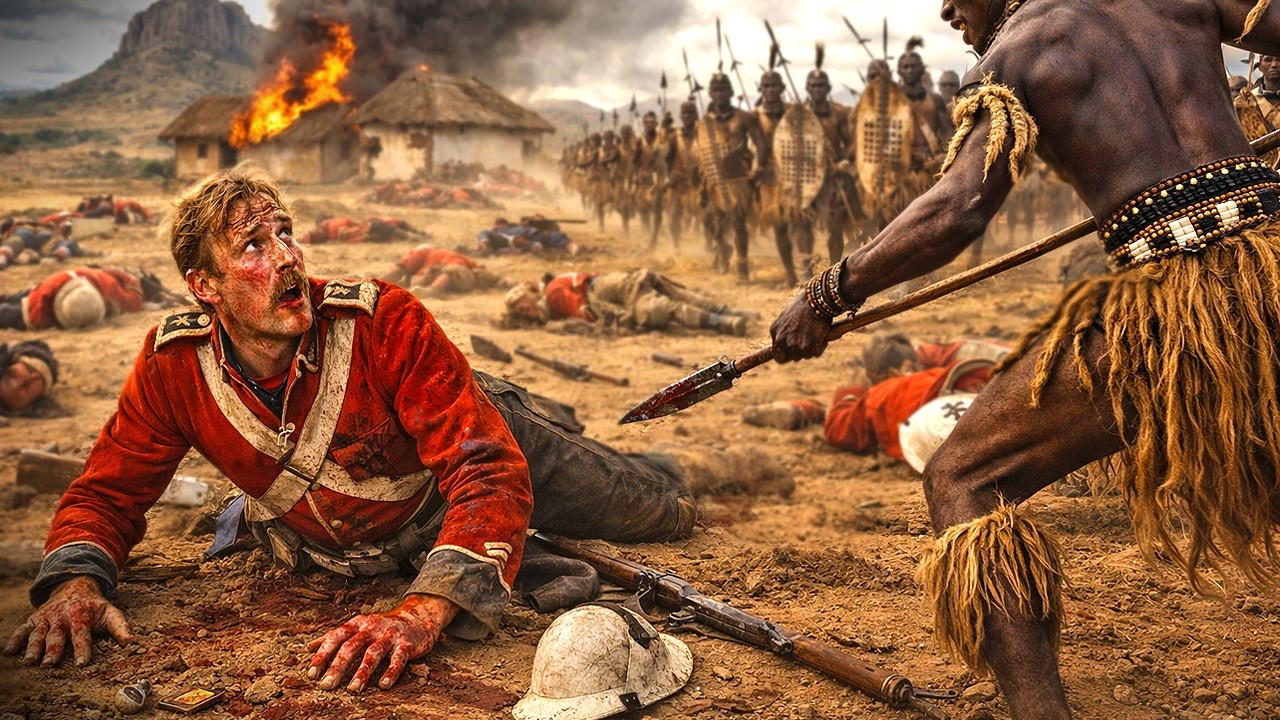
Within roughly ninety minutes, nearly every one of them will be dead. Fifty-two officers lie in the grass beneath a South African summer sun, more than Britain lost during the three main battles of Waterloo combined, and no one will come to bury them. The popular version of Isandlwana is simple: the Zulus charged, the British were overwhelmed, and that was the end. The final minutes were something else entirely.
Soldiers who ran out of bullets did not run. They threw down their rifles, drew their pistols, fired until those were empty, and then drew their knives. When the British returned to the camp hours later, they did not find chaos. They found geometry.
Bodies arranged in tight clusters, each man facing outward, shoulder to shoulder. The dead had organized themselves. Two days before the killing, the British central column established its camp on the open plain below Isandlwana. It was supposed to be temporary, a staging ground before the next advance into Zululand as part of a three-pronged invasion designed by Lord Chelmsford to crush King Cetshwayo’s kingdom in weeks.
No one entrenched. No one circled the wagons into a defensive laager, because no one believed they would need to. That was the first mistake. Frederick Thesiger, 2nd Baron Chelmsford, was 51 years old, a career officer from a distinguished family who had fought in Abyssinia and against the Xhosa, but had never faced a disciplined native army on open ground at this scale.
His central conviction was that the Zulu would never dare attack a British position head-on. On the morning of January 22nd, Chelmsford acted on that conviction. He took roughly half the column, the stronger half, and marched east to find the main Zulu army his scouts had reported in that direction. He left behind approximately 1,300 men under Colonel Henry Pulleine, an administrator who had never led troops in a significant engagement.
Pulleine was competent and respected, but untested in the way that matters when twenty thousand men are coming to kill you. On the other side of the hills, twenty thousand Zulu warriors sat in almost perfect silence in a valley beyond the plateau. They were not savages. They were regiments, the uMbonambi, the Khandampemvu, the NoKhenke, the Gobamakhosi, each with its own commanders, traditions, and battle songs.
They carried assegais and cowhide shields. Some carried rifles taken from earlier skirmishes, though most did not know how to aim them well. They were disciplined, patient, and under orders not to attack until the signal came. At approximately seven that morning, Colonel Anthony Durnford rode into the camp with a column of mounted troops, mostly Basuto horsemen, and a rocket battery under Major Russell.
Durnford was 47, a royal engineer with a reputation for boldness. He had lost the use of his left arm in a previous engagement, a wound that had nearly ended his career but had instead sharpened something in him. Mounted patrols had reported Zulu forces on the plateau above the camp as early as six in the morning. Durnford studied the reports and concluded the Zulus were massing on the plateau to drive a wedge between Isandlwana and Chelmsford’s departed column, to cut the British force in half.
It was a reasonable analysis. It was also wrong. The main Zulu army was not on the plateau. It was hidden in the valley beyond it.
Durnford met with Pulleine. The conversation between them is not recorded verbatim, but its outcome is. Durnford, the senior and more experienced officer, outlined his flanking theory. Pulleine listened and accepted Durnford’s calm analysis with some relief.
Not confidence, relief, the feeling of a man who wanted someone else to be right because the alternative was too large to face alone. Pulleine gave the order to stand down, keep equipment on, and prepare for the planned camp move. The men relaxed slightly. Some sat, some ate.
The machine of the camp continued to turn in its steady, orderly way. At approximately eleven, Durnford took his mounted force and rode out of the camp to intercept the flanking threat he believed was the real danger. He took the rocket battery with him. He was riding toward his own death.
He just did not know it yet. By late morning, the camp at Isandlwana was quieter than it had been at dawn. The mounted troops were gone. Chelmsford was fifteen miles east and moving farther away.
Pulleine had roughly 1,300 men, six companies of the first and second battalions of the 24th Regiment of Foot, two artillery pieces, and several companies of the Natal Native Contingent. They were strung out across an open plain with a mountain at their back and nothing between them and the horizon but grass. The first shots came just after noon, not from the direction anyone expected. Scouts, possibly Durnford’s vedettes, possibly men from the Natal Native Contingent, crested the plateau above the camp and stumbled upon the main Zulu impi hidden in the valley beyond, twenty thousand warriors sitting in regimental formation.
The discovery forced the Zulu hand. The impi had not planned to attack that day, but surprise was gone, and so the regiments rose, all of them, at once, and began to move. Commandant Hamilton-Browne, observing from a distance, watched the Zulu deployment with a mixture of awe and horror. He later wrote, “At about 12:00 a.
m. , the Zulus, who had apparently fallen back behind the hills, again showed in large numbers coming down into the plain with great boldness. And our guns and rifles were pretty busy for some time. It was a marvelous sight, line upon line of men in slightly extended order, one behind the other, firing as they came along.
” Marvelous, not horrifying, because what he was watching was not a mob running downhill. It was a military machine executing a formation their nation had perfected over generations. The formation was called the Impondo Zankomo, the horns of the buffalo. It was not a metaphor, it was a doctrine.
The chest, the center of the impi, advanced directly toward the enemy, drawing attention and fire. The two horns swept wide to the left and right, arcing around the flanks to encircle the target completely. The loins, a reserve force, sat behind the chest, facing away from the battle so they would not become excited and charge prematurely. This was engineering, the same formation they had used to hunt buffalo for centuries, now turned against men in red coats.
Durnford’s column, miles from the camp, was the first to feel the full weight. His mounted Basutos and Russell’s rocket battery had ridden out toward the plateau to intercept a flanking threat that was, it turned out, the entire Zulu army. In the broken ground of the dongas, dry ravines cutting across the plain, Russell’s rocket battery was caught. The rockets were slow to assemble, impossible to aim accurately, and useless at close range.
The Zulus poured into the dongas from above. Hamilton-Browne watched from the camp’s perimeter as the rocket battery fired once, twice, and then suddenly stopped. He wrote, “The rocket battery was firing and suddenly it ceased and presently we saw the remnants of Durnford’s force, mostly mounted Basutos, galloping back to the right of our position. Russell and his rocket battery was caught and none escaped to tell the tale.
”
Back at the camp, the British firing line stretched across the plain, companies of the 24th in extended order with the native contingent on the flanks. Martini-Henry rifles cracked in volleys that cut down Zulus by the score. For a brief window, it seemed like discipline might hold. The range was closing, four hundred yards, three hundred, two hundred, but the volleys were working.
The Zulus did not stop. A warrior from the uMbonambi regiment described the moment when the soldiers in the donga saw the Kandandlovu and uMpenvu getting behind them. They retreated toward the camp, firing all the time. As they retreated, we followed them.
Then the uNokenke and uNodwengu regiments, which had formed the right horn, joined with the uNgobamakhosi on the neck, the one gap in the encirclement, the only way out. It had just closed. The sustained volley fire, the one thing keeping the Zulu advance at bay, began to falter. Accounts differ on why.
Some say the ammunition supply was simply too slow. Others say the problem was distribution, runners having to cross open ground under fire to reach the wagons behind the firing line. Whatever the cause, the rifles grew hot and the ammunition grew thin. The volley fire died, not all at once, but faded, one section then another.
Into that terrible thinning of sound, the Zulu masses collided with the firing line. On the left flank, the Natal Native Contingent, African auxiliaries fighting for the British, many armed only with spears and old muskets, were the first to crack. They ran, and they opened a gap in the line that nothing could fill. Through that gap, the left horn of the impi flooded into the camp.
Men who were firing forward now had enemies behind them. The ordered ranks of the 24th began to contract, squeezed inward toward the tents and the ammunition wagons, toward the center of a camp that had become a killing ground. The noise shifted. The crack of rifles was replaced by something older, the sound of metal on flesh, of shouting in two languages, of men who could not see more than ten feet through the smoke and dust.
The British firing line held for perhaps twenty minutes. When it broke, the transformation from battle to massacre took less than five minutes. Small groups of the 24th did what their training demanded. They clustered, forming knots of resistance, ten men here, twenty there, backs to a wagon, faces to the advancing Zulu line.
The ammunition wagons became the epicenters of the final resistance. Men who could still fire converged on the wagons, but the crates were screwed shut. Quartermasters struggled with the lids while men died around them. Near the ammunition wagons, an eyewitness described one of the last organized stands.
A group of perhaps thirty men of the 24th formed a rough square. They fired steadily, each volley cutting down a score of Zulus, but the enemy closed. Thirty men, firing steadily, cutting down twenty men with each volley, and still the enemy closed. That is the mathematics of Isandlwana.
You could kill twenty men with every shot, and it would not matter, because behind those twenty were another hundred, and behind them another thousand. When the ammunition ran out, not gradually but all at once, in clusters, men reaching into cartridge pouches and finding nothing, the sound of the Martini-Henrys stopped. And in that silence, the Zulu warriors who had been pressing forward into the teeth of those volleys felt the pressure release, and they surged. What happened next followed a sequence Zulu veterans would later describe with precision.
The soldiers did not run. They threw down their rifles and drew their pistols. Officers and non-commissioned officers fired at point-blank range into the faces of men close enough to touch. When the pistols were empty, they drew their knives.
A Zulu warrior, his words preserved through translation, described this final phase. The soldiers gave a shout and charged down upon us. There was an induna in front of the soldiers with a long flashing sword, which he whirled round his head as he ran. They threw down their guns when the ammunition was done, and then commenced with their pistols, which they fired as long as their ammunition lasted.
And then they formed a line shoulder-to-shoulder and back-to-back, and fought with their knives. These men, with no ammunition, no artillery, no hope of rescue, did not scatter. They arranged themselves into a formation and fought with knives against warriors carrying short stabbing spears. That is not a military decision.
It is the refusal to die alone. The knife fight lasted minutes. Bayonets against assegais. Hunting knives against iklwa, short stabbing spears named for the sucking sound they made when withdrawn from a wound.
The square shrank. Ten men, five, two men standing back-to-back surrounded by a circle of warriors. Then one. Then none.
Then silence. Not everyone died in the camp. As the encirclement closed, a handful of mounted men made for the neck before the right horn sealed it. Among them was Lieutenant Horace Smith-Dorrien, 21 years old, a transport officer who had no business being in a battle at all.
He found a horse and he rode. Behind him, the camp was a chaos of smoke and sound. Ahead was the Buffalo River, chest-deep, fast-flowing, seven miles of broken country away. The Zulu pursuit was relentless.
One man who made it across the river later described looking back. The camp was overrun. Smoke rose from burning wagons. The ground was littered with bodies.
The mountain loomed behind it all, cruelly calm. Approximately sixty white men escaped Isandlwana, but almost all of them left before the battle began. The men who were still in the camp when the horns closed, the companies of the 24th, the gunners, the native auxiliaries, the quartermasters and bandsmen and orderlies, almost none survived. This was not a defeat.
This was an erasure. Fifteen miles to the east, Lord Chelmsford had no idea what had happened. Hours later, his column marched back toward Isandlwana. They had found no Zulu army to the east because the Zulu army had been behind them the entire time.
The first sign was the silence. No bugles, no normal campfire smoke, only the wrong kind of smoke, black and acrid from burning wagons. The camp had been completely destroyed. And across the plain lay the dead, British red coats, native auxiliaries, and Zulu warriors, hundreds of them.
Major Francis Grenfell of the 60th Rifles, who had known many of the officers of the 24th personally, gave testimony that captures the immediate grief. All my dear old friends of the last 4 years dead and gone, and we have not even been able to bury them. Officers and men behaved splendidly, dying back-to-back, and at the last rallying round the colors, not a man of the regiment attempted to escape till all was lost. The discovery that haunted the returning soldiers most was not the scale of death, but its order.
Bodies were found in groups, clustered in tight formations that clearly represented last stands. One officer wrote, “One of the most harrowing scenes I witnessed was a group of men who had clearly tried to form a square. They lay in a tight cluster, each man facing outward. The dead were stripped of their clothing, faces were hacked, arms severed, but the formations held.
Even in death, you could see the shape of the squares. You could see where the line had been. The dead had organized themselves, and the dead had held. ”
Over 1,300 British and colonial troops were killed, 52 officers dead, more than were lost during the three main battles of the Waterloo campaign combined.
The Zulu side paid an appalling price. Approximately 3,000 warriors lay dead on the plain, another 5,000 wounded, many mortally. Total Zulu casualties approached 8,000 out of a force of perhaps 20,000. When word of the victory reached King Cetshwayo, he did not celebrate.
He said six words that would define the legacy of Isandlwana from the Zulu perspective: an assegai has been thrust into the belly of the nation. The British lost a battle. The Zulu won and lost a kingdom. The news reached London eleven days later, on February 11th, 1879.
The reaction was shock, then fury, then myth-making. The British public could not accept that a modern, disciplined, technologically superior army had been annihilated by warriors carrying spears. Blame was assigned. Durnford, conveniently dead, became the scapegoat.
Pulleine’s stand down was buried under Durnford’s failure. Chelmsford, the man who had split his force and marched away from the battle, largely escaped censure. The myth obscured the Zulu achievement. The horns of the buffalo was not a primitive tactic.
It was a sophisticated encirclement maneuver executed with discipline that European generals would have recognized and admired if they had been willing to look. The Zulu regiments maintained formation under sustained rifle fire, coordinated the closing of the horns across miles of broken terrain, absorbed catastrophic casualties, and continued to advance. This was not a mob overrunning a camp. This was a military victory by a professional army.
And the British camp was not fortified because Chelmsford did not order it. Standard military doctrine of the era called for circling the wagons into a defensive laager when operating in hostile territory. Men who knew the ground and knew the enemy had warned him. He chose not to do it, reportedly because he believed it would delay the planned advance.
That decision, not Zulu bravery, not ammunition failures, not Durnford’s ride, is the reason 1,300 men died beneath Isandlwana mountain. Today, the battlefield is marked by white cairns, stone markers placed where clusters of bodies were found. They dot the plain in the same groupings the dead were discovered in, tight clusters near wagon positions, scattered lines along the retreat path, a dense concentration near the neck. The mountain still looms above.
The final minutes at Isandlwana were more terrifying than the legend because of what the men in those final squares knew. They knew no one was coming. They knew the ammunition was gone. They knew the horns had closed, and they formed up anyway, shoulder to shoulder, back to back, knives drawn, facing outward, waiting for the end together.
Isandlwana was not the end of the Anglo-Zulu War. The British returned in greater numbers with greater fury. Lieutenant Smith-Dorrien, the 21-year-old transport officer who fled across the Buffalo River, survived to become a general in the First World War. But nothing that came after erased what happened that January morning.
An empire learned it could bleed. A nation learned what victory costs. And on a quiet plain in Zululand, the dead held their formation.