Isaac Merritt Singer died on the Devon coast on July 23, 1875, inside a hundred-room mansion that was still wrapped in scaffolding. Workers were still on site, the last rooms unfinished, and the man whose name sat on sewing machines in half the parlors of America left behind an estate the courts would soon value at more than fourteen million dollars. He did not leave it to one grieving widow and a house full of children. He left it to five families, roughly a dozen sons and daughters born to five different women, most of whom had no idea the others existed, and all of whom now stared at the same enormous pile of money.
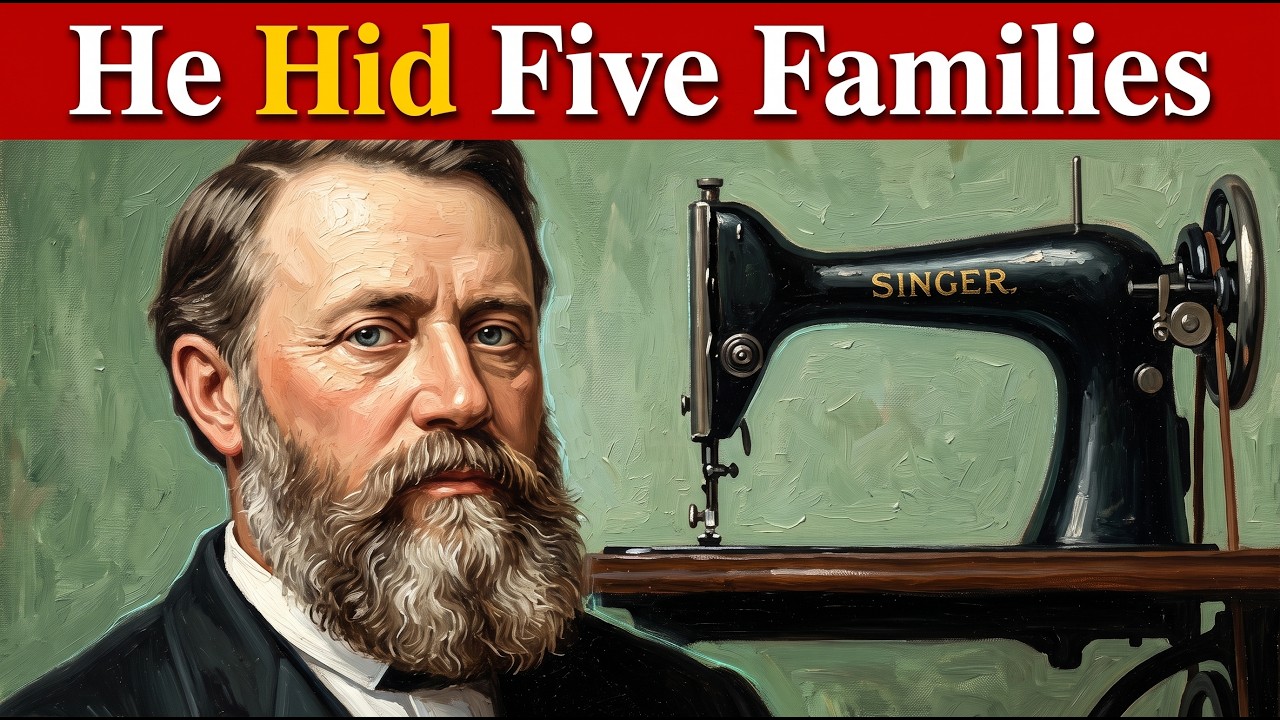
Buried inside the will was a detail that would turn grief into war, because the document named his final wife and her children in a way that made one of his other marriages appear never to have happened at all. The simplest question was the one his own children could not answer: how could a man maintain several separate households in a single city for years without any of them discovering the others? He did it with names, and the names were not his own. Then there was the will itself, seven pages long, with one son reduced to five hundred dollars while millions flowed toward the only wife the rest of the family refused to accept.
And there was the courtroom in White Plains, New York, where the abandoned wife stood before a judge and asked him to rule that the young widow had never been a wife at all, and that her six children were illegitimate. Most people knew the machine before they knew the man. The black-and-gold treadle in grandmother’s front room, the cast-iron cabinet that outlived everyone who ever sat down to work at it. That object carried his name into more homes than almost anything else in the century.
It sat in the corner where the family gathered, close to their evenings, their mending, their small economies, with an intimacy no piece of furniture could match. The man who put it there had no such corner of his own, because he had four or five of them, and none ever held the whole of him. When he died, the life he had kept hidden came out into a public courtroom for anyone to read. The beginning had nothing to do with family.
Biographers described a huge, restless man who spent his youth chasing the theater and tinkering with inventions that never earned him a dollar long before he ever touched a sewing machine. He did not invent that machine; working models already existed before his hands laid hold of one. What Singer did was harder to notice and far more valuable than any patent. He figured out how to sell the thing, and in doing so, he changed the way the whole country shopped.
The machine did not make the fortune. The way the machine was sold made it. The Singer Company offered its sewing machine on an installment plan at a time when nobody sold anything that way. An ordinary seamstress who could never pay the full price at once could take the machine home for a few dollars a month and pay the rest from the money she earned at her own table.
The company backed every sale with after-sales service, so no woman was left alone with a broken machine and a broken promise. It trained agents to demonstrate the machine in shop windows and front parlors, turning the sale into a small performance the family gathered around. Advertising ran until the word Singer stopped being a family name and became the name of the product itself. Machines spread by the hundreds of thousands, then by the millions, and the money came back faster than any man could spend it.
There were kitchens in rural towns that had never owned any manufactured good of real value; now they had a Singer in the corner like a small altar to the modern age. The name meant reliability. It meant a family that could clothe itself and a daughter who could earn a wage. All that trust belonged to the machine.
The man who put his name on it lived a life those homes would never have allowed through their front doors. While the company poured fortune into his hands, Singer was living a second, third, and fourth life at once, inside the same city. He kept separate families across New York, women who each believed she was the only one who truly had him. One common account tallies four families, all living in Manhattan, with sixteen children among them, though the exact figure shifts from source to source.
What nobody disputes is the shape of the thing. He ran parallel households openly, in one city, and kept each one ignorant of the others. Over his lifetime, Singer fathered at least twenty-two children who lived to be counted, some sources say closer to twenty-four, by five different women. Yet in all his life, he was married only twice.
The other three women lived as his wives, ran his houses, and raised his children believing they were married to him, while in the eyes of the law they were nothing of the sort. The structure held together by one cold and simple trick. Singer did not use his real name. With one woman, Mary McGonagal, he lived as Mr.
Matthews, and her children grew up as the Matthews family, never told their true origin. With another, Mary Eastwood Walters, the child she bore carried the surname Merritt. Each family was built behind a different name, so that a man could walk out one door as Singer and enter another as someone else on the same streets, in the same years, without any wife hearing the one word that would have given it all away. It required immense discipline: keeping the stories consistent, never letting names overlap, accounting for gifts and absences.
A second and third complete life managed like a set of separate ledgers. It took nerve, money, and a total willingness to lie to the people closest to him, and he had all three in inexhaustible supply. For a long time, the arrangement held. Then it collapsed, in the most public way such a thing could collapse.
The woman at the center of the ruin was Mary Ann Sponsler, who stayed with Singer longer than any of the others and bore him roughly ten children. For years she believed she was his wife in every sense, with a home and a decade of children to prove it. The moment it all fell apart, according to the biographers’ accounts, was almost absurd in its simplicity: she saw Isaac in the street, openly driving a carriage with another of his mistresses. Whatever her true motive, what she did next is documented in the records.
In 1862, she went to the authorities and had him arrested on a charge of bigamy. To move against him, she had to stand in public and admit that the family everyone assumed was solid had been a fiction all along. The scandal did to him what scandal does to a man who spent a fortune turning his name into a household word; it turned the name against him. Released on bail, in the middle of a scandal that filled New York’s newspapers, Singer did not stay to face the wreckage.
That same year, he sailed to Europe, leaving the tangle of his New York families and the criminal charge behind the Atlantic. He never answered the accusation, never stayed to repair things, never asked for the children he left behind. He put an ocean between himself and the wreckage and started over the way he always had. Europe gave him a fresh page, and he took it without looking back.
In England, then in France, Singer, past fifty and richer than ever, began the whole project again. He met a young Frenchwoman named Isabelle Eugénie Boyer, much younger than himself, and in 1863 he married her. But the marriage record did not carry the name Singer. He married her under an alias: Somerville.
What the marriage gave Isabelle was a place among the wealthy, and what it gave Singer was his newest and final beginning, the one he would choose to write into his will above all the others. With Isabelle he fathered six more children, the youngest of all his families. In the early 1870s, Singer bought land at Paignton on the Devon coast of southern England and hired an architect, George Sneath Bridgman, to build something enormous. He wanted the grandest private house in the region, and cost did not concern him.
The foundation stone was laid in May 1873. What rose was a mansion of about a hundred rooms, a private palace for a family scattered across two continents. The family began moving into finished rooms as soon as they opened, and a reception was held in the house just nine days before Singer died. He never lived to see it completed.
He died in July 1875 while work still went on around him, the last rooms unfinished, the scaffolding still standing, and the house was completed after his death by the family he left behind. One of his sons later demolished much of it and rebuilt it even more grandly as the estate known as Oldway Mansion. The will that reached the surrogate’s court in White Plains was no simple document. It ran to seven pages of fine paper, written five years before his death in Paris on July 16, 1870, and it specified twenty-five separate bequests.
The telegram that spread the news described the matter in a single sharp line: the inheritance included all his living sons but was limited to only one of his five former wives. That phrasing came from the newspapers, and it simplified a stranger thing than it appeared. Singer had been legally married only twice. The women the papers called former wives were wives in every sense except the one that mattered in a courtroom.
The will gathered them all, and all their children, into one list ordered by money. One son from that list emerged with almost nothing. His son William, from the first marriage, was left five hundred dollars, and the smallness of the figure was no clerical error. William had sided with his mother against his father, and the report noted he was well off anyway, already holding a position inside the Singer Manufacturing Company.
The business itself provided for him; the will did not need to. Now set the shares side by side as the will laid them out, and the shape of the coming fight becomes clear. The two New York women who had borne Singer most of his children, the hidden families he had managed for years under assumed names, were allotted roughly one million seven hundred and fifty thousand dollars between them. Isabelle, the final wife, and her six children received by far the largest share: nearly ten million dollars for her branch, including a life interest in an English estate valued at about four million, roughly seven hundred thousand in American money in her own name, and more than five million collected for her children.
More than half of that vast fortune went to the youngest family, the one the older families had never been allowed to know existed. The clearest single figure in the estate tells the whole story: one son from the first marriage received five hundred dollars; the final wife’s branch received most of ten million. The war began the moment the will was read aloud. Standing against it was Mary Ann Sponsler, the same woman who had informed on Singer for bigamy years before.
She did not come to argue about the size of her share. She came to bring down the will entirely. She claimed she was the lawful widow, the only legal Mrs. Singer, and that everything the document gave to Isabelle rested on a marriage with no legal standing.
Her argument targeted that marriage directly: Isabelle had never been a lawful wife of the testator and therefore deserved no widow’s inheritance. The children Isabelle bore him were not legitimate children, she argued, and the will itself could not stand because it had been improperly executed, because Singer was not of sound mind when he signed it and others had coerced him. Every door she could knock on, she knocked on. Behind all the doors was the same demand: annul the final marriage, and the fortune returns to her.
In the end, the courts recognized Isabelle as his lawful widow. Her marriage stood. Her children kept their name and standing, and the will that had been accused of stealing everything held together. The great objection that Isabelle was never lawfully married failed.
But the challengers were not defeated in open court, and that is the part that is easy to misunderstand. They were not beaten on the merits. They were bought. Mary Ann Sponsler, who had waged war to besiege Isabelle and her children, eventually accepted a payment of seventy-five thousand dollars and withdrew every claim she had ever made.
The first family settled as well: according to American Heritage, William, his sister Lillian, and the first wife Catherine Maria Hale received an additional one hundred fifty thousand dollars, paid by the more fortunate heirs to end the whole matter. No one from the losing side stood before a judge to hear a ruling that they had lost. They accepted the settlement and went home, and the bulk of the fortune stayed exactly where a dead man’s pen had placed it. What happened to the money afterward is the strangest part of the whole story, because the same fortune, divided among the same bloodline, produced nearly opposite lives.
Two of Isabelle’s children show this split better than any other pair in the family. Winnaretta Singer, born in 1865, took her share and turned it into one of the great institutions of modern music patronage. Married to a French aristocrat, she became the Princesse de Polignac and invested Singer money in composers who were reshaping European music: Stravinsky, Ravel, Satie, and others, opening her salon to works the concert halls were not yet ready to hear. In 1928 she founded the Singer-Polignac Foundation, which still operates today.
Her brother Paris Singer took the same inheritance in a different direction. He rebuilt the Devon house as a replica of Versailles, the version the world knew as Oldway Mansion, funded the dancer Isadora Duncan, and crossed the Atlantic to pour money into Florida, developing vast stretches of Palm Beach and founding the Everglades Club there. One of his Florida projects, a development on Monan’s Island, was described in his New York Times obituary as unsuccessful. The final turn was the one the whole story had been moving toward from the first minute.
The person the second family went to court to erase, the wife they swore in a legal filing was not a wife at all, was the only one still standing when the fight ended. Isabelle did more than survive the attack on her marriage. In the end she was recognized as the lawful widow of one of the richest men in America, granted a life interest in the great English estate and about seven hundred thousand dollars in her own name, with the principal held in trust for her children. She did not take the whole fortune, and she never asked for it.
What she kept was her name, her status as his widow, and an income sufficient for the rest of her life. The women who came first, who kept his houses and raised his children under his assumed names, were left with the shares the will gave them, and some accepted cash settlements to end the fight. The wife who came last, the one they tried to prove was no wife at all, kept the name Singer and carried it into the aristocracy of France through her daughter. A man who spent his entire life building families in the dark, so that none of them could ever possess him fully at once, died and left the dark to finish the work he began.
The only person he could not erase was the wife he had married under an assumed name while making his way out of the ruins of his first four marriages.