On the evening of May 8th, 2010, Betty White walked onto the stage of Studio 8H in New York and faced one of the hardest tests live television could offer. At eighty-eight, she was the oldest person ever to host Saturday Night Live, and a campaign on a social network she barely used had carried her there. Hundreds of thousands of people who knew her from different decades wanted to see what would happen when a woman from television’s earliest days entered one of its fastest, least forgiving live hours. She had resisted the invitation more than once.
She knew what live broadcasting could do to a performer who waited for certainty. Yet when the show began, she did not behave like a visiting monument. She entered the rhythm, listened to younger actors, accepted outrageous material, and let the audience discover that age had not made her cautious. The oldest host in the program’s history had arrived because she still understood the oldest rule of live performance: pay attention to what is happening now.
That night looked like a comeback. In truth, it was a return to first principles. For decades, White had remained present while formats, casts, audiences, and technology changed around her. The question was not simply how she lasted.
It was how a performer formed in television’s improvised childhood became someone each new generation believed it had discovered for itself. Betty Marion White was born on January 17th, 1922, in Oak Park, Illinois. When she was still young, the family moved to California and settled in the Los Angeles area. Her first ambition had nothing to do with cameras.
She loved animals and the outdoors and imagined becoming a forest ranger, but the United States Forest Service did not accept women for that work. The closed door redirected her attention toward another appetite she had already begun to feel: the pleasure of performing and the immediate connection between a story and an audience. In 1939, the year she graduated from Beverly Hills High School, White appeared in an experimental television broadcast, singing selections from The Merry Widow with a classmate. Few people could have seen it.
There was no national audience waiting, no career machinery ready to turn the appearance into a contract. But the moment gave her an early glimpse of television’s strange intimacy. The performer did not project toward the back row of a theater. She spoke to a lens and somehow entered a room.
The outbreak of World War II interrupted the ordinary beginning she might have expected. White joined the American Women’s Voluntary Services, driving supplies in the Los Angeles area. Her surviving service bag later entered the collection of the Smithsonian’s National Museum of American History. The war also shaped her first marriage.
In 1945, she married Dick Barker, a United States Army pilot. They tried life on a chicken farm in Ohio, far from the work she wanted. The marriage ended within months. She returned to Los Angeles and married talent agent Lane Allen in 1947.
Allen wanted a more conventional domestic future. White wanted a career. The marriage ended in 1949. Two divorces before the age of thirty did not fit the cheerful image audiences would later associate with her.
Yet they revealed an early firmness: she could compromise on comfort, but she would not surrender the work. Work, however, was not waiting politely. White took small radio jobs, read commercials, supplied voices, and accepted chances that offered experience rather than status. In 1949, the opening that changed everything arrived.
Los Angeles station KLAC hired her for local television, and she joined disc jockey Al Jarvis on Hollywood on Television. The program was not a polished half hour protected by careful editing. It was a daily live broadcast that could stretch for hours. White later remembered periods when she and Jarvis were on the air for five and a half hours a day, six days a week.
Early television disappeared as it happened; much of it was not recorded. What remained was the performer it built. White learned to fill time without appearing merely to fill time. There was nowhere to hide a weak instinct.
The camera stayed on. Years later, speaking at Emerson College, she offered advice that sounded less like philosophy than a professional method: “Taste it for what it is now. ”
Her partnership with Jarvis also placed her in a visible role at a time when women in television were often treated as ornaments. In 1952, White received a local Emmy as the most outstanding female personality on Los Angeles television.
The more important development was happening behind the camera. With producer Don Fedderson and writer George Tibbles, she helped form Bandy Productions. The company developed a recurring domestic comedy sketch from Hollywood on Television into a series called Life with Elizabeth. White was not merely the star.
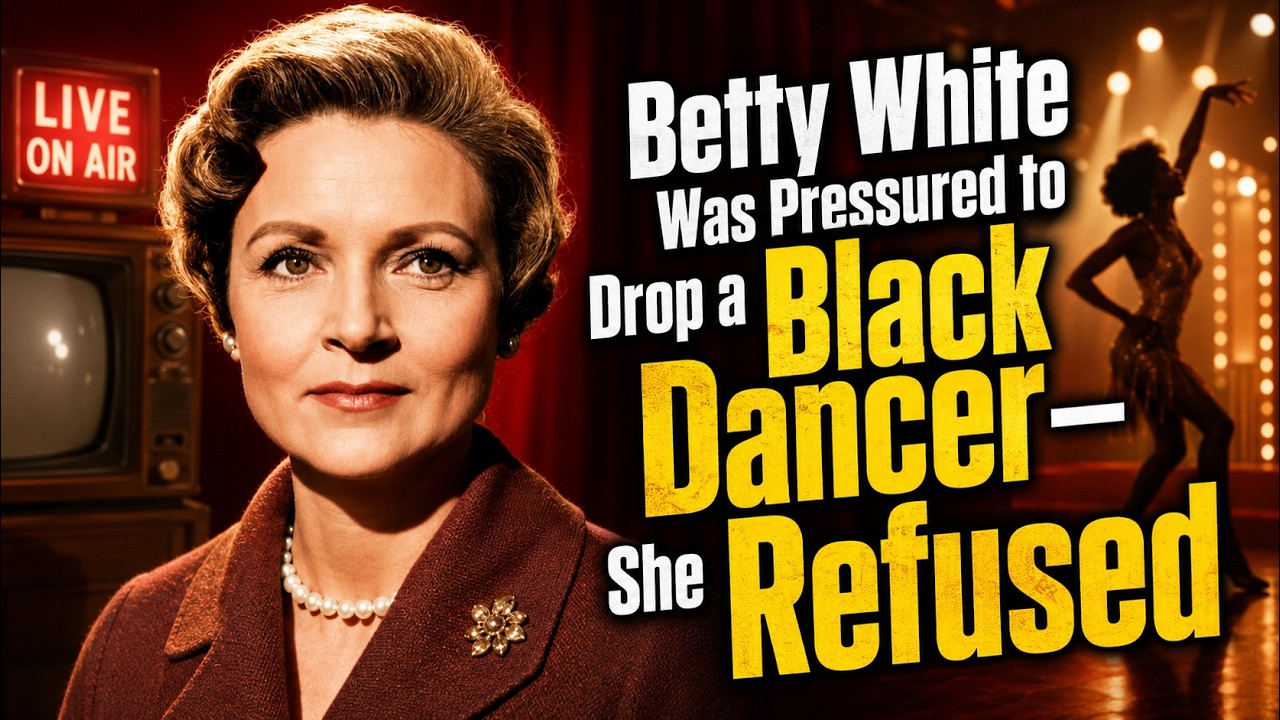
She was involved in production and creative decisions, making her one of the first women in television to exercise control on both sides of the camera. The Television Academy later recognized her as the first woman to produce a situation comedy. In 1954, she became the host of a daytime program carrying her own name. The Betty White Show also gave regular exposure to Arthur Duncan, a young black tap dancer whose talent White admired.
His presence drew complaints from some stations and viewers in the segregated America of the 1950s. White’s answer was brief: “I’m sorry. Live with it. ” Duncan remained on the program.
He would remember the decision for the rest of his life, going on to a long career in dance and television, including decades on the Lawrence Welk Show. Her early programs also revealed the limits of being ahead of an industry that was still unstable. The Betty White Show ended. Life with Elizabeth completed its run.
White kept moving through local broadcasts, variety programs, parades, commercials, and guest appearances. She became a welcome guest on panel programs like What’s My Line and I’ve Got a Secret, where the best performers understood when to ask a useful question, when to tease, and when to let another player have the moment. White’s delight in games was genuine, but the format also displayed one of her central skills: she watched. In 1957, her sitcom Date with the Angels began, with White and Bill Williams as a young married couple.
The production changed direction under network pressure and added variety elements. White disliked the shift. The show ended, and another series bearing her name followed briefly. She could have read these cancellations as a verdict.
Instead, she accepted work across forms. When she was offered a chance to join NBC’s Today in New York, she declined because the job would have required leaving California. She preferred Los Angeles and did not believe every prestigious invitation had to be accepted. Then a game show altered both her career and her private life.
Password began on CBS in 1961, hosted by Allen Ludden, a widower raising three children. White first appeared as a guest. Their ease together was visible, but she resisted the idea of marriage. She had already tried twice, and her career was established.
Ludden kept asking. At one point, he wore a ring on a chain around his neck after she refused it. They married in Las Vegas on June 14th, 1963. White became stepmother to David, Martha, and Sara Ludden.
The marriage gave her something her earlier marriages had not: a partner who understood the work because he had his own. Viewers saw a marriage in which professional intelligence was part of the attraction. White’s love of animals had begun in childhood trips with her parents. In 1966, the new Los Angeles Zoo opened in Griffith Park, and White became associated with it and the greater Los Angeles Zoo Association, a relationship that would continue for more than half a century.
In 1971, she created and hosted The Pet Set, a syndicated program in which celebrities appeared with their animals. That same year, she joined the board of Morris Animal Foundation, an organization devoted to funding veterinary research. Over the decades, she would serve as a trustee, become board president, and sponsor more than thirty studies involving the health of dogs, cats, horses, and wildlife. At the start of the 1970s, however, her television identity seemed unsettled.
The next great turn began with people who knew her socially and therefore hesitated to hire her. Mary Tyler Moore and her husband, producer Grant Tinker, were friends of White and Ludden. When the writers of The Mary Tyler Moore Show created Sue Ann Nivens, the smiling host of a fictional cooking program called The Happy Homemaker, they needed an actress who could make sweetness feel dangerous. The production team kept describing someone like Betty White.
Eventually, they realized the obvious candidate was Betty White. Sue Ann presented herself as a model of domestic warmth while pursuing Phyllis Lindstrom’s husband. The comedy required a performer who could preserve the polished television surface while revealing appetite, calculation, and shameless confidence underneath it. White did not destroy the sweetness; she sharpened it.
Sue Ann could offer a recipe, insult a colleague, and pursue a man without changing the musical calm of her voice. The role expanded, and White became a recurring member of the ensemble. She won Emmy Awards for the performance in 1975 and 1976. At home, the 1970s were also the central years of her marriage.
White and Ludden worked separately and together, traveled, and maintained a household shaped by his children and their shared attachments. Ludden’s health eventually changed that balance. He was diagnosed with cancer. He died on June 9th, 1981, at the age of sixty-three.
The loss ended an eighteen-year marriage and removed the person White later described as the love of her life. She never married again. When asked why, she often answered with characteristic economy: “Once you have had the best, who needs the rest? ”
Work gave time a shape.
In 1983, White hosted Just Men, a daytime game show that lasted only a few months, but she won a daytime Emmy for outstanding game show host, the first woman to win in that category. She also became part of Carol Burnett’s comic world, appearing on The Carol Burnett Show and later on Mama’s Family as Ellen Jackson. By the middle of the 1980s, she was in her early sixties. Writer Susan Harris created The Golden Girls around four women sharing a home in Miami.
Dorothy was divorced, intelligent, and impatient. Her mother, Sophia, was sharp and direct. Blanche was a Southern widow who loved men and attention. Rose, a widow from the fictional town of St.
Olaf, Minnesota, approached the world with openness that could look like innocence. The original casting assumptions placed White near Blanche because Sue Ann Nivens had already made her famous as a cheerful woman with a confident sexual life. Director Jay Sandrich, who knew White’s work from The Mary Tyler Moore Show, suggested switching them. White initially worried that Rose might be merely stupid.
Sandrich helped her find a more durable idea: Rose believed what she said. She came from a place with its own customs, stories, and logic. The Golden Girls premiered in September 1985 and quickly became a major success. White won an Emmy for the first season.
Over the life of the program, all four principal actresses received Emmys for their roles. The deep change was cultural. Older women were not visiting someone else’s story. They were the household, the center of feeling, and the reason viewers returned.
The program addressed subjects situation comedies often avoided: widowhood, menopause, age discrimination, poverty, illness, gay family members, and the fear of losing independence. The series granted older women comic desire and moral complexity on a scale American primetime had rarely sustained. The series ended in 1992 after seven seasons when Bea Arthur chose to leave. White, McClanahan, and Getty continued their characters in The Golden Palace, which moved the women into ownership of a Miami hotel.
The new series lasted one season. The failure was instructive: success could not be carried simply by preserving names and costumes. White entered her seventies without a single permanent television home. She did not wait to be preserved.
She took guest roles. In 1996, she appeared on The John Larroquette Show as a version of herself willing to behave badly, winning another Emmy. Three years later, the film Lake Placid gave her one of the sharpest reversals of her public image. White played a seemingly harmless widow living near a lake where a giant crocodile had been attacking people.
Her character swore, insulted investigators, and fed the animal in secret. The comedy depended on the audience expecting Rose and receiving someone far less innocent. That pattern would intensify. Younger writers and producers had grown up with The Golden Girls.
White appeared in Boston Legal as Catherine Piper, a woman whose mild appearance repeatedly concealed alarming behavior. At the same time, cable channels and reruns kept her old work in circulation. A teenager could meet Rose Nylund on the same evening an older viewer remembered White beside Al Jarvis. The differences among characters made her seem newly versatile.
In 2010, after the Deepwater Horizon oil disaster harmed wildlife along the Gulf Coast, Morris Animal Foundation created the Betty White Wildlife Fund in her honor. White became its first donor and strongly supported its work. That same year returned her to the center of popular culture. She appeared in a Snickers commercial during the Super Bowl, playing a football player who had become slow and irritable because he was hungry.
Soon afterward, a Facebook campaign urged Saturday Night Live to invite her as host. The campaign gathered hundreds of thousands of supporters. She initially resisted. The show eventually built a Mother’s Day episode around her and brought back former female cast members including Tina Fey, Amy Poehler, Maya Rudolph, Molly Shannon, Ana Gasteyer, and Rachel Dratch.
During rehearsals, the writers tested how far the material could go. White did not need protection from innuendo. She completed the week and the live hour. The performance earned her another Emmy.
The performance did not stand alone. In The Proposal, White played the grandmother of Ryan Reynolds’ character opposite Sandra Bullock. Then came another weekly ensemble. Hot in Cleveland began in 2010, with White playing Elka Ostrovsky, the caretaker of the house three women rented.
The character was originally intended to be smaller, but the audience and producers quickly recognized how much energy she added. The show ran for six seasons. White worked into her nineties, memorizing scripts and attending rehearsals. She also hosted Betty White’s Off Their Rockers, a hidden camera comedy in which older performers played pranks on younger people.
Her renewed popularity included a Grammy-winning spoken word recording of her book, If You Ask Me, and a flood of interviews that invited her to explain the secret of aging. She usually resisted grand formulas. She emphasized interest, work, gratitude, and looking outward. The principal cast of The Golden Girls gradually disappeared: Estelle Getty in 2008, Bea Arthur in 2009, and Rue McClanahan in 2010.
White became the surviving public voice of an ensemble built on the premise that no woman survives alone. Her final years occurred under the strange pressure of approaching one hundred in public. Fans counted toward January 17th, 2022, as though reaching the birthday would complete a national promise. White participated in some of the anticipation and expressed amazement at the attention.
She died at her home in Los Angeles on December 31st, 2021, seventeen days before her hundredth birthday. She was ninety-nine. Obituaries moved among Sue Ann, Rose, Elka, game shows, early production, animal work, and the late-night host who had made the internet campaign look like an invitation from an old neighbor. On what would have been her hundredth birthday, people donated to animal shelters, rescues, zoos, and veterinary organizations through a spontaneous campaign known as the Betty White Challenge.
At the Los Angeles Zoo alone, donations arrived from across the United States and beyond. Morris Animal Foundation received a surge of support for the wildlife fund carrying her name. Later, her estate made an additional gift to the foundation. In March 2025, the United States Postal Service issued a forever stamp bearing her portrait.
The image showed the familiar bright face against a violet background. Beneath her hair was a paw print earring, a small tribute to the animals that had occupied so much of her life. The first day ceremony took place at the Los Angeles Zoo at Allen Ludden Plaza. Fans gathered behind barriers while speakers remembered her.
The theme from The Golden Girls was performed. According to the Associated Press account, birds from the zoo interrupted the ceremony with their own calls. White had begun in the medium where something was always going wrong. Her response had been to listen, accept the interruption, and find the next live moment.
At Allen Ludden Plaza, while the planned speeches continued and the zoo refused to remain silent, Betty White’s smiling image waited to be sent out again.