In 1917, Pierre Cartier slid a double strand of natural pearls across a table to the wife of a railroad tycoon. In return, he walked away with a six-story mansion on Fifth Avenue in New York. That building still stands as Cartier’s American flagship, a monument to a moment when a family’s taste was worth more than a bank’s gold. The trade was celebrated as Wall Street legend, but it was only one move in a larger game being played by three brothers who had divided the world among themselves like pieces on a map.
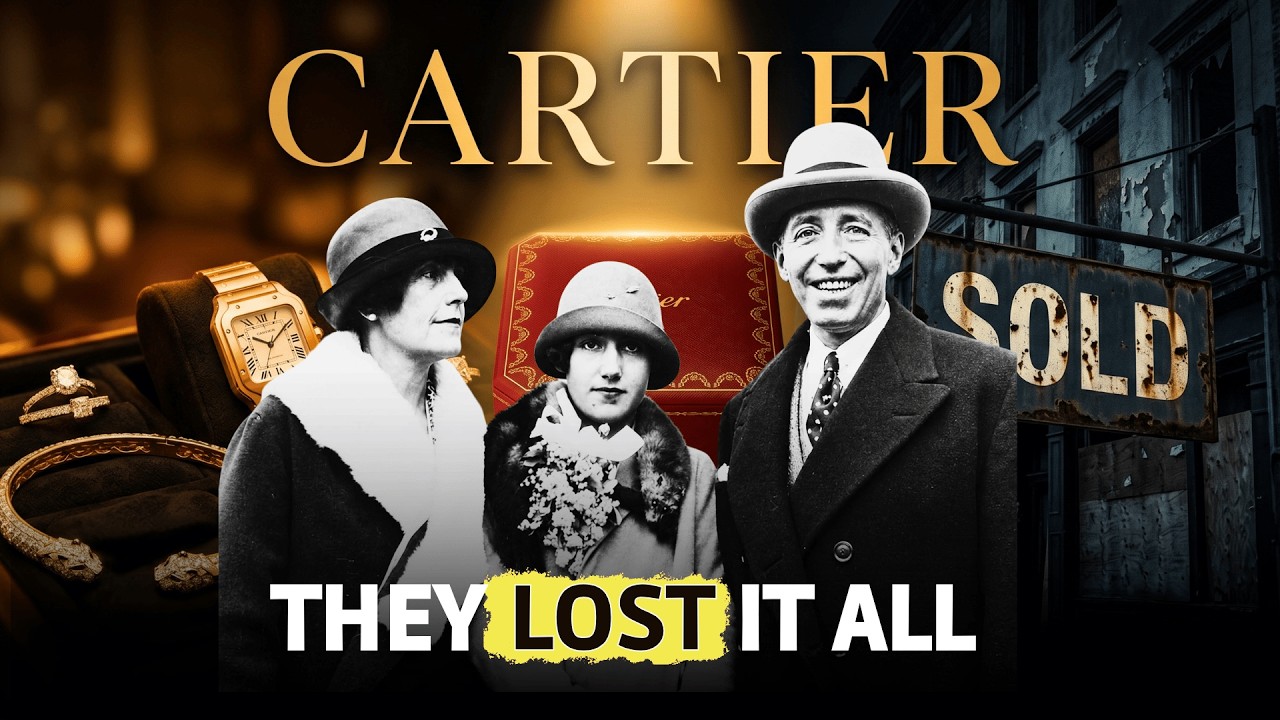
The story began in Paris in 1819, a city of rigid hierarchies where the children of working men did not grow up to dress the empresses of Europe. Louis François Cartier was born into that world. His father was a metal craftsman whose hands were stained dark by his trade. His mother was a laundress who scrubbed the delicate fabrics of wealthy women while her own family wore clothes mended so often they were more patch than original.
The family lived in a cramped apartment where every meal required calculation and every winter was a test of survival. Louis François spent his youth watching. While other children played in the cobbled streets, he studied how sunlight moved through glass and how metal, under the right hand, could be shaped into forms that stopped passersby. He was not simply admiring beauty.
He was trying to understand its mechanism, the specific quality that makes people want a thing so desperately they will pay almost anything to possess it. His apprenticeship under Adolphe Picard was grueling. The workshop at 29 Rue Montorgueil demanded work until hands were raw and bleeding, with a standard that accepted nothing less than perfection. Picard, a master of few words, recognized in the quiet youth a hunger that went beyond skill.
Louis François did not just want to make jewelry. He wanted to learn the essence of desire itself. In 1847, Picard offered to sell him the workshop. The price was everything Louis François had saved through years of disciplined self-denial.
It was a bet placed with no safety net. If it failed, there was nothing left. He took the bet. He understood something most craftsmen of his era did not.
In Paris, location was a declaration. In 1853, he moved his workshop to the prestigious Place Royale. By 1859, he had opened a boutique on the Boulevard des Italiens, where Napoleon III’s inner circle shopped and spent. The game-changing moment came in 1856, when Princess Mathilde, the emperor’s cousin, brought him a broken necklace that other jewelers had declared unfixable.
Louis François repaired it with such skill that she told her friends in aristocratic circles. The name Cartier began to move through the highest levels of Parisian society, and commissions arrived from empresses and duchesses who would never otherwise have spoken to a craftsman’s son. In 1874, Louis François handed the business to his son Alfred. What he passed down was a reputation built with surgical precision, meticulous and trustworthy among the most demanding clientele in Europe.
Alfred faced his first trial in 1870, when the Paris Commune choked the streets and the aristocracy traded titles for safe passage. With banks frozen and revolution looming, nobles scrambled for liquid cash. Alfred opened his doors and bought magnificent heirlooms for pennies on the dollar, amassing one of the finest jewelry collections in France. He modernized the business, bet its future on platinum, a metal others avoided, and in 1899 relocated the headquarters to 13 Rue de la Paix, the epicenter of Parisian elegance.
The stage was set for his three sons. According to family stories preserved by their descendant Francesca Cartier Brickell, the brothers gathered around a world map and divided the planet among themselves. Louis, the eldest, the artist and visionary, took Paris and Europe. Pierre, the strategist and negotiator, took New York and the new wealth of America.
Jacques, the adventurer, took London, the British Empire, and India. They were not looking for customers. They were looking for power centers, and they understood that to own the world’s diamonds, they first had to own the world’s elite. Louis became the house’s radical brain.
He exploited platinum’s strength to create the Garland style, where jewels appeared to float on skin. In 1917, inspired by the geometric silhouette of the new Renault FT-17 tanks on the Western Front, he created the Cartier Tank watch, a complete departure from ornate round pocket watches. He presented one of the first prototypes to General John Pershing. When production models reached the market in 1919, only six pieces were made.
He also introduced the mystery clock in 1912, with hands that appeared to float in a crystal case, a secret mechanism of crystal discs and hidden sawtooth rims. The first model was bought by J. P. Morgan.
In 1924, Louis designed the Trinity ring, three simple intertwined bands of yellow, white, and rose gold. When the poet Jean Cocteau adopted it, the ring became a cultural icon. Jacques opened the London operation in 1902, timing it to King Edward VII’s coronation. The London workshop produced 27 tiaras for the occasion.
The king was so impressed he granted Cartier a royal warrant and reportedly called the house the jeweler of kings and the king of jewelers. Spain, Portugal, Serbia, Russia, and eventually France followed with warrants of their own. Jacques then traveled to India, where he bypassed British intermediaries and established direct ties with the maharajahs. In 1911, he attended the Delhi Durbar and encountered rubies and emeralds of a size and quality the European market had rarely seen.
The Patiala necklace, commissioned in 1925 by the Maharaja of Patiala, was the summit of this Indo-European dialogue, a five-strand choker with 2,930 diamonds and a 234. 6-carat yellow diamond at its center. It was worn once in Paris, then disappeared for most of the century, re-emerging in London in 1998 stripped of most of its stones. Pierre conquered America.
In 1909, he opened the New York operation during the Gilded Age, when industrial titans had amassed millions but lacked the legitimacy of history. Cartier provided European aristocratic prestige wrapped in diamonds. The Fifth Avenue mansion was secured through the 1917 pearl trade, and Pierre later bought the Hope Diamond, found it difficult to sell because of its fearsome reputation, and leaned into the mythology of the curse. He sold it to the flamboyant socialite Evelyn Walsh McLean, who wore it constantly, and the publicity made the diamond and the Cartier name inseparable.
Pierre understood that a story, even a dark one, was more valuable than the object itself. The brothers built a coordinated system. Workshops functioned like temples of precision, where craftsmen spent decades mastering a single task. The mystery setting, patented by Louis in 1933, made stones appear to float without visible supports by sliding specially grooved gems onto concealed T-shaped gold rails.
When the Russian Revolution destroyed their aristocratic clientele overnight, the brothers pivoted to American millionaires without losing a year. When the Great Depression weakened that market, they shifted to the maharajahs of India and the oil-rich Gulf. In 1933, Jeanne Toussaint was appointed director of fine jewelry. A Parisian style icon who could not draw a single sketch, she guided master craftsmen with an audacious vision.
She was nicknamed La Panthère, and under her leadership the panther motif evolved from a flat pattern into fully realized three-dimensional jeweled sculptures. In 1948, she created the first three-dimensional panther brooch for the Duchess of Windsor, and a year later a platinum and diamond panther perched atop a 152. 35-carat cabochon sapphire. She gave women not just diamonds but claws.
The empire reached its full extent by the late 1920s. Paris, London, and New York operated as one coordinated machine. The ledger read like a map of global power, from the Rockefellers and Astors to the Maharajahs and Hollywood. But the foundations were made of men, not diamonds.
Jacques Cartier died in September 1941 at 57. Louis followed in July 1942 at 67. Pierre was left alone to manage a global operation during a world war. He held the business together, but he could not preserve its soul.
Pierre died in 1964. The fourth generation inherited the magnificent result without having endured the process. They received the mansion without memory of the cramped apartment, the Fifth Avenue address without memory of the struggle to secure it, the client list without memory of the broken necklace that launched everything. The Cartier hunger, forged by poverty, had not been inherited.
The descendants were successful by every social metric, but they lacked the sacrificial grit the brand demanded. The three geographic branches, once unified by shared vision, began to operate as separate entities with local priorities. The family chose to exit. Claude Cartier sold the New York operations in 1962, even before Pierre had died.
Paris was sold in 1972 to an investor group led by Robert Hocq and Joseph Kanoui. London followed in 1974. In 1976, the same group reunited the New York branch, and by 1979 all three were consolidated under a new entity called Cartier Monde. After 132 years of unbroken family ownership, the Cartier family was gone.
To save the fractured empire, Hocq and a young marketing executive named Alain Dominique Perrin made a radical pivot. In 1973, they launched Le Must de Cartier, a line of accessible luxury: gold-plated lighters, leather goods, scarves, perfumes, and affordable vermeil Tank watches. They democratized the ultimate luxury name. Traditionalists predicted the move would destroy the brand’s prestige, but by the 1980s the Must line was generating over a billion dollars in revenue.
The cash cow transformed Cartier into a financial weapon and eventually provided the capital for the South African Rupert family to achieve full ownership by 2012. Today Cartier sits as the crown jewel of the Richemont Group, generating more than six billion dollars in annual revenue with over two hundred stores worldwide. The brand survived the loss of the family and emerged financially stronger. The paradox is that the box grew larger only after the creators left the room.
Francesca Cartier Brickell tells the story differently. She discovered a forgotten trunk in a French wine cellar filled with the private letters of the three brothers. They were not business ledgers but the raw record of three men who divided a world map and meant every word of their pact. The letters documented their relationships, their ambitions, their relentless drive toward impossible standards of perfection.
The family lost the keys to the fortress, but through those letters, they reclaimed the heart of the empire. The name endures, the craft remains, and the story, told with conviction, proved to be the most indestructible thing of all.