In late January 1937, a faint and relentless barking echoed through the hallway of a modest Hollywood apartment building. Neighbors, growing alarmed, summoned the house boy to check on the occupant—a once famous actress who had not been seen in days. Inside, they found Marie Prevost lifeless on a foldout bed, an empty whiskey bottle in the sink, and her loyal dachshund whimpering at her side. She had died alone at forty, the victim of acute alcoholism and malnutrition after years of crash dieting, long past her days as a vivacious darling of the silent screen.
Prevost’s path to Hollywood began far from the California sun. She was born Marie Bickford Dunn on November 8, 1896, in Sarnia, Ontario. Tragedy struck early. Her father, a railroad conductor, died in a gruesome accident when poison gas flooded the St.
Clair tunnel where he was working. Her widowed mother soon remarried a charismatic mining engineer named Frank Prevost, whose restless pursuit of fortune dragged the family on a nomadic journey through the American West. The life brought adventure, instability, and occasionally danger. In 1906, while settling in Reno, Nevada, a housekeeping attempt nearly proved fatal when Marie’s mother accidentally ignited a sack of gunpowder in the cellar.
The explosion badly burned her mother and baby sister, though Marie escaped with minor injuries. By her teens, the family had landed in Los Angeles, where Marie attended high school. After finishing school, she found work as a secretary at a law firm that represented Keystone Film Company, the famous studio run by comedy impresario Max Sennett. In 1915, the pretty nineteen-year-old was dispatched to Keystone’s lot to deliver documents.
Fate intervened. Comedian director Ford Sterling spotted her, charmed by her wholesome looks, and asked if she would play a bit part in his short comedy. Marie agreed. The scene called for her to sit on a chair rigged for laughs, and the moment she sat down, the furniture collapsed beneath her.
In the finished film, all that could be seen were her legs waving in the air. But Max Sennett himself had been watching from the sidelines. The next day, Marie received astonishing news: Sennett wanted to see her immediately. He offered her a studio contract on the spot.
“I was to be one of his Sennett bathing beauties,” she later remembered. “Best of all, I was to be paid $15 a week. I signed without reading a word. ” Just like that, Marie Prevost became a professional actress.
She was not content simply to pose and smile. One afternoon, Sennett gathered the girls for a beach scene and encouraged them to do something funny. He instructed Marie to pretend to lose her balance and flail her arms as if falling off a pier. But Marie had a better idea.
As the cameras rolled, she pretended to slip and gave a fully clothed male comedian a sudden shove, sending him toppling into the water. Sennett roared with laughter. He kept the unscripted joke in the film and raised her salary to $25 the very next week. Over the next few years, Marie rose steadily through Sennett’s comedy factory.
By 1919, she had attracted interest beyond his studio. Newspaper magnate William Randolph Hearst approached her, but she stayed with Sennett out of loyalty, and he rewarded her with a generous new contract: three years at $195 a week. By 1921, however, Marie wanted to be taken seriously as an actress. When Universal Pictures offered a contract reportedly worth $1,000 per week, she decided to leave.
Whether she jumped or was pushed remains unclear—a letter from Sennett dated February 1921 suggests she may have been fired for skipping work—but she severed ties and, quite literally, burned them. She traveled to Coney Island and set fire to photographs of herself in bathing attire along with reels of her beach footage. The leap paid off. At Universal, she was elevated to leading lady status, starring in a series of light romantic comedies that caught the flapper era’s sass.
Her breakout year came in 1922, when she made eight feature films in about a year. One notable success was The Married Flapper, opposite a dashing leading man named Kenneth Harlan. Their on-screen chemistry leaked off-screen, and a real romance ignited. Both were soon hired by Warner Brothers, where studio boss Jack Warner cast them as the leads in The Beautiful and Damned, an adaptation of F.
Scott Fitzgerald’s Jazz Age novel. Fitzgerald famously loathed the film, calling it “by far the worst movie I’ve ever seen in my life,” but it hardly slowed Marie’s momentum. In 1923, Warner paired her repeatedly with another popular leading man, Monty Blue. That year, a major opportunity came from Europe’s most celebrated filmmaker.
Ernst Lubitsch, the sophisticated German director, personally chose Marie for a leading role in his first American ensemble comedy, The Marriage Circle. It was a prestigious validation. But just as filming was about to begin, Marie’s past came roaring back. In August 1923, her long-forgotten husband, a man named Sunny Girk whom she had secretly married in 1918 during World War I, resurfaced to file for divorce.
The marriage had been kept a complete secret to protect her career. Hollywood was stunned. Jack Warner was furious. Marie came clean in the Los Angeles Times, explaining that the marriage had been a youthful mistake made in the heat of war.
“Immediately the ceremony was over, we both realized what a silly thing we had done,” she admitted. The scandal blew over, but not before leaving a mark. Filming The Marriage Circle proved to be a revelation. Lubitsch’s directing style was meticulous and psychologically nuanced.
Initially baffled, Marie gradually grasped what the master was after. “It began to dawn on me what the art of acting was all about,” she confessed. When the film was released in early 1924, critics singled her out as the film’s spark. Variety declared the picture gave her “the chance of her life, and she assuredly makes the most of it.
” At the premiere, Lubitsch pulled Jack Warner aside and chastised him for not billing Marie as the top star. Warner, who already resented her over the secret marriage fiasco, reacted with alarming vitriol, threatening to fire everyone and even burn every reel of the film. Cooler heads prevailed, but on set Warner continued to sabotage her, demanding extra takes whenever she gave an especially good performance. Despite the grudge, Marie’s years at Warner Brothers proved the most productive of her career.
Throughout 1924 and 1925, she worked almost non-stop, reuniting with Lubitsch for two more pictures. In 1924 alone, she appeared in nine films. Personal happiness finally arrived too. After years of courtship, she and Kenneth Harlan married publicly in June 1924.
Life seemed great. Then the pendulum swung. By early 1926, Warner Brothers abruptly decided not to renew the contracts of either Marie or her husband. Her close friend Phyllis Haver later speculated that this rejection was the trigger that led to Marie’s decline into alcoholism.
Before Marie could process the setback, an even more terrible tragedy struck. In April 1926, her beloved mother died in a catastrophic car accident in the New Mexico desert. Marie, at twenty-nine, was now motherless and emotionally shattered. She threw herself deeper into work, accepting roles in low-budget comedies.
But the strain took a toll on her marriage. In October 1927, she filed for divorce from Harlan on grounds of extreme mental cruelty, testifying that he caroused late into the night and phoned her in drunken states. The divorce was granted in 1928. Marie was alone again, twice divorced, before the age of thirty.
Still, she delivered a few notable performances at the tail end of the silent era, including The Racket, a critically acclaimed crime drama produced by Howard Hughes. The advent of talking pictures was a double-edged sword. She possessed a serviceable speaking voice and managed to avoid the fate of some silent luminaries, but the new technology brought new pressures. Her lifelong battle with weight began to intensify.
Studios expected their leading ladies to maintain girlish slimness, and Marie’s love for rich food and drink often put her at odds with the scales. The more she fretted about her waistline, the more she turned to alcohol for comfort—a vicious cycle that only worsened her physical condition. In 1929, a lifeline arrived. Cecil B.
DeMille sought her out for a key supporting role in The Godless Girl. DeMille ordered her to bleach her hair nearly platinum. Marie begged to wear a wig instead, but DeMille was adamant. The sacrifice was not in vain.
Critics praised her performance, and the film showed Hollywood she could act in talkies. Through the early 1930s, she found steady work as a character actress at MGM, appearing in films alongside Joan Crawford, John Gilbert, and Clark Gable. But the roles diminished. By 1934, she was mentioned in the papers only in odd contexts—a lawsuit over flea-infested rental property, a doctor dying of a heart attack while visiting her in a hospital.
Determined to make one last bid for a career revival, Marie adopted extreme measures. By 1936, she embarked on what could only be described as a starvation diet, consuming almost no solid food and subsisting largely on alcohol. She did manage to slim down, and Warner Brothers, where she had once reigned, took pity and granted her a bit role in a 1936 musical. Soon she was appearing only as an uncredited extra, invisible in films she once headlined.
Her sister Peg, worried, wrote several times but received only brief postcards in reply. Peg and her husband decided to drive down from San Francisco to check on Marie in the new year. They never got a reply. Marie’s health was in shambles.
She spent Christmas 1936 alone in her small Hollywood apartment with only her dachshund Maxi for company. On Wednesday, January 20, 1937, she walked to a local delicatessen to repay a $2. 50 check that had bounced. She returned to her one-room apartment, poured herself the remaining contents of a whiskey bottle, lit a couple of portable gas heaters to chase away the January chill, changed into silk pajamas, and lay down on her folding bed.
She closed her eyes and never woke up. For two days, no one realized she was gone. It was not until Saturday, January 23, that the little dog’s incessant barking finally stirred concern. The house boy used his master key to enter the apartment.
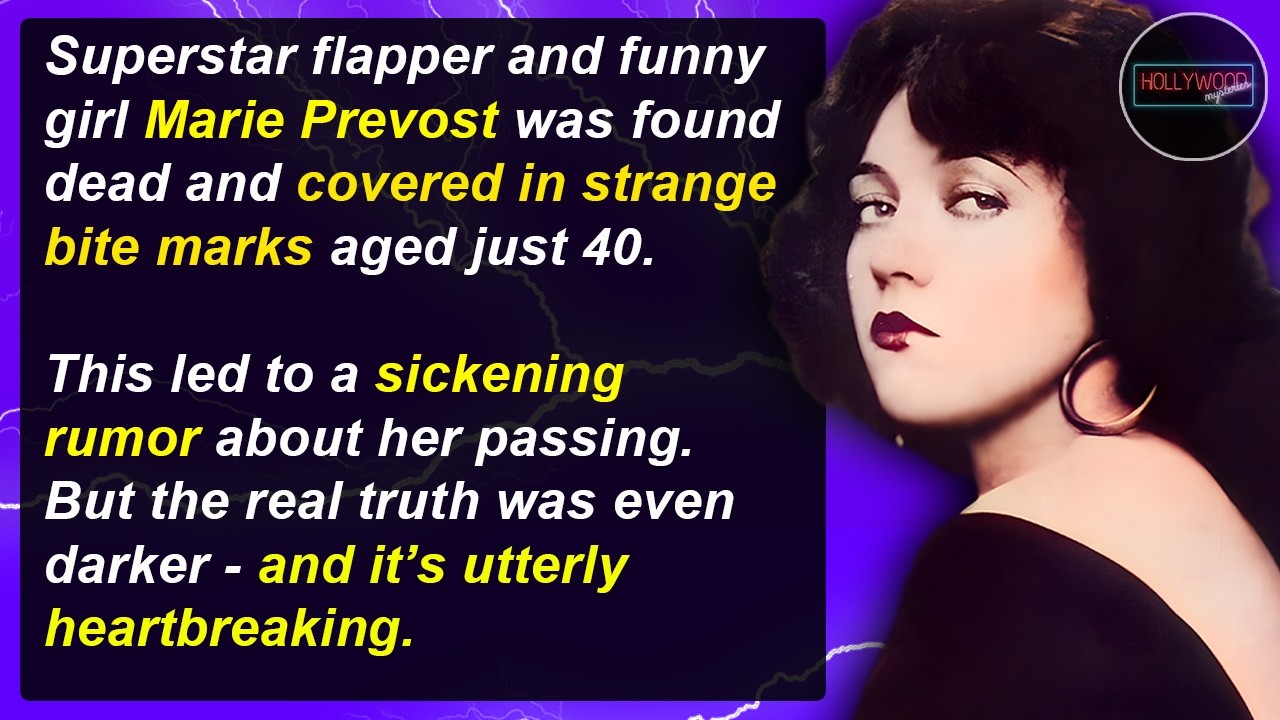
Marie Prevost was lying face down on her bed, motionless. Maxi, terrified and desperate, was at her side, whining. The dog had gently nipped at her arms and legs in an attempt to wake her—a detail that would later be grotesquely distorted into a lurid myth that the starving dog ate her. In truth, Maxi had only tried to save her.
An autopsy confirmed she had died of heart failure brought on by acute alcoholism and malnutrition. The deputy coroner found a considerable amount of alcohol in her body and very little else. She had essentially wasted away. In the aftermath, Hollywood awoke to sorrow and guilt.
Among her belongings, investigators found an unsigned promissory note for $110 made out to Joan Crawford. Crawford, upon learning of Marie’s death, was stricken. “She had only to ask, and I would gladly have given her help,” she said. It was Crawford who paid for the funeral.
The service brought out a who’s who of Hollywood’s golden age—Clark Gable, Barbara Stanwyck, Max Sennett, Douglas Fairbanks Jr. , Wallace Beery, and many others. Her sister Peg could not escape a bitter thought: “But where were they when she needed them? And where was I?
”
One of Marie’s last on-screen colleagues, actor Rex Lease, believed she was on the verge of a turnaround. In her final film, a low-budget racing drama, she had a sizable supporting role as a comedy character. By his account, she was terrific, stealing the show. “I think she was ready for a comeback,” he lamented.
If only she could have held on just a little longer. The very newspaper that once heralded her hopeful return ultimately summed up her journey with a sobering lesson: “Most of the time, unfortunately, they don’t come back. ”