In 1989, a mother held her newborn for only minutes before he vanished without a trace. Twelve years later, one ordinary evening, a single moment on TV would shatter everything she thought she knew. The first cries of the baby echoed faintly down the narrow, antiseptic-smelling corridor of St. Mary’s Maternity Hospital.
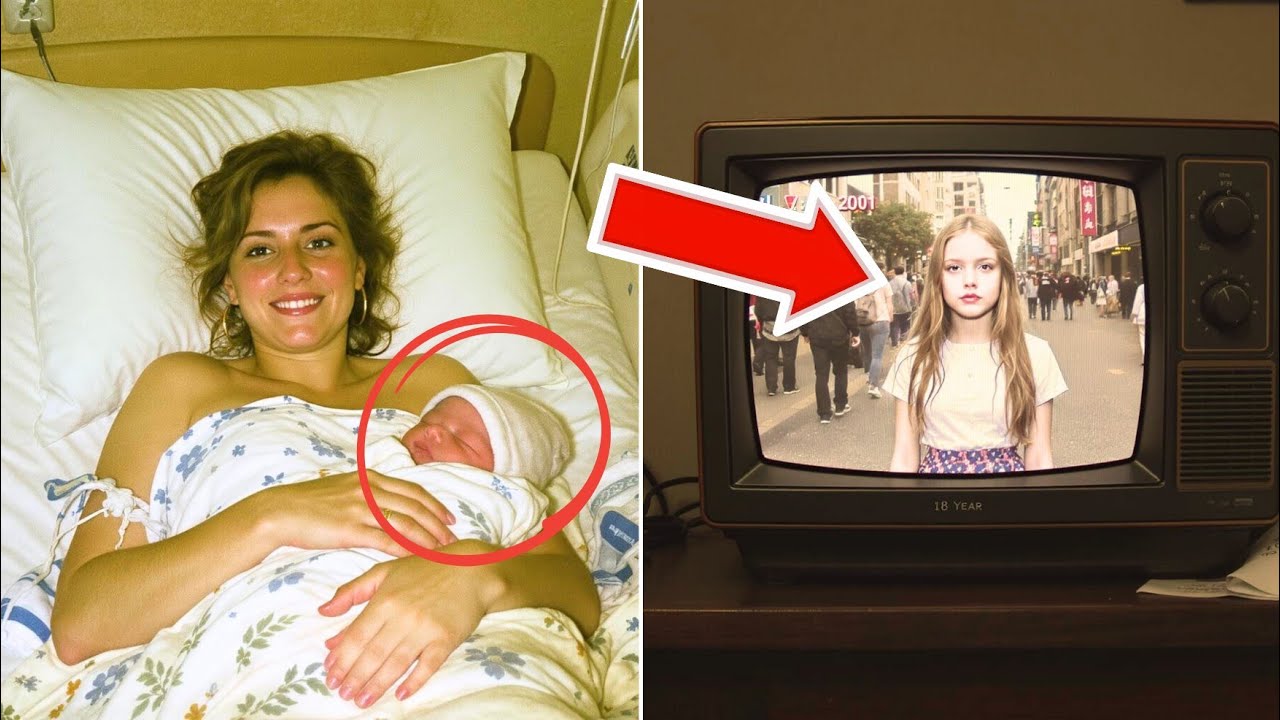
But by the time they reached the ears of Helen Carter, those cries were already fading into something else. Something she would spend the rest of her life trying to chase. It was July 14th, 1989, a Friday, 4:17 a. m.
The summer rain had been falling steadily since midnight, slicking the streets of the small town of Asheford in northern Pennsylvania. Inside the delivery room, the world was reduced to the rhythmic beeping of the fetal monitor and the shallow, panicked breaths of a woman who had been in labor for 19 exhausting hours. Helen’s husband, Mark, stood at her side, his face pale, the smell of coffee still clinging to his shirt. When the final push came, Helen barely registered the relief that surged through her body.
All she heard was the cry, a thin, startled wail that seemed to crack the air. A boy, tiny and red-faced, squirming under the harsh fluorescent lights. But then, as quickly as he appeared, he was taken from her arms. The nurse muttered something about needing to clean him up, check his vitals.
The normal routine, Helen thought. She let her head sink back against the pillow, too drained to question it. Mark kissed her forehead and murmured, “I’ll stay with him,” before following the nurse into the adjoining nursery room. The nursery was a modest space, two bassinets, a wall of cabinets, and a single window with blinds drawn against the rain outside.
Mark leaned against the wall, rubbing his tired eyes while the nurse worked quietly, her face obscured by a pale blue mask. Then the door opened. It was another nurse. At least she wore the same scrubs, the same white shoes, the same clipped, efficient posture.
She spoke to the first nurse in low tones Mark couldn’t make out. Then almost casually, she wheeled the bassinet toward the door. Mark frowned. “Where are you taking him?
”
“Just for a quick check in the special care unit,” the second nurse replied without looking at him. He didn’t think much of it then. He was exhausted, disoriented. It was only when he returned to the delivery room and told Helen that something in her shifted.
“Special care,” she repeated, her voice sharp despite the haze of exhaustion. “Why? They said he was fine. ”
Mark didn’t have an answer.
When he went back to the nursery, the room was empty. The bassinet was gone. The first nurse was gone. Even the second nurse was nowhere in sight.
The police arrived just after 5:00 a. m. Detective William Harlo, a heavy-set man with deep lines etched into his face from too many sleepless nights, took the lead. He questioned every staff member, reviewed every security camera, though in 1989, the grainy black-and-white footage was far from reliable.
The cameras covering the maternity ward’s main hallway showed nothing unusual. It was as if the baby had been erased. By sunrise, the hospital was swarming with uniformed officers. Nurses were crying in break rooms, and Helen lay in her bed, staring at the door, every muscle in her body locked in a trembling paralysis.
She hadn’t even held him long enough to memorize his face. The media descended within hours. Local news vans parked outside, reporters speaking into microphones about a mysterious disappearance that had rattled the quiet town. For the first few days, the search consumed everything.
Police canvassed the hospital grounds, combed through every inch of the nearby streets, and interviewed every staff member, patient, and visitor who’d been in the building that night. A composite sketch of the second nurse was distributed across the state, but no one claimed to recognize her. Helen and Mark clung to each other, alternating between frantic action and stunned silence. They put up flyers.
They made televised appeals. They sat through endless interrogations. Weeks passed, then months. The official investigation stalled.
Leads dried up. By the one-year mark, the story had faded from the news cycle, replaced by newer tragedies. The strain took its toll. Mark buried himself in work, often coming home long after Helen had gone to bed.
Helen stopped going out entirely. They spoke less, their conversations limited to logistics and empty reassurances. Every night, she lay awake, replaying the moment they took him. Every morning, she woke to the crushing reminder that no one knew where he was.
Six years later, in the summer of 1995, everything changed. It began with a phone call from Detective Harlo. His voice was cautious but tinged with something else. Something Helen hadn’t heard in years.
Possibility. “I can’t promise anything yet,” he said. “But something’s come up. You might want to come in.
”
When she and Mark arrived at the station, Harlo slid a thin manila folder across the table. Inside were a series of photographs, grainy, taken from what looked like a convenience store security camera. In the center of the frame was a teenage boy, maybe 12 years old. The image quality was poor, but something about the set of his jaw, the curve of his nose, the tilt of his eyes.
Helen felt the air leave her lungs. Her son. Or someone who looked exactly like him. Harlo explained that the boy had been spotted with a woman matching the old composite sketch from 1989.
The footage had been taken only a week ago, three towns over. The woman had paid in cash, avoided looking at the cameras, and left quickly. For the first time in years, Helen felt something other than grief or numbness. She felt the sharp electric pulse of hope and the equally sharp edge of fear.
Because if the boy was hers, it meant someone had been hiding him for 12 years. And whoever that was still out there. “Here’s what we know,” Harlo said, placing two more folders on the table. “The convenience store is on Route 48 in Bramblewood.
Small town, barely a blip. Security footage is from July 3rd, 9:14 p. m. The boy was with a woman in her late 40s, wearing a red raincoat.
Paid for groceries, milk, bread, and soup. Cash only. No credit cards, no ID. They left in an old blue sedan.
Plate partially obscured by mud. ”
“And you think she’s the same woman from the hospital? ” Helen asked. Harlo nodded slowly.
“I think she could be. But this is delicate. If she suspects we’re on to her, she’ll disappear again. ”
The plan was fragile, cobbled together from the few scraps of information they had.
Undercover surveillance on the convenience store. Quiet inquiries in Bramblewood about a woman matching the description. No press involvement this time. Three days later, the first new lead surfaced.
It came from a gas station attendant in Bramblewood. “Yeah, I’ve seen her. Comes by every couple weeks. Always late evening.
Sometimes with a kid, sometimes without. Never talks much. Keeps her head down. ”
“Did you ever catch where she was heading?
” Harlo asked. “South, I think. Toward the old mill road. But there’s not much out that way anymore.
Just woods, a few trailers, and that old farmhouse. ”
By dusk, they were parked in an unmarked sedan half a mile from the road the attendant had mentioned. Rain misted the windshield. It was almost midnight when the car came from the north, moving slow, its wipers squeaking with each pass.
Through the watery glass of the windshield, Helen caught a glimpse of the driver, a woman with sharp features and dark hair tucked under a cap. In the passenger seat sat the boy. Her boy. “It’s him,” she whispered, her voice breaking.
They kept their distance, following until the sedan turned abruptly onto a dirt path barely wide enough for one vehicle. Harlo stopped. “If we follow too close, she’ll know. We’ll wait.
”
The blue sedan vanished into the darkness. Then, faint in the distance, a light appeared through the trees. Dim, flickering, like it came from a single lamp in a large empty space. “The old farmhouse,” Mark murmured.
They didn’t move that night. Harlo said they needed backup. Over the next week, surveillance was set up. Officers rotated in shifts, watching the farmhouse from a concealed point in the woods.
The woman rarely left. When she did, she always went alone. The boy emerged twice, only briefly, once to feed chickens in the yard, once to fetch wood from a shed. On the seventh day, everything changed.
The woman left at dusk. She didn’t take the car. She walked into the woods heading west. An officer followed at a distance, but she never came back.
By 3:00 a. m. , Harlo made the call. They’d go in.
Helen wasn’t supposed to be there. But when she heard the engines starting up, the radios crackling, she climbed into the back of one of the unmarked vehicles without anyone noticing. The farmhouse loomed out of the darkness, tall and weathered, its windows dull with grime. When the officers moved in, Helen slipped from the car, staying just behind the shadows.
Inside, the air smelled of damp wood and something sour. Then from the hallway came the sound of footsteps. A boy emerged from the shadows, taller than she’d imagined, with a shock of dark hair and eyes that, when they met hers, made the years fall away. “Who are you?
” he asked. Helen stood there frozen in the half-light of the farmhouse hallway, her lips trembling around words that refused to form. “It’s me,” she finally whispered, her voice barely more than a breath. “I’m your mother.
”
The boy’s brow furrowed. He took a step back. “No, my mother’s not here. ”
The sentence sliced through her like glass.
Behind her, Harlo’s voice was low, urgent, telling her to step aside. But Helen couldn’t. She’d waited 12 years for this moment, only to have him look at her like she was a stranger breaking into his home. Officers began sweeping the rest of the house, their footsteps heavy on the upstairs floorboards.
Mark had slipped in by then. “Danny,” Mark said carefully, using the name they’d chosen for him the night he was born. “We’ve been looking for you since the day you were taken. ”
The boy shook his head.
“My name’s not Danny. ”
“What? What is your name? ”
He hesitated, as if even that small truth might cost him something.
“My name’s Eli. ”
Before she could say anything else, one of the officers called from upstairs. “Detective, better come see this. ”
Harlo went up.
Minutes later, he returned, his expression carved from stone. “Upstairs,” he said to Mark quietly. “You should see this. ”
The second floor was a warren of narrow hallways and low ceilings.
The first room they entered looked like it belonged to the boy. Narrow bed, worn blanket, a wooden desk with pencil marks carved into the surface. But it was what was on the walls that made Helen’s breath catch. Photographs, dozens of them, tacked up in no particular order.
Faded Polaroids, yellowed newspaper clippings, snapshots taken on cheap film. Most were of the boy at different ages, as a toddler in a yard she didn’t recognize, as a school-age child standing in front of a Christmas tree, as a teenager sitting on the porch of the very house they were in. But scattered among them were photographs of other children, strange children. Some were infants, others were older.
In many of the pictures, the children were smiling, holding toys, sometimes sitting beside the woman in the red raincoat. “Are these…? ” Helen began. “We don’t know yet,” Harlo said, his voice grim.
“But I’d bet this isn’t the only kid she’s taken. ”
When they left the farmhouse, Eli didn’t resist. He followed quietly, though he stayed a few steps behind, as though unsure if he was allowed to be near them. The woman in the red raincoat hadn’t returned, and Harlo ordered a full search of the surrounding woods.
At the station, they put the boy in a small interview room with a cup of hot chocolate he barely touched. A child psychologist spoke softly to him, trying to coax out details about his life. Bits and pieces emerged, fragments that didn’t fit neatly together. He’d grown up out in the country.
He’d never been to school. The woman he called Ma told him other people were dangerous, that they wanted to take him away. And he said something that made the room go still. “She told me I wasn’t the first one.
”
The psychologist leaned forward. The boy frowned, as if trying to remember something he’d been told long ago. “She said she had other kids before me, but they all left or got lost. I don’t know.
”
Harlo straightened. “We’ll run every missing person’s case in the tri-state area for the last 30 years against those photographs. If he’s telling the truth, we might be looking at a serial abduction case. ”
Two days later, the news came in.
The woman had been spotted again, this time 50 miles south, alone, walking along the edge of a two-lane highway. She was carrying a large duffel bag. By the time police reached the area, she was gone. They kept Eli close that day.
The safe house was reinforced. Extra patrols, cameras repositioned. But the air inside was still electric with unease. Helen decided to try again gently.
“Do you remember the place we found you? The farmhouse. ”
He shrugged. “I lived there as long as I can remember.
”
“What about before that? ”
Another shrug. “She said we moved around a lot. That people were after us.
”
“Did she ever tell you why she took you? ”
For a moment, something flickered in his eyes, a quick, almost frightened glance toward the window. “She said he didn’t want me. ”
The words slammed into her chest.
“That’s not true. That will never be true. ”
He didn’t answer. By late afternoon, Harlo called them into the living room.
He’d been in touch with analysts, reviewing the photographs from the farmhouse. “We’ve identified three of the kids,” he said. “All missing person’s cases. Two from Pennsylvania, one from Ohio.
Dates range from 1978 to 1985. ”
“What happened to them? ” Helen asked. “We don’t know.
None were ever found. Until now, we didn’t even have proof they were alive after they went missing. This woman, she’s been doing this for decades. ”
The clock on the wall ticked steadily, filling the silence that followed.
Then the phone rang. It wasn’t the landline the police used. It was Helen’s personal number, one she hadn’t used in weeks. She answered without thinking.
“Hello. ”
The voice on the other end was unmistakable. Low, calm, almost warm. “You’re doing a good job keeping him safe,” the woman said.
“For now. ”
Helen’s grip on the receiver tightened. “Where are you? ”
A soft laugh.
“Closer than you think. ”
“What do you want from us? ”
“Your son isn’t yours anymore. You gave him away the second you let them take him from that room.
I kept him. I fed him. I taught him. ”
“He’s my son, and I will never let you touch him again.
”
“Then I’ll make you a deal. You want him? Prove you can keep him. I’ll send you something tonight.
Follow it, and maybe you’ll understand what you’re really up against. ”
The line went dead. Harlo traced the call immediately, but it was routed through a prepaid cell that pinged off three different towers in under a minute. She was playing with them.
That night, a plain envelope was slid under the front door of the safe house sometime between 11:00 p. m. and 1:00 a. m.
No one saw who delivered it. Inside was a single Polaroid photograph. It showed a little girl, no more than seven, sitting on the same porch where they’d found Eli. Her hair was tangled, her clothes too big for her, but her eyes were sharp, wary.
On the back, in neat block letters, were four words: “She needs you, too. ”
Helen stared at the picture for a long time. The porch boards under the girl’s feet were the same warped planks she’d stepped on herself, which meant the photograph wasn’t old. “That girl is still there,” she said.
Harlo didn’t hesitate. “Then tomorrow we go back. “