In the Bavarian Alps, high above the village of Berchtesgaden, Adolf Hitler’s mountain retreat became the unofficial seat of power in Nazi Germany. Party leaders, ministers, generals, and foreign visitors passed through its doors. Among the men with permanent access to Hitler was Martin Bormann, an ambitious party official who steadily became one of the most powerful figures in the Third Reich. Near the Führer’s residence, Bormann’s growing family enjoyed a privileged life at the heart of the Nazi elite.
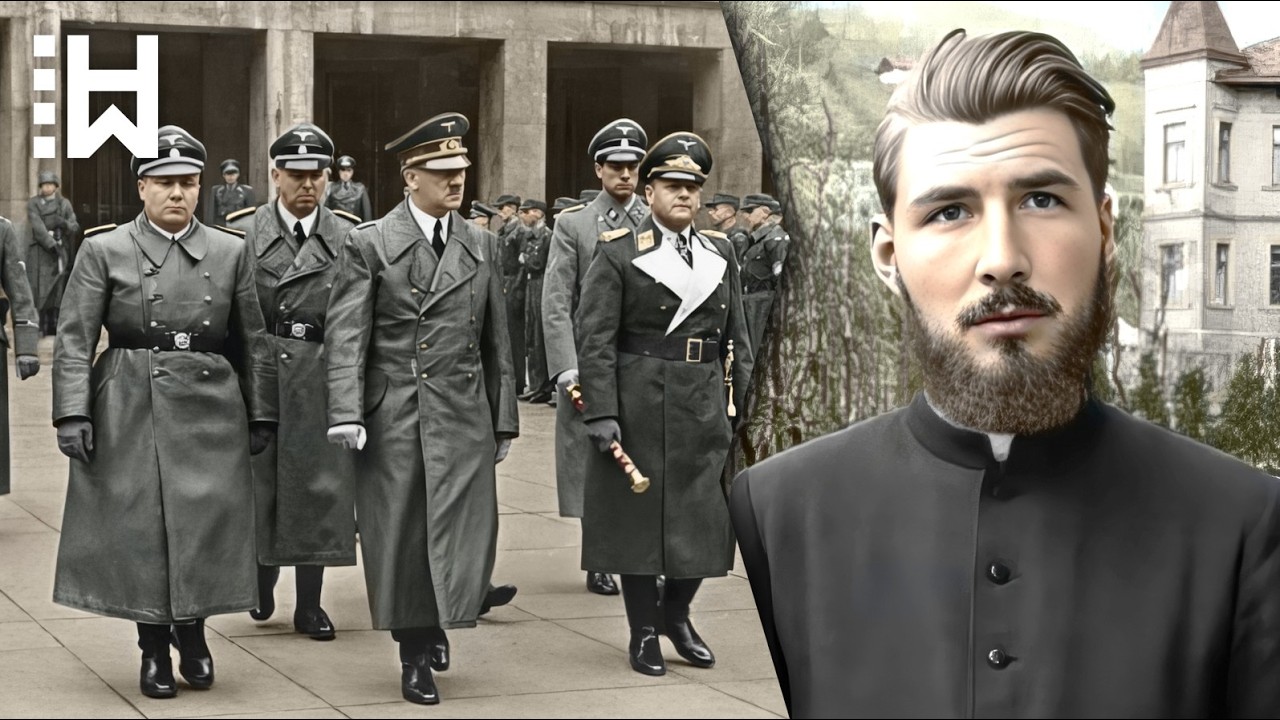
His children played in the shadow of Hitler’s home, raised closer to power than almost any other children in Germany. For many inside the regime, one boy in particular, known within the family as Krümel, seemed destined for a special future. As the son of Hitler’s trusted private secretary, he grew up closer to the center of Nazi power than nearly any other German child. Yet the path his life would eventually take could not have been further from the world into which he was born.
His name was Martin Adolf Bormann. Martin Adolf Bormann was born on April 14, 1930, in Grünwald, a suburb south of Munich. He was the eldest of ten children of Martin Bormann, the future head of the Nazi Party Chancellery and Hitler’s private secretary. His mother was Gerda Buch, daughter of Walther Buch, the long-serving chief of the Nazi Party’s internal court.
The family was shaped by ideology as much as by domestic routine. Martin Bormann Sr. was one of the most powerful and feared men in the Third Reich, a man who made himself indispensable to Hitler by controlling access to him and processing nearly every piece of civilian paperwork that crossed the Führer’s desk. His wife shared his convictions completely.
Gerda Bormann was a devoted National Socialist who treated childbearing as a political duty, ultimately giving birth to ten children. In letters she wrote to her husband at the front, she dismissed sympathy as weakness and even suggested polygamy for herself in an attempt to increase the birth rate. In Nazi Germany, children were baptized selectively. Martin Adolf was accepted into the German Evangelical Church with Hitler named as his godfather in a largely ceremonial gesture.
But as his parents’ hostility toward organized Christianity deepened, later children were never baptized at all. From his earliest years, Martin Adolf was immersed in the world of the Nazi leadership. During the war, the family lived partly at the Obersalzberg, the fortified mountain retreat near Berchtesgaden, where his father supervised the construction of an entire complex of villas, roads, and barracks around Hitler’s residence, the Berghof. The Bormann children were frequent visitors there.
A frequently cited incident dates from when Martin Adolf was about eight years old. Standing before Hitler, the boy raised his arm and cried out, “Heil Hitler, mein Führer. ” He received an immediate slap from his father. He had forgotten that in Hitler’s presence, he should have said only “Heil,” not “Heil Hitler.
”
In 1940, at the age of ten, Martin Adolf was sent to the Reichsschule Feldafing, an elite boarding school founded by the Nazi Party in 1933. Located on the shores of Lake Starnberg in Bavaria, the school was established to shape an ideological elite, the future leaders of party and state. Martin Adolf spent five years there, absorbing Nazi doctrine, undergoing physical training, and being prepared for a role in a world that was visibly collapsing around him. Even as his education continued, he later recalled, he remained a fervent young Nazi throughout, completely committed to the ideology instilled in him by his parents since childhood.
On April 15, 1945, with the school dissolved, Martin Adolf was among a group of pupils in Matrei am Osttirol, a market town in what is now Austria, who were told to make their way home. The Western Allied armies were advancing from the west and the Red Army from the east; the Reich was weeks from total collapse. A party official in Munich named Hummel advised the fifteen-year-old to try to reach his mother, who had fled from Urlach with eight of her younger children after an Allied air raid and was sheltering in a village in South Tyrol. The journey proved impossible.
Transportation had stopped, roads were clogged with columns of retreating soldiers, and every authority was disintegrating. Martin Adolf found himself stranded in Salzburg, where the Nazi regional leader Gustav Adolf Scheel provided him with forged identity papers. He found shelter with a farmer named Nikolaus Henvogl at a farm called Kreilichtenau, halfway up a mountain in the Salzburg Alps. He gave a false name and said nothing about his real identity.
Meanwhile, Hitler committed suicide on April 30, 1945, and Berlin fell. In the chaos of the final escape attempt, Martin Bormann Sr. disappeared. Witnesses reported seeing him flee with a small group in the early hours of May 2, 1945, heading through a burning city under Soviet fire.
After that, no trace of him was found. His wife, interrogated by Allied intelligence officers after her arrest in Italy, could provide no information about him. Her health was deteriorating rapidly. In the autumn of 1945, she was taken to a prison hospital in Sterzing, a town in South Tyrol, where doctors discovered she had cancer of the uterus.
She died there on March 23, 1946, at the age of thirty-six. In the meantime, the farmer treated the former heir to Nazi Germany as if he were his own son. That continued even after Bormann revealed his identity to him in October 1946, when he learned that his father had been sentenced to death in absentia. Instead of reporting him, Henvogl turned to the local priest, and the pastor of the pilgrimage church in Maria Kiental took him into his home.
During this period, Martin Adolf confronted for the first time the full scope of the crimes committed by the regime he had been raised to serve. He also witnessed the help and kindness of Catholic believers and church authorities. Together, these influences led him to convert to Catholicism. The faith Martin Adolf Bormann came to embrace represented a complete reversal of everything his upbringing had intended for him.
While serving as an altar boy in Maria Kiental, American intelligence arrested him and took him to Tittmoning, a town in the Austrian state of Salzburg, for questioning over several days. The Americans wanted to know where his father was. He truly did not know. Repeated tests confirmed he was telling the truth, and he returned to the parish.
After his time in Maria Kiental, Martin Adolf Bormann came under the care and educational support of the Missionaries of the Sacred Heart. He attended their school, and after completing his secondary studies in 1951, he entered the religious novitiate. That same year he went to Austria and began the prescribed period of novitiate, followed by philosophical and theological studies in Innsbruck. He kept his birth name throughout, dropping only the name Adolf in daily use.
As he later explained, no one can choose their parents. He gradually resumed contact with his brothers and sisters, almost all of whom had also converted to Catholicism, with the exception of one sister. On July 26, 1958, Martin Adolf Bormann was ordained a Catholic priest. In 1961, he was assigned to the newly independent Republic of the Congo, formerly the Belgian Congo, a country wracked by decolonization violence and Cold War interventions.
He worked in pastoral care and education under extremely difficult conditions. In 1964, Bormann was forced to flee because of the Simba rebellion, which targeted foreigners and missionaries as symbols of external domination. He returned for an additional year in 1966, but the environment remained unstable and he left the country again. In 1969, he suffered a near-fatal injury in a car accident.
During his long recovery, a nun named Cordula cared for him until he regained his health. Their relationship developed beyond what their religious vows permitted. In the early 1970s, Bormann left the priesthood, and Cordula released her vows as a nun. They married in 1971 and had no children.
He later worked teaching philosophy and theology in the town of Hain in West Germany until his retirement. While Martin Adolf moved further away from the world of the Third Reich, questions about his father’s fate persisted for decades. Rumors placed him in South America, Australia, or Italy. Intelligence agencies, including the CIA and the West German government, searched for him without success.
Then, in December 1972, construction workers found human remains near the Lehrter Bahnhof railway station in West Berlin. Fragments of glass embedded in the jaw of the skeleton suggested death by a cyanide capsule. Dental reconstruction pointed to Martin Bormann Sr. , and the West German government officially declared him dead.
Doubts lingered, however, and only in 1998 was the identity definitively confirmed through DNA testing, comparing the remains with a sample from a living relative. On August 16, 1999, at the initiative of the Frankfurt prosecutor’s office, the remains of Martin Bormann were secretly cremated in Bavaria, and his ashes were scattered in the Baltic Sea in Kiel Bay, outside German territorial waters. The authorities wanted to ensure that no grave could become a shrine for neo-Nazi remembrance. Martin Adolf Bormann did not remain silent about his origins or his father’s crimes.
Beginning in 1987, he participated in the reconciliation group “Children of Perpetrators, Children of Victims,” promoting dialogue between the descendants of Nazi officials and the descendants of those they had killed. Bormann later spoke in classrooms across Germany and Austria about his biography, the Nazi past, and the responsibility to confront what his father’s generation had done. In 2011, shadows fell over his later life when a former pupil at an Austrian Catholic boarding school accused him of rape, claiming the assault occurred when he was twelve years old and Bormann had been working there as a priest and teacher in the early 1960s. Other former students claimed they had suffered severe physical violence from him during the same period.
For some, these allegations suggested that the son had ultimately become morally worse than the father whose life he had spent disowning. Bormann denied any knowledge of these accusations. By that time, he was suffering from advanced dementia and was no longer able to mount a coherent defense. The Catholic Church compensated the man who brought the accusation.
Martin Adolf Bormann, the former heir to the Third Reich and a Catholic priest, died on March 11, 2013, in Herne, a town in western Germany. He was eighty-two years old.