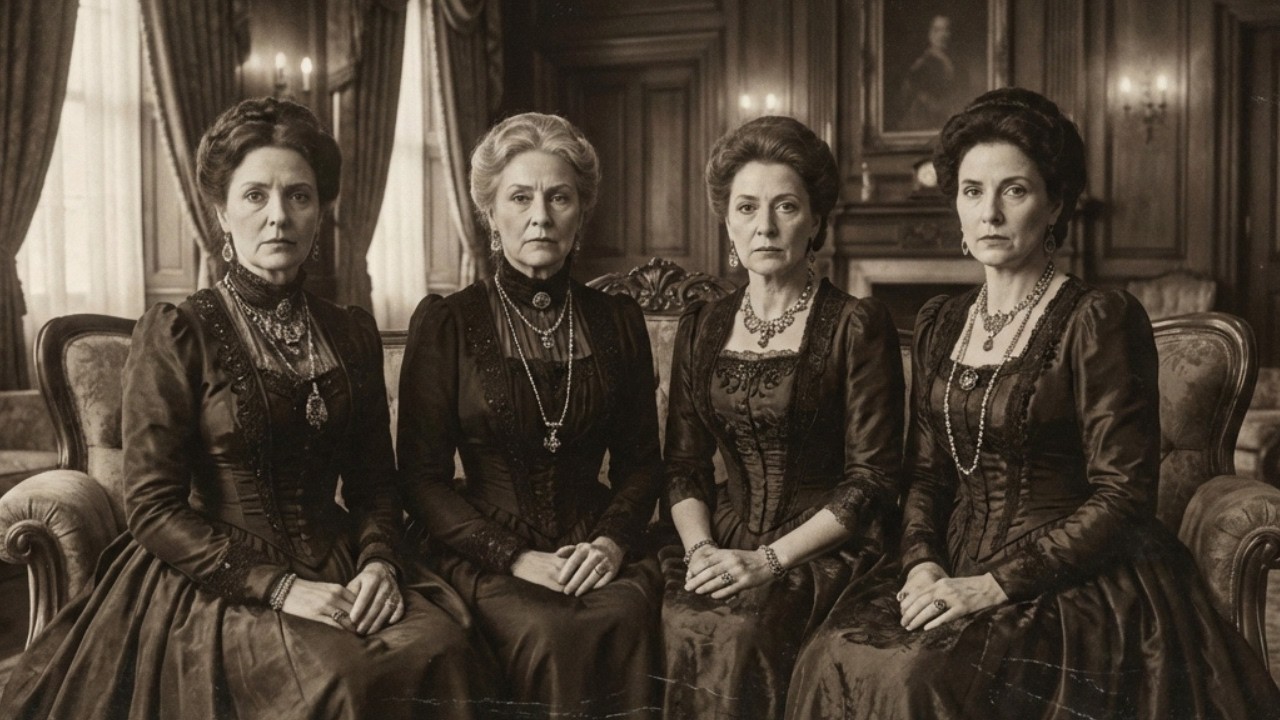
To be born into Gilded Age money was to inherit a script written by someone who loved the family name more than the child carrying it. In the parlors of Fifth Avenue and the drawing rooms of Newport, the real authors were often the mothers—women with velvet manners and iron rules. They kept ledgers of invitations, not feelings.
They decided who married whom, who was allowed to be seen, and who would be erased for disobedience.
Affection was optional, but obedience was not. Mothers did not simply raise children; they engineered them. By 1880, the social battlefield of New York and Newport had developed a tactical precision that would make military strategists jealous.
Every introduction was calculated, every dance card vetted, and every letter that entered or left the house passed through maternal hands first.
The toolkit was elegant and absolute. Chaperons shadowed daughters at every public appearance, not for safety, but for surveillance. Correspondence was intercepted and read before breakfast.
Allowances were adjusted weekly based on behavior, creating a financial leash that could be tightened at the first sign of rebellion. If a child dared to pursue an unsuitable attachment, the mother had a final weapon: public humiliation disguised as concern.
A young woman could not accept an invitation without her mother's approval. She could not leave the house unaccompanied. She could not speak privately with a young man, even at a ball in her own home.
Her clothing, posture, and conversation topics were managed like a portfolio. One misstep, one unseemly friendship, one whispered rumor, and the consequences were immediate. Invitations dried up, eligible suitors looked elsewhere, and the family's position on the social ladder could slip several rungs in a single season.
The mothers themselves had learned this system as daughters. They knew its cruelties intimately, yet they enforced it with even greater vigor, believing their own suffering had been the price of admission to a world worth any cost. They told themselves they were protecting their children, preparing them, loving them in the only way that mattered—which was to say, loving the family name more than the person carrying it.
Money made the machinery possible, but it was social terror that made it effective. A daughter might inherit a million dollars, but she could not access it without marriage. A son might bear his father's name, but his mother controlled which doors would open and which would remain locked.
No one asked if the child was happy. No one asked if the child felt loved. Those questions were sentimental, and sentiment was a luxury reserved for people without dynasties to protect.
By the time a child reached marriageable age, they had been trained like racehorses. They knew how to enter a room, how to hold a teacup, and how to laugh without showing too much enthusiasm. They knew which families were acceptable and which were poison.
They knew that their opinions were decorative, their desires irrelevant, and their futures already decided by people who measured love in silence and compliance.
### Alva Vanderbilt and the Manufactured Duchess
Alva Vanderbilt understood something her peers only whispered about. In the new American aristocracy, reputation was not inherited; it was manufactured. She had married into Vanderbilt money in 1875, when the family name still smelled of trains and coal, and old New York society still looked down their noses at the railroad fortune as vulgar and new.
Alva decided that if she could not be born into aristocracy, she would buy it brick by brick, headline by headline, and eventually daughter by daughter.
Her weapon was spectacle. In 1883, she threw a costume ball so lavish that even the queen of New York society, Caroline Astor, had to beg for an invitation. The ball cost roughly $250,000, equivalent to about $7 million today.
The house itself, a French chateau dropped onto Fifth Avenue, had cost $3 million to build. Alva did not just want to join society; she wanted to rewrite the rules.
By the time her daughter, Consuelo, turned 16 in 1894, Alva had already mapped the girl's future. The goal was simple: marry Consuelo to European nobility and complete the transformation from railroad money to royal adjacency. The daughter was beautiful, accomplished, and obedient.
There was only one problem: Consuelo was in love with someone else.
Winthrop Rutherford was handsome, American, and entirely acceptable by any reasonable standard. He came from old New York money and moved in the right circles, but he was not titled, and to Alva, that made him worthless. When she discovered the romance, she moved with surgical precision.
She intercepted their letters and forbade Consuelo from seeing him. She told Consuelo that the stress of her disobedience was literally killing her, that her heart condition would not survive the scandal. She wept, clutched her chest, took to her bed, and summoned doctors who confirmed with careful ambiguity that Mrs.
Vanderbilt was indeed suffering.
It was theater, but it was theater with consequences. Consuelo, 18 years old and terrified of becoming her mother's murderer, broke off the relationship. Alva already had a replacement ready.
Charles Spencer Churchill, the 9th Duke of Marlborough, was 23 years old, titled, and drowning in debt. His ancestral home, Blenheim Palace, required a fortune to maintain. He needed an American heiress.
Alva needed a duke.
The negotiation took months. The wedding date was set for November 6th, 1895. The press called it a fairy tale.
The contracts called it a transaction. In the months before the wedding, Consuelo tried to escape. She begged her mother to cancel the engagement.
Alva responded by locking her in her bedroom—not metaphorically, but literally. The door was locked from the outside. Meals were brought on trays.
Visitors were forbidden.
The settlement was staggering. Alva agreed to provide $2. 5 million in capital stock, generating an annual income of $100,000 for the Duke.
In exchange, Consuelo would become a duchess, and Alva would become the mother of royalty. Consuelo walked down the aisle anyway because the only thing more terrifying than marrying the Duke was defying her mother and discovering what punishments remained.
### The Gilded Cage of Newport
To understand how control becomes infrastructure, you must first understand the scale. Newport, Rhode Island, was not a vacation; it was a battlefield disguised as a resort town. The season ran from July through September, and the social calendar was as rigid as a train schedule.
To miss an event was to signal weakness. To be excluded was to be erased.
The cottages themselves were monuments to excess. Marble House, completed in 1892, cost $11 million to build, roughly $350 million in today's money. It required 500 workers and imported materials from around the world.
Inside these palaces, the rules multiplied like viruses. Daughters were expected to change clothing five to seven times per day. The wardrobe for a single season could cost $50,000, and the dresses could not be repeated.
To wear the same gown twice was to confess that you could not afford new ones.
For the daughters, this was prison with a chandelier. Every moment was scheduled, every interaction supervised. A young woman could not accept a flower without her mother's approval.
She could not walk to the end of the lawn unaccompanied. She could not express an opinion that contradicted the family line.
Alva Vanderbilt was a master of this machinery. She hosted dinners for 60 guests where the table settings alone cost more than most families earned in a year. She kept ledgers of who owed whom favors, who had slighted whom, and who was rising or falling in the invisible rankings that governed their world.
Consuelo stood in receiving lines for hours, her smile frozen, her thoughts a thousand miles away. At night, alone in her bedroom, she could hear the ocean through the open windows. She thought about Winthrop, about the letters she was not allowed to write, about the life she was not allowed to choose.
The final months before Consuelo's wedding were not a negotiation; they were a siege. The confinement began subtly. Consuelo found that her afternoon walks were suddenly cancelled.
Then her visiting hours were restricted. Then the door to her bedroom began to lock from the outside at night. Within weeks, Consuelo was effectively imprisoned in her own home.
Emotional blackmail is effective because it transforms rebellion into murder. Every time Consuelo considered defying her mother, she was forced to imagine the consequences: Alva collapsing, the doctor arriving too late, the funeral where everyone would whisper that the daughter's selfishness had stopped her mother's heart.
Alva explained with perfect clarity the mathematics of disobedience. If Consuelo refused to marry the Duke, Alva would ensure that no respectable man would ever consider her. The scandal would destroy not only Consuelo's reputation but her siblings' prospects as well.
The family name, which Alva had spent decades building, would be permanently damaged.
On the morning of November 6th, 1895, Consuelo's maid found her staring out the window, still in her nightgown two hours before the ceremony. She said she would never be ready, but she would be obedient because obedience was the only option her mother had left her.
The ceremony at St. Thomas Church was attended by 2,000 guests. Consuelo spoke her vows in a whisper.
The Duke placed the ring on her finger with the mechanical precision of someone completing a transaction. Alva smiled with the satisfaction of a general who has just conquered a particularly stubborn territory.
### The Exiled Son
While Alva Vanderbilt waged her war over a daughter's marriage, another battlefield was opening in a different dynasty. This one centered on a son punished for choosing the wrong love. The Astor family had been American aristocracy since the 1800s, and Caroline Astor was the undisputed queen of New York society.
She decided who was in and who was out.
Her son, John Jacob Astor IV, was the heir to this empire. He was intelligent, inventive, and independently wealthy. But in 1909, at age 47, he committed an unforgivable sin: he fell in love with a woman his mother considered unsuitable.
Madeleine Force was 18 years old, beautiful, and from a respectable but not prominent Brooklyn family.
The problem was that John Jacob was still married. His first marriage had been a society triumph in 1891, but by 1909 it was a disaster. When John Jacob filed for divorce, his mother responded with the full force of her social arsenal.
She did not scream or weep. Caroline Astor did not need to. She simply withdrew her support, signaling to all of New York society that her son was no longer under her protection.
The mechanism was elegant and brutal. Caroline stopped inviting John Jacob to family events. She made it clear that anyone who sided with her son would lose access to her.
The social execution was immediate. Invitations stopped arriving. Friends suddenly discovered they were too busy to accept his calls.
John Jacob and Madeleine left for an extended European honeymoon, partly to escape the scandal and partly because there was nothing left for them in New York. John Jacob discovered that his wealth could buy comfort but not belonging. He could afford any experience, but he could not afford to go home.
In April 1912, John Jacob and Madeleine boarded a ship called the Titanic, heading back to New York. When the ship sank on April 15th, 1912, John Jacob helped his 18-year-old wife into a lifeboat, declined a seat for himself, and went down with the ship. His body was recovered days later.
The story dominated newspapers for weeks. John Jacob was a hero. The scandal that had made him a pariah two years earlier was suddenly irrelevant.
In death, he was redeemed, and the family that had rejected him scrambled to reclaim him.
Madeleine was pregnant when the ship sank and gave birth to a son, John Jacob Astor VI, in August 1912. The child was the heir to an enormous fortune estimated at $87 million. But Madeleine's position was precarious.

She was tolerated because she was the mother of an heir, but she was not welcomed. John Jacob had left provisions for Madeleine, but they were contingent on her remaining unmarried. If she remarried, she would lose her access to the trust.
She chose freedom. In 1919, she remarried, forfeiting her financial claim and retreating from the Astor dynasty entirely. Her son remained connected to the family but was raised primarily by trustees and boarding schools, inheriting wealth but not warmth.
### The Legal Weaponization of Love
By the early 1900s, the American legal system had evolved to accommodate the peculiar needs of the wealthy. Trusts, settlements, and inheritance structures allowed families to control fortunes across generations, dictating not only who received money but how they were allowed to use it. The will was no longer just a distribution of assets; it was an enforcement mechanism, a way to discipline the living from beyond the grave.
Alva Vanderbilt understood this instinctively. After her divorce from William Vanderbilt in 1895, she had negotiated a settlement that gave her complete financial independence and control over her children's social futures. Rather than giving Consuelo direct access to her inheritance, Alva structured it so that the money flowed through trustees who could adjust distributions based on behavior.
If Consuelo divorced the Duke without her mother's approval, the income could be reduced or eliminated entirely. The trust was not a gift; it was a leash.
Consuelo Vanderbilt lived under this system for years. Her marriage to the Duke of Marlborough was a financial arrangement held in place by legal documents she had no power to change. The Duke was equally constrained.
Blenheim Palace required roughly $50,000 per year just for basic maintenance. He could not sell the palace without destroying his family name. He could not abandon it without losing his identity.
Everyone was imprisoned by the same structures, but they blamed each other instead of the cage. The Duke resented Consuelo for being American and unwilling to perform happiness. Consuelo resented the Duke for accepting her money and giving nothing in return.
Alva resented them both for failing to produce the fairy tale she had purchased.
The turning point came not through rebellion but through exhaustion. By 1906, Consuelo had given birth to two sons, fulfilling her primary duty as a duchess. She had spent a decade managing Blenheim Palace and discovered that performance cannot sustain a life.
She began to quietly explore the possibility of separation, hiring her own attorneys and discovering that the legal structures binding her were even more complex than she had imagined.
### The Haunted Trophy
Blenheim Palace was magnificent and unforgiving. The state rooms were decorated with priceless tapestries and old master paintings. Consuelo performed her duties flawlessly, but inside she was numb.
The Duke was not cruel in any overt sense; he was simply absent. He had married for money, secured it, and now focused on his real interests. They inhabited the same house but lived separate lives.
The birth of her sons provided a brief respite from the emptiness. Consuelo poured her stifled affection into the children, determined that they would not inherit the coldness she had experienced. But even motherhood was constrained.
The boys had nurses, tutors, and a rigid schedule that left little room for spontaneity.
The press continued to cover Consuelo's life with breathless enthusiasm. The public saw the portraits and the headlines and concluded that she had everything. They did not see the locked door, the silence, or the growing certainty that she had traded her personhood for a title.
By 1906, after more than a decade of marriage, Consuelo had begun to quietly research the possibility of divorce. British law made it difficult, requiring proof of adultery or cruelty, neither of which applied. The Duke was not violent or unfaithful; he was simply indifferent, and indifference was not grounds for legal separation.
Alva, meanwhile, had moved on to other conquests. She had remarried in 1896 and thrown herself into the women's suffrage movement, hosting rallies and positioning herself as a champion of female independence. The irony was apparently lost on her.
When Consuelo wrote to her mother expressing her unhappiness, Alva's responses were dismissive. The message was clear: endure.
### The Public Spectacle of Divorce
By the early 1910s, multiple American dynasties were discovering that the mechanisms of control had become engines of destruction. The Astor family was the first to fully weaponize litigation. After Caroline Astor's death in 1908, the estate was divided among her descendants, but the divisions were unequal and contested.
John Jacob Astor IV, already estranged from his family, found himself fighting not only for his inheritance but for his right to be acknowledged as an Astor at all.
The legal battle required an army of attorneys. The Astor estate employed at least 12 law firms simultaneously. The hearings dragged on for years, with testimony that revealed the family's private resentments to a public that devoured every detail.
Consuelo Vanderbilt's path to litigation was slower but no less inevitable. By 1912, her marriage to the Duke of Marlborough was unsustainable. Consuelo wanted a divorce.
The Duke was willing, provided the financial arrangements remained intact. The problem was Alva. She had spent 17 years defending the marriage as a triumph.
To admit that it had failed would be to admit that her entire strategy had been built on a foundation of coercion rather than wisdom.
When Consuelo approached her for support, Alva refused. Consuelo hired her own attorneys, a team of specialists who understood both American and British divorce law. The negotiations took months, then years.
The press coverage was relentless.
One particularly revealing exchange occurred when Alva was asked why she had opposed Consuelo's initial refusal to marry the Duke. She said that she had believed, and still believed, that personal happiness was less important than family duty. She argued that Consuelo's generation did not understand sacrifice.
The transcript does not record Consuelo's reaction, but witnesses later described her expression as one of profound, quiet devastation. Her mother had not been mistaken or misguided. She had been intentional.

The case was eventually settled out of court in 1921, after the Duke and Consuelo had already been separated for years. The financial terms were never fully disclosed, but it was understood that Consuelo retained her Vanderbilt money and the Duke kept Blenheim Palace. The marriage was annulled by the Catholic Church, allowing both parties to remarry.
### The Night the Dynasty Could Not Control
The Titanic sank on April 15th, 1912, taking 1,500 lives with it. Among the dead was John Jacob Astor IV, the man who had been exiled by his mother for marrying the wrong woman. In death, he was redeemed, but the redemption came with complications.
The will became a battlefield. John Jacob had left provisions for Madeleine, but they were contingent on her remaining unmarried. She chose freedom, remarried in 1919, and retreated from the Astor dynasty entirely.
The pattern repeated: money without love, inheritance without intimacy, and control extending even beyond death.
The Astor family's public image never fully recovered. The press, which had once treated them as royalty, now questioned their values. How could a family exile a son for marrying for love and then claim him as a hero once he was safely dead?
The hypocrisy was too obvious to ignore.
Across multiple families, the breaking points were converging. Children who had been trained to obey were beginning to rebel. Daughters who had been sold into titled marriages were seeking divorces.
Sons who had been disinherited were suing. The more the families tried to control the narrative, the more they revealed that the narrative had always been a lie.
### The Hollow Victory
Alva Vanderbilt Belmont lived until 1933, dying at age 80 after a life spent building empires and bending her children to her will. But in her final years, the victory began to look hollow. The social empire she had constructed was crumbling.
The balls she had once hosted with such fanfare were smaller. The younger generation did not remember her triumphs; they remembered her cruelties.
Her relationship with Consuelo remained fractured. After the divorce was finalized in 1921, Consuelo remarried, this time to a man she loved, and built a life that had nothing to do with her mother's ambitions. She wrote her memoirs in 1952, and the portrait they painted was damning.
Consuelo described her mother as brilliant but cold, strategic but incapable of affection.
Alva spent her final years involved in the suffrage movement, fighting for women's rights with the same intensity she had once applied to social conquest. When confronted with the contradiction of denying her own daughter the right to choose her husband while arguing that all women deserved autonomy, Alva reportedly said that she had done what was necessary in a world that did not yet value women's choices.
She had won every battle she set out to win. But when she died, the people at her funeral were there out of obligation, not grief. She had built a dynasty on control, and control is not inheritable.
### The Hidden Bill
The long-term consequences of coercive parenting are difficult to quantify because they are not recorded in estate documents or newspaper archives. But the patterns are consistent across dynasties. Children raised as investments develop predictable pathologies.
They inherit wealth but not resilience. They learn etiquette but not empathy.
Consuelo Vanderbilt spent years in therapy trying to recover from a childhood that had denied her autonomy and a marriage that had felt like imprisonment. She struggled with depression well into middle age. The numbness she had developed as a survival mechanism became a permanent feature.
Her sons inherited their own burdens. They had been raised in Blenheim Palace, surrounded by wealth and formality but starved of warmth. Both boys were sent to boarding school young, and both struggled with the isolation.
The Astor descendants faced similar struggles. John Jacob Astor VI, born months after his father's death on the Titanic, grew up without parents in any meaningful sense. He inherited $87 million and no emotional foundation.
The pattern repeated across generations. Children of coerced marriages often replicated the same dynamics in their own relationships, choosing partners for status rather than affection, or fleeing intimacy entirely. Trauma is an inheritance that requires no legal documents.
Consuelo's memoir, published in 1952, was an act of radical honesty for its time. She named what had been done to her. She described the coercion, the confinement, and the decades of emotional recovery.
She refused to frame her mother's actions as love and instead called them what they were: control.
### The Curse Was Not Supernatural
The dynasties built empires that outlasted their builders. They accumulated wealth that survived the generations. But they failed to transmit the one thing that makes inheritance meaningful: the ability to love without conditions.
From 1880 to 1920, American dynasties built an empire on roughly $500 million of combined wealth, equivalent to about $15 billion in modern terms. They lasted on average three to four generations before the fortunes were dissipated, the houses sold, and the descendants scattered. The median duration of American aristocracy was 60 to 80 years, a single human lifespan, proving that no amount of money can purchase permanence.
The curse was not the jewels or the houses or the money. The curse was the belief that any of those things could substitute for tenderness. The darkest secret of old money is not that it corrupts; it is that it reveals.
It shows us who we are when all the constraints are removed except the ones we impose on ourselves.
For the matriarchs of the Gilded Age, the constraint they chose was control—control over their children, their reputations, and their legacies. They won the battles they set out to win. They lost the war that mattered.
And the children who were supposed to carry the dynasty forward instead carried the scars, invisible but permanent. A legacy far more durable than any fortune.