In March 2021, officers arrived at a retirement community in Lancaster City, Pennsylvania, to arrest an 85-year-old man named Alan Feifer. He had said good morning to the woman at the front desk and brought a book to the reading room, just as he had on any other day. The charge was first-degree murder. The victim was Margaret Eloise Hoffman, strangled on a warm June evening in 1976 in the small town of Laurel Creek, Lancaster County.
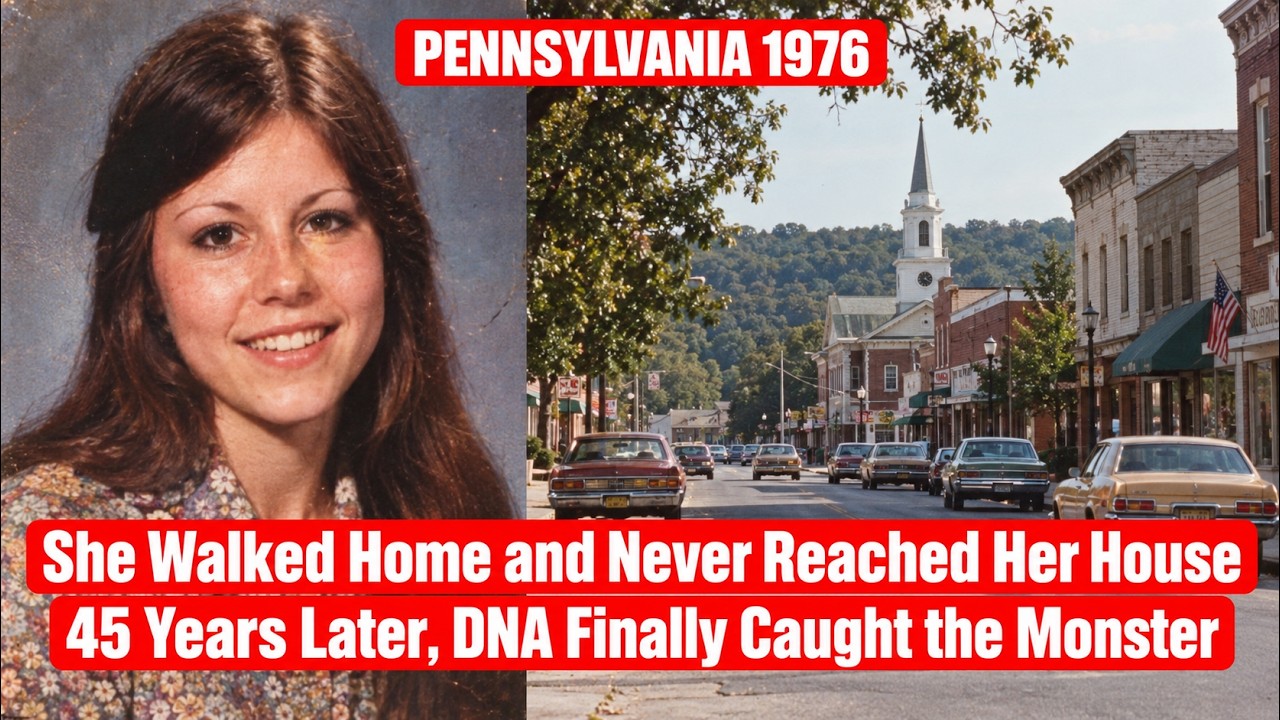
Feifer had lived three blocks from her home at the time of the killing, and he had spent the next 45 years inside the same community that had failed to find him. He attended events. He sang in the choir. He coached Little League.
He waved when people waved. The neighbors at the retirement community described their reaction afterward with a common word: disbelief. Laurel Creek in the summer of 1976 was the kind of town that kept its Fourth of July parade and meant it. It had a volunteer fire department, a church bulletin board, and a general store owned by the same family for three generations, where people still ran a tab and settled it on Friday.
The Bicentennial summer had filled the country with patriotic energy, and in Laurel Creek that meant bunting on the storefronts, a new flagpole in front of the elementary school, and a community barbecue in August that two hundred people attended. Margaret Hoffman was 51 years old and had lived in Laurel Creek for 29 of those years. She had arrived as a young wife, raised three children, endured the quiet dissolution of a marriage, and built a subsequent life largely on her own terms. She was the principal secretary at Laurel Creek Elementary School, a position she had held for eleven years.
Every child who passed through that school between 1965 and 1976 knew her face and her voice. Her garden was a source of pride, roses along the south fence and tomatoes in the back that she pressed on neighbors in August whether they wanted them or not. She had a weekly bridge game with four other women that had been running since 1968. People described her views consistently and without variation as fair.
If Margaret Hoffman thought something was right, it was generally right. On the evening of June 17, 1976, Margaret attended the annual school staff end-of-year gathering at the home of the elementary school principal. She stayed until nine, said her goodbyes, and began the eight-block walk home, a route she had taken a thousand times. She never arrived.
The next morning, her neighbor Ruth Kesler found the garden gate open and thought nothing of it until she knocked to return a borrowed cake pan, received no answer, and noticed the lights had been on all night. She called the police. Margaret Hoffman was found in the narrow lane behind her property. She had been strangled.
The investigation moved quickly in its first weeks. The Laurel Creek Police Department, supplemented by the Lancaster County Sheriff’s Office, identified three persons of interest. A man with a prior arrest record who had been seen near Margaret’s block that evening was cleared by physical evidence within two weeks. A former school board member who had a publicly contentious relationship with Margaret over a budget dispute two years earlier had been at a city council meeting with seven witnesses.
The third was Alan Feifer, 40 years old in 1976, who lived three blocks from Margaret on Sycamore Street and had no alibi for the night of June 17. He was interviewed once, answered all questions without a lawyer, and provided an account that could not be corroborated but also could not be disproved. He said he had been home alone. The biological evidence collected at the scene was processed according to the methodology available in 1976.
It was incomplete and insufficient for the technology of its time, but it was properly cataloged and sealed. The case was assigned to detective Frank Mahane, who worked it for three years before it went formally cold. Mahane was a thorough man. He interviewed 37 people over three years.
He went back to Alan Feifer twice more. Feifer was cooperative each time, expressed sympathy for the Hoffman family, and continued to live three blocks from where Margaret had died. He was in the community choir. He coached Little League in the summer.
His children attended Laurel Creek Elementary, the same school where Margaret had kept the front office. The irony of that was not lost on Frank Mahane, but irony is not evidence. Margaret’s daughter Janice left Philadelphia and moved back to Laurel Creek in 1978, partly to be closer to the case and partly because she had begun to feel the distance was wrong. She stayed.
She married a local man in 1981 and had two children who grew up in the same town where their grandmother’s killer had never been named. Dennis Hoffman, the youngest son, attended every public meeting of the Lancaster County Cold Case Task Force from 2001 onward. The task force met quarterly and produced more paperwork than progress, but Dennis was there, year after year, waiting for something to break. Robert Hoffman, the army son, died in 1989.
He had never stopped asking. By the mid-1980s, Margaret’s name appeared in the Laurel Creek Courier once a year on the anniversary of her death. The article was always brief and always ended the same way. The case remained open.
Alan Feifer lived on Sycamore Street until 1993, when he retired and moved with his wife of 41 years to a house on the outskirts of Lancaster City. By then he was 57. He had grandchildren. He sent Christmas cards.
Laurel Creek Elementary, where Margaret had run the front office for eleven years, was renovated in 1999, and a small garden was planted in the entryway in her name. The current staff knew who she was. The children who attended did not. By 2010, the Lancaster County Cold Case Task Force had been reorganized twice and renamed once.
The Hoffman file had been reviewed three times with no new leads identified. Janice was 63. She had spent 34 years watching the town where her mother died go about its life, and she had gotten very good at not showing what that cost her. In 2019, a new investigative team took over the Lancaster County Cold Case Unit.
The lead was Detective Carol Ashb, 44 years old, with an extensive background in forensic genealogy, trained specifically in the emerging field of investigative genetic genealogy, following several high-profile successful cases in other counties. She pulled the Hoffman file and submitted the biological evidence to a genealogical lab. The trace took 14 months. It moved through generations and across state lines, eliminating branches methodically, until it pointed toward a family cluster whose western Pennsylvania roots ran back through Lancaster County.
Age parameters derived from the DNA profile itself placed the unknown contributor at between 80 and 100 years of age. In 2021, Alan Feifer was 85. Ashb obtained a direct DNA comparison through a court-ordered sample. The method was indirect at first, using a relative’s DNA to confirm the genealogical match, and only upon confirmation, a warrant for a direct sample from Feifer himself.
The comparison was conclusive. On March 14, 2021, Alan Feifer was arrested at his retirement community. He had been interviewed three times by Frank Mahane, the detective who never stopped thinking about the case, and each time had answered every question calmly and cooperatively, and gone home. Feifer was charged with first-degree murder.
Due to his age and health, his legal team requested and received accommodations for the court proceedings, but the case moved forward. In October 2021, he entered a guilty plea, citing his age and a desire to spare the Hoffman family the weight of a full trial. He was sentenced to life in prison. At his age, that sentence had a particular and specific meaning.
He made no statement at sentencing. Janice Hoffman Garber, 74 years old, sat in the front row of the Lancaster County Courthouse and looked at Alan Feifer for the entirety of the proceedings. Afterward, she said she could not stop thinking about all the times he had been in the same room as her mother’s children and grandchildren and had simply continued existing. He took 45 years from us, she said, and for 45 years, there he was.
Dennis Hoffman, now in his late sixties and still living in Laurel Creek, gave a brief statement outside the courthouse. My mother deserved better from this town, he said. She deserved to be found sooner, but she’s found now, and that’s what I’ll hold on to. There is a rose garden in front of Laurel Creek Elementary School, planted in 1999 for a woman who ran that front office for eleven years and who walked home on a warm June evening and never made it through her own garden gate.
The roses come back every year. Alan Feifer had lived three blocks from that garden for seventeen years after he killed the woman it commemorates. The DNA that ended his 45 years of invisibility had been collected and cataloged at the scene in 1976, and had waited, sealed and numbered, for a technology and a database that Margaret Hoffman’s generation could not have foreseen. Justice found Margaret Hoffman.
After 45 years, it came from evidence that had been waiting since 1976 for the science to catch up to it.