On the night of May 1st, 1945, Martin Bormann slipped out of the Führerbunker in Berlin with a small group of men, all of them trying to break through the Soviet lines that had closed around the city. He had been at Hitler’s side to the very end, a witness to the dictator’s marriage to Eva Braun and his suicide the day before. His last radio message was a frantic attempt to coordinate an escape. Then he vanished.
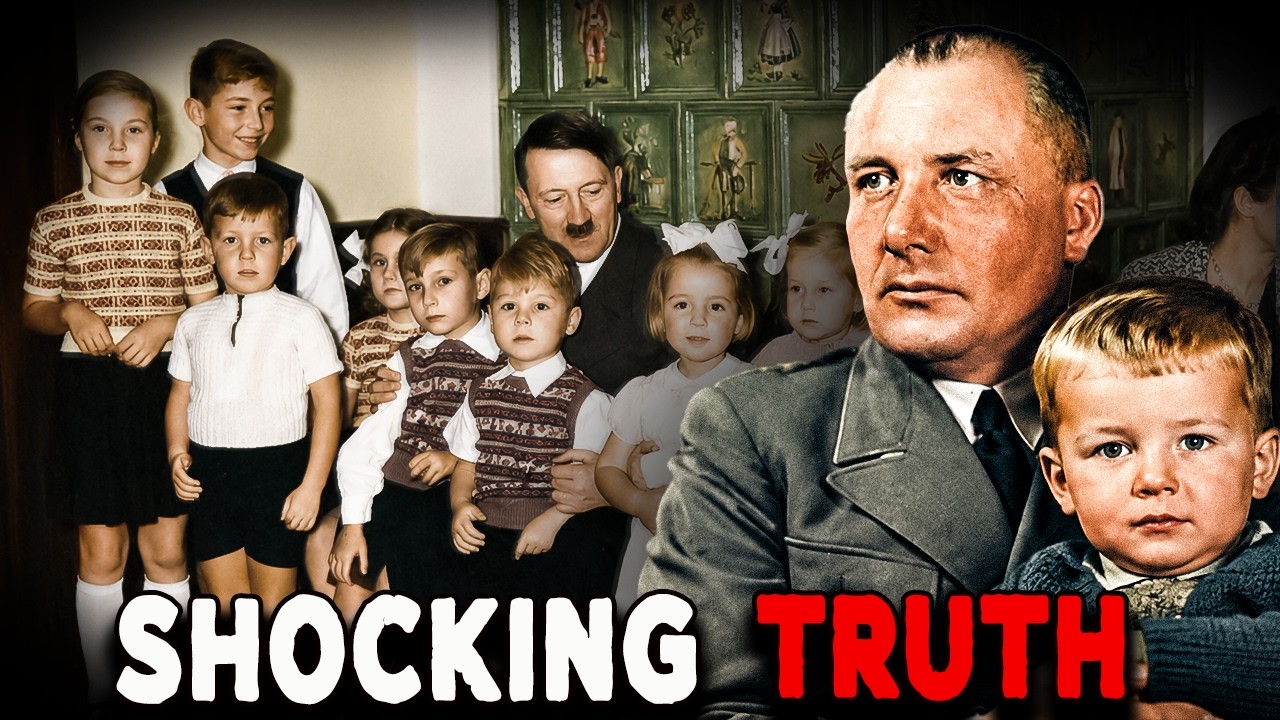
An eyewitness later claimed to have seen his body on a bridge near the Lehrter railway station, but no corpse was found. For decades, the fate of Hitler’s most trusted right-hand man would become one of the great mysteries of the postwar world. Bormann left behind more than a legacy of terror. He left a wife and nine children, a family raised in the innermost circle of Nazi power, and one that would spend the rest of their lives trying to escape the shadow of his crimes.
That family had been built years earlier in the Bavarian Alps, on a mountain called Obersalzberg. As Hitler’s chief of staff, Bormann had personally overseen the development of the heavily guarded complex around the Berghof, Hitler’s private residence. It was an Alpine fortress for the regime’s elite, and the Bormann house stood just a short walk from Hitler’s own, a daily symbol of the family’s proximity to absolute power. Here, Gerda Bormann lived out the Nazi ideal of German motherhood.
She was the daughter of Walter Buch, the supreme Nazi Party judge, who had drilled a fanatical ideology into her from childhood. She married Martin Bormann in 1929, with Adolf Hitler and Rudolf Hess serving as witnesses. Over the next thirteen years, she bore ten children, one of whom died in infancy. Her devotion earned her the Cross of Honor of the German Mother in Gold.
Her firstborn son, Adolf Martin, was Hitler’s own godson, known in the family by a chilling nickname: Kronzi, the Crown Prince. The Bormanns lived a life of extraordinary privilege, insulated from the horrors their patriarch was helping to orchestrate across Europe. Martin Bormann was the gatekeeper to Hitler, a bureaucratic master who controlled the Führer’s paperwork, appointments, and personal finances. He was a coarse and brutal man, involved in murder even before the Nazis took power, yet he held Hitler’s complete trust.
While her husband wielded that power, Gerda ran the household as a true believer. She even proposed a system of state-sanctioned polygamy to breed more Aryan children, offering to share her husband with his mistress as an example. For years, their world seemed untouchable. But in the spring of 1945, it came to a sudden and violent end.
On April 25th, a massive Allied air raid struck Obersalzberg, turning the mountain sanctuary into a smoldering ruin. That same day, Gerda gathered eight of her children and fled south toward Italy. Her eldest, fifteen-year-old Martin Junior, was away at a Nazi Party Academy and separated from the family. With the others, from toddlers to teenagers, she crossed the border into South Tyrol, a German-speaking part of northern Italy, and found refuge in the village of Wolkenstein under a false name.
While Gerda and her children hid, the final act of the Third Reich was unfolding in Berlin. Bormann remained in the Führerbunker to the end. After fleeing on the night of May 1st, he disappeared. At the Nuremberg trials, he was tried and convicted in absentia of war crimes and crimes against humanity.
On October 1st, 1946, he was sentenced to death. For his family, the verdict brought no answers, only confirmation that the missing father was a monster in the eyes of the world. Gerda did not stay hidden for long. By mid-1945, Allied intelligence had identified and arrested her.
She was taken to a prison in Merano and interrogated for days by American and British agents, who pressed her for information about her husband’s whereabouts. But Gerda, whose entire life had been confined to the roles of wife and mother, had no strategic information to offer. She was a fanatic, not a functionary. In the autumn of 1945, her health failed.
She was moved to a military hospital in Merano, where doctors diagnosed advanced uterine cancer. For a woman celebrated by the state for her fertility, it was a grimly ironic end. Some accounts suggest her death was hastened by the mercury-based medical treatments of the day. Gerda Bormann died on March 23rd, 1946, at the age of 36.
She had no trial and made no public statement of remorse. Her end was quiet and lonely. She was reportedly buried in a shared grave in Merano’s military cemetery, and her remains were later removed, cremated, and scattered at sea, erasing nearly every physical trace of her. She left behind nine orphaned children.
Their mother’s death plunged them into total uncertainty. Their father was a ghost, a notorious fugitive hunted across the globe. They were utterly alone and scattered, their powerful name a mark of shame. A Catholic clergyman named Theodore Schmitz took over the care of the eight children left in Italy, placing them in various foster homes.
To protect them, their identities were often hidden. They grew up separated not just from their parents, but from each other. Their father had been a virulent anti-Christian, yet several of his children found refuge in the Catholic Church, a profound and ironic turn. Most of the others chose to live their lives in silence, staying out of the public eye.
Ilsa died in 1958, still in her twenties. The rest, Irmgard, Rudolf, who went by Helmut, Heinrich, Eva Uta, Gerda, and Fred Hartmut, faded into obscurity, building quiet lives and ordinary careers. For them, survival meant anonymity. But for the eldest son, the crown prince, escape was never really an option.
His journey would be the most public, complex, and troubled of them all. Adolf Martin Bormann, known as Martin Jr. , was separated from his family when the Reich collapsed. At just fifteen, he was stranded in the Austrian Alps until a Catholic farmer took him in.
He hid his identity for two years, working on the farm and attending mass. It was there, reading a newspaper, that he finally learned of his mother’s death, a year after it had happened. The boy groomed to be a future Nazi leader was now an orphan, questioning everything he had been taught. He confessed his identity to a local priest, who took him in.
American intelligence officers soon found him, arresting him while he was serving as an altar boy, and interrogated him about his father. Convinced he knew nothing, they let him go. The experience marked a turning point. Martin rejected the Nazi ideology he had been raised in and converted to Catholicism in 1947.
In a stunning act of rebellion against a father who had sought to destroy the church, Martin Bormann Jr. decided to devote his life to it. On July 26th, 1958, Hitler’s godson was ordained as a Roman Catholic priest. He joined the Order of the Missionaries of the Sacred Heart and, in 1961, was sent to the Congo.
He spent years in Africa, a life of service in stark contrast to his father’s. After a severe injury in the late 1960s, he was nursed by a nun named Cordula. In the early 1970s, he renounced his vows, and the two married. He became a theology teacher, retiring in 1992.
For decades, Martin toured schools in Germany and Austria, speaking about the horrors of the Third Reich and his own childhood. He even traveled to Israel and met with Holocaust survivors. He never defended his father, but admitted he still wrestled with loving the man he knew as a father. By the time the story of his own life took its final dark turn, Martin was suffering from advanced dementia and unable to respond.
He died in 2013 at age 82, leaving the question of his legacy unresolved. While the Bormann children navigated their new lives, the world continued to hunt for their father. For twenty-seven years, Martin Bormann was the subject of sightings reported across South America. Famed Nazi hunter Simon Wiesenthal was among those who believed he had escaped.
The truth, however, was buried under Berlin. On December 7th, 1972, construction workers near the old Lehrter railway station, the same area where an eyewitness claimed to have seen Bormann’s body in 1945, uncovered two skeletons. One was quickly identified as Hitler’s doctor. The other, based on dental records and an old collarbone injury, was identified as Martin Bormann.
Glass fragments in the jaw of both skeletons suggested they had committed suicide by biting cyanide capsules to avoid capture. In 1973, West German authorities officially declared him dead. Still, rumors persisted. Finally, in 1998, German authorities ordered a definitive genetic test.
After more than fifty years, it was confirmed: Martin Bormann had died in Berlin on May 2nd, 1945. On August 16th, 1999, his remains were cremated. Martin Bormann Jr.
was permitted to take the ashes and scatter them in the international waters of the Baltic Sea, ensuring that no grave would ever become a neo-Nazi shrine.