On the afternoon of July 21st, 1985, in the unincorporated community of Glen Ellyn, Illinois, a fifteen-year-old girl named Christina Wesselmann left her house to run a short errand. Her mother, Sandra, had asked her to pick up a candy bar and a soda from the Jewel grocery store, less than two minutes away. The route was a worn dirt path through a field behind the store, familiar to every child in the Valley View subdivision. It was an ordinary Sunday, and no one in the neighborhood had any reason to think otherwise.
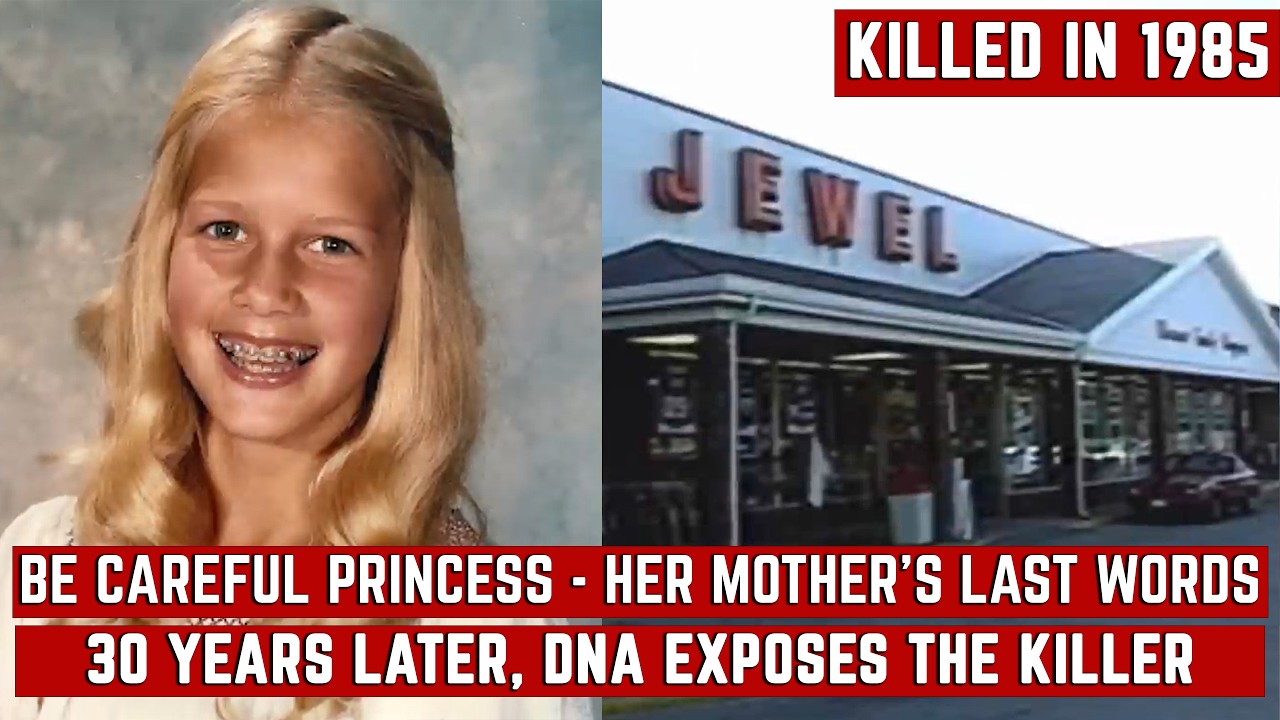
Sandra watched her daughter leave. On her way out the door, she said, “Be careful, princess. I love you,” but the words were lost on a door already closing. Christina arrived at the store around four in the afternoon.
She bought what her mother had requested. Employees saw her leave. She never made it home. At 1:50 the following morning, Sandra reported her daughter missing.
The next day, Christina’s body was found in a field directly behind the store, hidden among three to four feet of weeds. She was partially nude and had been sexually assaulted. Autopsy results confirmed a minimum of eight stab wounds. A shoelace was knotted around her neck, consistent with attempted strangulation.
The forensic evidence documented a prolonged physical struggle. Near her body lay a bag containing a half-eaten candy bar and a soda. The pearl ring she had been wearing when she left the house was gone. Forensic technicians recovered semen from the scene.
In 1985, the FBI’s national DNA database did not yet exist, so there was no way to process a profile against a national index. The evidence was cataloged and preserved anyway, on the principle that evidence only becomes useless if science never catches up to it. For thirty years, that profile sat in a file, matching nothing. DuPage County Sheriff’s detectives launched an immediate investigation.
They canvassed every street in Valley View, interviewed Jewel employees and McDonald’s staff, and ran hundreds of leads across Illinois and neighboring states. Pawn shops and jewelry stores were searched for the pearl ring. It was never found. The geographic profile of the crime was broad: the field was accessible from the road, the parking lot, and the path itself.
Anyone who knew the area could have used it. The radius of possible suspects was not narrow. One name surfaced early: Dana Henry, a thirty-four-year-old unemployed laborer from Valley View. His mother’s backyard sat roughly one hundred yards from where Christina’s body had been found.
Investigators identified him as a person of interest, questioned him, and did not charge him. He had never met Christina. When early DNA technology became available in 1988, investigators returned to Henry and requested voluntary blood and saliva samples. He declined.
DuPage County obtained a subpoena. When he continued to refuse, he was held in contempt and taken to jail. According to Henry’s account and a subsequent lawsuit filed on his behalf by the ACLU of Illinois, he was stripped of his clothing and held in a cell until he agreed to comply. He provided the samples.
They did not match the semen recovered from Christina’s body. Henry was never contacted by law enforcement again. His legal fees reached fifty thousand dollars. He lost his house.
Years later, he would describe the preceding three decades as having only two settings: angry and depressed. The apparent basis for the suspicion was that his mother’s backyard sat one hundred yards from the crime scene. He had never met the victim. The man who had actually walked out of that field was a hundred and fifty miles away, and no mechanism connected him to the murder.
He was not a man who had stopped being violent. In 1999, he pleaded guilty to domestic battery in Champaign County. Under the laws then in effect, a misdemeanor conviction did not require DNA submission to any database. His profile remained absent from CODIS, the FBI’s national system that had been searchable across all fifty states since its creation.
A felony conviction would have placed him in the database fifteen years earlier. The misdemeanor classification was the precise legal boundary that determined who did and who did not submit a genetic record. In July 2015, that man, Michael R. Jones, pleaded guilty to a second domestic battery charge in Champaign County.
This one was a felony. He submitted the required biological specimen. Sixty-one days later, on September 10th, 2015, a notification arrived at the DuPage County Cold Case Unit. The specimen Jones submitted under a domestic violence statute had returned a match against the semen profile entered into CODIS from Christina’s crime scene thirty years earlier.
The comparison spanned thirteen core genetic loci, with a statistical probability of coincidence in the range of one in several trillion. It was not an approximation. It was the same. A search warrant was issued for Jones’s residence in Champaign.
Investigators arrived on Friday, September 18th, 2015. Jones denied any connection to Glen Ellyn. Shown a photograph of Christina, he said, “As God is my witness, I have never seen her before. ” Two days later, he was arrested and held without bond at the DuPage County Jail.
Michael Jones’s record in the Illinois legal system had not begun with Christina. It preceded her by nearly a decade. In 1976, he sexually assaulted a woman named Judith Van Kirk. He was never convicted.
In 1977, he rammed his vehicle into a woman on a bicycle on the northwest side of Chicago, bound her wrists, covered her head, dragged her into his car, and drove her to his parents’ home, where he sexually assaulted her. Her name was Jeri Michael. Jones was convicted and sentenced to between ten and twenty years. He served six and was released on parole.
Those parole conditions were current on the afternoon of July 21st, 1985, when Jones walked into the field behind the Jewel in Glen Ellyn. He had been formally classified as a violent offender and placed under active monitoring. The machinery designed to manage men like him had processed him, logged him, and returned him to public streets four years early. He arrived in that field with a method he had already used and a parole that should have had years left on it.
A piece of legislation passed in 2002 had been built, in part, around the shape of what happened to Christina Wesselman. The Illinois General Assembly required any person convicted of a felony to submit a biological specimen for genetic marker testing. The law was introduced by DuPage County State’s Attorney Joe Birkett, who had watched a preserved DNA profile sit in a database with nothing to match against it. The law was patient, searchable, and waiting when Jones handed over a felony conviction in Champaign County thirteen years later.
On January 18th, 2018, Michael Jones entered a DuPage County courtroom and pleaded guilty to murder and sexual assault. Thirty-two years and nearly six months had passed since Christina’s body was found. Sentencing took place on January 23rd. Jeri Michael, the woman Jones had run off a bicycle in 1977, stood before the court.
“Had he served at least the ten years,” she said, “we wouldn’t be here today for this. ” Judith Van Kirk, his 1976 victim, addressed the court next. “I was Michael Jones’s first victim. He took away our innocence, but he did not take away our love that we have inside.
” Sandra Wesselman, seventy-eight years old, delivered an eleven-minute victim impact statement. She glanced at Jones once and said afterward, “It’s a joyful day and a very sad day. We will always miss Christie. I can go home today and try to be a real person, whatever that is.
”
Judge Brian Tellander sentenced Michael Jones to eighty years in state prison. He was sixty-four at sentencing. He will be over one hundred before he is eligible for parole. “Based on his conduct,” the judge said, “the defendant has earned each and every day of his sentence.
” Jones did not speak. Dana Henry sat in the gallery as Jones was sentenced. He watched the man who had cost him fifty thousand dollars, his house, and thirty years of his life receive eighty years. Asked if it brought peace, he said, “I just want what I lost back.
”
Within weeks of Jones’s arrest, Christina’s former Glenbard South classmates had begun raising funds to restore a scholarship in her memory. The original award, started by Sandra with a single check in 1988, had been given once and allowed to lapse. It became an annual scholarship, awarded every year to the freshman class president, the same role Christina had held. The file is closed.
The path is gone. Sandra kept her promise.