In April 1985, the Coca-Cola Company’s telephone hotline in Atlanta received roughly 400,000 calls and letters in a single month. These were not complaints about quality or warranty claims. People were calling to mourn a soft drink. One woman from Seattle appeared on local television and declared she would rather bury her husband than accept what the company had done.
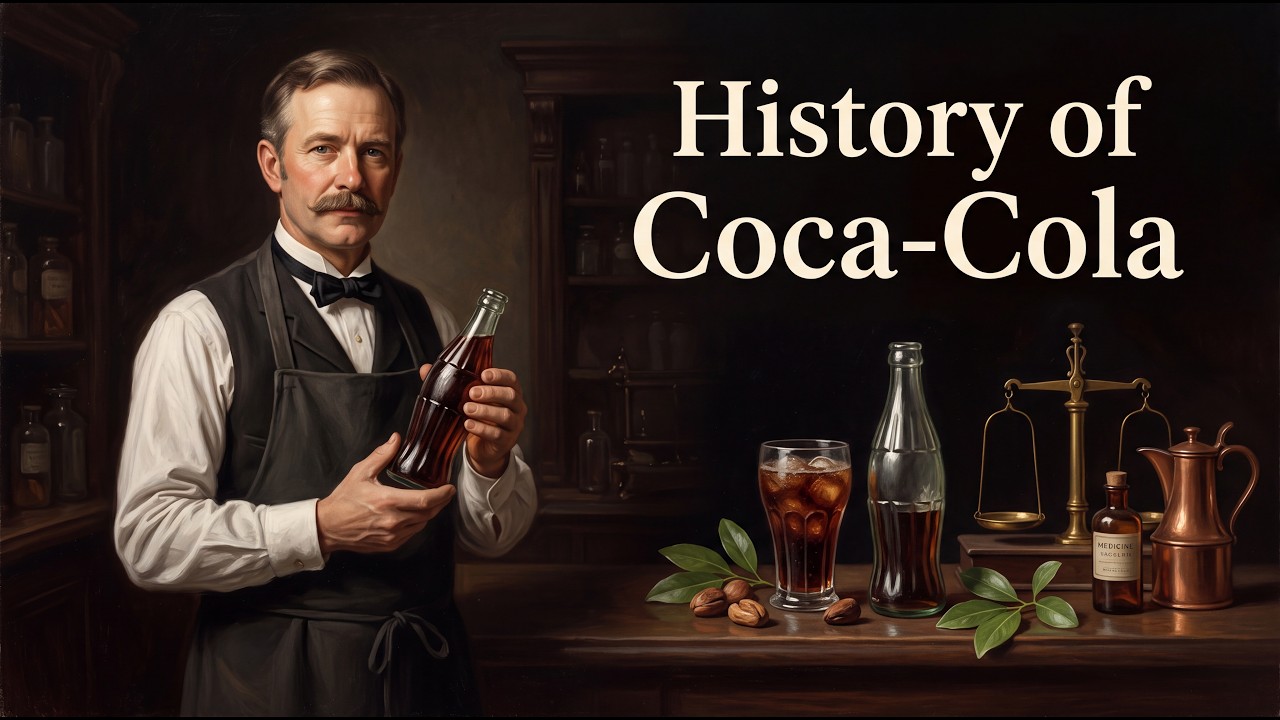
On the black market, bottles of the original formula began selling at inflated prices as though they were rare antiques rather than soda. In some cities, organized groups of angry consumers demanded the return of the original taste, and a Seattle resident filed a lawsuit claiming that replacing the formula violated his personal consumer rights, though he later admitted the lawsuit had been more of a symbolic gesture than a genuine legal claim. The reaction did not begin in 1985. It began a hundred years earlier in a small pharmacy in Atlanta, where a pharmacist named John Pemberton was stirring syrup in a copper kettle, preparing a tonic made from coca leaf extract and cola nuts intended to treat nervous exhaustion and headaches.
At the time, the cocaine component raised no concerns. Coca extract was widely sold as an ingredient in dozens of patented medicines. Pemberton was typical of the pharmacists of his era. The product sold poorly.
Pemberton died in 1888 without ever becoming wealthy from his invention, and by the end of his life he had sold the rights to the formula to several different buyers at once, which later produced a tangle of legal disputes among his heirs. The rights were eventually consolidated by businessman Asa Candler, who transformed the modest pharmacy syrup into the company that exists today. The cocaine component did not disappear immediately, nor primarily out of concern for consumers’ health. By the beginning of the twentieth century, attitudes toward cocaine in the United States had grown cautious, and several southern states introduced laws restricting the sale of products containing the drug.
Under pressure from changing legislation and public opinion, the company gradually reduced the active cocaine alkaloid to virtually zero by 1903, while continuing to use coca leaf extract as a flavoring ingredient after removing its psychoactive substance. The industrial process of decocainizing coca leaves remains one of the very few legal operations of its kind in the United States, permitted under federal law specifically for the production of the beverage. Candler was an exceptional marketer, but one of his decisions later came to be described as one of the most expensive business mistakes in American commercial history. In 1899, two lawyers from Tennessee approached him with a proposal to establish bottling plants across the country and asked for the rights to bottle the drink.
Candler dismissed the idea as having little future. He believed the product belonged in pharmacy soda fountains, not in bottles, and he sold the bottling rights for what later proved to be a symbolic sum compared to the profits they would generate. Bottled Coca-Cola turned out to be exactly the format that transformed the drink into a mass-market product, making it available in virtually every store and gas station across the country rather than only at pharmacy soda fountains. For years, the company fought legal battles with independent franchise bottlers in an effort to regain control of a business it had given away for almost nothing.
The terms of the 1899 agreement fixed the price of syrup on paper indefinitely, with no adjustment for inflation. Decades later, when inflation accelerated during the 1970s and world sugar prices soared, the company found itself forced to sell syrup to its own franchise bottlers at prices set at the beginning of the century. This led to another wave of legal disputes that stretched on for nearly two decades before a compromise introduced a variable pricing system. The decision to sell the bottling rights is often judged harshly in hindsight.
In purely financial terms, Candler gave up enormous future profit. But in the context of 1899, the decision was rational. The company had neither the capital nor the production capacity to build its own nationwide bottling network, and transferring that risk to independent entrepreneurs in exchange for guaranteed growth in syrup sales was a logical way to expand without massive investment. There is a persistent myth that the original Coca-Cola formula exists in only a single copy locked inside a special vault in Atlanta, known to only two people at any given time who are forbidden from flying on the same airplane.
In 2011, the company did move the historic handwritten formula into a secure vault at the World of Coca-Cola as a museum exhibit and branding asset. But the secrecy surrounding the formula is far more ordinary than the legend suggests. Throughout the twentieth century, independent chemists and journalists repeatedly published versions of the recipe, including a credible reconstruction released in the 1970s by a reporter for the Atlanta Journal-Constitution who recreated the formula from old records belonging to the Pemberton family. The company never seriously challenged these publications.
A more likely explanation is that the mystery of the formula has long since become less about protecting the recipe itself and more about preserving a marketing asset. From a legal standpoint, the formula was never protected by a patent, because a patent requires the complete public disclosure of a product’s composition in exchange for a temporary monopoly of typically twenty years, after which the formula enters the public domain. The company deliberately chose not to patent the recipe in the late nineteenth century so it could keep the composition a trade secret indefinitely. While patents covering competing tonic drinks expired and became public knowledge, Coca-Cola’s trade secret has formally remained in effect for nearly 140 years.
By the twenty-first century, the secret served less as a means of protecting the recipe and more as a pure marketing tool. The chemical composition of virtually any industrial beverage can be reconstructed through laboratory analysis in a matter of days, and competitors are fully capable of producing drinks with an almost indistinguishable taste. The brand’s real protection lies in the story surrounding it, the sense of participating in a mystery that the company sells along with every bottle. By the beginning of World War II, company president Robert Woodruff made a decision that looked like a financial loss on paper but laid the foundation for the brand’s global empire.
He announced that every American serviceman, no matter where he was stationed, would be able to buy a bottle of Coca-Cola for five cents, regardless of the actual cost of delivering the product to a combat zone. The company began building bottling plants in close proximity to front lines from North Africa to the Pacific Theater, often with direct logistical support from the US military, which regarded supplying soldiers with a familiar drink as a matter of morale. By the end of the war, the company had built more than sixty such plants overseas, financed as part of the war effort rather than as commercial ventures. When the war ended, those facilities became a ready-made international production network.
The company’s civilian technical specialists, who officially accompanied US Army units as consultants responsible for maintaining bottling equipment, earned the nickname Coca-Colons among the soldiers, though none of them held military rank. Some bottling plants had to be evacuated or rebuilt after enemy attacks. Woodruff was not buying short-term profits. He was buying decades of consumer loyalty, linking an entire generation’s memories of liberation and victory with the taste of Coca-Cola.
In 1979, as the United States and Communist China were just beginning to restore diplomatic relations, Coca-Cola became one of the first Western consumer products officially allowed into the Chinese market. The presence of an American drink on the shelves of a communist country was seen as much as a political signal as a commercial deal. Long before China, similar symbolism appeared with the Soviet Union. In 1959, during the famous kitchen debate between Soviet Premier Nikita Khrushchev and US Vice President Richard Nixon at the American National Exhibition in Moscow, a bottle of Coca-Cola became one of the few Western consumer products publicly offered to the Soviet leader on camera.
By the early 1980s, Coca-Cola’s main competitor, Pepsi, had launched a marketing campaign known as the Pepsi Challenge. People were invited to taste both drinks blind, without seeing the brands, and choose the one they preferred. In most of these blind taste tests, participants consistently favored the sweeter taste of Pepsi. Coca-Cola’s leadership took those results seriously.
The company conducted its own extensive taste tests, reformulated the drink to make it sweeter and smoother, and announced that the classic formula would be completely replaced by a new version called New Coke. The company’s internal marketing research cost around four million dollars and involved more than 200,000 participants, making it one of the largest consumer taste testing programs ever conducted. The leadership was so confident that the decision to replace the formula was made almost unanimously, despite warnings from a handful of marketing executives that a blind taste test based on a single sip could never predict the reaction of consumers who had spent years associating a particular flavor with personal memories and lifelong habits. The backlash was so overwhelming that after just seventy-nine days, the company brought back the original formula under the name Coca-Cola Classic, effectively capitulating to public pressure.
There is a conspiracy theory that the entire New Coke fiasco was a carefully planned marketing operation designed to generate emotional attachment to the returning original formula. The internal company documents and later admissions from senior executives suggest the panic was genuine rather than staged, and that Coca-Cola’s marketing team was just as caught off guard as the consumers. A genuine failure accidentally became one of the most powerful demonstrations of brand loyalty in the history of consumer products, and the company capitalized on that accident, weaving the story of its own mistake into the brand’s mythology. Company CEO Roberto Goizueta spent years publicly describing the New Coke episode not as a failure but as a successful experiment that proved the enduring value of the original product.
Yet employees who worked alongside him during those weeks later recalled an atmosphere far closer to a genuine corporate crisis than to any carefully planned experiment. Today, Coca-Cola remains one of the most recognizable trademarks on the planet, sold in more than 200 countries, with its logo recognized by nearly ninety-four percent of the world’s population. Over the past two decades, the company has faced growing criticism over the link between sugary beverages and obesity and diabetes, prompting it to introduce reduced-sugar products and diversify through the acquisition of water, juice, and energy drink brands. In some countries, the formula itself is adapted to comply with local regulations.
In Mexico and several European countries, Coca-Cola is made with real cane sugar rather than the high fructose corn syrup used in the United States. These regional variations have become a subject of cult following among travelers who deliberately seek out bottles from specific countries because of the differences in flavor created by local sugar regulations. The journey from a copper kettle in an Atlanta pharmacy to a global corporation passed through legal confusion following the inventor’s death, a franchise deal that proved one of the costliest business mistakes in history, the wartime logistics of a global conflict, the diplomatic symbolism of the Cold War, and one voluntary failure the company ultimately turned to its own advantage. The telephone hotline overwhelmed with calls in April 1985 proved something the company had never intended to prove.
The value of a product is measured not by what is inside the bottle, but by how many years of human memory have been poured into it.