Eugene O’Neill won the Nobel Prize in Literature and four Pulitzer Prizes, and he is almost universally regarded as the greatest playwright the United States has ever produced. The work that earned him that reputation was built on the ruins of his own family: a morphine-addicted mother, a miserly actor father, and an alcoholic older brother. He dramatized their destruction with such merciless honesty that Long Day’s Journey into Night is widely considered the finest American play ever written. Yet the same man who could diagnose a family’s collapse on the page could not do anything to stop the identical catastrophe unfolding in his own house.
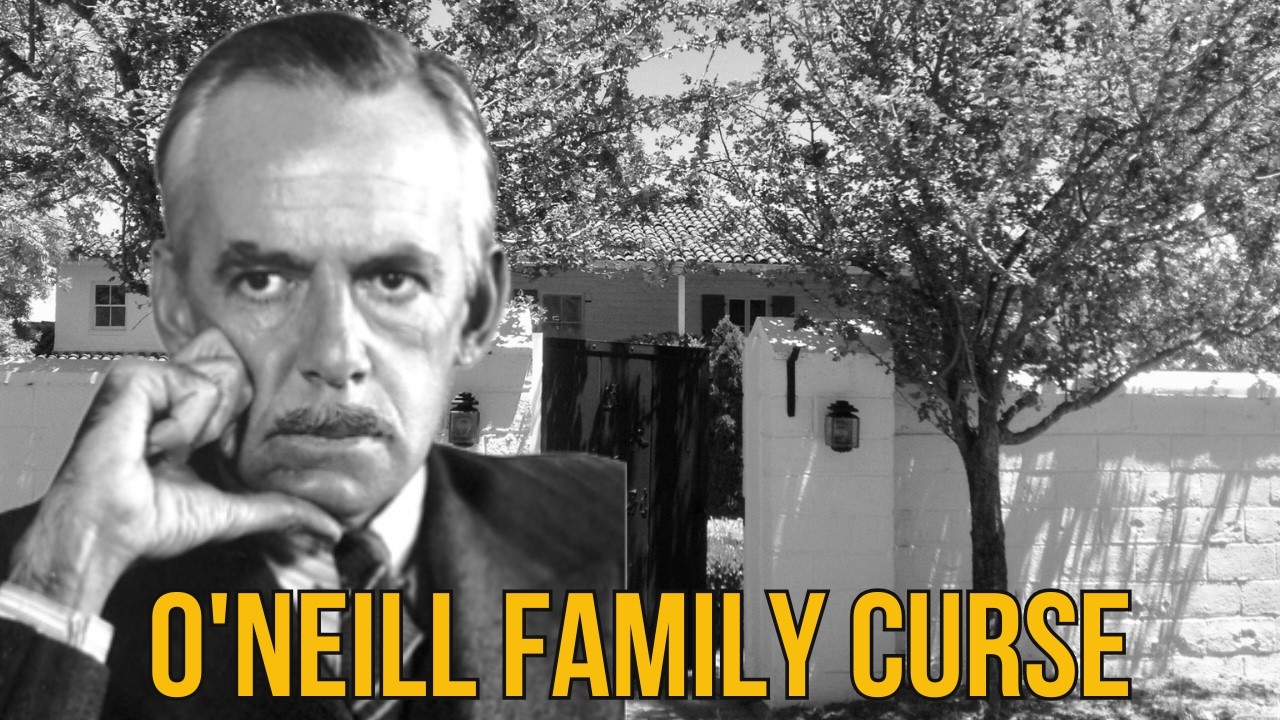
He had three children. Two of them died by their own hands, and the third was erased from his life for falling in love. When he died in a Boston hotel room in 1953, he had not spoken to his only daughter in a decade, his eldest son was three years in the grave, and his youngest was lost to heroin and grief. O’Neill was born on October 16, 1888, in a hotel room on Broadway in New York City, because his father, James O’Neill, was a traveling actor and the family had no real home.
James had been one of the most famous performers in America, a matinee idol who squandered a serious classical career to play The Count of Monte Cristo for decades, earning fortunes while the soul of his art withered. Raised in brutal Irish immigrant poverty, he could never stop counting pennies, even at the height of his wealth. Eugene’s mother, Mary Ellen, called Ella, received morphine for the pain of his difficult birth. It was routine in 1888, and no one understood the consequences.
Ella became addicted that day, and she remained addicted, on and off, for more than twenty years. The family performed normalcy around her, while the truth of the upstairs bedroom was never named aloud. Eugene grew up believing, in some buried way, that his birth had broken his mother. He was sent to boarding school at seven, learned to drink from his brilliant, alcoholic brother Jamie, and spent his early adulthood as a sailor and a drunk.
In the winter of 1912, in a room above a saloon on the New York waterfront, he swallowed an overdose of sedative and tried to kill himself. He survived by accident, then contracted tuberculosis and was sent to a sanatorium. Lying flat on his back with nothing to do but think, he decided to become a playwright. It saved his life.
Within eight years he had won his first Pulitzer, and by 1936 he became the only American playwright ever awarded the Nobel Prize. At the same time the prizes piled up, he was quietly building the next catastrophe. By 1929, married for the third time to the actress Carlotta Monterey, he had everything his own childhood lacked: money, fame, a magnificent estate on Sea Island, Georgia, built in a Spanish style shaped like a ship. Carlotta organized her entire existence around protecting his genius, managing the money, the houses, the visitors, and giving him the silence he needed to write.
But his three children were almost never in that house. He loved the idea of them at a distance, but could not bear them near. They were packed off to schools, relatives, and their mothers, anywhere the great man was not writing. He was doing to his own children exactly what his father had done to him, only in a bigger house.
In 1941, writing in California, he produced Long Day’s Journey into Night, weeping at his desk day after day by his wife’s account. He put his own dead mother and father on the stage, dramatizing with merciless precision how a family with talent, love, and money tears itself apart through addiction and the inability to say the true thing out loud. He saw the disease clearly in his own childhood. He could not see it in his own house, because at the very moment he was diagnosing his parents’ tragedy, the same disease was working through his three children in three different cities.
Eugene O’Neill Jr. , the eldest, was born in May 1910 while his father sailed for Honduras, and Eugene did not lay eyes on the boy for eleven years. Raised in an ordinary middle-class home by his mother and her second husband, the boy grew up away from the great man’s shadow and, by every early measure, magnificently. He was tall, athletic, brilliant, and genuinely gifted at the classics.
At Yale he studied Greek and Latin, earned his doctorate, and by his late twenties was a respected professor of Greek tragedy and a translator, one of the most promising classicists in America. When he finally met his father, something rare occurred: of the three children, Eugene Jr. was the one his father actually respected. They talked about Aeschylus and the structure of tragedy as equals.
The father was proud of this son in a way he could never quite manage with the others. But Eugene Jr. had inherited more than the name. He had inherited the drinking.
Quietly at first, then not quietly, the same alcoholism that had destroyed his uncle Jamie and was even then loosening its grip on his own father. His career began to wobble. He left Yale under murky circumstances. By his late thirties he was a man with three failed marriages, a fading reputation, and a drinking problem he could not master.
And the father pulled away. The respect had been conditional, based on success and intellect. As the son unraveled, the pride curdled into disappointment, then coldness. Requests for money were met with the same miserliness that had defined James O’Neill.
On the night of September 25, 1950, alone in a cottage near Woodstock, New York, Eugene O’Neill Jr. cut his wrists and ankles, opened his veins, and bled to death, the Roman way, the death of the Stoic philosophers he had spent his life teaching. He was forty years old. He left a note containing a black classicist’s joke, something to the effect of never letting it be said that an O’Neill failed to empty a bottle.
When news reached the father, the reaction was, by every account, devastating in its restraint. He grieved, but he could not break open. The man who had wept over his own mother on the page could not weep for his own dead son in any way the world was allowed to see. Shane O’Neill was the son who grew up too close.
Born in 1919 to Eugene’s second wife, Agnes Boulton, he was a beautiful, gentle, dreamy child, sensitive exactly as his father had been, without the one thing that had saved his father, the iron compulsion to write. And he had a father who could not bear him. Eugene was not cruelly dramatic with Shane, just devastatingly absent and cold. The boy worshipped him, and the father responded with lectures, disappointment, and finally weary contempt.
Shane tried art, tried the sea, tried everything to win the love that had been decided against before he could speak. By his twenties he was a heroin addict, and he would remain one for the rest of his life. In 1944 he married Catherine Givens, and in 1946 they had a son, named Eugene O’Neill III, carrying the great man’s name into a new generation. The baby lived only months.
In early 1948 the infant died in his crib, of what we would now call sudden infant death syndrome, a cause that then had no name, no explanation, and no mercy. The loss broke Shane in a way nothing ever mended. His father, the most articulate man alive on family grief, offered almost nothing. Soon after, Eugene O’Neill disinherited him entirely.
Shane carried two unbearable things for the rest of his life: a dead son he could not save and a living father who would not. The single coldest act of O’Neill’s life was committed against the one child who had done nothing wrong. Oona O’Neill was his only daughter, born in 1925 to Agnes Boulton. She was enchanting, dark-haired, witty, luminous, and by her teens a celebrity in her own right, a debutante of the year courted by the brilliant young men of her generation, including the writer J.
D. Salinger. Her father loathed her glamour. And in 1943, at eighteen, she married Charlie Chaplin.
Chaplin was fifty-four, thirty-six years older than she was, older than her father, and a figure of constant scandal. Eugene did not attend the wedding. He cut her off financially, legally, and totally, and he never spoke to her again, not once, for the rest of his life. He refused her letters, refused contact.
He decided that his only daughter no longer existed, and he held to that decision with the same iron will he brought to his work, all the way to his death. He never met any of her eight children. The savage irony is that the marriage he condemned her for turned out to be one of the great happy marriages of the twentieth century. Oona and Chaplin were married for thirty-four years until his death, building a warm, stable home in Switzerland with eight children.
Chaplin gave her the steadfast devotion and tenderness Eugene never gave any of his children. She was the only one of the three who escaped the curse, and she escaped by running into the very marriage her father damned her for. The man who knew the human heart more deeply than almost anyone who ever held a pen was catastrophically, completely wrong about his own daughter. Shane carried the tragedy alone into the 1970s.
The decades after his father’s death were a long disintegration: heroin, poverty, more children he loved but could not properly care for, the dead baby always behind him, the disinheritance, the shame of the famous name. On June 23, 1977, in an apartment in Brooklyn, Shane O’Neill opened a window on an upper floor and jumped. He was fifty-seven years old. The second son dead by his own hand, twenty-seven years after the first.
Charlie Chaplin died on Christmas Day, 1977, within months of Shane’s suicide. Oona was fifty-two. For thirty-four years she had leaned entirely on the older man who had replaced her father, and when he was gone, the structure that held her up collapsed, leaving nothing underneath but the original wound, as raw as it had been at eighteen. She turned to the bottle, the same alcoholism that had run through the entire family for generations.
Oona O’Neill Chaplin died of pancreatic cancer on September 27, 1991, in Switzerland, at sixty-six, the last of Eugene O’Neill’s children. She had outlived her brother by forty-one years, her father by thirty-eight, and she spent her final years drinking against a loss that had two faces: the husband and the father. Of the three children, only Oona left a line of descendants. Her eight children included Geraldine Chaplin, who became a celebrated actress in her own right, carrying the blood of both Charlie Chaplin and Eugene O’Neill, two of the most important figures in the history of American performance, joined in a marriage that one of them tried with all his iron will to forbid.
The family did not end at the cottage in Woodstock or under the Brooklyn window. It continued through the one child the great man threw away. There is no photograph of Eugene O’Neill holding one of his grandchildren because it never happened, not once. When Oona’s letters came, he did not open them.
When reconciliation was possible, he closed the door. He died in a Boston hotel room in 1953, his hands shaking too badly to hold a pencil, his unproduced masterpiece sealed in a drawer, his first son three years dead, his second lost to heroin and grief, his daughter erased and forbidden. He had written the truest tragedy in American letters about a family destroyed by a cold father and an addicted mother, and at the very moment he was writing it, he was living it with his own children. He understood the wound perfectly.
He could name it with total precision. And understanding was where he stopped. He died without ever turning that mirror toward the family he made, alone with the one tragedy he could never bring himself to write down, the one with his own name on every grave.