In the spring of 1897, the road into Willowbrook Hollow in Letcher County, Kentucky, ended at the sawmill for reasons no one would state aloud. The families living below the ridge avoided mentioning the name of the family living above it. In the county records, the pages containing two births and one marriage had been carefully torn from the edges. The women at the head of the hollow were Mercy and Tabitha Ottwell.
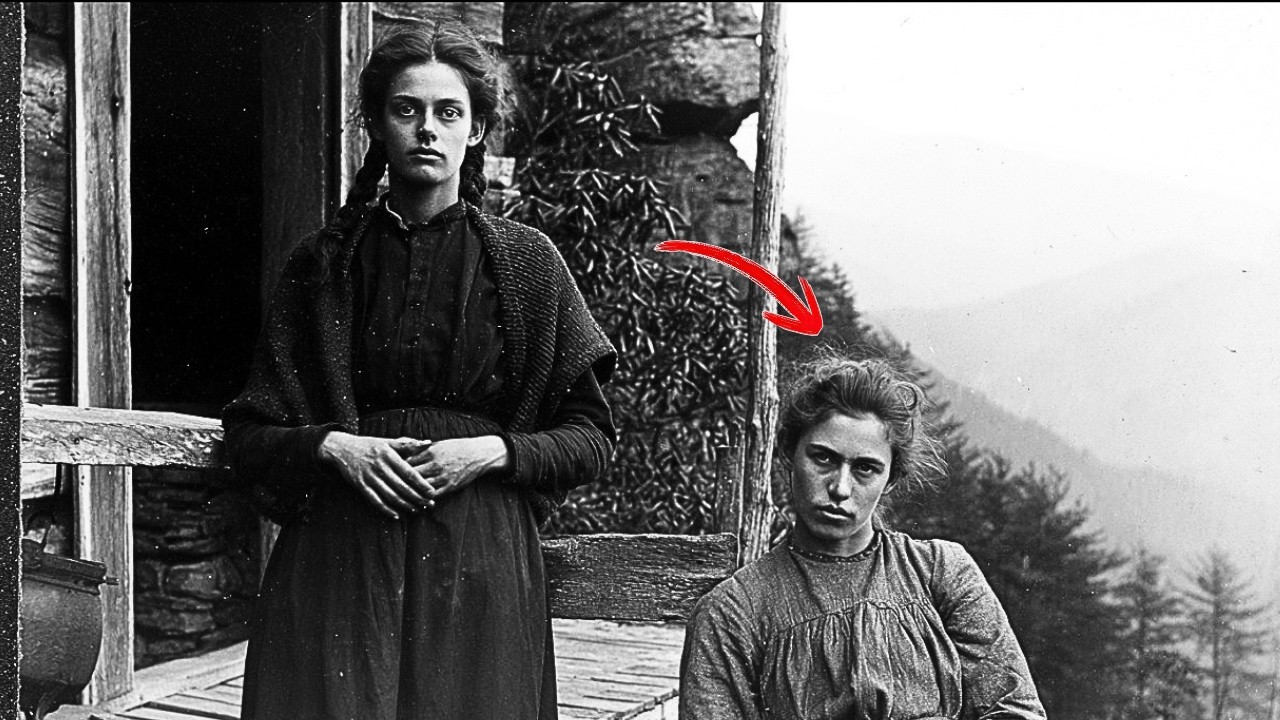
Mercy was thirty-two, Tabitha twenty-eight, the last of a line that had settled the valley before the county itself had a name. Their great-grandfather had come from the Yadkin Valley carrying a rifle, an ax, and a debt he never intended to pay, passing three cleaner settlements to stop beneath a rock ledge where winter sunlight reached the porch for only two hours a day. He lost one of his hands in that first winter, and by the time a traveling photographer captured his image in 1831, the right sleeve of his coat was pinned shut. That photograph still hung in the church annex, the first face in a family record the church would later strike from its books four generations on.
The sisters lived in the same cabin where their mother, Sylvina, had died and where their father, Absalom, had walked past the springhouse one November morning in 1889 and never returned. No one brought his body home. The people of the valley did not speak of what he had seen in that hollow, or what he had done that first winter, or why the porch faced a direction that suited neither sunrise nor the approaching road. They only knew, the way small places know things without writing them down, that the family at the top of the notch had always kept something in check.
Mercy and Tabitha were the ones the county sent for when someone needed saving through the winter. Old Prudence Halloran, sixty-eight that spring, told anyone who sat still long enough that Mercy had come down through a snowstorm with a jar wrapped in flannel, sat by her bed for a day and a night without eating or sleeping, and the fever had broken by dawn. The tea tasted like nothing anyone could name, and Prudence learned to want the result, not the recipe. Both things were true.
The sisters healed the sick. And their names had been blotted from the church register by the previous minister, a man named Kelso, who had held the pulpit for sixteen years without once climbing the mountain path to visit them, and who left the table without a word when pressed for a reason at a Christmas dinner. His replacement, the Reverend Elfinstone Corwin, climbed that path in the second week of April 1897, carrying a Bible and a question. He was forty-one, a graduate of a seminary in Ohio, with two years of mission work along the Cumberland River behind him.
The mule the deacons had lent him refused the final turn, so he tied it to a laurel and walked the last half mile. Mercy met him on the porch. Before he could speak, she told him he was welcome to sit, that she would make tea, and that if he had come to strike their names from the book again, it had already been done. Corwin later wrote to a friend in Cincinnati that she had a way of looking at you that was not unkind, and that was the problem.
A woman who looks at you harshly is a woman you can argue with. A woman who looks at you the way Mercy Ottwell looked at him had already finished the argument in her head and was waiting patiently for you to catch up. He asked about their parents. Mercy said her father had passed the springhouse in November of 89, climbed to the gap, and not come back.
When asked if they had gone to look for him, she said they had gone as far as they were meant to go, and no farther. Some land was theirs to keep, she told him, and some they were not to set foot on. Their father had known the difference and chosen to forget. When he asked if he could pray in the house, Tabitha spoke from the corner, barely audible, saying the house did not need it either.
Corwin noticed that she spoke only when prayer was raised, and that when she did, the two large dogs sleeping by the hearth lifted their heads and looked not at her, but at the door. As he left, Mercy told him that if he heard singing on his way down, he must not turn around, must keep walking, must hum something loud and dull until he passed the sawmill. When he laughed politely, she said without changing her tone that she was not joking. He heard the singing halfway down, in the trees to his left, then to his right, then directly behind his ear, a woman’s voice matching his steps one for one.
It was Tabitha’s voice, he was certain of it. He hummed a hymn he did not much like, did not turn, and at the sawmill the singing stopped mid-word. By the end of April, three separate reports had reached Sheriff Silas Radcliffe at the county seat. A traveling salesman had turned back at the pass because his horse refused a certain bend.
A widow named Ora Thrillgill said she had woken three nights in a row to someone trying her front door, the latch moving, then stopping, then moving again, and on the fourth morning found a bundle of dried sage on the top step wrapped in gray cloth, and knew who had left it. The third report came from Uriah Thrillgill, a forty-six-year-old timber cutter, who described a circle the width of a wagon wheel where every leaf had been turned upside down, not scattered, but turned like a playing card, with something in the middle he had not approached close enough to identify. He said he did not believe it was something meant to be looked at. Radcliffe was fifty-seven, eleven years in office, a practical man who believed most mountain mysteries were a shortage of daylight and an abundance of liquor.
He read the reports, sat on them for a day, then saddled his horse on the morning of May 2 with a deputy named Enoch Blodsoe, twenty-nine, whose only qualification was being the nephew of the sheriff’s wife and needing the pay. When they reached the cabin at one-thirty, the door was locked, unusual in itself, since locking a door in a small community was the same as saying something you did not want to say. The sheriff knocked and called both names. From inside came a single sound: a chair being drawn from under a table.
When the door opened, Mercy Ottwell stood there, a woman who had not slept in a week. She said they had expected him, but not so soon. She stepped onto the porch and closed the door behind her. Something had gotten in, she told him.
Her family had always performed certain care. Her mother had known it, her grandmother had known it, and the ground at the top of the gap was not ground that could be left untended. Her father, in his last year, had decided the care was superstition, had stopped doing it, and had climbed up there in November of 89 to prove there was nothing to fear. That was why he never came back.
The minister’s visit had not caused what was happening, she said, but it had been noticed. Something had used it as a gate. Something had followed him back down. Then, three weeks later, it had returned, and this time it had brought company.
She asked the sheriff to go back down, to tell the widow to burn the sage and keep a lamp burning three nights, to tell Uriah Thrillgill not to walk his upper line at dusk until mid-June, and to tell the minister to burn the notebook he kept. She said she and Tabitha would handle the rest. When Radcliffe said he could not simply leave, that if there was a problem, he was the one meant to be there for it, she told him this problem was not his kind, that his help would make things worse, that his gun would be as useful as a bell that does not ring. Then she asked him, not as a suspect asking a sheriff, but as a neighbor asking a neighbor, not to enter the cabin.
He would carry what he saw there for the rest of his life. He did not enter. Deputy Blodsoe wanted to, on principle, and the sheriff put a flat hand on his chest and turned him around. On the ride down, both men heard singing behind them for the last mile.
At the sawmill, Blodsoe stopped his horse. The sheriff told him to keep riding. The sheriff filed a report listing the women as missing, writing that no evidence of a struggle had been found and that the cabin and outbuildings were in an orderly state, that the springhouse was empty, and that the road above the sawmill was closed by his order until further notice. He never reopened it.
When a state survey for a new farm-to-market road came through in 1922, a young engineer met with the sheriff, returned home, and the route was changed. On later maps, the road appears as a dotted line marked private, with no private owner listed. Ora Thrillgill kept Tabitha in her home for the rest of her life. Tabitha did not speak a single word for thirty-seven years, except once in 1902, when she sat up in bed at dawn and told Ora that Mercy had finished the work, that Mercy was still up there, that Mercy did not want to be brought down, and that Ora must not send anyone up.
When Ora asked how she knew, Tabitha said she had woken up knowing. She lay back down and never spoke again. She died in 1934, at sixty-five, in a bed facing east, because she had left a note asking for it to be turned so she could see her sister when she came. She was buried under a small stone that reads only: Tabitha Ottwell, Sister.
The Reverend Corwin left the county in June of 1897. His notebook, which stops mid-sentence on the ninth day, was given to the historical society and now sits in a Chicago archive. The final full entry, from the eighth day, says he did not know what he had seen at the top of the gap. He knew it was a woman.
He knew she was not the older sister and not the younger. He knew she was looking at him and smiling, and that she stood where no woman could stand, because the ground behind her did not exist. The mountain simply ended. The next day’s entry reads: God help me.
Then an ink blot, then nothing. Sheriff Radcliffe stayed in office until 1915. He never spoke publicly about Willowbrook Hollow, but in a private letter to his wife, he wrote that his certainty that not entering that cabin was the best decision he ever made. He wrote that he understood, standing on that porch looking at Mercy’s face, that she was about to do something on behalf of all of them, for the whole valley, and that his job that day was to stay out of her way.
Hunters in Letcher County have said for generations that the cabin still stands, that the paint on the front door looks fresh, that the porch is swept, that the remains of the four candles still sit on the four corners of the shelf and the fifth still sits on the table, and that the back door of the cabin, the one leading to the springhouse, is always open. They say that if you stay quiet at the right hour, you can hear someone humming steadily somewhere above the springhouse, a tune no one quite knows but everyone thinks they have heard before. One old hunter said he knew, without any way of knowing, that Mercy Ottwell had been humming it since May 7, 1897, and that she would keep humming it until the thing she had gone up to hold grew tired of being held. He said he did not believe it would grow tired.
He said he believed Mercy, in her quiet, careful way, had agreed to that. A woman who tends something her whole life comes to know it better than anyone else, he said. When the care becomes difficult, the one keeping it is the only one who understands the cost of giving it up. He said Mercy had realized, on the seventh of May, that giving it up would cost the whole valley.
So she set the price in a simple, unassuming way, like a woman who had spent her life making tea for the dying. The road above the sawmill has not been used since. It appears on no county map printed after 1962, and the land it crosses is listed as unbuildable. In the margin of the assessor’s record, in old handwriting no one has bothered to identify, is a note that has been copied into every edition since 1922, reading simply: Forbidden to survey.
No one in the county offices knows who wrote it first. The last recorded incident was in 1955, when a state trooper stopped a car full of hunters trying to take the closed road and found them in such distress that they asked to be questioned at the county seat instead of remaining on it. The questioning never took place. The trooper filed a short report and requested a transfer to another county the following week.
Each hunter gave a different account. One said he saw a woman walking. One said he saw a light in the window of a cabin that was not there. The third refused to confirm or deny anything, repeating only that the road above the sawmill had a wrong feature he could not describe.
He moved away the next month and never returned. He was the last person known to have tried to drive up it. Ora Thrillgill wrote in her small journal, dated 1910, a year before her death, that she had come to believe there were two kinds of people in the world: those who do the keeping, and those who are kept.
Most of us, she wrote, live our whole lives as the second kind without knowing it, and go to our graves grateful for a quiet valley, never asking who stands above us in the dark, holding the line.