Zsa Zsa Gabor, born Sári Gábor in Budapest on February 6, 1917, entered the world with a platinum blonde wave, a thick Hungarian accent, and a laugh that arrived before she did. She became the most photographed woman of the twentieth century, a fixture on magazine covers, at Hollywood premieres, and, repeatedly, in courthouses. But the headlines never captured what lay inside. Nine marriages.
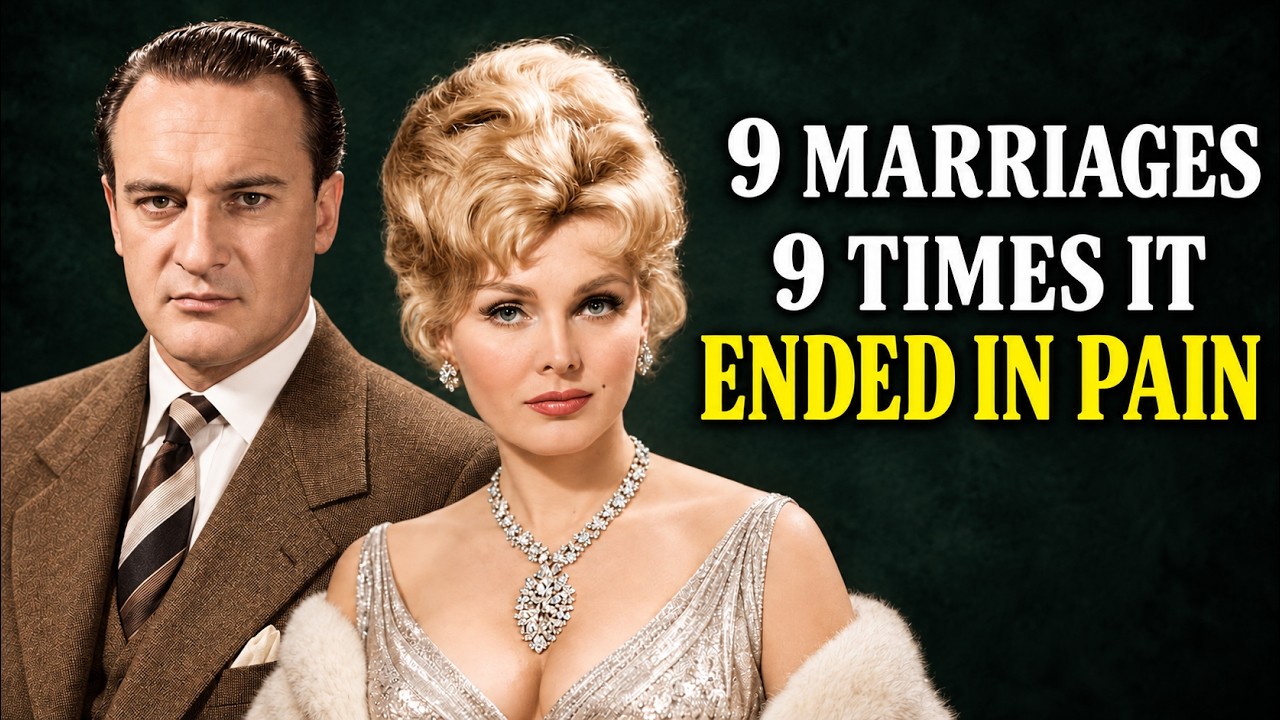
Nine times she decided that this time it would last. The story of those nine men, what each marriage gave her and what it cost her, reveals a life far more complicated than the jokes ever suggested. Her mother, Jolie, was the engine behind the Gábor sisters. She raised Sári, Eva, and Magda with a single, unrelenting lesson: a beautiful woman could go anywhere in the world, provided she understood the value of her beauty and never gave it away cheaply.
Jolie secured voice and acting teachers for young Zsa Zsa, entered her in beauty contests, and placed her on any stage that might put her before the right eyes. At fifteen, Zsa Zsa competed in the Miss Hungary pageant. Whether she actually won remains disputed, but the experience taught her something she never forgot: she had a magnetism that could not be taught or faked. People looked at her.
In Budapest of the early 1930s, being noticed by the right people could change your entire path. Budapest was still living on the glitter of old Europe then, even as the century prepared to tear it apart. Grand hotels remained open. Café debates stretched late into the night.
But beneath the surface, nationalist movements were rising across the continent, and the language of exclusion was growing louder. For Jewish families like the Gábors, the future was far less secure than it appeared from an elegant sitting room. Jolie sensed this even if she never said it aloud. She steered her daughters toward influential men and lives that could carry them beyond Hungary’s borders while there was still time to leave.
Zsa Zsa’s first serious encounter with a man of real standing came in Vienna. She went there in 1936 to study at the Reinhardt, a prestigious theater school attracting ambitious young women from across Central Europe. There she met Burhan Asaf Belge, a Turkish diplomat, journalist, and intellectual, considerably older than she was, moving easily among the cultural and political elites of Ankara in the era of Atatürk. They married in 1937 in Ankara when Zsa Zsa was about twenty, and she followed him to Turkey.
The life she found there was quiet and constrained, full of embassy dinners and cautious conversation. It did not suit her. By 1941, the marriage was over. She rarely discussed the details then or later, and the Turkish press left little record of her time there.
What is clear is that she left and headed west. By 1941, she had reached the United States, settling first in New York before working her way toward Hollywood. The world was at war. Europe was growing more dangerous by the month, and Jewish families could read the warning signs earlier and more clearly than most.
The Gábor family’s dispersal, with Jolie and Vilmos later emigrating and each daughter finding her own road to America, was no longer about ambition. It was about survival. In New York in 1942, at a dinner party indistinguishable from hundreds of others in that wartime city, she met the man whose name she would carry for the rest of her life. He was Conrad Nicholson Hilton, already a titan of American business at fifty-four.
He had spent the 1920s and 1930s building his hotel empire, buying properties in years when most men in his industry were just trying to hold on. He was a devout Catholic, and he had divorced his first wife, Mary Adelaide Barron, the mother of his three sons, leaving him in an awkward position within his church. He was also a man accustomed to giving orders. She was twenty-five.
They married on April 10, 1942, in Santa Fe, New Mexico. The early months carried genuine romance. The rest of the time was difficult almost immediately. Conrad was introverted, disciplined, strict about his faith and his business.
Zsa Zsa was lively, drawn to showmanship, and used to being the center of attention. He traveled constantly to expand his hotel chain, leaving her alone in large houses built for a quiet she had never asked for. Their daughter, Francesca Hilton, was born on March 10, 1947. She grew up between two powerful personalities and a fortune that, in the end, was never truly hers.
As an adult, she faced serious financial problems despite the name on her birth certificate, fought long legal battles over her father’s estate that lasted years, and spent long periods estranged from most of the family. The marriage to Conrad ended in divorce in 1947, the same year Francesca was born. Conrad later wrote about it in his 1957 memoir, Be My Guest, with bluntness and very little nostalgia. She kept the Hilton name, using it through every marriage that followed like a businesswoman holding onto a brand she owned.
But the Hilton years left her something she had not planned on: a daughter who would spend her life half trapped in the shadow of a famous name, half denied everything that name was supposed to guarantee. The next man was, by nearly every account including her own, the most important. George Sanders was born in St. Petersburg, Russia, in 1906 to English parents, raised in England, and entered acting late after failed attempts in business.
He had a deep, deliberately arrogant accent that became one of Hollywood’s most distinctive voices. In 1950, he won the Academy Award for Best Supporting Actor for his role as Addison DeWitt, the acerbic theater critic in All About Eve, a part so perfectly suited to him that audiences could no longer tell where DeWitt ended and Sanders began. Zsa Zsa met him in the mid-1940s, probably in 1946, through the shared world of European immigrants and Hollywood professionals. The attraction was immediate and obvious.
Both were Old World people who had entered Hollywood with a knowing superiority, each aware that fame was a costume. She used that knowledge to move forward with energy, warmth, and a genuine passion for company. He used it as a reason to withdraw, from work, from the city, from the people who loved him. They married on April 2, 1949, in Las Vegas.
She was thirty-two, he was forty-two. What followed was five years of emotional turbulence. Sanders was never physically cruel, but he could do significant damage with silence alone, long absences, heavy drinking, and reckless spending on things that seemed to bring him no pleasure. He treated life, including his own, as a joke that had stopped being funny some time ago.
Their fights were loud and often public, as were the reconciliations. The marriage ended in divorce in 1954. Yet whatever had been between them was far from finished. In 1970, sixteen years after that divorce, not four as many retellings claim, George Sanders married Zsa Zsa’s sister, Magda Gábor.
The marriage lasted thirty-two days before being annulled. It was enough to shake the entire Gábor family and tear open something everyone assumed had long been closed. Zsa Zsa’s reaction was public and dramatic. Then, in April 1972, it ended in the most permanent way possible.
George Sanders took his own life in a hotel in Castelldefels, near Barcelona, Spain. He was sixty-five. He left a short note, direct and clear, writing that he found life unbearable and that, in the end, he was simply too bored to continue. Zsa Zsa seemed shaken in a way the public had never seen on her.
In interviews for years afterward, she kept returning to George Sanders the way she did with no other man she had married. She called him the great love of her life, publicly and formally. She said more than once that the real pain did not come in 1954 when they divorced, but in 1972 when he was truly gone. The woman who always knew how to move on, it turned out, never got over this one.
Her later marriages were shorter and stranger. In 1975, she married Jack Ryan, a Harvard-trained engineer who had spent years at Raytheon working on weapons systems, contributing to the Hawk and Sparrow missiles, before leaving defense to work at Mattel, where he played a pivotal role in developing Barbie, specifically engineering the doll’s jointed body. The same hands that worked on guided missiles designed the mechanism for the doll’s bending. He built an estate in Bel Air everyone called the Castle, filled with odd designs and gadgets that guests described for decades.
The marriage lasted less than two years. Days after it legally ended, she married Michael O’Hara, a lawyer who had once represented her. That marriage lasted until 1982, making it her longest since Sanders. It passed with very little external turmoil, a quiet period after years of raucous relationships.
The ninth place in the sequence is often misrecorded. Many accounts list a businessman named Edmond de Szigethy, a name with almost no presence in any reliable record. The actual sequence ran differently. After Herbert L.
Hutner, a New York investment banker she married in November 1962, came Joshua S. Cosden Jr. , heir to a Texas oil fortune. She married Cosden six days after finalizing her divorce from Hutner.
There was also a marriage almost every account omits because it barely lasted long enough to complete the paperwork. In 1983, between O’Hara and von Anhalt, she married Felipe de Alba, a Mexican actor and lawyer. The ceremony took place on April 13. The annulment came the next day, April 14, because her divorce from O’Hara was not yet final in the eyes of the law.
That marriage lasted exactly one day. Her longest and most complicated relationship came late in life. Frédéric Prinz von Anhalt was born Hans Robert Lichtenberg in 1943 in Bad Wimpfen, Germany. His path to nobility ran through a legal document rather than ancestry.
In 1980, Princess Marie Auguste of Anhalt adopted him as an adult. He met Zsa Zsa in the early 1980s, and they married in Los Angeles on August 14, 1986. She was sixty-nine. He was forty-three.
Skepticism was immediate: the age gap, the adopted title, the very ordinary life before it all. The question of whether he was a genuine partner or a man who understood precisely the value of attaching himself to one of the most famous names on the planet followed the marriage from its start. Three years into that marriage came the incident that would define her public image for the rest of her life. In June 1989, driving in Beverly Hills, she was pulled over by a police officer named Paul Kramer.
She was accused of slapping him, arrested, and the case went to court. The trial became a spectacle. She arrived elaborately dressed for every appearance, treating the courthouse steps like a red carpet. She was convicted of assaulting a police officer, possessing an open alcohol container in the car, and driving with an expired license.
The sentence was three days in jail, 120 hours of community service, and a fine. She served it in full. Another inmate reportedly asked for her autograph while she was still inside. Time was not kind to her either.
In 2002, she was seriously injured in a car accident when another driver ran a red light, permanently affecting her mobility and health. In 2010, at ninety-three, she suffered a severe stroke at her home and became bedridden. In 2011, her right leg was amputated due to circulatory complications from the stroke. The woman who commanded any room she entered could no longer rise from her bed without help.
In 2012, Francesca filed a court petition for independent guardianship, accusing von Anhalt of isolating her mother, keeping her under heavy sedatives, and managing her finances in a way she could no longer ignore. Von Anhalt fought back, and the court ended up appointing him as temporary guardian, but with a long list of conditions. The longest of her marriages ended in a courtroom battle between her husband and her only daughter over control of what remained of her life. Then, in January 2015, Francesca Hilton died at sixty-seven, before her mother.
Zsa Zsa was never told. Von Anhalt confirmed this himself, saying Zsa Zsa was not aware of the news and he would not allow anyone near his wife to tell her. Zsa Zsa Gabor died on December 18, 2016, in her Bel Air home at the age of ninety-nine. The cause was heart failure.
She had lived through two world wars and the disappearance of the Budapest she grew up in, a city that no longer resembled the one in her memory. She was buried at Westwood Village Memorial Park in Los Angeles, not far from many of the names she had shared headlines with throughout her life. When Conrad Hilton died in 1979, he left most of his estimated $200 million fortune to the Conrad N. Hilton Foundation.
His only daughter, Francesca, received approximately $100,000. She sued for more and lost. Under the terms of the will, she lost even that amount. By around 2014, she was in serious financial trouble.
The name her mother had used all her life as a trademark gave her daughter nothing at all. For decades, the number nine was material for mockery, a symbol of a frivolous woman who failed at relationships no matter how many chances she was given. But reviewing the marriages one by one, considering what each gave her and what each took away, a different picture emerges. This was not a woman who treated love lightly.
It was a woman who kept going after it, paying a real price every time it left. Nine times she offered herself up to pain again, knowing exactly how her previous attempt had ended, and doing it anyway. She came from a country that no longer existed in the form she knew. She built her entire life from nothing, without connections, without a career waiting for her, without any support but her nerve.
She raised a daughter largely alone, then outlived her by less than two years. She began life as Sári Gábor, a girl from Budapest. She left after ninety-nine years as Zsa Zsa Gabor, the name still carrying all its weight.