By the early afternoon of July 21, 1861, the Confederate left was coming apart. Men who had marched out of camp that morning expecting a quick and easy victory were now running. Whole regiments dissolved into clots of frightened individuals; officers grabbed at sleeves and shouted orders no one obeyed. The first great land battle of the American Civil War was only a few hours old, and on a low Virginia farm hill, one side was already losing it.
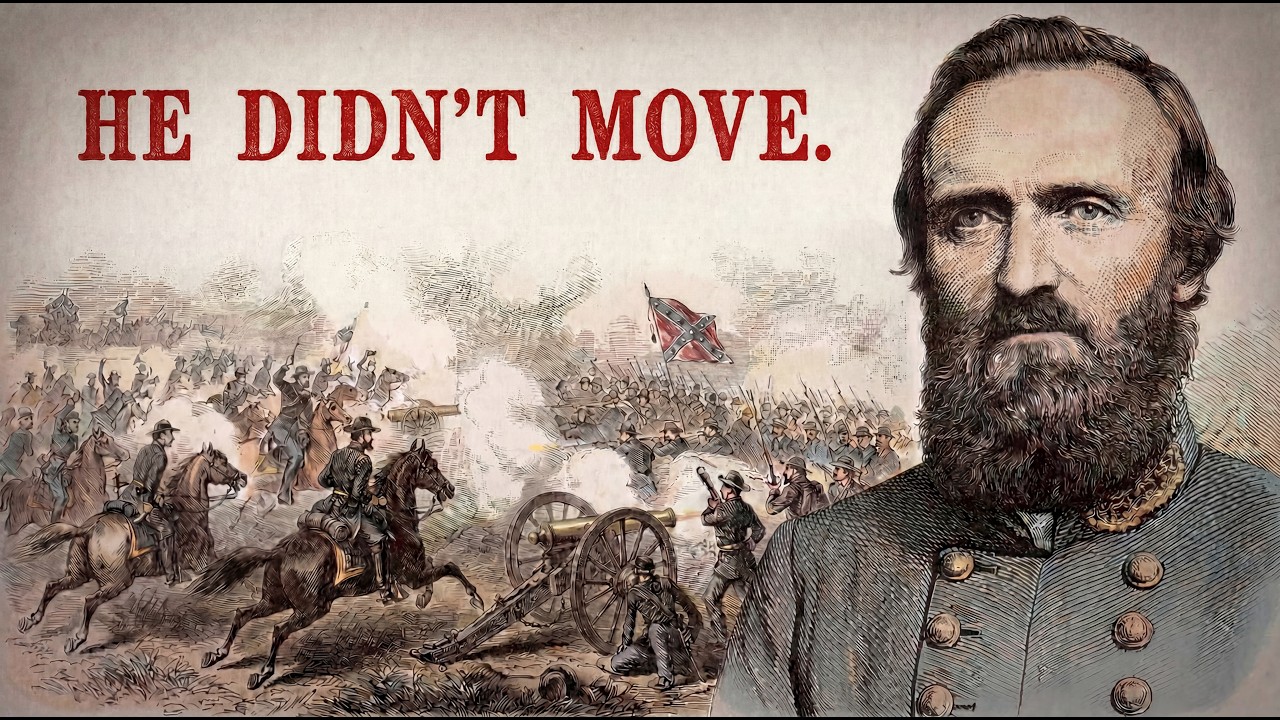
Then a Confederate general rode into that wreckage. His name was Barnard Bee, and his own brigade had just been shattered. He looked across the drifting smoke and saw one body of troops that had not moved: a brigade of Virginians under an officer almost no one in the country had heard of, a former military college instructor named Thomas Jonathan Jackson. And Bee said a sentence about Jackson standing like a stone wall.
Within a day, Bee was dead. He never explained what he meant. He was struck down while leading his men forward into the fighting, carried from the field to a small cabin near the battlefield, and died there on July 22, 1861, one of the first general officers killed in the war. The single witness who could have fixed the meaning of the phrase forever carried the answer into that cabin with him.
To understand how a reputation could be forged in that single chaotic minute under artillery fire, you have to start with two armies that both believed the war would end by autumn. In the summer of 1861, the Confederate bombardment of Fort Sumter in April had pushed the country into open war, but north and south still imagined a short one. In Washington, newspapers and politicians took up a single insistent cry: “On to Richmond! ” The ninety-day enlistments of many Union volunteers were already running out; if the army was going to strike, it had to strike soon.
The man given the job was Brigadier General Irvin McDowell, who commanded the largest field army yet assembled on the continent, somewhere around 35,000 men. On paper it was impressive. In reality it was barely an army at all. Most of its regiments had existed for only a few weeks, and the soldiers wore a confusing patchwork of uniforms in every shade and pattern.
McDowell knew his men were not ready and asked for more time to drill them. President Abraham Lincoln overruled him, saying plainly that the Confederates were just as green. They were, but that fact would cut both ways before the day was done. About twenty-five miles southwest of Washington lay a vital railroad crossing called Manassas Junction, where the Orange and Alexandria Railroad met the Manassas Gap Railroad running west into the Shenandoah Valley.
Whoever held that junction held a doorway between the valley and the Virginia interior. Guarding it was a Confederate army of roughly 22,000 men under Brigadier General P. G. T.
Beauregard, the officer who had directed the firing on Fort Sumter. Beauregard placed his troops behind a meandering muddy stream called Bull Run, spreading them along a series of fords and a stone bridge. McDowell’s plan depended on arithmetic. A second Confederate army of about 11,000 men under General Joseph E.
Johnston sat far off in the Shenandoah Valley; if those two forces combined, the Union advantage would vanish. So a separate Union force under General Robert Patterson was sent west with one job: hold Johnston in place. McDowell would smash Beauregard before Johnston could arrive. Speed was everything.
Speed was exactly what McDowell did not get. His untried army took three days to cover the short march to Centreville, the men breaking ranks along the road to pick blackberries and hunt for water no matter what their officers shouted. On July 18, a Union division probing the Confederate line ran into a sharp fight at Blackburn’s Ford, where Confederate troops under James Longstreet stopped them cold. The clash rattled McDowell and cost him still more time.
Every hour he spent was an hour the Confederates could use, because they had something McDowell’s calculation never accounted for: a railroad. When Beauregard telegraphed that the Union advance had begun, orders flashed to Johnston: “Come at once. ” Patterson failed completely, hesitating until his enemy had slipped away. Johnston marched his men to the rail line at Piedmont Station and began loading them onto trains bound for Manassas.
It was slow, clumsy work—never enough cars, the trains crawled—but it is often described as the first time in American history that a railroad carried an army into the outcome of a battle. Johnston’s troops began reaching Manassas on July 19 and 20, brigade by brigade, and the careful Union arithmetic quietly collapsed. On the morning of July 21, McDowell finally moved. He sent two divisions on a wide loop north, splashing across Bull Run at Sudley Ford to come down hard on the exposed Confederate left flank, while other troops made a noisy demonstration at the Stone Bridge to hold the enemy’s attention.
Behind the movement gathered a crowd of congressmen, reporters, and Washington families with picnic baskets who had ridden out to watch the rebellion be settled in an afternoon. For a few hours the plan worked. A sharp-eyed Confederate colonel named Nathan Evans suspected the Stone Bridge attack was only a feint, pulled his men away, and rushed to meet the real threat. The flanking column struck the thin Confederate left near Matthews Hill.
The fighting was loud and savage—the first real combat most of these men had ever known. The outnumbered Confederate brigades, including one led by Barnard Bee, held as long as they could and then gave way. By late morning they were streaming back in disorder toward a farm plateau crowned by a widow’s house. That plateau was Henry Hill, and the entire battle was about to turn on it.
Henry Hill was not dramatic ground, just a broad, gently rising plateau climbing slowly over open grass and farm fields with a screen of trees along its rear slope. At its crest sat a modest farmhouse belonging to the Henry family. But terrain does not need to be dramatic to be decisive. Henry Hill commanded the open ground any Union advance toward Manassas Junction would have to cross.
Hold it and the Confederate army still had a battle to fight. Lose it and the road to the junction lay open. Around noon, a fresh Confederate brigade reached the hill: five Virginia regiments under Brigadier General Thomas J. Jackson, a stern, awkward, deeply religious former instructor from the Virginia Military Institute.
Instead of crowding his men onto the exposed crest, where Union guns could see and tear them apart, Jackson placed his line along the reverse slope, where the swell of the ground itself would shield them. Then he began gathering artillery and pointing it forward. By the time the Union army was ready to fight for Henry Hill, Jackson had close to thirteen guns in position and a line of infantry waiting, unseen, just below the skyline. He had time to do all that because of a Union mistake.
After driving the Confederates off Matthews Hill, McDowell held perhaps 18,000 men against a beaten, disorganized enemy. The straightforward move was to push hard and fast before the Confederates could reform. McDowell did not. For roughly two and a half hours he launched no major attack.
Instead he ordered two batteries of regular United States artillery under Captains James Ricketts and Charles Griffin—around eleven guns between them—to roll up and duel the Confederate line. It was a costly hesitation, and it handed the Confederates the one thing they most needed: time. While McDowell paused, Beauregard and Johnston fed brigade after brigade onto Henry Hill. When the order finally came, Ricketts and Griffin galloped their guns onto Henry Hill itself and unlimbered roughly three hundred yards from Jackson’s position.
For artillery, that is point-blank distance. What followed was a savage, uneven exchange. The Union batteries carried fine rifled cannon, but at three hundred yards their rifled shells tended to sail clean over the heads of the Confederates and burst harmlessly behind them. Jackson’s older smoothbore guns, less useful at distance, were now perfectly placed for the work.
Federal gunners and horses began to fall around the guns. And in the middle of that exchange stood the Henry House with a civilian still inside it. Judith Carter Henry was an elderly widow, bedridden, unable to leave her home. As the fighting closed in, Captain Ricketts came to believe Confederate marksmen were firing on his gunners from inside the house.
He turned his cannon on the building. A shell struck the upper room where the widow lay, fatally wounding her. Judith Henry died later that day, remembered as the only known civilian killed at the First Battle of Bull Run and often described as the first known civilian fatality of the war. By mid-afternoon the pressure on the Confederate line was enormous.
The brigades thrown back from Matthews Hill were arriving piecemeal, ragged and rattled, no longer steady formations but tired men looking for a place to stop. Some units were melting toward the rear. Colonel Francis Bartow of Georgia would be killed on this hill. The South Carolina planter Wade Hampton went down at the head of his men.
Morale was cracking in plain view. Into that chaos rode Barnard Bee, a thirty-seven-year-old West Point graduate and Mexican-American War veteran from Charleston, South Carolina, whose command had been broken to pieces on Matthews Hill. He was doing what dozens of officers did that day, trying by sheer presence and voice to gather frightened men back into a fighting line. It was somewhere in those minutes that Bee saw Jackson’s Virginians and spoke the words that made a legend.
Here the historical record turns genuinely uncertain. No one wrote down Bee’s exact words at the instant he said them. What survives are accounts gathered afterward, and they do not fully agree. In several versions, Bee rides up to Jackson and tells him the enemy is driving the Confederates back, and Jackson answers calmly, almost coldly, that they will give the Federals the bayonet.
In the most famous version, Bee then turns to his own wavering soldiers and cries out something close to: “There stands Jackson like a stone wall. Rally behind the Virginians. ” Spoken that way, it is a tribute and a rallying cry at once. But that is not the only reading.
At least one account holds that Bee said the line in frustration, even bitterness—that he meant Jackson was standing there motionless, like a stone wall, instead of advancing to relieve Bee’s own collapsing brigade. In that telling, the words were not praise at all. They were a complaint. A third possibility sits between the two: that Bee, in the deafening noise and terror, said something ambiguous, and his listeners heard it in different ways, each man’s memory later shaped by what he wanted it to mean.
The question cannot be closed, because the one man who could have settled it was dead within a day. But the conflict on Henry Hill was not over. It did not end with a grand sweeping charge but with a case of mistaken identity. In 1861, the rule of blue for the Union and gray for the Confederacy did not yet exist.
Both armies wore whatever their states had provided, and the result was dangerous confusion. Jackson himself still wore the dark blue uniform of a United States military instructor. Captain Griffin had pulled two of his guns to a new position, hoping to rake Jackson’s line with destructive fire along its length. As he prepared to open up, a body of troops came toward him through the smoke, many of them wearing blue.
Griffin concluded they were Confederates and ordered his crews to load canister, the close-range shot that turned a field gun into an enormous shotgun. At that instant, a senior Union artillery officer stopped him, insisting the men were Griffin’s own infantry support coming up at last. Griffin disagreed sharply, but he was overruled and reluctantly swung his guns away. The approaching troops were Confederate.
They came on in silence, halted at very short range, leveled their muskets, and fired a single volley into the Union gunners. Men and horses went down across the battery. The crews were wrecked in seconds, the Virginians surged forward and seized the guns, and Ricketts’s battery was overrun as well. Henry Hill became a brutal swaying contest fought back and forth across those captured guns.
A hard-charging New York regiment counterattacked, drove the Virginians back, and recaptured the cannon, pouring fire into the flank of Jackson’s line until part of it began to give way. Jackson fed in fresh regiments to steady it. The guns changed hands again. For more than an hour the fighting surged across the same few hundred yards of trampled grass, the lines so close that neither side could hold the prize for long.
Through all of it, the core of Jackson’s brigade stayed on the hill. That, in the end, was the simple and decisive fact: the line bent, it did not break. Jackson himself was wounded, struck in the hand, the middle finger of his left hand broken by a ball or fragment. He refused advice to have the finger amputated and kept to his command.
While Henry Hill held, the rest of the battlefield shifted against the Union. Johnston’s men, still arriving from the Shenandoah Valley, were extending the Confederate line further and further. Late in the afternoon, fresh Confederate troops under Colonel Jubal Early swung wide and struck the exposed Union right flank. Cavalry under Colonel J.
E. B. Stuart added to the panic. The Union army, which had attacked all day, had committed its regiments piecemeal and never brought its full weight to bear at any one moment.
Now exhausted, disordered, and suddenly hit from a new direction, it began to pull back. The withdrawal quickly curdled into panic. Tired, frightened men streamed away from Henry Hill, tangling with the carriages of the Washington spectators now fleeing for their own lives down the same narrow roads. An overturned wagon blocking a bridge turned a difficult retreat into a genuine rout.
McDowell’s army did not march back to Washington in defeat; it ran. By evening, the first great battle of the Civil War was over. Combined casualties on both sides came to nearly 5,000 men killed, wounded, or missing—a number that stunned a country that had expected a brief and almost bloodless contest. And in the smoke and exhaustion of that field, without anyone planning it, a legend had been born.
In the days after the battle, Bee’s phrase spread through the Confederate camps and into the Southern newspapers. A shaken public wanted a hero, and here was one ready-made: an unshakable officer who had stood firm while others ran. Thomas J. Jackson became Stonewall Jackson.
His brigade became the Stonewall Brigade, a name they would carry for the rest of the war. Within months he was promoted to major general and given his own command. There is a deep irony buried in that name. A stone wall is a fixed thing; it endures by standing still and absorbing punishment.
But Jackson’s real military gift was almost the opposite. In the spring of 1862, in the Shenandoah Valley, he built his lasting military reputation not by standing pat but by marching his men at a punishing pace over long distances, appearing where his enemies did not expect him, striking hard, and slipping away before they could concentrate against him. The most famous nickname of the war froze him in a single defensive pose, while his actual genius was that he almost never stayed still. The legend grew in other ways, too, fed by genuine oddity.
He had been a stiff, awkward instructor at the Virginia Military Institute, where cadets had mocked him with the nickname “Tom Fool” long before anyone called him Stonewall. His own soldiers more often called him Old Jack. Even the famous story that he constantly sucked lemons in battle is essentially a myth; historians have found that the obsession grew mostly out of colorful postwar memoirs, and that Jackson simply liked fresh fruit. It is a small and harmless example of a large and important truth: the legend was built up layer by layer, partly from fact and partly from things people wished were true.
What can be said for certain? The Confederate line on Henry Hill came close to breaking, and Jackson’s brigade held when holding mattered most, despite heavy casualties. That steadiness was real, and it genuinely helped save the Confederate army from disaster in its first great battle. That much is solid ground.
But what Barnard Bee meant—praise, rally, or rebuke—died with him in a cabin near the battlefield in the first hours after the guns fell silent. The most famous nickname of the American Civil War rests finally on a sentence no one can fully decode. And perhaps that is the truest thing about it: a reputation forged in one confused, smoke-filled minute can outlast the man who sparked it, outgrow the facts that produced it, and become, in the end, larger and more certain in memory than the truth ever was on the ground.