In 1950, a Black man in New York City fought a quiet battle every day just to feed, clothe, and house his family. At work, on the subway, and in front of his children, he endured small humiliations to keep a job that most white men would never have had to fight for in the first place. At Grand Central and Pennsylvania Stations, two of the busiest rail hubs in the nation, the Pullman Company still operated its fleet of overnight sleeping cars, employing Black men exclusively for the work, a hiring pattern that had made Pullman the largest employer of Black men in the United States since the early part of the century. The wage structure behind that uniform had barely changed over the decades.
A porter working the New York platforms in 1950 still earned a fraction of the base pay of the white supervisor watching him on the same train. A union contract in 1937 had narrowed the documented gap slightly but never closed it, leaving porters dependent on passenger tips just to approach a livable income. That same year, government census figures recorded the average nonwhite family income across the United States at $1,869, compared to $3,445 for the average white family, a gap approaching double. That documented disparity is the starting point for understanding the broader economic reality facing Black workers in New York City in 1950, a reality that shaped daily life in Harlem in ways that wage numbers alone could only hint at.
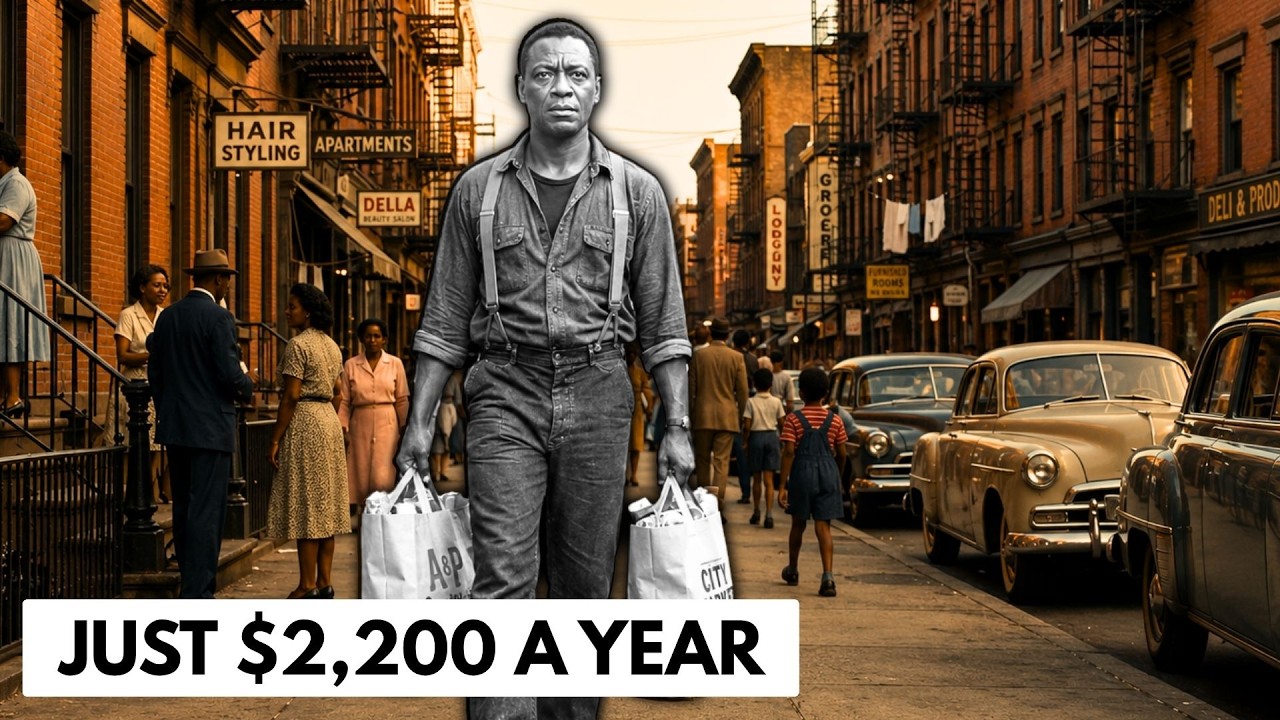
New York City, 1950. Before the sun fully rose over Harlem, a man was already awake, dressing quietly in a cold, cramped apartment he shared with his wife and three children, while the radiator rattled against the winter air outside, preparing for a workday that would stretch past twelve hours and bring him about $2,200 by the end of the year. That amount had to cover rent, food, clothing, transportation, and whatever small margin might remain for a family of five living in one of the richest cities in the world. Down in the street, the same scene repeated at every doorway.
Other men left for early shifts as porters, dishwashers, and factory workers. Women wrapped in coats against the cold headed for the subway toward domestic service jobs in neighborhoods they could never afford to live in. An entire community rose together each morning to face a city that promised opportunity but delivered something far narrower and harder to reach. That wage figure was not unusual for a Black man in his position.
In the same year, government researchers recorded that the average nonwhite family income nationwide was only about $1,869 annually, compared to roughly $3,445 for the average white family, meaning a man earning $2,200, by the harsh arithmetic of 1950s America, was actually doing slightly better than most Black families across the country. Yet that amount was nowhere near enough to live the way white New Yorkers with similar wages in similar jobs within the same city lived. To understand how a man ended up in this exact position, standing in a cold rented Harlem apartment at dawn with a family entirely dependent on him, it helps to go back a generation to the specific decision that pushed so many Black families north in the first place. Between the 1910s and the 1950s, roughly six million Black Americans left the rural South in a movement historians now call the Great Migration, fleeing not just poverty but a legal and social system built on segregation, sharecropping debt, and racial violence that made any real future in the South seem impossible.
New York City, and Harlem in particular, became one of the primary destinations. Newspapers like the Pittsburgh Courier and the Chicago Defender actively encouraged this migration, publishing letters from relatives in the North describing wages that seemed almost imaginary compared to Southern sharecropping income, along with job listings and detailed practical instructions about which trains to take and what to expect upon arrival, functioning as an informal employment and support network stretching thousands of miles. For a man born in rural Georgia, South Carolina, or Virginia in the 1920s who arrived in Harlem as a young man in the years after World War II, the city represented genuine hope: a chance to earn decent wages, join a union if he was lucky enough to find work that offered one, and raise children who might never have to pick cotton or defer to the plantation owner’s son the way his father had. The reality that greeted him was far more complicated than the promise.
New York did not enforce formal Jim Crow laws the way Georgia or Alabama did, and there were no signs designating separate water fountains or train cars. For a man raised under explicit legal segregation in the South, that absence alone was enough to feel, at least initially, like real freedom. But the freedom New York offered was narrower and more restrictive than it first appeared. Housing discrimination, employment discrimination, and social exclusion operated in New York just as effectively as any Southern law, only informally, through the private decisions of landlords, employers, bank loan officers, and labor unions rather than through statutes written into state constitutions.
The Black man in Harlem in 1950 quickly learned that the city’s promises came with a small asterisk attached to almost everything. A job was available, but only certain jobs. An apartment was available, but only in certain neighborhoods, and usually at a higher price than the same apartment would cost a white tenant elsewhere in the city. That price difference was neither small nor accidental.
Researchers who studied Harlem housing conditions during those years documented that Black tenants regularly paid rents nearly double what white tenants had paid for the same buildings before they became predominantly Black. At the same time, landlords spent almost nothing on basic maintenance. Studies of Harlem housing found thousands of apartments without reliable heat, thousands more without steady hot water, and hundreds of toilets that simply did not work. All of this happened while rent collectors arrived precisely every month demanding payment for buildings that, in some cases, had not seen any real renovation since before the turn of the century.
Families often coped by taking in lodgers, a cousin newly arrived from the South, an elderly relative with nowhere else to go, or simply a stranger paying money and recommended by someone trusted at church, dividing an already cramped apartment further for a few extra dollars toward the monthly rent. Surveys conducted during the period found that more than eighty percent of Harlem’s residential structures had been built before 1900, aging buildings originally constructed for entirely different residents decades earlier. They had been subdivided repeatedly over the years into smaller and smaller units to accommodate more tenants and extract more total rent from a single building, with little regard for whether the plumbing, wiring, or structural condition could handle the density packed inside. By 1950, tenant organizing efforts had confronted these conditions for years with documented successes.
Harlem tenants had organized rent strikes since the 1930s, formed tenant leagues that protested outside buildings and refused to pay until basic repairs were completed, and forced landlords to accept rent reductions and commit to repairs through sustained collective pressure. This history of organized resistance continued into the 1950s and 1960s, proof that the community facing these conditions was never passive. Sociologists who studied American housing patterns in the following decades described what happened to neighborhoods like Harlem not as a market accident but as the direct cumulative result of deliberate policy choices: banks that refused to lend in Black neighborhoods, a federal government that supported the redlining maps used to justify those refusals, and a private real estate sector that steered Black families into an ever-shrinking housing stock regardless of income or credit. A man earning $2,200 a year in Harlem in 1950 was not failing to escape poverty through any lack of personal effort.
He was operating inside a housing market engineered deliberately, building by building and policy by policy, to make escaping poverty extraordinarily difficult. The frustrations from these accumulated pressures did not always remain quiet. In 1943, Harlem erupted in public unrest after a white police officer shot a Black soldier. A single incident ignited years of accumulated anger over housing conditions, job discrimination, and daily humiliations, resulting in a night of rioting that left people dead and hundreds of businesses damaged.
That simmering frustration continued throughout the 1950s without full resolution, occasionally exploding in the years that followed. If a man had served his country during the recently ended war, the injustice left an even deeper mark that would echo through his family’s finances for decades to come. The Servicemen’s Readjustment Act, known as the GI Bill, promised returning veterans low-interest home loans, college tuition costs, and unemployment support. These benefits were credited with building the American middle class almost overnight, moving millions of white veterans into new suburban homes and skilled careers within just a few years.
Black veterans earned those same benefits through the same wartime military service, but they found the promise effectively emptied of meaning by the same mechanism that had denied them fair housing in the first place. Banks and mortgage companies simply refused to approve loans in Black neighborhoods, regardless of what the federal government guaranteed on paper. In New York and northern New Jersey combined, researchers later found that out of 67,000 GI Bill-backed mortgages in the postwar years, fewer than 100 went to nonwhite veterans. A Black man’s military uniform, his service, and his federal paperwork meant almost nothing once he stood before a loan officer who could simply say no, without any law requiring him to explain why.
The consequences of that quiet, individual refusal cascaded across generations in ways that proved nearly impossible to reverse. A white veteran who secured a GI Bill mortgage in 1950 bought a home in a new suburban development where property values rose steadily over the following decades, building real transferable wealth he could pass to his children. A Black veteran denied the same loan remained a renter for life, paying monthly rent that built no ownership at all and leaving nothing for the next generation to inherit. That difference, multiplied across millions of families over multiple decades, became one of the largest factors economists identified in the enormous wealth gap that continued to separate Black and white American families for the rest of the twentieth century and into the twenty-first.
Historians described the postwar suburban housing boom as the largest government-subsidized transfer of wealth in American history up to that point, a transfer that, through the combination of federal policy and private discrimination, deliberately directed the lion’s share of its benefits to white families while leaving Black families like this one continuing to rent in neighborhoods the government itself had previously classified as risky and unworthy of investment. Work itself offered similarly narrow doors. A Black man in New York in 1950, regardless of education, ambition, or prior experience, found himself overwhelmingly confined to a small handful of occupations white employers considered acceptable for Black labor: elevator operator, janitor, dishwasher, porter, factory worker, delivery boy, or, if he was lucky enough to land one of the more respected jobs available to him, a Pullman porter, a position whose importance to Black economic and political life in that era is difficult to overstate. The Brotherhood of Sleeping Car Porters, founded decades earlier and led for most of its existence by labor organizer A.
Philip Randolph, had by 1950 become the first Black-led union to win a real, formally recognized contract with a major American corporation, transforming the Pullman porter’s job from one of utter subservience. White passengers often called the workers “George” regardless of their real names, a deliberate denial of their identity. Yet the job had become one of the few occupations available to Black men in the country that offered genuine job security, a pension, and collective bargaining power that most Black workers in 1950s America could only dream of. A man fortunate enough to hold a Pullman porter position occupied a distinguished and respected place within Harlem’s social hierarchy, commanding real respect from neighbors working in less secure jobs for less reliable employers.
A generation earlier, observers walking through Harlem noted that few randomly selected men on the street could honestly claim to earn more than $100 a month. Though wages had risen somewhat by 1950, the occupational ceiling had not moved at all. An elevator operator rarely became a building manager. A janitor rarely became an office employee.
Educational qualifications that might open doors for a white applicant often meant nothing at all when presented by a Black man to a hiring manager who had already decided, before any interview began, which jobs were appropriate and which were not for a man of his race. Veterans among these men carried a particular quiet frustration into those job interviews. They had served their country overseas in racially segregated military units, some earning decorations, only to return home and discover that a white employer saw only their skin color, ignoring the uniform, rank, or sacrifices that had defined the past few years of their lives. That ceiling was not merely cultural bias operating without consequences.
Committees investigating employment conditions in Harlem during those years documented that Black workers were disproportionately concentrated in only three industries: domestic and personal service, manufacturing, and transportation. The other sectors studied employed fewer than ten percent of Black workers, despite Harlem’s Black residents possessing training, education, and experience across a far broader range of fields than employers were willing to recognize or utilize. A man with a high school diploma or even some college coursework before the war cut his education short could spend his entire working life operating an elevator rising and falling between the same twelve floors, watching younger, far less qualified white men steadily move past him into supervisory roles for which he was never seriously considered. Labor unions, theoretically existing to protect workers regardless of race, in practice reinforced the opportunity ceiling rather than challenging it, with many trade unions maintaining separate branches, informal membership barriers, or explicit exclusionary policies that kept skilled trades like plumbing, electrical work, and construction almost completely closed to Black applicants, regardless of actual competence or training.
Some specific employers stood out from this general pattern. The Pullman Company had built and staffed the luxury sleeping cars used on long-distance passenger trains, becoming by the early twentieth century the largest employer of Black men anywhere in the country, hiring Black porters exclusively while excluding them from every other position within the company. This arrangement was rooted in paternalistic racist thinking about which jobs suited Black workers, yet it paid significantly better than most other work available to Black men at the time and carried genuine social status within Harlem itself. The United States Post Office provided a relatively reliable path, being one of the few employers in the country committed to civil service rules that, at least on paper, evaluated candidates through standardized test scores rather than the personal judgment of an interviewer.
This formal structure never entirely eliminated discrimination. Hiring officials still exercised considerable discretion through a practice known as the rule of three, which allowed them to select any candidate among the top three scorers and quietly bypass qualified Black applicants in favor of a white applicant who had scored lower. But compared to the near-total discretion private employers enjoyed elsewhere, postal work remained one of the safest and most respected government employment paths available to a Black man in New York in 1950. New York’s massive garment industry, concentrated in the Manhattan district known to this day as the Garment District, employed thousands of Black women as seamstresses and garment makers, many bringing these precise skills from the South or the Caribbean.
A significant number rose to leadership positions within the International Ladies’ Garment Workers’ Union, serving as shop chairs who organized their coworkers, collected union dues, and represented worker grievances before management, gaining organizational skills many later carried directly into the civil rights movement the following decade. In stark contrast, the major department stores on Manhattan’s main shopping streets routinely excluded Black applicants from visible sales positions, limiting their employment to stockrooms, elevators, and cleaning crews, jobs that kept Black workers inside the building but completely invisible to the white customers those stores were created to serve. Upscale hotels and restaurants followed similar logic, employing Black workers extensively as porters, dishwashers, and kitchen staff, the same establishments that in many cases refused to serve those workers as paying customers had they entered through the front door instead of the service entrance. Many wives and mothers in these families also worked, often as domestic servants in the homes of wealthier white families in Manhattan or the outer suburbs, cooking, cleaning, and caring for children who were not their own before returning home each evening to care for their own families with whatever energy remained.
In some Northern cities during those years, informal outdoor labor markets appeared where domestic workers gathered each morning on specific street corners waiting to be selected for a single day’s work by employers driving by to inspect them as one might choose produce at a market stall, a practice sharply criticized by Black newspapers and civil rights organizations although it continued for lack of better alternatives for women barred from most other forms of paid work. The family earning $2,200 from the husband’s labor alone often depended on the wife’s additional income simply to keep the household afloat, income that frequently went uncounted in official wage statistics precisely because domestic work took place outside any formal organized labor market. Under these conditions, $2,200 a year had to cover every possible need for a family of five. Rent alone, given the inflated prices Harlem landlords charged Black tenants, likely consumed between a quarter and a third of total income, leaving about $35 to $40 a week for everything else: food for five people, clothing for growing children, coal or fuel for heating during New York’s harsh winters, transportation costs to and from work, medical care on the rare occasions the family could afford a doctor visit, and whatever small, simple pleasures a worker might allow his family now and then, a movie ticket, a slightly better Sunday dinner, a new pair of shoes bought only after the old pair became entirely unwearable rather than merely worn.
Breaking this budget against actual prices paid by New Yorkers in 1950 makes the arithmetic clearer. $2,200 a year equaled roughly $42 a week before any deductions. Citywide, the average apartment rent in New York was around $49 a month according to that year’s census figures, with Manhattan rents reaching nearly $56. Harlem landlords, however, routinely charged Black tenants far above the city average for buildings in far worse condition, sometimes reaching $80 or more a month for cramped, poorly maintained units, while a white tenant elsewhere in the city might pay half that amount.
Housing costs alone could consume nearly half of a man’s entire weekly wage before a single loaf of bread was bought. A loaf of bread that year cost between twelve and fourteen cents. A dozen eggs ran roughly fifty-three to sixty cents. A gallon of milk cost between seventy-seven and ninety-five cents.
A pound of coffee, a staple in nearly every Harlem home, sold for about seventy-nine cents. A man’s ordinary work shirt cost about $1. 79. A woman’s everyday shoe sold for $2.
98. A simple dress for a young girl ranged from $1. 98 to $2. 98.
Individually modest figures, but they added up quickly when multiplied across a family of five with children outgrowing their clothes every few months regardless of how carefully they were cared for. Major purchases were entirely out of reach. A new Chevrolet sedan, one of the most common and affordable American cars on the market, cost about $1,450 in 1950, nearly two-thirds of this man’s entire annual income before taxes, and that purchase price did not account for additional gasoline, insurance, and repair costs. Very few Harlem families owned cars, not from any lack of desire for the independence and convenience they provided, but because the arithmetic simply did not work, and because many men in the neighborhood relied on the city’s subway and bus system to reach their scattered jobs in Manhattan and the outer boroughs at far lower cost than car ownership would permit.
Owning a home was even more out of reach. The average price of a new single-family home nationwide that year was about $7,350, more than three times this man’s entire annual income, even before accounting for down payments, closing costs, and the discriminatory lending practices already described that made obtaining a mortgage nearly impossible for a Black family in the first place. Small luxuries carried their own careful arithmetic. A haircut cost between one dollar and one dollar fifty.
A pack of cigarettes cost between seventeen and twenty-four cents depending on the brand. A postage stamp cost three cents. A local phone call from a corner public telephone cost five cents, useful for a quick conversation with a relative or potential employer without the cost of home phone service, which in 1950 reached only about sixty-two percent of American households and far fewer than that in Harlem specifically. Given the additional monthly cost, most families could not justify going to the movies, one of the few affordable entertainments the city offered, with tickets typically around fifty cents.
It was an occasional pleasure for a family that otherwise spent almost nothing on entertainment, saving whatever small margin remained each week for the next emergency, the next winter coat a growing child needed, or next month’s rent, which arrived on schedule without mercy regardless of whether the week had left anything to pay it with. Food itself required constant, careful calculation. Meat cuts wealthier families considered undesirable, chicken necks and wings, ham hocks, pig feet, and other parts that slave owners had once discarded and passed to enslaved cooks generations earlier, remained affordable staples precisely because white families avoided them, transforming what had originally been a mark of deprivation into the foundation of a rich, resourceful cooking tradition Black families throughout Harlem and across the country continued to cook not only from necessity but with real skill and pride passed down through generations of mothers and grandmothers who had learned to make something nourishing and delicious from whatever the market and their wallets allowed. Vegetables, cornbread, rice, beans, and a Sunday pot of something slow-cooked and shared among neighbors and extended family rounded out a diet built as much on community and generosity as on simple economic necessity.
Clothing followed similarly disciplined logic. A man heading to work as a porter or elevator operator understood, often without being directly told, that his appearance carried consequences white coworkers rarely had to consider. A wrinkled shirt or missing button could be interpreted by a supervisor as evidence of laziness or unreliability in a way it would never be for a white employee. Clothes were therefore mended, ironed, and cared for with attention born directly of necessity.
Sunday clothes were kept entirely separate from workday clothes. One good suit, purchased through real financial sacrifice, was expected to last for years across weddings, funerals, and church services alike. Barbershops and beauty salons occupied a similarly important place in this careful preservation of dignity. They were not merely businesses but among the few Black-owned commercial spaces in the neighborhood, where a man or woman could fully relax among people who understood without any explanation what kind of week they had endured.
They functioned simultaneously as informal community centers, news exchanges, and quiet refuges from a wider city that offered very few places where dark-skinned New Yorkers could simply live without performing any role for anyone. The church absorbed much of what government and employers refused to provide. Harlem’s churches during that era functioned as something far larger than places of worship. They were employment networks, passing word of available jobs from member to member, informal credit unions where a trusted deacon might lend a struggling family enough to cover a shortfall, and social safety nets providing food, used clothing, and companionship to families facing hardship without access to the formal social services more readily available in white neighborhoods.
Outside the formal economy entirely, an informal financial world flourished throughout Harlem, most visibly in the form of the numbers game, an illegal lottery in which players bet small amounts, often just a few cents, on a three-digit number, hoping for a win that could sometimes mean the difference between a hard month and a desperate one. Despite being legally prohibited and formally condemned by respectable society, the numbers game employed thousands of Harlem residents as runners and bankers, occasionally provided life-changing payouts to lucky players, and represented for many families completely shut out of legitimate banking and investment opportunities one of the few forms of financial hope available to them. Some of Harlem’s most successful Black entrepreneurs during that era built their fortunes directly from running numbers operations, using profits from these illegal businesses to finance legitimate commercial ventures, purchase real estate, and make charitable contributions within the same community that could not access traditional bank loans. Children growing up in these families absorbed the full weight of these economic pressures long before they understood the specific policies driving them.
Harlem’s public schools, despite New York having no official legal segregation, remained overwhelmingly Black and consistently received fewer resources, less experienced teaching staff, and more overcrowded classrooms than schools serving white neighborhoods. Just a few subway stops away, researchers and civil rights organizations documented and protested this pattern throughout the 1950s, even as city officials repeatedly denied any deliberate segregation existed. A father earning $2,200 a year understood, often without stating it directly to his children, that their path to a better life than his ran through an education system quietly designed to work against them. Many families made genuine sacrifices, moving when they could to reach a slightly better school district or urging their children to study harder simply to overcome an obstacle the surrounding city refused to officially acknowledge existed.
Higher education for the rare child who managed to reach it despite these obstacles often meant attending one of the nation’s historically Black colleges and universities, institutions founded specifically because so many other American universities had spent generations categorically refusing Black applicants, schools that by 1950 had produced generations of Black doctors, teachers, and civic leaders because they simply provided a door the rest of the country’s higher education system kept firmly shut. Healthcare followed a similarly unequal pattern. Harlem Hospital served as the primary medical institution for the majority of the neighborhood’s Black residents. The hospital suffered from chronic understaffing and underfunding compared to hospitals serving wealthier, whiter areas of the city, while many private doctors and hospitals in Manhattan refused to treat Black patients or placed them in separate, lower-quality wards regardless of their ability to pay.
A man earning $2,200 a year rarely had surplus money for medical care that was not absolutely urgent, and even when illness or injury made a doctor visit unavoidable, he often faced a healthcare system that treated his family with less urgency and attention than it gave white patients with the same symptoms and the same ability to pay. Black doctors and nurses working in institutions like Harlem Hospital often carried a large share of this burden themselves, working longer hours with less recognition than their white counterparts elsewhere in the city, driven by a genuine and deep commitment to a community that found few advocates within the medical establishment willing to fight strongly for it. The cumulative impact of all these forces, housing, employment, and lending discrimination, and a GI Bill that promised opportunity while quietly withholding it, did not disappear when the difficult year of 1950 ended. It compounded year after year into the next decade and beyond, shaping which families could buy homes and which could not, which children inherited a paid-off house and which inherited only rent receipts, and which families entered the second half of the twentieth century with a foothold of accumulated property while others started where their fathers had started, working hard and living honorably yet finding the basic doors of American economic life closed to them for reasons that had nothing to do with their effort or character.
The story of the man earning $2,200 is not really about poverty at all. It is about the deliberately narrowed doors that limited his choices, and the quiet, unrecorded strength required of him to keep walking through those doors every morning for years that became an entire working life. His name rarely appears in any history book. No plaque marks the apartment building where he lived.
No oral history project recorded his words. The elevator he operated for decades has certainly long since been replaced by an automatic one needing no operator at all. But the wages he earned, the inflated rent he was charged, the loan he was denied, and the discipline it took to keep his family fed, clothed, and rooted in its faith against every obstacle deliberately placed in his path together form a part of American history as real and significant as any signed law or famous speech.
It is the ordinary, unglamorous foundation upon which the progress of an entire community was quietly and patiently built, one hard year after another.