By the autumn of 1942, Saburo Sakai had grown accustomed to counting the planes on the way home. The ground crews at Lae and Rabaul did the same without saying a word. The flight would take off with twelve aircraft and return with the same number, or close to it. The Zero had earned those calculations.
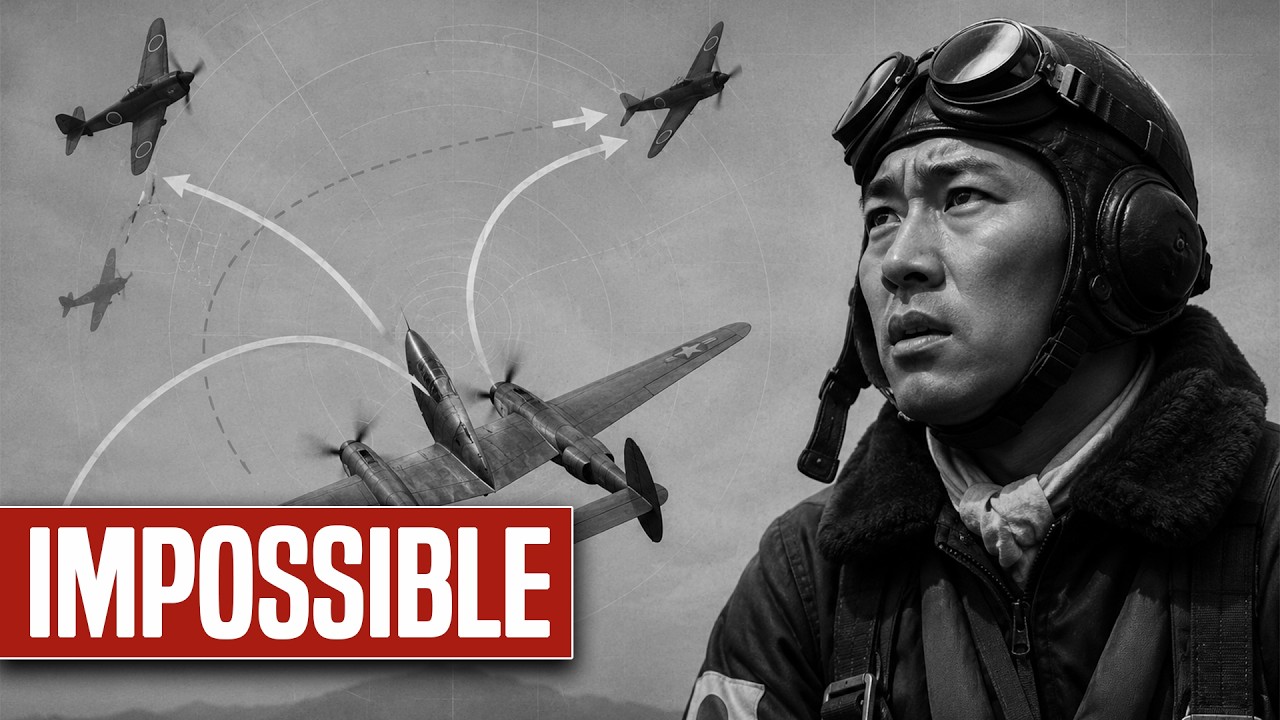
Nothing the Americans threw against it in the air had changed that arithmetic. The short-nosed Airacobra had failed, the Warhawk had failed, and even the heavy Buffalo had not altered the equation. The belief behind those numbers was simple and, until that moment, correct. No American pilot had found a way to defeat the Zero in a dogfight, and none of them seemed to be trying anything else.
Across the Pacific, American squadrons had spent the first year of the war receiving the same advice in one form or another: never try to turn with a Zero, because no one had yet found the pilot who could. That autumn over the Solomon Islands, that belief was tested and held. New American fighters appeared in combat, twin-tailed and twin-engined, so large that some Japanese pilots initially mistook them for bombers. Sakai, recovering from wounds that had cost him most of the sight in one eye, later wrote about the newcomers in the memoirs that made him famous on both sides of the Pacific.
The new type seemed to offer only speed and a steep dive in combat, and fortunately for the pilots who flew with him, its crews kept trying to turn with the Zero. Maneuvering was the only move that gave the Zero the win, and for a time, the new American fighter, later known across the Pacific as the P-38 Lightning, made that move and paid the same price as every American fighter before it. Four thousand miles to the north, a different story had already ended five months before any Lightning met a Zero over the Solomons. On June 4, 1942, a Zero flown by Petty Officer Tadayoshi Koga took ground fire that hit its oil line during the raid on Dutch Harbor and began trailing smoke over the Aleutian Islands.
Koga was flying as one of three Zeros assigned to escort the attack that morning. One of the other pilots, watching the oil trail behind Koga’s engine, was the first to realize what would happen. Koga chose Akutan Island for his forced landing. A stretch of tundra looked solid from the air, but it was not.
The wheels caught the moment they touched the ground. The fighter flipped onto its back, and Koga drowned, trapped upside down in the cockpit, while his comrades circled overhead. Uncertain whether he was actually dead, orders required the destruction of any Zero that fell intact on unreachable ground. No one could confirm Koga’s death, so no one bombed the wreck.
An aircraft worth more than any single ship in the Pacific fleet sat intact in a marsh for five weeks while both sides ignored it. A navy patrol crew spotted it on July 10. A recovery team arrived two days later, waded through the mud that had killed the pilot, and found the airframe nearly intact, twisted in places but complete in the important parts. It was the first flyable Zero either side had gotten its hands on.
Getting it off the island required cables, floats, and a barge borrowed for the job, before it was shipped to Naval Air Station North Island in San Diego. Mechanics there spent weeks draining saltwater and mud from an engine that had drowned with the man who flew it. They stripped the airframe to bare metal and examined every control surface for damage left by the crash and the weather. The aircraft flew again on September 20, 1942, repainted in American markings, with Major Eddie Sanders at the controls.
Sanders flew 24 test flights over 25 days, and what the aircraft revealed in the air did not match a year of guesswork based on combat reports on the ground. Above a certain speed, the ailerons became so stiff that turning required real physical effort, exactly at the moment a pilot needed quick response. Pushing the nose into a steep dive could starve the engine completely, because the float-type carburetor, designed for level flight, cut off fuel the moment the aircraft pitched into a steep attitude. The lightness that allowed the Zero to outmaneuver every other aircraft was the same lightness that made diving away from it, the only logical option an American pilot had, the one thing it could not do.
None of this reached squadron pilots as rumor. It reached them as official documents, Intelligence Summary No. 59 and Technical Air Intelligence Summary No. 3, records filed into tactical and technical directives before Sanders even finished his test program.
A pilot facing Zeros in 1943 never heard of Sanders and had no reason to. He inherited a set of instructions stripped of their reasons, the kind of documents that tell a pilot what not to do without telling him why. That was enough to save a man’s life. The tests did not stop with Sanders and a stack of papers.
At Eglin Field on the Florida panhandle, the same repaired aircraft staged mock battles against every American fighter type then headed for the Pacific. Navy Wildcats and Corsairs, army P-39s and P-40s, and the twin-boom Lightning, which at that stage of the war was still losing air combats it should never have been fighting eight thousand miles away. Pilots stationed at a proving ground on the Gulf Coast, men who would never see a Japanese airfield in their lives, spent an entire season learning when the captured Zero stopped being dangerous. They ran repeated passes against the real machine instead of rumors about it, recorded which altitudes gave the American fighter the advantage and which took it away, noted how long it took a Zero pilot to reach the point where the ailerons froze in a dive, and how a Lightning could wait out its climb until that happened.
None of it looked like the making of history. It looked like paperwork completed on schedule by men doing a job no one outside the program noticed. Some of what they recorded never reached an official bulletin and remained hangar talk among squadrons, the kind of information a new pilot learns from a crew chief before reading a word about it. Historians still argue over how much credit belongs to that single recovered airframe.
Naval aviation historian John Lundstrom and others have strongly challenged the popular version of this story, the claim that dismantling the Koga Zero alone taught the Americans how to defeat it. Combat pilots in the Solomons were already learning parts of the same lesson the hard way, at heavy cost, and fragments of other Zeros shot down in Australia and China reached Allied hands before Akutan did. The dispute has never been settled and may never be, since much of what any pilot carried into a cockpit in 1943 was a mixture of official bulletins, hangar talk, and survival instinct that no surviving records can sort out. What the dispute does not change is simpler, and for a P-38 pilot flying from Port Moresby a year later, far more useful.
A complete, flyable Zero existed on American soil by September 1942. An unnamed officer tested it to its structural limits and recorded the results flight after flight for 25 days. American pilots fought mock battles against it by name, including pilots of the type about to carry that knowledge into a war it had theoretically learned how to win. Search the Japanese side for any reflection of this and no trace of the documents appears.
No captured American fighter tested in surviving records, no bulletin outlining where their own Lightning’s limits lay. Allied technical intelligence teams operating from Australia spent part of 1943 rebuilding a Zero from parts gathered from five separate airframes captured at Buna, the same stretch of coast where the 39th Fighter Squadron would soon be fighting. They then tested the completed aircraft in mock combat against a Spitfire over Brisbane. The verdict, documented and numbered like everything else in this story, was that the Zero ruled the sky below 20,000 feet and lost control above that line.
The rebuilt airframe crossed the Pacific a second time, eventually aboard an escort carrier, to be tested and studied again at Wright Field, Ohio. Another record in a program with its own numbers in the files and its own named test pilots at every stage. If Japan ever ran a similar program against a downed Lightning, no surviving document indicates it. Researchers on both sides of the Pacific have spent decades searching without finding one.
Call it what it is: an asymmetry in paperwork. One side has a dated file for nearly every stage of the process, the other has nothing resembling it. That disparity, not any change in the aircraft itself, settled a battle at a proving ground in Florida a full year before the men who would fly it ever left the ground. A bulletin issued in the autumn of 1942 sat in unit files for months, waiting for a war that had not yet caught up with its paperwork.
The war caught up with that file cabinet in September 1942, when General George Kenney took command of the Fifth Air Force and began pushing every Lightning he could get his hands on into New Guinea. The 39th Fighter Squadron, which had been flying underpowered P-39s from Port Moresby, re-equipped with P-38s that autumn. They painted shark mouths around the twin nose booms and went looking for a fight on terms no one over the Solomons had yet managed to achieve. They found one on December 27 over Buna and Dobodura, where they broke up a Japanese air raid aimed at the beachhead below.
The squadron claimed ten aircraft downed that day: three army fighters, six navy Zeros, and one dive bomber, against the loss of a single Lightning. Captain Thomas Lynch shot down two army fighters to become the first ace in his unit before the mission report was even written, an action that earned him the Distinguished Service Cross for breaking up the raid before it reached the ground forces it targeted. A 22-year-old second lieutenant named Richard Bong, attached from another squadron while his own P-38s were still being shipped from Australia, climbed into the borrowed aircraft, tail number 42644, that morning, and scored his first two victories that same afternoon: a Zero and an army fighter, the first entries in a combat record that would make him the highest-scoring American pilot of the entire war. No one recording the claims that evening had any reason to note the tail number as significant.
It was just an aircraft the squadron happened to have. The mission that day launched to intercept a bombing raid before it reached the beachhead, and the fight took place over Buna at low altitude amid scattered clouds, where P-38s dove out of the haze onto formations that had not expected a fighter that large to climb to where the Lightnings were waiting. Four days later over Lae, the same unit destroyed nine more Zeros in a single mission. Lynch alone got two of them.
None of it involved taking a Lightning into a turning fight with anything. The doctrine that spread through the Fifth Air Force throughout 1943 had a clear character: refuse the turn, dive through the formation, fire once from the rear or above, use the rate of climb to regain altitude before the Zero could respond. It was practically the Eglin Field results arriving eight thousand miles late, converted into instinct by pilots who had never read the bulletin that made it possible and had no reason to ask where it came from. Bong applied it in his flying.
Thomas McGuire, who arrived in the theater the following year and finished the war with 38 confirmed victories, applied it too, chasing Bong in what the newspapers back home were already calling the great Pacific ace race. Neither man’s combat record contains a single reference to Akutan, Sanders, or a proving ground in Florida. The doctrine arrived without any acknowledgment of its sources. Command rarely explains itself to the men doing the flying.
This time, the silence ran in both directions, since the Americans writing the explanations had no intention of telling their enemy what they had learned either. Japanese pilots kept trying the old bait well into the following year. Expose a Zero’s tail, lure them into a turn, let the tighter turning radius do the rest. The same bait that had worked against P-39s and P-40s twelve months earlier stopped working, and no one flying against it appears to have been told why.
A command structure that had never lost a technical argument to this particular enemy could not explain, in any surviving document, what had changed in the American fighter they were facing. Nothing about the American fighter had changed at all. What had changed was that the other side now knew, in precise and tested detail, exactly how far their captured and repaired machine could be pushed before it fell apart, and they had told their men what to do with that knowledge without ever telling them its source. Replacement pilots arriving at Rabaul and Lae throughout 1943 received the same circular combat training their predecessors had received in 1941, from instructors who had not themselves been briefed on why those tactics were failing in the theater the newcomers were about to join.
None of this made the Lightning a perfect answer to the Zero problem. Pushing a P-38 into a dive fast enough to escape brought its own special difficulties. The controls stiffened at very high speeds, an effect no one understood in 1942, called compressibility once engineers found a name for it. More than one American pilot never recovered from that dive.
Lockheed spent years searching for a solution that did not reach the squadrons practically until dive recovery flaps appeared late in the war, long after Bong and McGuire had built their reputations without them. The same airframe that solved a structural weakness in the enemy carried its own structural weakness the entire time it was doing so, and the men flying from New Guinea in 1943 met that failure less often than pilots over Europe a year later, diving from much greater altitudes. Sakai flew against this pattern again later in the war and wrote about the contrast without ever naming its cause. In his account, the Lightning pilots of 1943 were a different kind of problem from those who had engaged and died over the Solomons a year before: patient with altitude, willing to break off an engagement rather than chase it, disciplined in a way no one flying a Zero in 1942 had ever had to plan for.
He never mentioned Akutan Island. He never mentioned Sanders or a proving ground on the Gulf Coast or a bulletin with a file number attached. He got the effect right and missed the cause entirely in his book, which is itself a kind of evidence. The most famous surviving fighter pilot in Japan, writing years later with every reason to explain how the tide had turned against his country, could not point to what had happened to his aircraft before he met its new version in the air.
The Akutan Zero outlived the war it had helped decide by nearly three years, and not much longer than that. It spent 1943 undergoing further evaluation at a navy test center in Maryland, and 1944 at North Island in San Diego, teaching novice pilots what a Zero could and could not do before they met one for real over open water. In February 1945, taxiing for a training flight, it was struck by an out-of-control Curtiss Helldiver that tore through the fuselage with its propeller and set fire to what remained of the airframe. A handful of flight instruments survived that wreckage.
They sit today in museum collections in Alaska and outside Washington, D. C. , the last physical trace of an aircraft that had already done its part without firing a single shot in the war it helped decide. Whether a Japanese counterpart was never built or was built and lost in the destruction of the war’s final year is not a question the surviving archives of either side can answer.
Eddie Sanders returned to a test pilot career that never made his name famous outside a small community of pilots who already knew the value of his 25 days in the autumn of 1942. No Japanese officer who ran a similar program against a captured American fighter appears in any account examined for this story, because the records show no such officer or program ever existed. History remembers Bong’s name. Sanders’s name appears in almost nothing written since.
The results outlived the man who produced them. By the end of 1943, Bong alone was credited with 21 kills, flying the same combat doctrine that Eglin Field had quietly written a year before he sat in a cockpit in New Guinea. McGuire, arriving later, surpassed him in total kills, and neither man mentioned in his memoirs the name of the Florida test range that made those calculations possible. The Lightning units of the Fifth Air Force as a whole were, by that time, scoring at ratios the men who had fought and died over the Solomons a year earlier would not have believed.
Those units continued flying the same doctrine, the no-turn doctrine, through 1944, past the point where anyone still in service could remember it as a new revelation rather than simply the way a P-38 was flown. No Japanese record of the air war over New Guinea, no postwar interrogations, no surviving unit histories, not even Sakai’s widely read memoirs, ever identified the actual mechanism behind that shift. The American paper trail runs unbroken from a swamp on Akutan Island to a hangar at Eglin Field, to a stamped file number on a 1942 intelligence bulletin, every document dated, numbered, and existing in archives today. The corresponding Japanese record, a captured Lightning, a test pilot’s log, a bulletin explaining when that machine stopped being dangerous, has never surfaced.
Not in Tokyo, not in the remnants of Imperial Navy records that survived the firebombing, the surrender, and the occupation that followed. Nothing in more than seventy years of research by scholars on both sides of the Pacific suggests it was ever written in the first place. The model followed at Eglin Field, capturing an enemy machine, testing it until it broke, recording how it broke in specific and repeatable terms, then handing the results to pilots who did not need to know their source, became the standard way the United States studied enemy aircraft for the rest of the war, and for the wars that followed. No one called it a model in the autumn of 1942.
It was just an airplane in a Florida hangar flown by men doing a job assigned by someone further up the chain of command, filed under a number no one outside the program had good reason to look up. Ten Japanese aircraft against a single Lightning over Buna. Nine Zeros in one mission four days later at Lae. Twenty-one confirmed kills for Bong alone by the end of 1943.
Every one of them flown according to a doctrine whose documents can be traced, file by file, back to a swamp on Akutan Island. The other side of the record, whatever papers Japan kept about the captured wreckage of its own aircraft, has never been found by anyone still looking.