In the fall of 1925, the world’s most famous movie star lay dying in a Paris hospital. Gloria Swanson, just twenty-six years old and reigning as Hollywood’s queen, was the subject of daily tabloid speculation over whether she would live or die. Only a handful of insiders knew the true cause of her crisis. The actress had nearly perished from a botched operation undertaken in desperate secrecy—an illegal abortion arranged to prevent a scandal that could have ended her career.
For over a decade she had been America’s ultimate movie goddess, but the glittering image she had built now hung by a thread. Swanson was born Gloria May Josephine Swanson in Chicago on March 27, 1899, the only child of a Swedish American army quartermaster and his ambitious wife. Raised as an army brat, shifting from base to base across Chicago, Key West, and Puerto Rico, she learned early to adapt and entertain herself. Precocious and imaginative, she later claimed she felt like an old soul even as a child, and developed a taste for self-invention that would define her life.
At fifteen, while visiting her aunt in Chicago, Gloria developed a hopeless crush on matinee idol Francis X. Bushman. After begging her aunt to arrange a studio visit, she found herself at Essanay Studios in 1914 and walked directly into her destiny. A studio employee needed a girl for a walk-on bit part, and the star-struck teenager eagerly volunteered.
She earned $3. 25 for the role, but the money was irrelevant. From the instant she stepped before a camera, Gloria Swanson knew she would never do anything else. She dropped out of high school to pursue motion pictures, to the horror of relatives who considered acting disreputable.
She found steady work at Essanay, where one of her earliest assignments was a brief comedy scene directed by and co-starring a young English musical comic named Charlie Chaplin. The experience was a disaster. The four-foot-eleven teenager, paired with Chaplin’s hyperactive slapstick style, later said she felt like a cow trying to dance with a toy poodle. Chaplin was unimpressed and asked that the girl be replaced.
Swanson took the rejection in stride, insisting even then that she would become very famous. By late 1916, not yet eighteen, Gloria followed the industry westward to Hollywood, making comedic two-reelers for Mack Sennett’s Keystone Studios. She proved a natural at comedy, and audiences took notice of the mischievous brunette. But offscreen, the naive convent-educated girl was plunged into Hollywood’s anything-goes social scene.
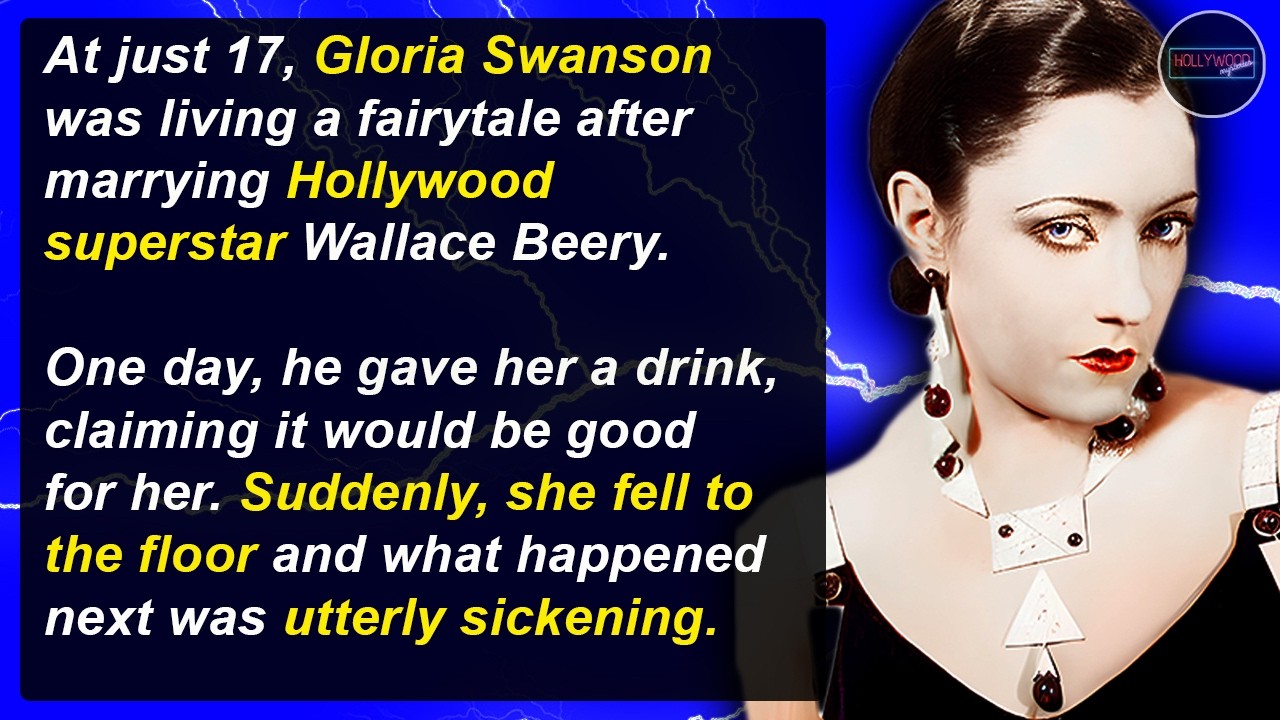
Barely a year into her Hollywood adventure, she made a rash decision that forever changed her life. She eloped with her handsome but hard-drinking co-star, Wallace Beery. Gloria was only seventeen when she married Beery, a thirty-year-old actor known for his lumbering comic persona. From almost the start, it was a nightmare.
On their wedding night, Beery got Gloria drunk on champagne and, according to her later account, raped her while she was half-conscious. Soon she became pregnant, but Beery did not want a baby. One day he offered her pills, claiming they were for morning sickness. Shortly after swallowing them, Gloria doubled over in agony as she miscarried their child.
Beery was also prone to beating her in drunken rages. By 1918, she fled the abusive marriage, with the divorce finalized in early 1919. Still just nineteen, Gloria Swanson had survived a brutal induction into the wages of both stardom and womanhood in Hollywood. She would carry the scars of that trauma for the rest of her life, but the experience steeled her resolve to control her own destiny.
As she put it, she was determined never to be taken advantage of again. If anything, Swanson’s career flourished after her divorce. She signed with Famous Players–Lasky, the future Paramount Pictures, and was soon working with the legendary Cecil B. DeMille, who instantly saw star quality in the feisty, photogenic young woman.
Cast in lavish society comedies draped in jewels, satin, and peacock feathers, Swanson blossomed under DeMille’s nearly paternal indulgence. He helped refine her persona from saucy comedian to elegant leading lady. By the early 1920s, Gloria Swanson had become, as one writer put it, “the movie star’s movie star. ”
At the height of her fame, she received ten thousand fan letters a week and could barely leave her house without causing a sensation.
She was making more money than she ever dreamed possible and spending it just as freely. By 1924, she was earning over a million dollars a year, close to twenty million in today’s money, and lavishly burning through half of it on a lifestyle of almost absurd luxury. In one year she splurged five hundred thousand dollars on jewelry, fifty thousand on gowns, nearly ten thousand on Persian rugs and exotic pets, and almost ten thousand on silk stockings. When asked why she spent so wildly on clothes, she shrugged that dressing like a queen was simply part of the job.
Her personal life remained as headline-worthy as her films. Shortly after shedding Beery, she married Herbert K. Somborn, a Chicago businessman, in 1919. The union produced a daughter, Gloria Jr.
, and Gloria adopted a baby boy she named Sunny. But in late 1923, Somborn abruptly filed for divorce, accusing his famous wife of adultery with no fewer than thirteen men, including DeMille and Rudolph Valentino. Swanson vehemently denied the more outlandish claims, scoffing that she would have found no time. Nevertheless, the divorce made lurid headlines, and a chastened Paramount added a morality clause to her contract, warning that if she caused moral outrage, the money fountain would be shut off.
By the mid-1920s, Gloria stood at the pinnacle of Hollywood, second only to Mary Pickford among beloved female stars. Yet she felt increasingly restless, churning out formulaic films that left her craving artistic control and respect. In 1925, an opportunity arose to film a pet project in France, a historical comedy called Madame Sans-Gêne about a laundress who marries a nobleman. Gloria personally negotiated with the French government to shoot in Napoleon’s actual royal palaces, a coup no studio had managed before.
While in Paris, Gloria fell in love with the film’s dashing translator, Henri, Marquis de la Falaise de la Coudraye, a handsome, charming, and penniless aristocrat. They began an affair, and when she discovered she was pregnant with his child, panic set in. She was still legally married to Somborn. If she had a baby visibly conceived before her second marriage ended, it would be a public relations catastrophe.
She could be branded an adulteress, and the studio could invoke the morality clause and blacklist her from the industry. Facing a difficult choice, Gloria did what countless women of her era did. She sought an illegal abortion in Paris, where France had recently tightened its laws, making the procedure a crime for both the woman and the practitioner. The procedure was nightmarishly botched, leaving Swanson hemorrhaging and feverish with infection.
For days she hovered at death’s door as reporters got wind that the great Gloria Swanson was mysteriously and gravely ill overseas. “Will she live or die? ” the headlines screamed while Gloria fought for her life in a Paris clinic. Miraculously, she survived, emerging physically weakened and emotionally devastated.
She later admitted she was severely depressed for months. After her recovery, she finally married Henri once her divorce from Somborn was finalized, and for a time she could play the role of European royalty in real life. But inside, she was furious at the studio system she felt had essentially contractually forced her into sacrificing her child. Jesse Lasky, head of Famous Players–Lasky, tried desperately to keep his profitable star, dangling increasingly extravagant sums.
Swanson did not bite. Shocking Hollywood, she walked away from the studio that had made her a star and accepted an offer from United Artists, which promised her complete creative freedom. It was an audacious move for a woman in 1926, essentially becoming an independent mogul. In 1927, Swanson founded her own production company.
Her first self-produced film, The Love of Sunya, was an ambitious mystical melodrama that proved an artistic misfire, sold off to foreign markets just to recoup costs. Undaunted, she set her sights on adapting a scandalous W. Somerset Maugham story called Rain, retitled it Sadie Thompson, and decided to produce and star in it despite the risque subject matter. She personally courted Will Hays, head of the industry’s self-censorship board, charming him into believing the film would be made with taste.
With Hays’s tentative blessing, she had effectively defanged any censorship threat. Production was beset with challenges, and the budget ballooned from $250,000 to over $650,000. But when Sadie Thompson premiered in 1928, the gamble paid off spectacularly. Critics called Swanson’s portrayal the finest work of her career, and the film was a box office smash, grossing over a million dollars in the US and an astonishing seven million worldwide.
She earned a nomination for Best Actress at the very first Academy Awards in 1929. At the same time, Gloria’s personal life once again entwined with her professional endeavors. She had begun an affair with Joseph P. Kennedy, a savvy and forceful Boston financier determined to break into the movie business.
Kennedy offered to take charge of her tangled finances, fired her entire staff, and set up a new corporation with himself in charge. In 1928, they embarked on a grand spectacle titled Queen Kelly, hiring the flamboyant Erich von Stroheim to direct. Von Stroheim was known for his obsessive perfectionism, and within weeks the film was wildly over budget. Midway through filming, Swanson shut the production down and fired him.
The film was quietly shelved, incomplete, a notorious unfinished symphony that cost Swanson dearly in fortune and reputation. Kennedy came out looking bad, and their affair deteriorated under the stress. By 1930, Gloria ended both the business partnership and the romance. Queen Kelly’s collapse coincided with the broader upheaval of talking pictures, and many of her contemporaries faded away when sound took over Hollywood.
Swanson, however, was determined to adapt. In late 1929, she made her talkie debut with The Trespasser, which turned out to be a solid hit, earning her a second Oscar nomination. But she could not entirely escape the forces bearing down on Hollywood. The Great Depression hit, tastes changed, and the opulent romantic escapism she specialized in began to seem outdated.
By 1935, with her film prospects dwindling and four marriages behind her before age forty, Gloria Swanson faced a big question: what now? Rather than cling to past glory, Swanson reinvented herself yet again. In 1938, she uprooted to New York City and announced she was embarking on a new chapter as a businesswoman and patron of science. She formed a venture called Multiprises Incorporated, aimed at rescuing European scientists imperiled by the rise of Nazi Germany and developing their inventions in America.
Using two hundred thousand dollars of her own dwindled fortune, she assembled a board of directors, rented offices at Rockefeller Center, and personally helped extricate at least four scholars from under the Nazis’ noses. The grateful inventors nicknamed their stylish benefactor “Big Chief. ” Multiprises developed a new carbide steel cutting tool, created the first plastic buttons for clothing, and one scientist began work on a talking typewriter for the blind that pre- aged the modern dictaphone. Multiprises was short-lived, pulled into government research by World War II, but Gloria never stopped innovating.
She also reconnected with live theater, made an early presence on television, and became an evangelist for healthy living long before it was trendy, practicing yoga and advocating macrobiotic diets. Then fate and Hollywood had one more starring role in store for her. Director Billy Wilder set out to cast his caustic new screenplay, Sunset Boulevard, a darkly satirical tale of a once-great silent movie star now a reclusive, delusional older woman dreaming of a comeback. Wilder needed someone who could embody both the faded grand and the ferocious desperation of the character Norma Desmond.
Greta Garbo demurred. Mary Pickford was insulted. Other former stars turned it down. Then Wilder’s co-writer Charles Brackett thought of Gloria Swanson.
She was the obvious choice, the epitome of a 1920s superstar. Gloria nearly balked when told she needed a screen test. Director George Cukor convinced her, telling her bluntly that this was the role of a lifetime. The test was arranged, and Wilder immediately saw what he needed.
Swanson was Norma Desmond. On set, life and art danced a fine line. Wilder cast her former director Cecil B. DeMille to play himself, calling Norma “young fellow” just as he had called Gloria in the 1920s.
He cast silent comedy legend Buster Keaton as one of Norma’s bridge partners, and in the most surreal stroke, he cast Erich von Stroheim, the very man who had torpedoed Queen Kelly, as Norma’s butler Max. In one scene, Norma watches an old silent film projected in her crumbling mansion—none other than the long-lost Queen Kelly, giving American audiences their first glimpse of that unfinished collaboration. When Sunset Boulevard premiered in August 1950, critics hailed it as a masterpiece and reserved their loudest applause for Swanson’s fearless turn. She was suddenly the toast of the town again at fifty years old.
She collected a Golden Globe and her third Oscar nomination. She lost the Best Actress statue to Judy Holliday, but she had achieved something precious. She had outlived her own legend and reshaped it for a new era. She refused to be typecast as a ghoulish version of herself and returned to New York, resuming the eclectic pursuits that had sustained her.
In 1980, she published her autobiography, Swanson on Swanson, a hefty and deliciously candid bestseller in which she finally came clean about that long-rumored abortion with the marquis back in 1925, writing candidly about nearly dying in that Paris hospital and the bitterness she felt toward the studio system as a result. She had at last found a partner who adored her in William Dufty, whom she married in 1976. On April 4, 1983, Gloria Swanson died of heart failure at New York Hospital. She was eighty-four years old.
Fittingly, she was laid to rest in an elegant church crypt on Manhattan’s Upper East Side, her name reading simply, “Gloria Swanson, actress. ” She was Hollywood’s first glamour queen, an actress so celebrated that newspapers referred to her as just Gloria, confident everybody knew who they meant. Above all, she was the author of her own life, one she seized with both hands. As she liked to remind people, “Never say never.
Life is too full of rich possibilities to have restrictions placed on it. ” She lived on her own terms, died with few apologies, and was always ready for her close-up.