On December 18, 1944, in the late afternoon gloom of the Ardennes, a column of German armor was looking for a bridge. It had been moving for two days along roads selected months earlier by staff officers working with maps and rulers, and it was already behind schedule. Its commander was one of the most aggressive officers in the Waffen-SS, leading a battle group built around heavy tanks. His orders were simple and enormous: head west, cross the Meuse River, and stop for nothing.
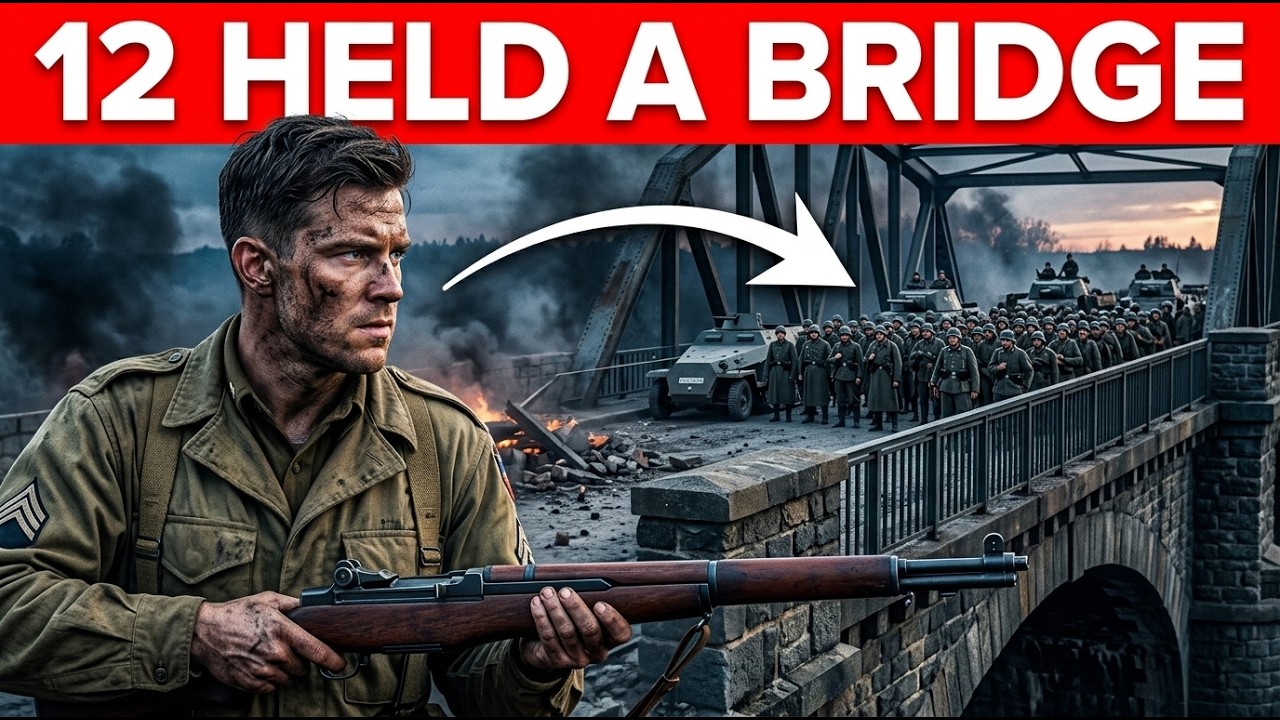
The problems were fuel and terrain, and both came down to the same thing. In that country, in winter, armor moved on roads, and roads crossed rivers by bridges. Remove the bridge, and a seventy-ton tank became an expensive object parked in a valley. That was why the column was searching for one.
It was also why a very small number of Americans were standing on the other side of it. Not a company. Not a platoon. A handful of men, mostly engineers from a combat engineer battalion, plus whatever else had drifted into the position.
A few infantrymen separated from their units, a bazooka team, one machine gun. They had a truck of mines, some demolition charges, a few automatic rifles, and a semiautomatic rifle in every hand. What the Germans reported up their chain of command that day, and in the accounts written afterward, was not a handful of men. It was a defensive position, a fortified line prepared for delay.
In some reports, it was a full battalion. That mistaken estimate, repeated at bridge after bridge during the first four days, was what stopped the most dangerous armored column in the German army. It is worth understanding how twelve men produced it with precision. The German situation explained everything about how they interpreted what they encountered.
The battle group was operating on a timetable, and that timetable was not a suggestion. The entire German offensive was built on speed: break through a weak sector, reach the road network, rush west before the Americans could react, cross the Meuse, and reach Antwerp. Every hour lost was an hour for the Allies to move their reserves. The column also had a specific and deadly constraint.
It did not have enough fuel to reach its objective. The plan assumed the capture of American fuel depots along the way, which was more of a hope with geographic references than a plan. The terrain added to the problem. The Ardennes in winter was steep, forested, and cut by streams in narrow valleys.
Heavy vehicles moving off paved roads became nearly impossible in wet conditions. The tank column was therefore very long and very thin, chained to a ribbon of road, unable to deploy, outflank, or even turn back without losing disastrous amounts of time. The commander at the front understood what this meant psychologically. Every time the column met resistance, he had to make a decision under time pressure.
Either push forward and risk losing his lead vehicles in a spot where they would block his advance, or find another route, which meant reversing a column of heavy armor down a mountain road in winter. Both options cost hours. The one thing he could not afford was lost time. His estimate of what he faced mattered more than what he actually faced.
If he thought he had hit a roadblock held by a few men, he pushed through. If he thought he had hit a prepared defensive position, he reconnoitered, deployed, waited for infantry, and called for artillery. Every minute spent deciding was a minute the Americans used. Now came the American side and the mechanics of the illusion, because it was not so much an illusion as an honest miscalculation.
A German officer estimated enemy strength the way any officer did, by the density and variety of fire. That method was reliable in an army where the firepower of a rifle platoon was a known constant. It became unreliable when the enemy’s firepower per man was several times your own. Consider what twelve Americans could produce at a bridge.
Each man had a semiautomatic rifle, firing eight rounds as fast as he could aim without working a bolt. Two or three men had automatic rifles firing continuous bursts. There might be a light machine gun. Ammunition was not rationed because ammunition was the one thing that always arrived.
Against the German officer’s mental model, where a similar volume of small-arms fire meant a much larger number of riflemen with bolt-action weapons, the estimate came out high. Not because he was a fool, but because he was using a conversion rate that no longer applied. The engineers multiplied the illusion. They had mines, and a row of mines laid across a road at dusk was indistinguishable from inside a tank as a prepared minefield covering a defensive position.
They had explosives, and a bridge blowing up in the face of the advancing vehicle told the commander that this crossing had been planned for, which meant there was a plan, which meant there was a staff, which meant there was a formation. They had felled trees and diggings, an obstacle across a forest road covered by fire, a classic prepared obstacle straight out of the manuals. Four men took an hour to build it. A tank column took much longer to deal with it.
Then there was the bazooka, and it deserved special attention for what it did to the assumptions of the column commander. It was a shoulder-fired rocket launcher, a tube, a rocket, two men, and a shaped-charge warhead. Against the frontal armor of a heavy tank it was nearly useless. Against tracks, running gear, side plates, and engine covers from close range, it was deadly.
In a village or a forest path, where the side of a tank was thirty meters from a doorway, close range was the only range available. The tactical effect was completely disproportionate to the weapon itself. One hit immobilized the lead vehicle on a road with a stone wall on one side and a slope on the other. That did not disable just one tank.
It blocked the entire column. Everything behind it stopped in the open with no way around. The commander whose lead tank had been hit by an infantry weapon from a place he could not see had to assume there were more of them, which meant dismounting infantry to clear the ground ahead, which cost another hour. Then came the piece that settled the argument: artillery.
Any American position of any size, anywhere in that campaign, had reasonable contact with guns. A forward observer or an officer with a radio and map coordinates could bring down a concentrated strike within minutes. A German commander reconnoitering a roadblock who came under artillery fire did not conclude that he had run into twelve men with a radio. He concluded that he had run into an organized defense with fire support, because in his own army, artillery ready to respond that fast meant a formation headquarters somewhere behind it.
Twelve men, a line of mines, a bazooka, a demolition charge, and a radio. To the receiving end, that read as a full battalion. The engineer war in those four days was not really about holding ground. For the most part they could not hold ground and did not try.
It was about time and roads. The pattern repeated at crossing after crossing. A handful of engineers reached a bridge shortly before the German column. They prepared it for demolition.
They fought just long enough to make sure the enemy had committed to that route. Then they blew the bridge, sometimes with German vehicles in sight, and fell back to the next one. In many documented cases, this happened within minutes. A bridge exploded while the advancing tanks approached the far bank, and an armored column that had been rushing for two days stopped in front of a river it could not cross.
What that produced, cumulatively, was the strangling of the German advance. Not a defeat in battle. The battle group was not destroyed at any of those bridges. Something worse for the Germans happened.
They were diverted, pushed off good roads onto bad ones, sent through valleys that narrowed, forced to turn back, burning irreplaceable fuel on routes they had not planned for, arriving at each new obstacle later than the one before. By the time the column was pushed into a valley too narrow for deployment, out of fuel, with the fuel depots they had counted on either evacuated or burned, the men who had done it were gone. They had blown their bridges and withdrawn. Something else those scattered groups did struck directly at the weakest point of the German plan.
The offensive was built on the assumption that the advancing columns would capture Allied fuel, not as a bonus but as a basic requirement. The distances involved and the fuel allocated did not match any other way, and the German war planners knew it. So when American forces in the path of the advance burned or evacuated fuel depots rather than letting them be captured, in some cases setting fire to hundreds of thousands of gallons, in others simply moving the barrels away at night, they were not destroying supplies. They were removing the assumption on which the entire operation rested.
A column diverted onto longer roads by blown bridges consumed more fuel. A column that then reached a burning depot had no way to make up the deficit. The two facts multiplied each other, and by the fourth day, the most dangerous armored formations in the west were a collection of stationary vehicles with empty tanks in some valley. Meanwhile, the American reaction was on its way.
Parachute divisions were being trucked up from reserve. Armored combat commands were moving laterally at night. Artillery battalions were shifting into positions the Germans needed. Every hour bought by twelve men at a bridge was an hour the Americans spent moving thousands.
That was the actual mechanism of the entire Ardennes defense in the first week. Small units, often engineers or mixed groups of whoever was there, buying hours of time at road junctions and river crossings while a much larger machine behind them assembled the response. The men who did that work were not, for the most part, infantry. They were engineers whose normal job was construction, standing on a bridge about to be destroyed, in the dark, with a column of heavy tanks approaching.
The German misreadings were not due to stupidity, and it is worth being precise about why intelligent professionals made the mistake repeatedly. The first reason was the firepower conversion problem already described. Their general rule for converting observed fire into estimated numbers was calibrated against armies equipped like their own, and an American infantry platoon simply produced more noise and ammunition per man than that rule allowed. The second reason was that the Germans expected the defense to be organized, because in their own army it would have been.
A blocking position on a major axis would have been established by order, from a specific unit with a specific commander and a laid-out plan. When they encountered obstacles, mines, demolitions, and fire at successive crossings, the logical conclusion was that some headquarters had established a defensive line. There was no line. There were scattered groups acting on their own initiative and doing the same logical thing independently, because they had all reached the same conclusion about what mattered, which was the bridge.
The third reason was the fog of war in its literal sense: fog, snow, forest, and the short winter days. A column commander three vehicles back could not see the position firing at him. He received reports from the lead tank commander, who was under fire in poor visibility at close range and was not inclined to underestimate the enemy. The fourth reason was time again, and it was what made the error costly.
A commander under severe time pressure who was uncertain of enemy strength would in most cases choose the cautious option, deploy, wait, bring up support, because the downside of charging into a strong position was losing the vehicles that would block his own path. Uncertainty cost hours. The Americans at those bridges were not really selling casualties. They were selling doubt, and the Germans paid full price every time.
There was a fifth reason, more structural than tactical. The Germans had no way to verify. Verifying an estimate of enemy strength required reconnaissance, either a man working around the flank of the position to see how far it extended, or an aircraft watching from above. In that terrain, in that December weather, flank reconnaissance on foot through wooded valleys took hours, and there was no meaningful German air reconnaissance over the American rear areas.
So a commander who suspected he might be facing only a handful of men had no practical way to confirm it before the price of delay had already been paid. He could either act on the pessimistic estimate immediately or spend the time finding out the truth. Finding out the truth cost almost as much as the mistake itself. It was a trap with no way out, and the Americans at those crossings were sitting inside it deliberately.
The verdict is that the German column was not stopped by force. It was stopped by a calculation error that made a few men inevitable. Everything about the American position at those crossings was small: the number of men, the weapons, the time they could realistically hold. What was not small was the amount of information those men could put into the German commander’s head in ten minutes.
Mines, demolitions, automatic weapons fire, artillery, each piece of information pointed to a conclusion that was wrong but that no sensible officer could ignore. Beneath the illusion lay real capability, and that was why the illusion worked. The artillery could actually be called in. The mines were actually there.
The bridge had actually been blown. The reinforcements were actually coming. A deception works when the thing being masked is believable. In the American army of 1944, it was believable because most of the time it was real.
One final point deserves to be stated clearly because it was the point German after-action reports never reached. The men at those bridges had not been ordered to be there according to any coherent plan. They were engineers doing engineering work: road maintenance, sawmill operations, bridge repair. Then they found a German offensive coming their way, and they decided on their own, at the company, platoon, and squad level, that the right response was to lay mines in the approaches and prepare the crossings for demolition.
No one at army headquarters had ordered it. There was no time for anyone at army headquarters to tell anyone anything. The German officer who looked at that resistance and reported a battalion was right about one thing after all. He was not looking at a battalion of men.
He was looking at what independent decisions looked like when they added up to a battalion: a few dozen unauthorized decision-makers all making the right decision within the same hour. The twelve men and the thirty hours are a composite. The events are not. American engineer units in the Ardennes did fight as provisional infantry.
They did blow bridges ahead of the lead vehicles of the most dangerous German column in the offensive. They did succeed in diverting it from planned roads into terrain it could not exploit. And the German accounts consistently overestimated the forces they faced at those crossings. The groups that did that work were never told they had decided the battle.
But the rest of the army had enough time to arrive because of them.