James Vernor was fifteen years old in 1858 when he took his first job as an errand boy at Higgby and Sterns, a pharmacy on Woodward Avenue in Detroit. He wrapped parcels, ran deliveries through the mud streets, and proved himself quick and careful enough that the pharmacists trusted him with a mortar and pestle rather than just a broom. Within a few years he had risen to junior clerk, standing behind the counter and measuring compounds by hand. Pharmacy in the 1860s was closer to alchemy than science.
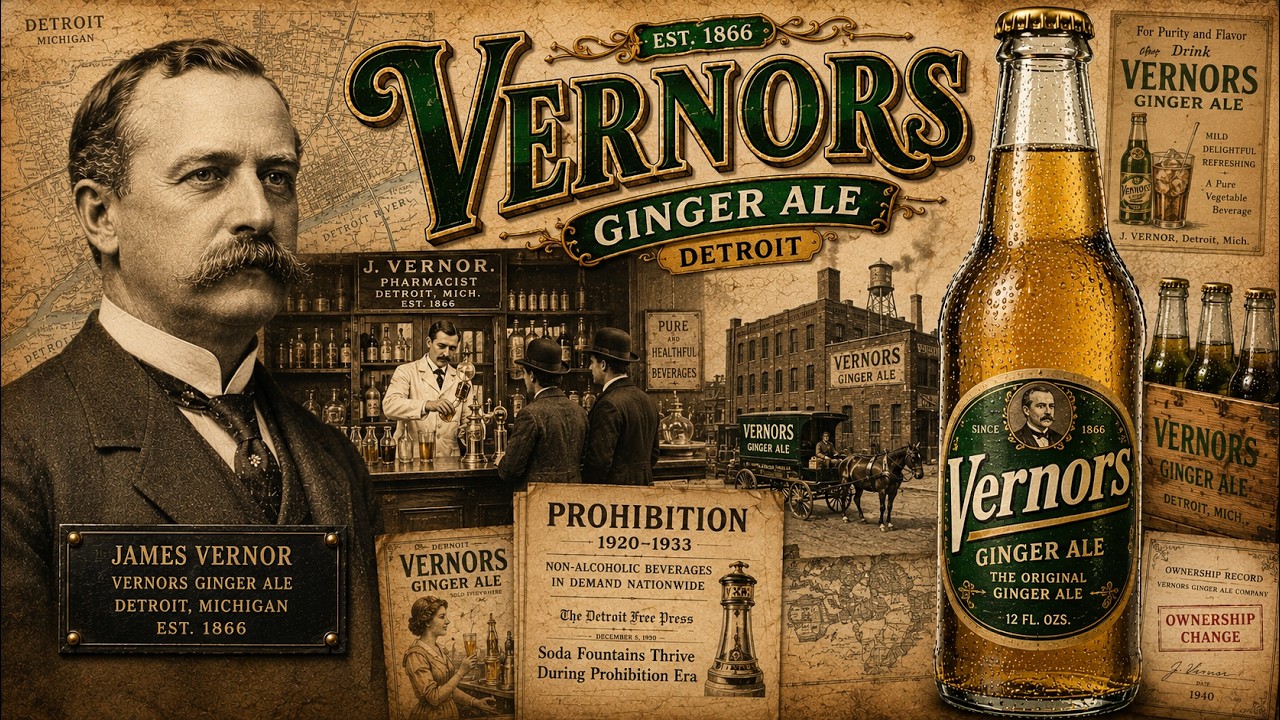
Pharmacists blended their own tonics, syrups, and elixirs from raw ingredients, testing combinations by feel and taste, and guarding their formulas the way a chef guards a recipe. It was exacting work, and Vernor absorbed its discipline completely. By 1862, he had found something to obsess over. Ginger drinks were fashionable that decade, sold as much for their reputed power to calm an upset stomach as for their taste.
But raw ginger extract was harsh and sharp, fighting the drinker instead of refreshing him. Vernor began experimenting with a blend of ginger, vanilla, and spices, chasing a formula that did not exist anywhere else in the country. Then the Civil War interrupted him. He enlisted in the Fourth Michigan Cavalry and served through the back half of the war.
Here the story splits into two versions. The version the company told for over a century holds that before leaving for the war, Vernor sealed his half-finished ginger blend inside a charred oak barrel and set it aside. Four years later, in 1866, he came home and cracked open the barrel, expecting ruin, and instead found a drink transformed. The wood had mellowed the sharpness of the ginger.
Time had done what mixing could not. It was a beautiful founding myth, giving the brand its slogan for generations, aged four years in wood, and its claim to being the oldest soft drink brand in America, dated not to when it was sold but to when the barrel was sealed. There is only one problem. James Vernor’s own son, James Vernor II, said later in life that his father actually developed the ginger ale formula after coming home from the war, not before he left.
No four-year barrel. Just a pharmacist back from the fighting, returning to work on a formula he had already been chasing before he shipped out. Which version is true likely died with the two men who could have settled it. What is certain is that by 1866, James Vernor had a ginger ale recipe he was proud enough to sell, and he opened his own pharmacy on Woodward Avenue to do it.
For a while, that single storefront was the only place on earth where a person could buy a glass of Vernor’s ginger ale. Vernor treated it exactly the way he had been trained to treat a prescription, with obsessive, almost clinical control. As demand grew and other soda fountains around Detroit wanted to carry it, he required each fountain to install specific equipment before he would sell to them, and he personally sold them the carbonated water the syrup was meant to be mixed with. He was by every account difficult to work with in exactly the way a man who cares more about the product than the sale tends to be.
It cost him convenience. It bought him consistency. In a business built entirely on taste, consistency was the whole game. By the 1880s, the operation had outgrown a single storefront.
Word of Vernor’s Ginger Ale had spread past Detroit, carried by travelers and traveling salesmen. Demand was no longer local. It was regional. And Vernor faced the same decision every small producer eventually faces: stay small and protect the product, or scale up and risk losing what made it special.
He chose to scale, but on his own terms. Every soda fountain that wanted to serve the ginger ale still had to install his specified equipment first. The company was not chasing volume at any cost. It was making volume come to it, one properly equipped fountain at a time.
In 1896, the transformation became official. James Vernor closed his pharmacy for good. The ginger elixir was outselling the medicine. He moved a short distance down Woodward Avenue to open a soda counter and bottling plant devoted entirely to the drink that bore his name.
His son, James Vernor II, stepped in as president that same year. It was not a founder cashing out. It was a founder handing the wheel to blood, the first of what would become a full century of Vernor family control, a rarity in an industry where regional brands typically change hands within a generation or two of their founding. The company kept growing.
Eventually it bought the old Riverside power plant on the Detroit River and converted it into something far more ambitious: a ten-story bottling plant crowned with a massive illuminated sign bearing the Vernor’s name, visible for miles along the waterfront. The location was not chosen by accident. The Detroit River was one of the busiest passenger corridors in the region, carrying ferries packed with Detroiters heading to Windsor, to Boblo Island, to Belle Isle for a Sunday outing. Every one of those ferries passed directly beneath the sign.
In the 1940s, the company pushed visibility even further, opening a shop along the river where visitors could watch the bottling process in person while they enjoyed a drink. Underneath all of this sat a quieter strategic advantage. Vernor’s was not trying to outmarket the giants of the national soft drink industry. Ginger ale sold as much for its association with settling an upset stomach as for refreshment, embedding itself into daily domestic life in a way a purely recreational soda never could.
Michigan households treated it less like a soft drink and more like something kept in the cupboard next to the aspirin, warmed on the stove with lemon for a sore throat or a stubborn cough. That dual identity, medicine and treat, came directly from the fact that the man who made it first sold it from behind a pharmacy counter. Prohibition should have hurt ginger ale. By the time the Eighteenth Amendment took effect in 1920, golden ginger ale had developed a reputation problem nationwide.
It was the drink of choice for cutting bootleg liquor, strong and sweet enough to mask whatever a bathtub distiller had cooked up. Across the country, sales of golden ginger ales fell as the category became associated less with refreshment and more with what it was being poured into. Vernor’s did not bleed with it. Its advantage was reputation.
Decades of pharmacy counter credibility meant the company had never been understood as a mixer. It weathered a decade that gutted much of its own product category. In 1928, a dedicated Vernor’s shop opened in Decatur, Illinois, and a franchise opened in Zanesville, Ohio, complete with the same specialized serving apparatus the company had required of every fountain since James Vernor’s earliest years. James Vernor did not live to see how far that discipline would carry the company.
He died on October 29, 1927, at eighty-four years old. His family would later joke that he had not truly retired until a few hours before he died. The company he left behind was not a founder’s fragile creation waiting to fall apart without him. Through the Great Depression and two world wars, it continued to operate under family leadership while countless smaller regional beverage companies folded, merged, or disappeared.
Then the city that had helped build its reputation turned around and took the building away from it. In the early 1950s, Detroit was planning a sweeping redevelopment of its riverfront, a civic center that would eventually become Hart Plaza. The Vernor’s plant sat directly in the path of that vision. On September 22, 1951, the city issued a formal condemnation notice on the property.
Mayor Albert Cobo offered Vernor’s a trade: the old convention hall site further up Woodward Avenue in exchange for giving up the riverfront. Vernor’s did not fight the deal. The company poured roughly five million dollars, worth more than sixty million today, into building out the new plant, and made a deliberate choice with that investment. Rather than hide the bottling operation behind a factory wall, Vernor’s built the new plant with a glass front running the length of an entire block, so anyone walking down Woodward Avenue could stop and watch the ginger ale being made in real time.
When the plant opened in 1954, complete with its own soda fountain and a fifty-five-foot neon sign of a gnome pouring a bottle, it became one of Detroit’s genuine tourist attractions. For the next three decades, that plant was Vernor’s. The four-year barrel aging process was not a footnote on the label. It was the whole argument for why Vernor’s tasted like nothing else on the market.
But a four-year aging process is also, from an operational standpoint, an enormous liability. Capital tied up in barrels that will not generate a dollar of revenue for years. A production timeline that cannot be sped up no matter how much demand grows. As long as the company stayed in family hands, that tension did not matter.
Then the family sold. In 1966, exactly one hundred years after James Vernor first sold ginger ale from behind his own pharmacy counter, the Vernor family sold the company to an investment group. What followed was a chain: seven owners across sixty years, each one a little further from Detroit than the one before. The investment group did not hold on long.
Ownership passed to American Consumer Products, a conglomerate with no particular attachment to ginger ale, soda fountains, or the city of Detroit. From there it passed again, to United Brands, a sprawling multinational corporation best known for produce. It was under United Brands’ ownership that the chain produced its most consequential decision. On January 18, 1985, the flagship Detroit bottling plant, the same glass-front factory built with pride in 1954, filled and capped its final bottle.
Production did not stop. It simply left. The company announced it would relocate operations to the suburbs, and the local rights to bottle Vernor’s in Michigan were handed over to Pepsi-Cola. The Woodward Avenue plant sat empty for two years.
Demolition began in late 1987, and the building that had once been one of Detroit’s genuine tourist attractions came down to make way for nothing in particular. An empty lot where a company’s proudest investment had stood for just over three decades. Ownership kept moving. In 1987, the same year the plant was being torn down, A&W Beverages acquired Vernor’s through Canada Dry Mott’s, folding the brand into a portfolio of soft drinks with almost nothing in common with each other except that they had all once been proud regional names.
Around the same period, Woody the Gnome, the mascot since the early twentieth century, was dropped from the packaging entirely. In 1993, Cadbury Schweppes, a British confectionary and beverage conglomerate, acquired Vernor’s as part of its broader portfolio of American soda brands. Under this ownership, the company’s oldest and most sacred production detail quietly began to change. The label that had read aged four years in wood was rewritten to flavor aged in oak barrels.
Then, by 1996, to barrel-aged bold taste. The actual aging period had been quietly shortened from four years to three. Real ginger extract gave way over time to natural flavors. Cane sugar gave way to high fructose corn syrup.
In 2008, Cadbury Schweppes split its confectionary and beverage businesses, and Vernor’s went with the beverage side, becoming part of the newly formed Dr Pepper Snapple Group. In 2018, Dr Pepper Snapple Group itself was acquired by Keurig Green Mountain, creating the company that owns Vernor’s today: Keurig Dr Pepper, headquartered not in Detroit, not even in Michigan, but split between Burlington, Massachusetts, and Plano, Texas. None of these owners set out to destroy the brand. Each decision on its own was a reasonable one.
Consolidate production. Standardize a formula. Cut a line item that no longer made financial sense inside a company managing dozens of brands across multiple continents. It is only when you look at the whole chain, seven links, sixty years, one direction, that the pattern stops looking like a series of unrelated business decisions and starts looking like what it was: a hundred-year-old Detroit company moving further from Detroit with every single sale, until the distance itself became the story.
The brand survived every ownership change, every relocated factory, every quiet label revision. Keurig Dr Pepper’s flagship Michigan bottling plant today sits in Holland, Michigan. Still the state James Vernor called home. Still technically Michigan made, but nearly 150 miles from the Woodward Avenue address where the company built its identity for over a century.
The brand kept its home state. It lost its hometown. And yet in August 2022, Keurig Dr Pepper released a black cherry variant, the brand’s first new flavor in more than fifty years, tested first in a limited run across Michigan before any wider rollout. What the corporations could never buy was the ritual built around the drink itself.
The Boston cooler, Vernor’s poured over vanilla ice cream, is still on menus across Michigan. In Flint, it is still paired with an olive burger at Halo Burger, and a faded mural honoring Vernor’s still stands on the wall beside that restaurant, repainted and preserved by people with no corporate obligation to care about it at all. On June 14, 2026, Michigan marked the brand’s 160th anniversary with a full day of celebration in Detroit’s Eastern Market District. There were Vernor’s floats and Boston coolers served from a food truck.
There was Woody the gnome in costume greeting a crowd that had gathered specifically to toast a soft drink. There was a countdown, and then a block of Riopelle Street lifted paper cups together and drank. Nobody from Keurig Dr Pepper’s Texas headquarters needed to organize that gathering. Detroit organized it for itself.
A corporation can buy the name, the recipe, the trademark, the bottling rights, the label copy, even the number of years printed on that label. What it cannot buy is a block of Riopelle Street lifting paper cups in unison, or a mural somebody in Flint keeps repainting for no financial reason at all. Vernor’s survived everything except the simple cumulative weight of belonging to fewer and fewer people who had ever actually been to Detroit. Somewhere tonight, in a diner at the edge of a Michigan town, someone is pouring a Vernor’s over a scoop of vanilla ice cream, building a Boston cooler the exact way it has been built for over a hundred years.
They are not thinking about corporate headquarters in Texas, or a label that used to say four years and now says three. They have been doing this since they were kids. The way Detroiters have been doing it since a pharmacist built something worth remembering out of ginger, vanilla, and a little bit of patience.