In the autumn of 1923, in the hills of western Pennsylvania, the town of Black Ridge depended on a single building. The Black Ridge Processing Plant, constructed in 1904 and converted to chemical manufacturing a decade later, employed nearly every man of working age in the town of roughly 1,400 people. The foreman, Ogden Hargrove, was a 51-year-old veteran of the plant who had worked there since 1914 and ran the floor with a steady, respected hand. Under him worked about 63 men across two shifts, leaving the building empty for eight hours each night except for the watchman, a 60-year-old named Pernell Subtles.
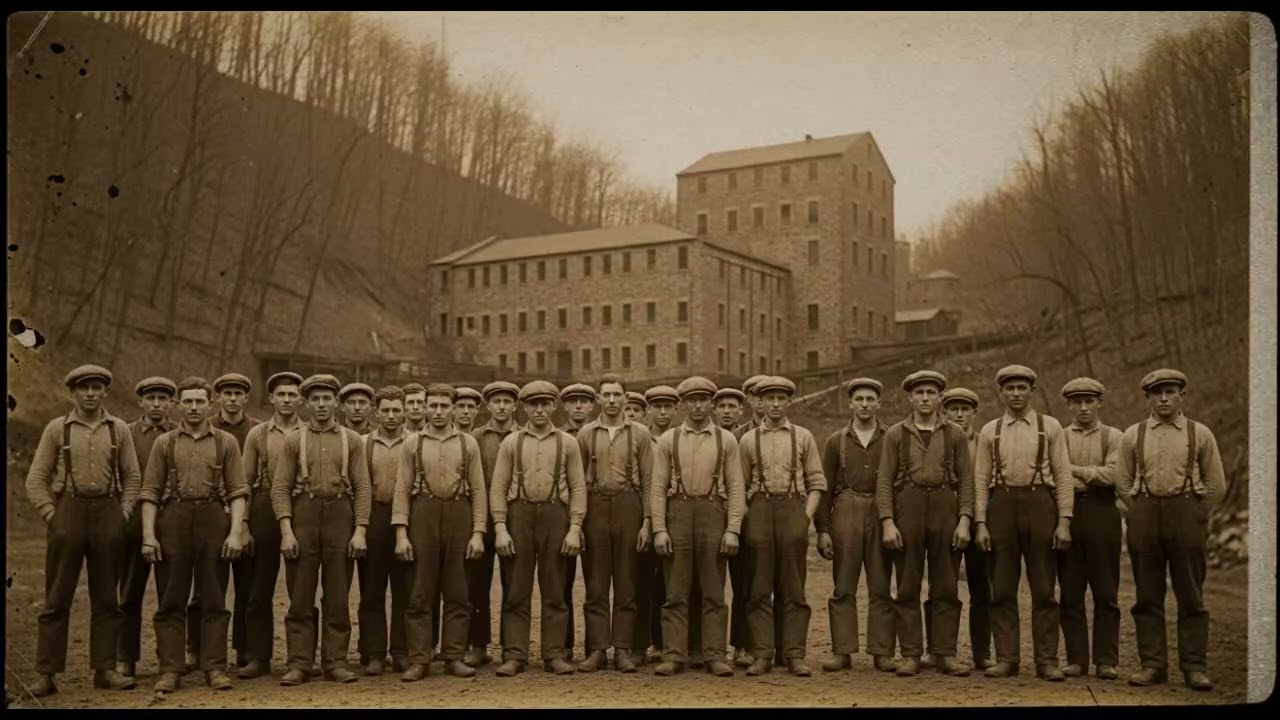
For nine years, nothing unusual happened at the plant. Then, on the morning of October 7, 1923, Ogden noticed a smell. It was different from the usual sharp chemical odors, something organic and sweet, heavy with decay, clinging to the walls of the rear section that had been carved into the hillside. He checked for leaks and found nothing.
His assistant foreman, Coswell Dietrich, suggested a dead animal in the walls. Ogden accepted that explanation, but the smell did not fade. By Friday, it was stronger, and two workers asked to be reassigned from the back section because the odor made them lightheaded. Ogden requested funds to inspect the walls from the plant’s owner, a Pittsburgh businessman named Aldrich Voss who had never once visited the facility.
The request was denied. On the night of October 12, Pernell Subtles heard something on his rounds. A rhythmic, wet, thick sound, almost like breathing, came from the back corridor. He stood in the dark listening for several minutes, then turned and walked the other way.
He did not pass that section again that night. The next morning, he told Ogden what he had heard. Ogden investigated and found the back corridor cold, unnaturally so, and the wall itself damp with a slick, oily residue. He sent two experienced workers, Redmond Pry and Dutton Ash, to inspect the walls.
When they returned, Redmond’s face was pale. He reported that the corridor was cold, but the far wall was hot, as if something behind it was generating heat. The smell was coming from the stone itself. Dutton had pressed his ear against the wall, and whatever he heard left him shaking and unwilling to speak for the rest of his shift.
Ogden sent a detailed letter to Aldrich Voss requesting a structural engineer. The response came by telegram four days later: handle locally, no funds available, maintain production. So Ogden sealed off the back section, told the men it was a possible gas leak, and continued operations in the rest of the plant. But the smell spread.
By the third week of October, workers reported headaches and nosebleeds. A boiler operator named Fenick Galt told Ogden he was dreaming of the plant at night, of the machines running with no one operating them, of the sealed door to the back section standing open, and of something inside trying to speak in a voice that was almost but not quite human. Four other workers reported similar dreams over the following days. On the night of October 26, Pernell Subtles heard footsteps above him on the locked second level of the plant.
They were slow, deliberate, barefoot on wet stone, with a faint dragging sound between steps. He left the building entirely and sat in his truck until dawn. In the morning, he told Ogden that the building was not empty at night. Something was in there with him, it knew his route, and for the first time, it was not hiding.
Ogden decided to enter the back section himself that night with Coswell, Redmond, and a newer worker named Harlon Mets. When they removed the bolted wooden door, the smell struck them like a physical force. The cold was worse, and the walls were slick with a gelatinous substance that reflected faint greens and purples in the lantern light. At the back wall, Ogden found the stone hot, pitted with small, organic-looking pores that emitted a faint vapor.
Harlon Mets pressed his ear against the wall and reported that there was a large space behind it, and something was moving inside, sliding continuously across stone. Ogden decided to open the wall. The mortar crumbled too easily, and behind the stones there was darkness with texture and density, like looking into deep water. From the opening came a voice, smooth and even, carefully constructed but wrong in tone, speaking fragments of recognizable words: come closer, down here, come.
Harlon Mets stood by the opening and smiled, a calm, unsurprised smile that broke Ogden’s composure. Ogden ordered everyone out and padlocked the door. The story spread through town by morning. The dayshift worked in tense silence, and a delegation of workers confronted Ogden demanding answers.
He offered explanations, a natural cave, a dead animal, air moving through old mine passages, but when asked why he had padlocked the door if it was only that, he had no answer. Workers began describing a feeling of being watched from everywhere, as if the walls themselves had developed awareness. That night, Ogden stayed with Pernell and heard the footsteps for himself. He walked to the stairwell inside the sealed section, and from directly above his head, something knocked three times, spaced exactly two seconds apart.
He did not open the stairwell door. The next day, he sent another telegram to Aldrich Voss, stating plainly that the plant had a hazardous anomaly requiring professional evaluation. The owner responded within twelve hours, sending his assistant, an accountant named Pritchard Low, to assess the situation. Pritchard Low arrived on October 29.
He toured the main floor, stood outside the sealed door for thirty seconds, and declared that the plant was operating at an unacceptable 82 percent capacity. The back section was to be reopened immediately. The smell was to be addressed with ventilation. The stories were superstition.
When Ogden asked him to come inside the back section and see for himself, Pritchard refused, saying he had a train to catch. He left that afternoon and never returned. Ogden kept the section sealed. The smell grew worse.
Workers reported ringing in the ears and vivid nightmares about tunnels beneath the hill, vast networks of passages where something moved, always moving, never resting. On November 1, at approximately four in the morning, Pernell Subtles heard the voice again as he passed the sealed door. This time it was not muffled. It spoke his full name, the name his mother had given him, the name that appeared on no document at the plant.
Pernell dropped his lantern and ran. He never went back to the plant. Within the week, he left Black Ridge entirely and moved to Ohio. With no watchman, the plant sat unguarded for eight hours each night.
Over the following two weeks, conditions deteriorated rapidly. The smell became so pervasive that workers wore rags over their faces. Three men quit outright. The dreams spread to the wives of workers, who reported finding their husbands standing at windows in their sleep, staring toward the plant.
The cold expanded beyond the back corridor. On the morning of November 9, Ogden found marks on the inside of the sealed door: impressions pressed into the wood from the other side, shaped like hands, but the proportions were wrong, the fingers too long, the palms too narrow, dozens of them overlapping as if pushed against the door simultaneously. He added a second padlock. On November 11, Coswell Dietrich told Ogden he was quitting.
He described looking up at the ceiling of the vat room the previous afternoon and seeing something in the shadows between two beams, darker than the darkness around it, watching him. He left town the next day. By November 14, only 31 of the original 63 men remained, those with debts or dependents or nowhere else to go. That night, at approximately three in the morning, residents of Black Ridge heard a sound from the direction of the plant.
Not an explosion, but a long, slow exhale, as if the building had been holding its breath and finally let it go. The sound lasted about four minutes. In the morning, the main doors of the plant stood open. They had been locked the night before.
The men gathered outside, none willing to cross the threshold. Ogden entered alone. He found the walls coated in the same oily, iridescent substance that had been confined to the back section, now spread over everything. The sealed door was open, the padlocks intact but the hasp pulled from the wood, the wood softened and let go.
The back wall was gone. In its place was a wide, roughly circular passage leading into the hill and into absolute darkness. The lantern light did not penetrate it. From the passage came a low, steady hum, felt in the teeth and the bones.
Ogden backed away, closed the main doors, and told his men the plant was closed, effective immediately. Aldrich Voss responded with threats of legal action and blacklisting. Ogden did not reply. The county sent an investigator, Josiah Dreer, who spent two days in Black Ridge.
He visited the plant but did not enter the back section. His report concluded that toxic gas from an underground geological source had caused the smell, temperature anomalies, and hallucinatory experiences. He recommended the building be condemned and sealed until a proper survey could be conducted. The survey was never conducted.
The plant was boarded up and fenced off. Without it, Black Ridge diminished. The population dropped to about 800 by 1930 and under 500 by 1945. Locals avoided the property, though stories persisted: a smell detectable from the road on certain nights, faint greenish lights moving through the windows, a hum audible near the fence.
Ogden Hargrove left Black Ridge in 1925 and moved to upstate New York, where he worked as a carpenter until his retirement. He never worked in a factory again. But in letters to his brother, preserved after his death, he wrote every October about the plant, a line or two, as if reminding himself it was real. In his last letter, written in October 1954, a year before he died, he described a recurring dream of standing at the edge of the passage with his lantern, watching something begin to emerge from the darkness.
He always woke before it fully appeared. But lately, in the dream, it was getting closer, and he felt that when it finally stepped into the light, he would not wake up. He died the following spring in his sleep. Harlon Mets, the man who had smiled at the wall, stayed in Black Ridge for two more years, sometimes standing at the fence around the plant, saying he was listening.
In 1926, he left town. No record of him appears after that date. The plant itself decayed over the decades. The roof caved in during the 1950s, the walls followed, and by the 1970s it was little more than a foundation and fragments of stone.
But the hill remains, and the passage that opened in the back wall on that November night is presumably still there beneath the earth. No one has ever gone in. At least no one who came back. Whatever was behind that wall did not break out.
It opened the wall slowly, gradually, as if it had been working at it for a very long time. And the voice that spoke through the stone, the one that learned to say Pernell’s name, the one that got better at sounding human with each attempt, was not calling for help. It was practicing.