In April 1941, Germany and its Axis allies invaded the Kingdom of Yugoslavia and crushed the Royal Yugoslav Army in just days. In Serbia, one of the most important parts of the occupied kingdom, the new authorities found willing collaborators among the followers of Zbor, a small fascist movement that had spent years promoting authoritarian rule, antisemitism, and close ties with Nazi Germany. The German occupation transformed Zbor from a marginal political movement into an active collaborator. Thousands of its followers eventually served in the Serbian Volunteer Corps, fighting alongside German forces against the communist partisans led by Josip Broz Tito.
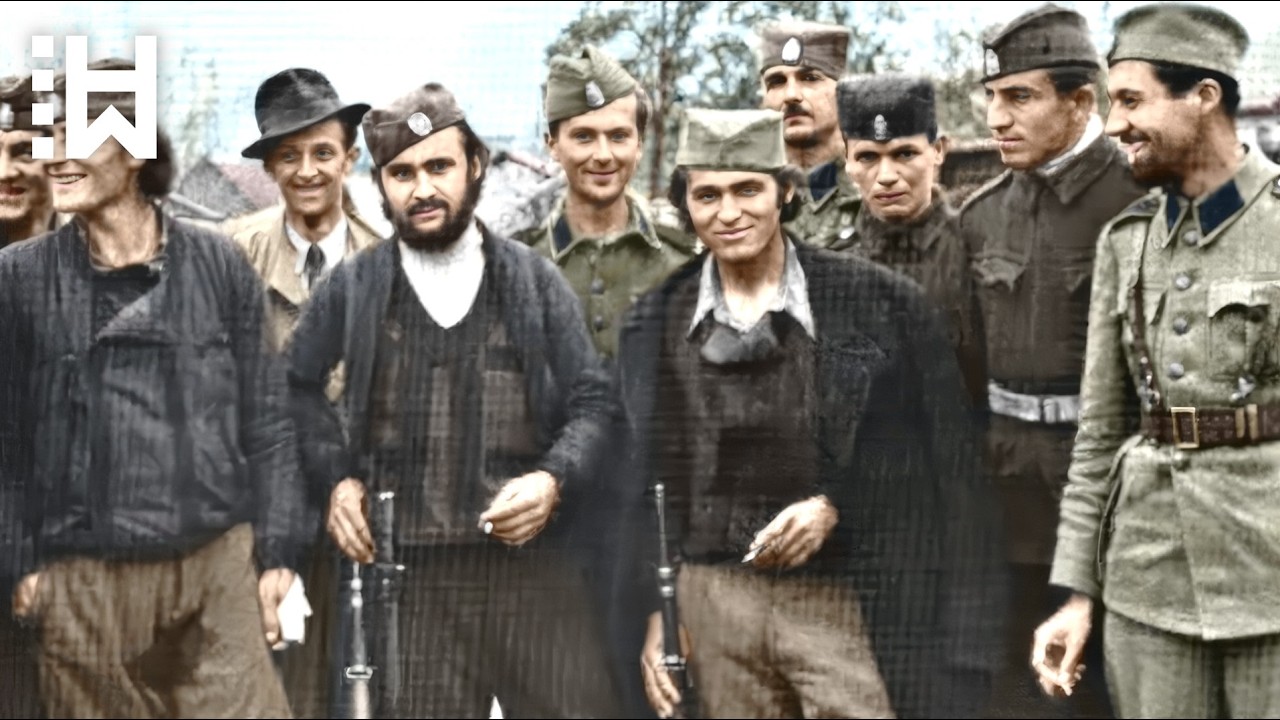
Others helped track down Jews who had escaped capture, drawing the movement ever deeper into collaboration with the Nazi occupation regime. But by 1945, Nazi Germany was collapsing and Zbor’s followers were retreating westward. Many eventually surrendered to the British, believing they had escaped the advancing partisans. Instead, thousands were returned to Yugoslavia and handed over to the very forces they had spent years fighting.
For many, there was no escape a second time. The Yugoslav National Movement, known as Zbor, was founded in Belgrade on January 6, 1935, through the merger of several small nationalist and far-right organizations. It was led by Dimitrije Ljotić, a Serbian politician and former Yugoslav minister of justice who rejected parliamentary democracy and wanted to replace it with an authoritarian, centrally organized state. Another prominent figure was Velibor Jonić, who served as Zbor’s general secretary during its early years.
Zbor presented Christianity, traditional values, and corporatism as the foundations of this system. Ljotić spoke of uniting Serbs, Croats, and Slovenes in a common Yugoslav state, but he envisioned Serbia as the dominant force. The movement was fiercely anti-communist and xenophobic, and Zbor became the only political party in Yugoslavia that openly promoted antisemitism. One German observer described it as a kind of National Socialist party based on opposition to Jews, Freemasons, communists, and Western capitalism.
Yet these ideas found little support among ordinary Serbs. Zbor’s active membership never exceeded 10,000, and the movement’s attempts to gain power through elections failed. Ljotić’s open sympathy for Nazi Germany only made him more hated in a country where anti-German sentiment remained widespread. What Zbor lacked in local support, it found increasingly abroad.
German industrial companies and intelligence agencies provided funds to the movement, strengthening a relationship with Nazi Germany that would become ever more important. When World War II began in September 1939, Ljotić publicly supported Yugoslavia’s neutrality while arguing that the country’s foreign policy should orient toward Berlin. By that time, German influence inside Zbor had extended further. The movement was penetrated by the SS, the Gestapo, and the German military intelligence service, the Abwehr.
During 1940, the movement became increasingly violent. Clashes with communist youth helped fuel the growth of Zbor’s student wing, known as the White Eagles. On October 23, its members gathered at the University of Belgrade armed with pistols and knives. Students and faculty members were threatened.
Several people were stabbed while the attackers cheered for Adolf Hitler and Benito Mussolini amid antisemitic slogans. The violence provoked outrage across Serbia. The next day, the Yugoslav government banned Zbor and later arrested several hundred of its members. Ljotić went into hiding, and a government investigation concluded that his movement had committed high treason by accepting German money.
However, the authorities stopped short of arresting Ljotić himself for fear of Berlin’s reaction. By early 1941, Zbor was forced to operate in secret, but the German invasion of Yugoslavia was only months away, and Zbor’s connections to Berlin were about to place its followers in an entirely different position. On April 6, 1941, Nazi Germany and its Axis allies invaded Yugoslavia. The country surrendered after only 11 days, and Serbia fell under direct German military occupation.
For Zbor, the collapse of the Yugoslav state changed its status completely. The movement that had been banned only months earlier was now able to operate under the protection of the occupying power. Ljotić emerged from hiding, and Zbor members quickly became involved in the new collaborationist administration. On April 30, 1941, the Germans established a commissar government headed by Milan Aćimović, a former Yugoslav interior minister.
Ljotić was offered the post of economic commissioner but refused, partly because he was deeply unpopular among Serbs and did not want to play a secondary role. In August, the Germans replaced Aćimović’s administration with a Government of National Salvation led by former Yugoslav General Milan Nedić. Zbor also became more involved in propaganda work. In October, the movement helped organize a large anti-Masonic exhibition in Belgrade with German financial support.
Through photographs, posters, and other exhibits, the exhibition promoted the conspiracy theory that Jews, Freemasons, and communists were secretly working together to achieve world domination. But propaganda was only one part of Zbor’s new role. As armed resistance to the occupation spread across Serbia, the movement’s followers were soon armed themselves. By the summer of 1941, armed resistance to the German occupation was spreading rapidly throughout Serbia.
Both the communist partisans and the royalist Chetniks were attacking German forces, and the occupation authorities increasingly turned to local collaborators for help. In September, Zbor members formed the nucleus of a new armed formation known as the Serbian Volunteer Detachments. Command was eventually given to Konstantin Mušicki, a former colonel in the Royal Yugoslav Army and a committed supporter of Ljotić. The volunteers were primarily anti-communist, and their main task was to fight the partisans alongside German and other collaborationist forces.
Despite its close ties to Ljotić and Zbor, the formation operated under German supervision. It was supplied with weapons and equipment by the occupation authorities and gradually expanded as fighting intensified. The detachments were later reorganized into the Serbian Volunteer Corps, or SDK. The armed formation remained closely connected to Zbor, whose members would soon play a role in one of the most notorious atrocities of the German occupation of Serbia, the Kragujevac massacre.
In October 1941, German commanders launched brutal reprisals after resistance fighters killed 10 German soldiers and wounded 26 others. In the aftermath, thousands of civilians were arrested in and around the city of Kragujevac. Among those detained were workers, teachers, schoolboys, Jews, Roma, and men dragged from their homes and workplaces. Zbor members were allowed to inspect the prisoners, after which more than 3,000 detainees identified as supporters of the movement or considered politically reliable were removed from the execution lists.
Those who remained were marched to fields outside the city on October 21, where German troops from the 717th Infantry Division opened fire on them. By the time the massacre ended, nearly 2,800 men and boys had been killed. Over the following years, the Serbian volunteers became an increasingly important part of the German campaign against the resistance. The Serbian Volunteer Corps fought primarily against the communist partisans, participating in operations alongside German forces and other collaborationist units.
Despite its Serbian leadership, it remained under close German control and could not conduct major operations independently. Its role also extended beyond the battlefield. SDK members helped the Gestapo track down Jews who had escaped earlier arrests, and they helped send captured Jews to the Banjica concentration camp in Belgrade. As the war continued, the corps expanded significantly, reaching approximately 10,000 men by 1944.
By the autumn of 1944, Soviet forces were approaching Serbia from the east while the partisans advanced throughout the country. In October 1944, Soviet and partisan forces entered Belgrade, forcing the Germans and their collaborators to retreat. Ljotić fled the Serbian capital with Milan Nedić and hundreds of officials from the collaborationist administration. The Serbian Volunteer Corps also withdrew westward with the retreating German forces.
By the end of October, Ljotić and most of the corps had reached Osijek, in present-day Croatia, and were continuing their march west toward Slovenia. In the following weeks, the corps reached German-held Slovenian territory, where it continued fighting the partisans while Ljotić tried to unite various anti-communist Serbian forces for a last resistance against the communist partisans. But the military situation was hopeless. By the spring of 1945, the Third Reich was only weeks from defeat, and the partisans were closing in from the east.
Ljotić and his remaining followers now looked toward Italy and Austria, hoping to reach the Western Allied forces before Tito’s troops could capture them. Dimitrije Ljotić never made it. On April 23, 1945, while traveling through Slovenia, he was killed in a car accident. The 53-year-old leader of Zbor died just weeks before the end of the war in Europe.
His death did not stop the retreat. With Germany collapsing, the surviving members of the Serbian Volunteer Corps continued their march toward Italy and Austria, where they hoped to surrender to British forces rather than fall into partisan hands. For many, reaching the British seemed like a way out. But surrender did not bring the safety they expected.
In the final weeks of the war, thousands of corps members crossed into Italy and Austria and surrendered to British troops. Some of those who surrendered in Italy remained in Allied custody and eventually emigrated to Western countries. For those who reached Austria, the escape from Yugoslavia was only temporary. They were handed over to Tito’s partisans.
Thousands were transported back across the border, and a great number were executed without trial. Estimates suggest that between 2,100 and 2,300 corps members were executed in May 1945, some killed in the Kočevski Rog forests in Slovenia, where their bodies were buried in mass graves. Other prominent collaborators faced different fates. Milan Aćimović, who had headed the first collaborationist administration in German-occupied Serbia, joined the Chetnik forces under Draža Mihailović during the final months of the war and was killed while retreating from the partisans in May 1945.
Milan Nedić, who later headed the Government of National Salvation, was captured by the British and handed over to Yugoslavia. He died in custody in Belgrade on February 4, 1946, after falling from a window, though the circumstances of his death remain disputed. Konstantin Mušicki, commander of the Serbian Volunteer Corps, also fell into British captivity and was later transferred to Yugoslav authorities. In 1946, he appeared before a military court in Belgrade and was sentenced to death.
Velibor Jonić, who had served as minister of education in Nedić’s government, stood trial alongside him. Both were executed on July 17, 1946. By the end of the war, Zbor had effectively ceased to exist. Its leader was dead.
Many other prominent figures associated with the movement faced postwar trials, and thousands of its armed followers had been killed or captured. The human cost of the occupation was immense. Approximately one million people lost their lives throughout Yugoslavia. Among them were more than 67,000 Jews killed by Nazi Germany and its Axis partners.
In Serbia alone, of the roughly 17,200 Jews living there before World War II, about 88 percent were killed during the Holocaust.