In the spring of 1920, the city of Los Angeles was still young, spreading out from the dust and orange groves into something like a great metropolis. The scent of orange blossoms mixed with fresh tar along streets being cut for automobiles that were beginning to replace horse-drawn carriages. On South Catalina Street, near the new wide Wilshire Boulevard, stood a 14-room Tudor-style mansion behind its fence, elegant and quiet, its leaded windows catching the afternoon light. It belonged to a widower named Jacob C.
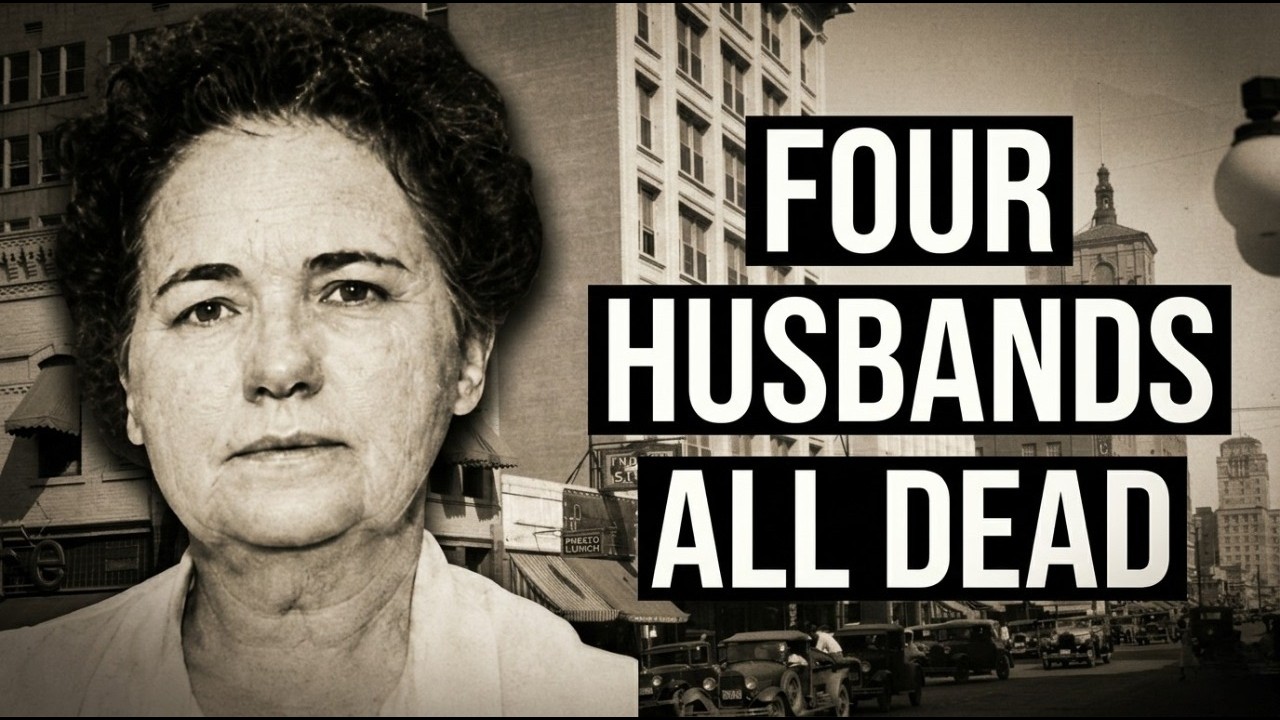
Denton, a mining engineer who had made his fortune underground and now wanted only to rent out his large house and travel for a time, after losing his wife and youngest child to the influenza that had swept the country. He was, by all accounts, a lonely man wandering rooms built for a family that no longer existed. A woman responded to his advertisement. She introduced herself as Mrs.
Louise Peete, separated from her husband, accompanied by a young daughter, with a soft Southern voice and a gentle charm that those who met her later found hard to describe precisely. By the end of May, she had persuaded Denton to lower the requested rent from $350 a month to just $75, a negotiation that made more than one of Denton’s acquaintances wonder what kind of woman could make a cautious businessman abandon his judgment entirely. She moved into his home before he left on his business trip, and within one week, the neighbors said the two were behaving like a married couple rather than a landlord and tenant. Within two weeks, Jacob Denton had vanished from the records of the neighborhood, and the woman who called herself his tenant had spun a story so strange, so full of claims, that the most experienced officers of the Los Angeles police struggled to trace its threads.
She had been born Louie Louise Pressler on September 20, 1880, in the small town of Bienville, Louisiana. Her father was a man of standing in the community, publisher of a respected newspaper, and the family was considered respectable by the standards of the era. Little is known about her mother, and the records do not clarify the nature of the household in which she spent her early years. At age fifteen she was sent to a private school in New Orleans, where she was expelled for stealing from her fellow students and for conduct the school administration deemed improper.
She returned home in disgrace, though the disgrace did not seem to trouble her much. By 1903, Louise had married a traveling salesman named Henry Bosley, nine years her senior, and the couple set up house together, moving constantly from town to town as his work demanded. The marriage proved troubled from the start. Bosley’s work kept him away from home for long periods, and in his absence, Louise was said to be unfaithful on more than one occasion.
After four years of marriage, in the summer of 1906, Bosley returned unexpectedly from a trip to find his wife in the company of another man. All accounts indicate he was devastated by the betrayal. Two days later, he was found dead in a hotel room near Waco, Texas, a small-caliber pistol in his hand. The authorities at the time classified the death as suicide.
It was the first of several similar deaths that would follow her wherever Louise Peete settled. After Bosley’s death, she sold what remained of his belongings and moved first to Shreveport, Louisiana, then onward to New England, where she was said to support herself by accompanying wealthy men and quietly stealing their possessions whenever the opportunity arose. According to her own later account, given long afterward to those she met in prison, she considered those years a period of necessary self-reliance, without any regret for the men whose fortunes faded, and in some cases whose lives ended, because of that acquaintance. The pattern that once began never stopped.
By 1911, she had reached Boston, where she abandoned her name again, calling herself Louise M. Gould, and invented an entirely fictional history, claiming to be a runaway heiress from Dallas fleeing a convent where her family had imprisoned her. So convincing was her manner that a prominent Boston family hosted her in their home, treated her almost as an adopted daughter, provided her lodging, introduced her to society, and extended her a degree of trust she had done nothing whatsoever to deserve. Before long, she returned to her old habits.
Louise ran up extravagant bills at the city’s finest stores under the family’s name and stole money from their friends and from the household staff. When her deception was finally exposed, the family she had deceived chose silence over scandal. Rather than risk public embarrassment, they simply allowed her to leave town. No charges were filed, no report was recorded, and no word of the matter reached the newspapers.
Louise seemed to have learned a valuable lesson, one she would apply again and again in the years to come: that social respectability itself, if managed properly, could be turned into a shield, and that those she had wronged often preferred silence to justice. She traveled next to Waco, Texas, where she met a wealthy oil man named Joe Abel, a man fond of diamonds, wearing them on his fingers, his belt, even his shirt buttons, displaying his wealth to everyone he met. Their acquaintance was brief, by all accounts no more than a few days rather than months. Within one week of their meeting, Abel was found shot dead, his diamond jewelry gone.
Louise was arrested and brought before a grand jury on a murder charge. She testified that Abel had attempted to assault her and that she had fired the fatal shot in self-defense. The jury believed her account. She was released without further charges, the diamonds were never recovered, and no other suspect was ever identified.
In 1913 in Dallas, she married again, this time a nightclub manager named Farrot. Valuable jewelry worth $20,000 disappeared from a hotel safe during his work shift. Police questioned the man and cleared him of any involvement. They also questioned Louise but found insufficient evidence to connect her to the theft.
Farrot committed suicide that same year, humiliated by the accusation and said to be desperate over his wife’s betrayals. Some who studied the case in later decades doubted this account, suggesting that Farrot, like Bosley before him, may have been another victim of Louise rather than a man who took his own life, though the records of that time do not permit a more certain conclusion. By 1915, Louise had settled in Denver, Colorado, and married a salesman named Richard Peete. They had a daughter the following year, Frances Anne, known to the family as Betty.
The marriage was not peaceful. The couple argued constantly, and by the summer of 1920, after years of discord, they separated. Louise left her husband and young daughter in Denver and traveled west alone to Los Angeles, a city where no one yet knew her name or the trail of sorrow she had left behind in two states. In Los Angeles, she answered the advertisement for the 14-room mansion on South Catalina Street and met Jacob C.
Denton, the widower who had lost his wife and youngest child to the influenza pandemic only months before. He agreed, for reasons the records do not explain, to rent her the house for a fraction of the price he had asked. She moved in on May 26, 1920, just days before Denton was scheduled to leave on a business trip. On June 2, little more than a week after she moved in, Jacob Denton disappeared.
Shortly before his disappearance, Louise had ordered a workman to haul several loads of dirt into the basement of the house, explaining that she intended to grow mushrooms there, a food her landlord favored, as she claimed, to surprise him upon his return from his travels. In the weeks that followed, Denton’s friends, neighbors, and business associates grew increasingly concerned at receiving no word from him. Louise offered one explanation after another, each more complicated than the last. To some, she said he had gone on a long business trip to unknown places.
To others, she spoke of a mysterious Spanish woman who had shot Denton in the arm during a violent quarrel, necessitating the amputation of his arm, leaving him so ashamed of his disfigurement that he could not appear before anyone who knew him. Meanwhile, she lived as though she were Denton’s wife, spending his money lavishly, driving his car around the city, pawning his jewelry, and collecting rents from the tenants of his properties as far away as Phoenix, Arizona. By August, she had purchased two expensive dresses in his name from a prominent store, continuing to claim she was his wife, a deception carried out with such confidence that none of the store’s employees seemed to question it. Denton’s teenage daughter, finally suspicious of the long silence surrounding her father, hired an attorney to press Louise for answers.
Louise gave evasive responses, then left in September for Denver to rejoin her estranged husband and child, renting the great mansion out behind her as she departed, as though the question of where the property’s owner had gone no longer concerned her at all. Once Louise had finally left the house, a search of the property became possible without obstruction. On September 23, 1920, a private investigator hired by Denton’s daughter discovered the body of a man, decomposed beyond easy recognition, bound with numerous ropes, wrapped in a quilt, and hidden inside a wooden chamber built beneath the basement stairs. The dirt Louise had ordered delivered weeks earlier had not been intended for mushrooms at all, but to conceal the digging of that grave.
Some accounts of the period suggest the chamber itself was covered with a crude cement vault to further disguise what lay beneath. Examination of the remains concluded that the victim, later confirmed to be Jacob Denton, had died from a gunshot wound to the head. Some accounts also recorded evidence that he had been strangled, said to be with a belt, before or after the shooting. His limbs were found entirely intact, a detail that eliminated one of Louise’s many explanations, for she had told acquaintances that Denton’s arm had been amputated after his supposed encounter with the mysterious Spanish woman.
That woman was never found. No such amputation had ever occurred. Police traced Louise to Denver and brought her back to Los Angeles for questioning. She denied any involvement in Denton’s death and instead offered a series of contradictory accounts: that he had fled from his own disgrace; that he had wanted to conceal his private affairs from his family and acquaintances; and finally, most astonishingly, that the body discovered under the stairs was not Denton at all, but an unknown lookalike whom Denton himself had killed and left behind.
This last theory convinced no one and was quickly dismissed by investigators as impossible. A search of the property turned up a . 32 caliber pistol in a cabinet among Louise’s clothing and personal effects. Investigators concluded the ammunition matching this weapon was consistent with the wound that had killed Denton.
The disturbed soil, the ropes binding the body, and the quilt in which it had been wrapped were classified as evidence against her, and the items were transferred to the district attorney’s custody for trial. The district attorney of Los Angeles, Thomas Lee Woolwine, prepared the case against her, alleging that between June 2 and August 9, Louise had disposed of Denton’s clothing, pawned his diamond ring through an intermediary, given his car to an acquaintance, and forged checks bearing his signature, all while his body lay dead beneath the house she occupied and continued to rent to tenants. Louise was formally charged with one count of first-degree murder and held in the county jail pending trial, announcing upon her return to Los Angeles that she was ready to tell the district attorney everything she knew about the matter, a promise that proved far easier to make than to keep. Her trial for the murder of Jacob C.
Denton began on January 20, 1921, in the Los Angeles Superior Court before Judge Harry L. Willis. District Attorney Thomas Lee Woolwine led the prosecution himself, a man already known throughout California for securing convictions against women accused of violent crimes. Woolwine later stated in an interview the following year that his office had achieved unusual success in proving the guilt of women accused of violent crimes, and that the main obstacle to such prosecutions lay in what he called the false chivalry that juries often extended to female defendants.
The prosecution’s case rested on the discovery of Denton’s body, the pistol found among Louise’s belongings, and the long string of forgeries and lies she had left behind through the summer months. Woolwine argued that Louise had killed Denton for financial gain, then spent months living on his money and property while building an ever-changing story to explain his continued absence. Witnesses were called to testify about the conflicting accounts she had given to different parties. The defense attempted to raise doubt where possible, though the weight of the physical evidence proved difficult to overcome.
Louise did not take the stand in her own defense. Throughout the trial, which lasted about two and a half weeks, reporters widely noted her calm and composure, as she sat quietly through testimony that might have caused visible distress to any other defendant. Thousands of spectators gathered daily outside the Hall of Justice, eager for a glimpse of the woman the Los Angeles Herald persistently called, in the language of sensational journalism, the Woman of Mystery, a label that stuck with her for the rest of her life. Other papers exploiting the same fascination called her the Tigress Woman.
On February 17, 1921, the all-male jury returned its verdict. Louise Peete was convicted of first-degree murder. The jury declined to recommend the death penalty, fixing the punishment at life imprisonment instead. She showed no visible emotion as the verdict was read.
The court committed her to San Quentin State Prison. She filed motions for a new trial in the months that followed, and the court denied each one. Her husband, Richard, who had stood by her faithfully throughout the trial, despite having filed for divorce before her arrest, continued his devotion even after the verdict. In 1923, Louise told him he should proceed with the divorce and remarry, to free himself from her.
He agreed, though he swore he would wait for her release from prison regardless. Soon afterward, Louise stopped answering his letters and refused to see him when he visited the prison. In 1924, alone and desperate, Richard Peete shot himself in a hotel room in Arizona. Louise would later tell others that her former husband had ended his life out of guilt over her conviction and despair over his failing health, an explanation that omitted the silence she herself had imposed on him in his final months.
Louise served her sentence first at San Quentin, then was transferred to the California Institution for Women at Tehachapi. By all accounts she was a model prisoner, tending the flower garden, working as a dentist’s assistant, and writing for the prison newspaper, earning the trust of the warden, Georgia Monahan. After 18 years, and after several earlier requests had been denied, her parole was approved in the spring of 1939. The journalist Carolyn Walker, who had covered her original trial, warned a member of the parole board directly that Louise had lived her entire life by theft, lying, and violence, and that releasing her would be a tragedy for someone.
The board member who heard this warning was Emily Lamm, who dismissed it and told Miss Walker that journalists simply did not believe in the prison’s ability to reform people. On April 11, 1939, Louise walked out of Tehachapi free, issuing a statement to the gathered reporters in which she insisted, as she always had, that she had been wrongly convicted and asked only to be allowed to build her life away from the spotlight. She was released into the custody of Jesse Marcy, who championed her freedom and employed her as a live-in housekeeper. Marcy died of natural causes shortly afterward.
Louise then moved in with parole officer Emily Lamm to work as her housekeeper and nurse. Lamm died of a heart attack in 1943. Neither death raised suspicion, as the authorities did not know that the woman calling herself Anna Lee, a name Louise had legally adopted, was the same Louise Peete convicted of murder a generation before. Through her friendship with Margaret Logan, a retired social worker who also believed in her innocence, Louise found her final haven in the care of Margaret and her husband Arthur, who suffered from dementia.
In May 1944, she married the banker Lee Borden Judson without revealing her past, and soon told the neighbors that Arthur was prone to violent rages. On June 1, Margaret Logan disappeared. Three days later, Louise admitted Arthur to Patton State Hospital, claiming to be his adopted sister, and told the neighbors that Margaret’s face had been disfigured by his violence. For six months, Louise and Judson took over the Logan family home and forged checks from the couple’s accounts.
Arthur died in the state hospital on December 6, never once visited by Louise. Bank employees discovered the forgeries and notified police, who found Margaret Logan’s body on December 20 in a shallow grave under an avocado tree. Examination revealed she had been shot in the neck and suffered a fractured skull. Louise was arrested within hours and admitted she had buried Margaret but denied killing her.
Judson was also charged but released on January 11, 1945, for insufficient evidence. The next day, he threw himself to his death from the Spring Arcade Building in Los Angeles. Louise wept at the news and told reporters she felt guilty over what had happened. Her third trial began on April 23, 1945, before Judge Harold B.
Landreth, with Ellery Cuff defending her as a public defender. A chemist testified that the bullet fired from a pistol in Louise’s bedroom matched the bullet found at the Logan home. Louise took the stand, claiming it was Arthur who had killed his wife. But when asked to demonstrate using the weapon, she refused to hold it in her hand.
On May 31, a jury of eleven women and one man convicted her of first-degree murder, and Judge Landreth sentenced her to death by gas. Her appeals failed over the following two years, and the United States Supreme Court denied her final request on April 9, 1947. On the morning of the 11th, Louise Peete entered the gas chamber at San Quentin before some 91 witnesses, telling the warden she had been ready for a long time. The gas pellets dropped at 3:10.
She was pronounced dead ten minutes later. She was only the second woman ever executed in the state of California. She lies today in Angelus Rosedale Cemetery, while the great house on Catalina Street has long since vanished from a city that grew up and moved beyond the ghosts it once sheltered.