For nearly a century, the spot that would become Dodge City, Kansas, had been a waypoint on the Santa Fe Trail, with thousands of wagons rolling past on their way to New Mexico. Long before that, the land belonged to the Wichita, then the Plains Apaches, and eventually the Kiowas and Comanches. The first white settlement in the vicinity, a civilian outpost called Fort Mann, was built in 1847 to protect travelers along the trail, but it lasted barely a year. The army replaced it with Fort Atkinson in 1850, but the soldiers abandoned it by 1853, tired of living in a sod structure they mockingly called Fort Sod and later Fort Sodom.
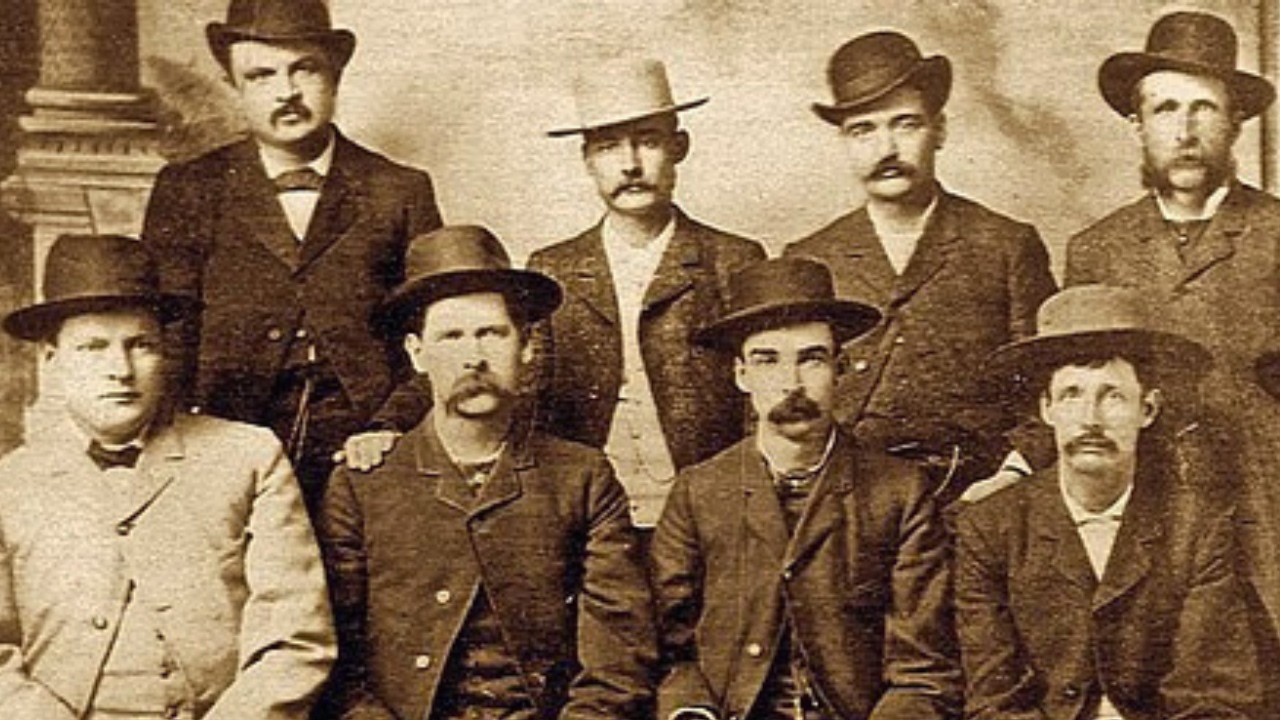
A third post, Fort Dodge, was established in 1865, likely named after General Grenville Dodge, who had sent its first command into the wilderness in the dead of winter. The first real settler, rancher Henry Sitler, built a sod house about five miles west of the fort in 1871, intending it as a headquarters for his cattle operation. Because his home sat right on the Santa Fe Trail, it quickly became a popular stopping point for travelers and hunters. Then came the whiskey.
In June 1872, Colonel Richard Irving Dodge took command of the fort, and according to the story, one of his first acts was to ban the sale of alcohol. No written order has ever been found, but the ban wouldn’t have mattered much anyway. The army’s authority over business dealings stopped at the boundary of the land set aside around the fort, which ran about five miles out. Anyone who wanted to sell whiskey just had to set up shop exactly five miles and one step west of the line.
That’s precisely what a 24-year-old Canadian named George Hoover did on June 17, 1872, showing up with a wagonload of whiskey and selling drinks at a quarter a piece. His whiskey tent went down in history as the very first business in what would become Dodge City. Hoover would eventually become the town’s first elected mayor and one of its wealthiest citizens. That August, a group of businessmen and army officers organized a town company, a frontier real estate startup that laid claim to land, hired a surveyor to carve it into streets and lots, and filed the paperwork.
The town was initially named Buffalo City, but since Kansas already had one of those, they renamed it Dodge City after the fort. The timing was everything. The founders knew exactly where the railroad was headed, and in September 1872, the tracks of the Atchison, Topeka & Santa Fe rolled in from the east. The arrival changed everything.
With a massive demand for buffalo hides back east, Dodge City was transformed into the hide capital of the world almost overnight. More than 850,000 buffalo hides were shipped out of Dodge in the first three years alone, and about a million and a half by the time the slaughter ended. When the hides ran out, they shipped the bones, sold by the ton for everything from fertilizer to fine china. One of the town’s original founders, Robert Wright, recalled that business began long before a depot could even be built, with dozens of cars a day loaded with hides and meat.
He had seen mining camps with rich strikes, he said, but he never saw any town to equal Dodge. For roughly its first year, however, Dodge City had no real law enforcement. No sheriffs, judges, or town marshals. When things got out of hand, local business owners handled it themselves, or hired what were essentially private enforcers who were given the title of marshal without any official authority.
The first jail was nothing more than a hole in the ground where drunks were lowered until they sobered up. It was during this first year that Dodge earned its bloody reputation. The first known killing came on September 5, 1872, when a man named Jack Reynolds got into an argument with a railroad track layer and was shot dead. A few weeks later, a gambler known only as Denver killed a man in the streets for no other reason than to watch him kick.
Another gambler, Matt Sullivan, was accused of cheating at cards, went for his gun, and he and his companion killed at least two of their assailants. About a month later, Sullivan was assassinated, most likely by that same companion. No one can say for certain how many people were killed during that first year. George Hoover claimed at least fifteen.
Robert Wright said closer to twenty-five, with perhaps more than double that number wounded. Historians Robert Dykstra and JoAnn Manfra put the number at eighteen verified homicides between July 1872 and July 1873. Dodge had no newspaper yet, so some killings may have gone undocumented, but eighteen is what can be proven. For a town with a permanent population of around three hundred, that number was astronomical.
By modern homicide rates per 100,000, Dodge City during its first year had a rate somewhere between 3,600 and 6,000, compared to roughly fifteen for Chicago and the mid-40s for St. Louis. In a camp that small, eighteen murders a year meant everyone personally knew somebody who had been shot, probably several somebodies. By February 1873, things had gotten so bad that the leading citizens formed a vigilance committee.
They were effective for a little while, but the vigilantes soon began abusing their power to settle personal scores. The breaking point came in early June 1873, when a drunken mob murdered a black man named William Taylor for essentially nothing. Taylor happened to be a personal servant of Colonel Richard Dodge. In retaliation, Dodge sent in soldiers to arrest the vigilantes.
Just two days later, on June 5, 1873, the very first election ever held in Ford County took place. The man chosen as sheriff was Charlie Bassett, one of the original owners of the establishment that would become the famous Long Branch Saloon. The same ballot gave the county a probate judge and a prosecutor, which made a real difference. Up until then, there was no one who could swear out warrants or file charges.
Even a deputy U. S. Marshal working nearby dealt only in federal crimes, not drunk buffalo hunters shooting up a dance hall, and there was no local court to try anyone anyway. After the election, there was finally a process: a sheriff to make the arrest, an attorney to press charges, and a judge to hear cases.
Violence declined drastically, though it did not stop completely. As Dodge was getting its act together, the industry that built the town was running out of buffalo. By 1874, the herds in western Kansas had been shot out, and hunters began searching further south into the Texas panhandle, which was technically illegal per the Medicine Lodge Treaty of 1867. In the spring of 1874, a party of hunters left Dodge for an old trading post called Adobe Walls, over 150 miles deep into Comanche territory.
Two stores there were buying up hides, one owned by Robert Wright and his partner Charles Rath, the other run by merchant A. C. Myers. The man pouring drinks there was James Hanrahan, one of Ford County’s first commissioners.
Adobe Walls was essentially a Dodge City outpost. The Comanches took notice and attacked on June 27, 1874. Just twenty-eight men and one woman held off several hundred warriors, thanks in large part to the big buffalo guns and a long-range shot by hunter Billy Dixon. A relief party of about fifty men rode south from Dodge to fetch the survivors.
The fight at Adobe Walls helped kick off the Red River War, which ended with the last of the Comanches being sent to the reservation, and within a few years, the great southern buffalo herds were hunted to near extinction. What kept Dodge from becoming a ghost town was a tick known as Boophilus annulatus. Since just after the Civil War, Texas ranchers had been driving herds of longhorn cattle north to the Kansas railheads, first to Abilene, then to places like Newton, Ellsworth, and Wichita. The longhorns carried a tick that spread a disease called Texas fever, which was a death sentence for cattle already in Kansas that hadn’t been exposed.
As more farmers settled in central Kansas, they pressured the state legislature into drawing a quarantine line across the state, with no Texas longhorns allowed east of it. The line kept moving west, and by 1876, all the other established cow towns were off limits. Through that process of elimination, Dodge City became the Queen of the Cowtowns. A new route called the Great Western Trail carried herds straight up from Texas, and over the next decade, millions of longhorns came through the Dodge City stockyards.
Each herd brought along at least a dozen cowboys, who had been in the saddle for two to three months, choking down dust and sleeping on hard ground. They were looking for a bath, a drink, and a woman, not necessarily in that order. They brought trouble, though mostly not in the form of killing. It was mostly drunk teenagers galloping up and down the street firing off pistols, fistfights, and busted windows.
The city came up with a compromise, drawing a line straight through the middle of town, which was actually the railroad tracks. North of the tracks was the respectable side, no guns and no nonsense. South of the tracks, where most of the saloons and brothels were, you could do pretty much as you pleased, as long as you didn’t kill anybody. Over the next few years, Dodge City employed just about every big name in the Old West: Wyatt Earp, Bat Masterson, Bill Tilghman.
They swapped badges so often it was dizzying. Charlie Bassett served as county sheriff for four and a half years, then hired Bat Masterson as his undersheriff. In November 1877, Bat won the election to sheriff, and Bassett took his former position. Bat’s older brother Ed was city marshal, and Bassett served as his assistant marshal.
When Ed was killed in the line of duty, Bassett took over as marshal and hired Wyatt Earp to fill his old spot. Despite their legendary reputations, these lawmen weren’t getting into nearly as many gunfights as people think. More often than not, they cracked drunks upside the head with their pistols and dragged them off to jail, which meant less paperwork and usually everyone woke up the next morning. Sometimes things did turn deadly.
On April 9, 1878, Ed Masterson tried to disarm a drunk named Jack Wagner. The two wrestled over the pistol, and Wagner shot Ed at point-blank range. Ed staggered about two hundred yards to Hoover’s saloon before dropping dead. That October, a woman named Fannie Keenan, known to Dodge as Dora Hand, was shot to death in her sleep.
The bullets weren’t meant for her. They were meant for the mayor, James Kelly, who had recently beaten up a spoiled young Texan named Spike Kennedy. Rather than accept the beating, Kennedy rode up to Kelly’s place in the middle of the night and started shooting, unaware that Kelly was out of town and Dora was staying in his absence. The posse that went after him consisted of Bat Masterson, Wyatt Earp, Charlie Bassett, and Bill Tilghman.
They rode him down near Meade City, shot his horse out from under him, and took him into custody. One of the most famous gunfights occurred less than six months later at the Long Branch Saloon. On the night of April 5, 1879, a gambler named Levi Richardson walked in looking for another gambler known as Cock-Eyed Frank Loving. Loving had accused Richardson of making advances on his wife.
Richardson took a seat across from Loving, they began arguing, and Richardson said, you wouldn’t fight anything, you damn son of a bitch. Loving calmly replied, try me and see. Both jumped to their feet and started shooting. Richardson was dead, and Loving walked away with nothing but a graze.
His luck wouldn’t hold. A little over three years later, he was killed in Colorado by another gambler, and after that man was acquitted, he returned to Dodge City and became a preacher. The gunfight between Richardson and Loving was the exception rather than the rule. Men like Luke Short, J.
J. Webb, and Charlie Siringo walked the streets of Dodge. Doc Holliday was there during the summer of 1878, pulling teeth by day and playing cards by night. That same year, Wyatt Earp allegedly had a confrontation with the notorious Clay Allison.
Most of these men weren’t famous yet. Earp was still three years away from the OK Corral, and Holliday was just a sickly dentist who liked to gamble. By the early 1880s, most had scattered. They came back in the spring of 1883 to support their old friend Luke Short, who had bought a half interest in the Long Branch Saloon, a direct competitor with the Alamo Saloon owned by the former mayor.
After a heated city election, Dodge’s new city council passed two ordinances aimed at eliminating prostitution, but they weren’t enforced equally. Luke Short’s singers were promptly arrested while those in his competitor’s saloon next door were ignored. Rather than slink away, Short called in his friends: Wyatt Earp, Bat Masterson, and eventually Doc Holliday and Texas Jack Vermillion. The so-called Dodge City War was settled without a single shot fired.
The threat of so many deadly men converging on Dodge was enough to make the city officials reconsider. The wild days weren’t entirely over. The following summer, Mysterious Dave Mather began butting heads with Tom Nixon, the buffalo hunter who had led the relief party to Adobe Walls a decade earlier. They ran competing saloons, and there was a rumor that Mather was involved with Nixon’s wife.
On the night of July 18, 1884, Nixon opened fire on Mather as he stood in the street outside his saloon, but missed. Three nights later, on July 21, Mather walked up to Nixon and shot him dead. The Globe Livestock Journal reported that Mather called to Nixon, who was standing on the corner, and as Nixon turned around, Mather commenced shooting at him, firing four shots and killing him instantly. A couple of years after that, Mather went missing under mysterious circumstances.
By then, the party was just about over. The quarantine line never stopped moving, and farmers kept coming. By 1885, the Kansas legislature extended the quarantine across the entire state, with no Texas cattle allowed at all. The winter of 1885 and 1886 wreaked havoc across the Great Plains, part of a string of die-offs that gutted the cattle industry.
The Santa Fe Trail had been obsolete for years. The buffalo were gone. With the Indian Wars wrapping up on the Southern Plains, the army no longer needed Fort Dodge, which closed in 1882. In the span of a little over a decade, everything that had built Dodge’s economy, the buffalo hunters, the soldiers, the cowboys, had dried up.
The legend, however, wouldn’t go anywhere. Books, movies, and later television shows like Gunsmoke and The Life and Legend of Wyatt Earp cemented Dodge City’s place in the American imagination. There were even Wyatt Earp comic books set in Dodge. The real town took full advantage, building a replica of Front Street for tourists and holding mock shootouts daily during the summer.
As for whether Dodge City really was the wickedest little city in America, it was, but only for about a year, back when it was a lawless buffalo camp, roughly from the summer of 1872 to the summer of 1873. The Dodge City that most people think of, with the cowboys, Wyatt Earp, and the Long Branch, wasn’t all that bad. From 1876 to 1885, the town experienced only fifteen homicides, an average of about one and a half per year.