Every night for thirty years, Johnny Carson stepped out from behind the same curtain to reassure America that everything would be all right. He was quick-witted and warm, the most trusted face on television, the man millions of strangers invited into their bedrooms at 11:30. To everyone watching, he seemed to have figured out life. The cameras never caught his other version.
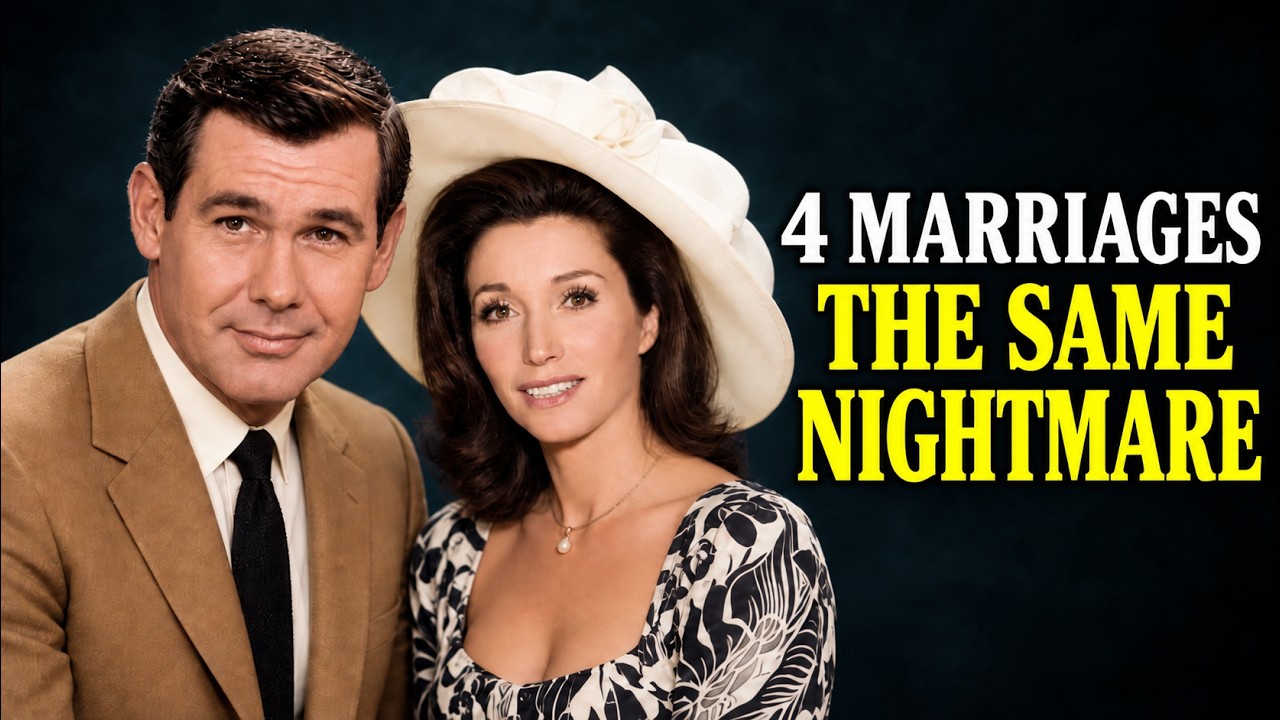
Four women did. John William Carson was born on October 23, 1925, in Corning, Iowa, the second of three sons of Homer and Ruth Carson. His father worked for an electric company, a steady, practical job that anchored the family’s modest Depression-era life. When Johnny was eight, they moved to Norfolk, Nebraska, a small prairie town where the practical temperament left little room for emotional display.
The Great Plains of the 1930s and 1940s did not encourage men to say what they felt, and the Carson household was no exception. Whatever warmth existed in that home was not of the open, spoken kind. He would spend the rest of his life either performing that warmth for strangers or withholding it from the people who lived with him. By fourteen, he was performing magic tricks for neighbors, learned from a mail-order instruction book.
He loved what it did for him: a room full of people giving him their complete attention, responding only to what he chose to show them. At seventeen, he was hosting a local radio program in Norfolk. The instinct for audiences came early and never left. He could address a crowd more easily than he could sit quietly with the people closest to him.
He served in the United States Navy in the final years of World War II aboard the USS Pennsylvania in the Pacific. Like most men of his generation, he returned home with very little desire to talk about what he had seen, and no one pushed him. He finished his studies at the University of Nebraska, graduating in 1949 at twenty-three, fully aimed at the career he had chased since childhood. Postwar America was a good place for a young man in a hurry, and Carson had the quick mind and natural charm to make it work.
No one yet knew, least of all Carson, what that charm would cost the people who loved him. In his final years in Nebraska, he met his first wife. Her name was Joan Muriel Walcott, known as Jody. They married in October 1949 in North Platte, the same year he graduated.
He already had a radio job in Omaha, and his career was clearly advancing. The early years were a series of moves as the career grew: Omaha radio, then a local television program in Los Angeles in 1951, then the daytime quiz show Who Do You Trust, which he hosted from 1957 to 1962 and which made his name known coast to coast. Three sons were born during this period: Christopher in 1950, Richard in 1952, and Cory in 1953. From Johnny’s point of view, every move was a step upward, a bigger market, a bigger show.
From Jody’s, each relocation meant packing up three small children and starting over in a city where she knew almost no one. By the time Cory was born, the pattern of their marriage was set. She handled the children and the constantly changing home; he worked a broadcaster’s schedule on his way to stardom. His career came first automatically.
Hers came second, and that era did not question the arrangement. The most candid account of those years comes from the biography The Great Carson, on which Bill Zehme was working when he died in 2023, completed by Mike Thomas for publication in 2024. The picture it paints is not comfortable. Alcohol was at the center of it.
Carson had poor tolerance for drinking, and he was not one of those men who become jovial after a few drinks. He became someone else. The anger he suppressed in his normal state, the self-control learned in childhood that emotions were not for public display, came out twisted once he drank, in rages that terrified those around him and that he barely remembered the next morning. The household organized itself around one question: which version of him would come home that night.
On more than one occasion, according to the biography, he would return from wherever he had spent the night, wake Jody, and shout that his life was being wasted at work while she did nothing at all, an accusation that ignored three small children and the home she had managed alone that day. But Jody was not a passive figure in all this. The biography describes a marriage in which both parties vented their anger. She flirted with other men at parties in ways clearly meant to provoke him.
Infidelities went both ways. Drinking ignited provocations, provocations ignited explosions, and neither seemed able or willing to break the cycle. Other couples witnessed scenes they were embarrassed to attend. The same drunken argument repeated, followed by silences that could last days.
Carson gave his most direct account of the drinking years in a 1979 interview with Mike Wallace on 60 Minutes. He said plainly that he did not handle drinking well. Where others became happy and sociable, he went the opposite direction, and by the time he noticed it happening, it had already happened. There was real self-knowledge in that answer.
But the behavioral change that should have followed took twenty-five more years. The couple divorced in 1963 after fourteen years of marriage and three children. Carson was thirty-seven and about to become the most powerful man in American entertainment. Before the year in which the divorce was finalized ended, he had remarried.
Her name was Joan, making it the second time in his adult life he had married a woman with a very similar name. Joan Copeland was working as a Pan American flight attendant when they had their first date in 1960. She was attractive and intelligent, a woman who had built a career and a life of her own long before Carson appeared, and she understood the entertainment world. That made her more of a professional partner than was usually expected of a wife in that era, and her judgment about his career carried real weight with him.
In 1962, Carson was offered the job that would define the rest of his life: hosting The Tonight Show after Jack Paar’s sudden departure. It was not an obvious decision. The role was enormous, the expectations bigger, and the risk of replacing a beloved predecessor while the entire television industry watched was real. Many close to Carson advised caution.
Joan told him it was the right job at the right moment and that he should take it. He did, and the gamble paid off by every measure. Within a few years, Carson was not just a successful television host but one of the most famous and trusted men in the country, watched by tens of millions nearly every night. This was the Johnny Carson the nation knew.
Joan, married to him by then, saw someone different up close. On August 17, 1963, he married her in a ceremony the outside world knew nothing about in advance. No announcement, no leaked plans, no photographers waiting outside a church. The press found out only after they were already husband and wife.
That silence was itself a statement. Carson had spent his entire career learning to control what the public saw and when. He was now applying that instinct to his own wedding. It was also the year his divorce from Jody became final, meaning he had repeated the timing of his first marriage almost exactly, the wedding coming right around a major career turning point, the personal and professional so intertwined that there was no longer any separation between them.
The Tonight Show, broadcast from NBC studios in New York, consumed nearly all of Carson’s energy. Five nights a week was only the visible part. Hours of reading and research went into every recorded episode. Working relationships had to be maintained, talent cultivated, favors exchanged, all of it a constant stream of social obligations attached to being, overnight, the most influential tastemaker in American entertainment.
What was left for the marriage at the end of all that was often not much. The drinking pattern that had damaged his first marriage never disappeared. The Tonight Show made Carson so famous that a version of Johnny Carson became, in a sense, the property of the entire country. The version that came through his own door at night remained the property of the man who had consumed too much alcohol, exactly as it had been during his marriage to Jody.
Joan Copeland’s account of what the marriage looked like from the inside is among the most candid any of Carson’s wives ever gave. She described living with two completely different people. One was the sober Carson, warm, funny, easy to love. The other appeared after a night of drinking, and the word she chose to describe him was a tiger.
She told his biographers he had poor tolerance for alcohol and suffered blackouts. On more than one occasion, he came home in the early hours, woke her, and accused her of infidelity in words that meant nothing to either of them once he regained consciousness. What made it frightening, in her account, was not just the anger but the lack of warning. Nothing reliably predicted which nights would end that way.
A show that went well or a party that seemed pleasant could turn hours later into the same kind of night she had learned to prepare for, and she never discovered a reason to guard against it in advance. None of it was visible from the outside. From a distance, the marriage looked natural, the country’s most confident entertainer and the brilliant woman who had helped persuade him to take the job that made him so. The anger had a particular character, and Joan was the first of his wives to describe it precisely.
She said he had a tremendous anger toward women that surfaced when he drank. She did not mean his anger at her specifically. She meant an anger toward women as a category, one the sober Carson controlled and the other Carson did not control at all. She could not identify its source and never claimed to be in a position to explain it.
What she could do was describe what it looked like from her perspective. Of everything the four wives said about him on the record, that statement was the most quoted, and deservedly so. It named something the other descriptions circled without landing on. The temper explained part of it; the drinking explained another part.
What she described was a hostility aimed at women as a group, one that appeared only when he dropped his guard. The next day, he felt remorse. By the testimony of everyone, the remorse was real. He was embarrassed and sorry in a way that seemed sincere to those receiving his apology.
Then the cycle began again, because remorse, however genuine, does not mean change. By 1970, after seven years, the question hanging over the marriage was no longer just whether the drinking would end it. Another question had emerged beside it: whether either of them still trusted what the other was doing. There is another side to the final years of that marriage that received far less attention than the drinking.
It involves a man who spent nearly two decades so close to Carson that he saw almost everything. Henry Bushkin was Carson’s lawyer and confidant for a long time and eventually wrote a memoir about the years he spent alongside him. According to Bushkin, Carson came to suspect that Joan was seeing someone else. In 1970, again according to Bushkin, Carson brought his lawyer and private investigators, and the four of them entered an apartment Joan was said to have rented under an assumed name, looking for evidence of another man in her life.
What they found, in Bushkin’s account, convinced Carson that the other man was football star Frank Gifford, something the Gifford family has since denied. The claim comes from a memoir published decades later, not from a court record or a news report written at the time, and no independent confirmation of Gifford’s identity exists outside Bushkin’s own account. What the episode demonstrates more reliably is that by the final years of this marriage, its breakdown was no longer about alcohol alone. It had become surveillance and suspicion, a mutual distrust that could not be explained by drinking or fame alone.
The marriage ended in 1972 after nine years. The court ordered Carson to pay six thousand dollars a month in alimony, continuing until Joan remarried or Carson died, whichever came first. Neither happened for a very long time. Carson lived another thirty-three years, and the payment was made in every one of them, outlasting the duration of every marriage that came after it.
Measured one check at a time, it was Johnny Carson’s longest continuous relationship with any of the four women in this story. Joanna Holland was a model. She met Carson in 1971 at the 21 Club in New York, one of those rooms where the world The Tonight Show occupied gathered to be seen by others. He said later in an interview with People that he had been openly flirting with her since the moment they met and that the attraction had been mutual from the start.
She was attractive and self-assured, a woman who had built a life of her own, including a son, Joe Holland, from a previous relationship. They married in 1972, the same year his divorce from Joan was finalized. The pattern that had shaped two previous marriages continued in the third: the new one beginning before the old one had fully ended. The Tonight Show was also moving that year from New York to Los Angeles, professional upheaval coinciding with personal upheaval once again.
In 1982, Carson was arrested for driving over the legal alcohol limit. He pleaded guilty to a misdemeanor, paid sixty-three dollars, and was placed on probation for three years. The news spread as widely as was always expected. For a brief and unsettling period, the gap between the self-controlled man on television and the real-life figure closed in front of the public that trusted him.
Joanna’s own account, given in the 2024 biography and an earlier interview with Mike Wallace, followed the pattern described by the two wives who came before her. She would go out in the evening with one man and come home with someone whose mood had completely changed. She also used a word neither Jody nor Joan had stated so plainly before. She said she was afraid, and that she never knew what might trigger his anger.
The marriage had been deteriorating for years by the time the divorce was finalized in 1985. Joanna initially sought monthly alimony of 220,000 dollars. What she actually received was far less, yet it remained one of the largest celebrity divorces of that era: 35,000 dollars a month, two million in cash, several luxury cars, a house in Bel Air, an apartment in New York, and a Picasso painting. The total settlement was estimated at over twenty million dollars.
One detail about this divorce matters more than the settlement figure. While the financial dispute was still ongoing, Carson continued turning it into material for his show night after night. The Washington Post reported in 1987 that Joanna’s alimony demands had become fodder for his monologue. The Los Angeles Times described in 1989 his sharp on-air jokes about the divorce and the money.
It is the most characteristic Johnny Carson behavior in the entire story. The greater his own pain, the more capable he seemed of displaying it on stage and timing the laughter, making sure he was the one telling the joke before anyone else could tell it about him. Part of this pattern that the marriages do not explain has almost nothing to do with alcohol. It goes back further than any of the four wives, to that house in Norfolk where a boy performed magic tricks for the neighbors and then returned to something quieter and harder to understand.
His mother, Ruth Carson, was by the testimony of everyone a difficult woman to please. She was sharp, critical, and remarkably sparing with praise for her son. Fame did not change that. When Carson called to tell her he had won the Governor’s Award in 1980, one of television’s highest honors, her reaction was closer to indifference than celebration.
Perhaps they knew what they were doing, she said. He did not attend her funeral. His friend Burt Reynolds later wrote that the only comment Carson made about her death was a single sentence: the wicked witch is dead. What he found afterward complicated that sentence considerably.
While going through her belongings, he discovered a box she had hidden for years, filled with newspaper clippings covering his entire career, every achievement she had never once mentioned to his face. He kept the box in his bedroom closet for the rest of his life. Drawing a direct line from that one relationship to everything that happened in his four marriages would be a reductive simplification. Carson never offered that explanation himself, and the record does not support that kind of certainty.
What is difficult to ignore is the accounting. He spent thirty years making millions of strangers feel warm and welcomed every night. The one person whose approval Carson seemed to want more than anyone else never gave it to him directly, not once. That is the contradiction at the heart of the story.
The most trusted face in America made an entire country feel that everything would be all right five nights a week for thirty years, then came home to a mother who could not or would not do the same for him even once. Three marriages ended in three divorces. When the three women were finally asked about those marriages, they described strikingly similar versions of the same private reality. Each described a devoted, funny, genuinely warm man who transformed into someone else when he drank.
Each described an anger toward women that none of them could fully explain, and neither could Carson. The drinking made the headlines every time, but it was only part of what was happening. Where that anger came from is a question no biography has answered with real confidence, including the mother theory. For most of his adult life, Carson managed that anger far better than he understood it, and that control held until alcohol switched it off.
Carson came close to addressing all of it in a remark he made to People years later. He said that if he had invested in his marriage as much as he invested in The Tonight Show, he would probably have had a great marriage. The statement is true as far as it goes, and the show did take nearly everything he had. But the statement is also an evasion wrapped in candor.
It shifts blame to something external, something that supposedly drove him, rather than something he himself did. His anger was not caused by The Tonight Show, and neither was his drinking. Carson once explained, in a rare moment of self-disclosure, that he was raised in a part of the country where one did not show one’s feelings. Showing what you felt was considered weakness there, and learning to keep your inner life hidden was the price of belonging.
He was aware of what that upbringing had done to him and was able to name it clearly, even eloquently, in interviews and asides throughout his life. Naming the problem and getting rid of it turned out to be two entirely different things. The first came easily to him. The second took three marriages and most of four decades.
Before his fourth marriage, Carson stopped drinking the way he had drunk during the previous three decades. The exact timing was never revealed with precision, but the difference it made is beyond doubt. Alexis Maas met Johnny Carson in 1987. The usual account of this part tells a very old story: the famous older man and the young woman barely out of her twenties.
It is not quite accurate. Carson was sixty-one. Alexis, according to the spokesperson who confirmed the wedding at the time, was thirty-five. She worked in brokerage and had never been married.
She had met Carson on a beach in Malibu a year or two before the wedding. The wedding itself, in June 1987, was deliberately private. It took place at Carson’s beach house in Malibu, and according to The Washington Post, the only people there besides the couple and the officiant were Carson’s brother, Dick, who served as the sole witness. After three marriages conducted before lawyers and headlines, and ultimately before an audience of millions, the fourth began before a single man.
It is easy to portray this part as the moment when the right woman arrived and fixed him. That story flatters everyone, but it is most likely an oversimplification. By 1987, Carson had not only recovered from his addiction but had reached sixty-one, after three marriages and three divorces, in a life that had exhausted much of what had fueled his anger and recklessness, and his career had entered its final long chapter. Alexis may have been the reason for that change.
She may also have been the person who happened to be there when age and exhaustion finally did what nothing else had managed to do. Producer George Schlatter, who knew Carson for decades and watched him through all four marriages, described Alexis as the real love of Johnny’s life. Other people who knew the couple said the same thing in their own way. She was the first of the four with whom he seemed to have reached something that had eluded him in every previous attempt.
Alcohol was not a central problem in this marriage as it had been in the other three. He and Alexis lived in Malibu along the California coast, as far as possible from the New York and Burbank studios that had made his career. He watched tennis. He wrote jokes he never told anyone.
He followed science, politics, and culture out of pure curiosity, long after the show had stopped needing any of it. By all outside accounts, it was a quiet life, and quiet had never been a word associated with Johnny Carson before. He retired from The Tonight Show in May 1992 after thirty years. The final broadcast did something Carson had never allowed himself on camera in his carefully controlled public life: he let genuine emotion show.
He sat alone at the desk for the final segment, no guest in front of him, and spoke about what the show and the audience had meant to him for three decades. For the first time in thirty years, there was no one sitting across from the most confident face in America to perform for. There was the desk, the cameras, and thirty years of accumulated silence about everything that had been happening at home all that time. After that night, Carson became a private person in a way almost unprecedented for someone of his stature.
He gave almost no interviews in the thirteen years between his retirement and his death. He declined honors and tributes he could easily have commanded. The man whose public life defined an era of American television ended that public life on his own terms and at the time of his choosing, which had never been the case in the four preceding decades. He developed emphysema, the heavy bill for decades of heavy smoking.
The decline was gradual for a time, then stopped being gradual. Alexis was with him through his illness and until his death on January 23, 2005, at the age of seventy-nine, in the Malibu home they had shared for eighteen years. She inherited the estate along with Christopher and Cory, two of his three sons who were alive to see it. She never wrote a book.
She never gave the kind of extended interviews that the previous marriages had ultimately produced. She remained the person who was present, which may be the most honest description of what the fourth marriage was. Richard was not among them. He had died fourteen years earlier, in June 1991, at the age of thirty-nine, in a car accident on the California coast while photographing landscapes.
Carson took a month off from the show, unusual for a man who treated the desk as sacred ground. He once told his audience how infectious his son’s laugh was, then never spoke of it publicly again. Looking at four marriages and three divorces, the easy version of this story is the one the opening lines might suggest: each of the four women who said yes to Johnny Carson eventually left him. That is not exactly what happened, and the difference matters.
Carson was the one who ended his marriage to Jody. She went on to build a quiet life of her own, largely out of the public eye, until her death in 2015. Joan received her financial settlement for thirty-three years and said, by her own account, that she felt no bitterness about any of it. Joanna became a Broadway producer and philanthropist, building something entirely her own before her death in July 2025, two decades after the death of the man she had once been married to.
Alexis did not walk away from anything. She stayed through the illness to the end, the only one of the four who was present when it all finished. Henry Bushkin, who watched Carson more closely than anyone for twenty years, reached a conclusion late in his memoir. The distance Carson maintained for two decades was not just performance.
He wrote that Carson was essentially lonely in a way that is hard to fully explain, and that Carson had built a special kind of internal isolation that allowed him to be charming and attractive in public while remaining truly difficult to reach in private. That wall was not a position he could abandon simply by coming home. It was holding something up. Three of his four wives found that wall too tall to keep living on the other side of it.
The fourth came only after age and sobriety had worn the wall down enough to let something more honest show behind it. Even the secrecy changed its nature by then. In 1963, Carson married in secret because he wanted precise control over what was told to the world and when. In 1987, he married before a single witness for almost the opposite reason.
What the world thought no longer mattered to him the way what actually happened inside that house did. The old lesson from Nebraska about feelings and weakness, which he once explained so simply, never stopped influencing him, and he never stopped paying for it. For sixty years, that price was what bought the version of him the country had every night at 11:30. He was only able to show warmth through performance, and performing that reliably meant keeping everyone at a distance, including the four people who married him.
Whether Alexis Maas was truly the one who brought that wall down, or whether it was just the weight of age and running out of road to keep escaping himself, is a question Carson never answered in public and perhaps never answered for himself. What that warmth cost the people closest to him is part of the story that The Tonight Show, in thirty years, never found time to tell. And so is what it finally required of him to give up enough of it that one of them could stay. Four women knew the answer to that better than anyone watching from home.
Only one of them was still there to see how it ended.