On the night of March 26, 1883, carriages lined Fifth Avenue for sixteen city blocks. Inside a newly built limestone mansion at the corner of Fifty-Second Street, a small, dark-haired twenty-nine-year-old woman stood at the foot of a grand staircase, dressed as a Venetian princess with a jeweled peacock in her hair. She had spent four years and three million dollars building that house for a single night. She had spent twelve weeks planning that one evening with the goal of breaking one woman.
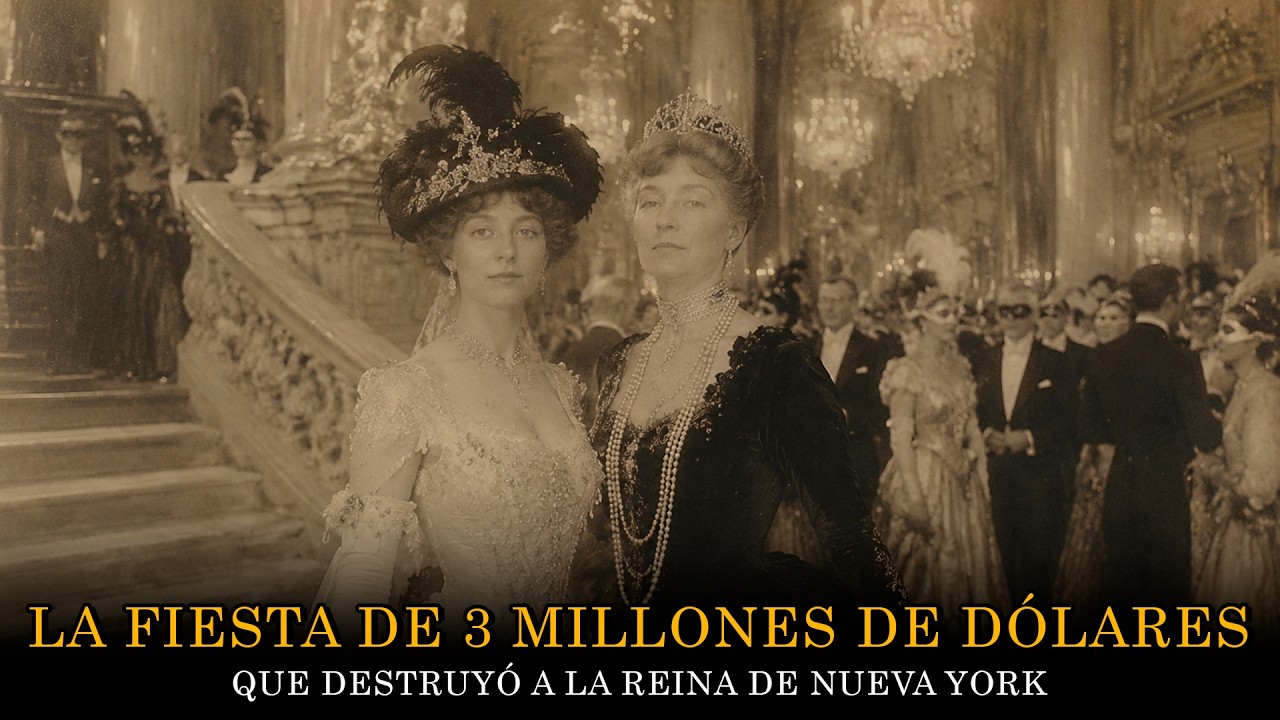
In the line of carriages waiting in the street, the woman she meant to break was already on her way. Alva Erskine Smith was born in Mobile, Alabama, in 1853, the third of four daughters of Murray Forbes Smith, a merchant whose business spanned the Atlantic, and Phoebe Desha Smith, a Kentucky-born woman of forceful personality and large ambitions. Before the Civil War, the Smiths lived like Southern landed gentry, with a house in Mobile, servants, trips to New York where cotton was sold, and journeys to Europe where the profits were spent. The war destroyed the cotton economy that supported all of it.
By the late 1860s, with the crop ruined and fortunes evaporating, Murray Smith moved the family north and then to Paris. The Smith daughters were educated in French boarding schools. Alva became devoted to Paris with singular intensity, wandering the Louvre as a teenager and studying the architecture of chateaux on family travels. She returned to New York speaking fluent French and carrying a clear preference for the French Renaissance style over any other.
In 1875, at twenty-two, Alva married William Kissam Vanderbilt, the second son of William Henry Vanderbilt, who would soon become the wealthiest private citizen in America. Alva understood from the day she married what her position was. The Vanderbilt money was newer than the Astor money, newer than the Schermerhorn money, newer than the Dutch families who had ruled New York since the colonial era. When old Commodore Cornelius Vanderbilt died in 1877, he left nearly one hundred million dollars, almost all of it to his eldest son.
By the early 1880s, William Henry had nearly doubled that sum to about two hundred million, more than the entire reserves of the United States Treasury. Yet despite all this money, the family was not received in the important houses. Alva noticed. She did not accept it.
She had been raised to believe she belonged at the top of any room she entered. She intended to bring that authority to New York. In 1877 and 1878, she met the architect Richard Morris Hunt, the first American trained at the École des Beaux-Arts in Paris, and began explaining what she wanted. She wanted a chateau.
She wanted a corner of Manhattan that looked like the Loire Valley. She wanted a building that would force every house in New York to take notice. She was twenty-four years old. Her husband was paying the bills, and she had already decided that she would design the house and then design one night inside it that would change everything.
Twenty blocks south, Caroline Astor had already drawn the map of who mattered in New York. Born Caroline Webster Schermerhorn in 1830, she came from the kind of Dutch family that had been in Manhattan since the 1640s. In 1853 she married William Backhouse Astor Jr. , grandson of John Jacob Astor, the German-born fur trader who became America’s first millionaire.
The marriage was strategic on both sides: the Schermerhorns gained Astor money, and the Astors gained Schermerhorn legitimacy. Caroline, a stern and dignified woman of enormous sustained will, took charge of the household and decided what to do with it. She decided to rule. In the 1870s, after the death of her famous mother-in-law, Caroline inherited not only the position of head of the Astor family but the title “Mrs.
Astor” itself. She lived on Fifth Avenue at Thirty-Fourth Street in a mansion whose centerpiece was a ballroom that held four hundred people. That number, four hundred, would become one of the most significant numbers in the social history of nineteenth-century America. She did not invent the Four Hundred alone.
Her partner was Ward McAllister, a Savannah lawyer who had decided in middle age to become the high priest of New York society. Together they decided who was in and who was out. The principles were never written but were widely understood: a family had to have been in society for at least three generations, and industrial money was acceptable only if time and behavior had refined it into something that could pass for old. The Vanderbilts, by Caroline’s standards, were not yet on the list.
They were rich, but they were new. Alva had announced the ball in early February as a masquerade requiring two elaborate costumes. The date was Monday, March 26, 1883, chosen strategically because it fell during Lent, when the most conservative families curtailed their social activities, ensuring no competing event. The costume requirement was strategic for a different reason: it forced every potential guest to order a special outfit, visit dressmakers, consult friends, and spend weeks in preparation.
The ball would dominate the conversation of every New York drawing room for two months before it even took place. Six quadrilles would be presented, each requiring four couples in matching costumes performing a set choreography. One was the “Hobby Horse Quadrille,” with dancers dressed as riders on horses, padded horse legs attached at the waist. Another was the “Mother Goose Quadrille,” with guests costumed as nursery rhyme characters.
A Dresden group would appear as porcelain figurines. The Star Quadrille would feature women representing celestial bodies, each wearing glittering ornaments. Each group required six weeks of private rehearsals in the homes of the women participating. Carrie Astor, Caroline’s twenty-one-year-old unmarried daughter, was a natural participant in the Star Quadrille.
She was placed in the rehearsals, measured for her costume, and practiced the steps with her friends. She assumed her invitation had simply been delayed. It had not been delayed. It had never been sent.
Alva had sent invitations to the Roosevelt, Belmont, Goelet, Schuyler, Cutting, Iselin, and Vanderbilt families. She sent no invitation to Mrs. Astor, and none to Carrie. It was not an oversight.
It was a trap. The customs of the time, the silent rule of New York society, held that a hostess could not invite a family to which she had not been formally presented. A formal presentation was made by the delivery of a calling card. Until Mrs.
Astor left her card at the Vanderbilt mansion, Alva was technically barred from sending an invitation to the Astor family. The trap turned the rule against the woman who had enforced it. When Carrie realized in early March that her invitation had not arrived, she went to see her mother in tears. Mrs.
Astor remained silent for a long moment. She had spent a decade ensuring that no Vanderbilt entered her ballroom. Now her daughter was asking her, with tears in her eyes, to surrender that authority. Mrs.
Astor said she would go. She would do what she had refused to do for years, for Carrie’s sake. Outside on Fifth Avenue, the carriage was prepared. When Caroline Astor finally understood what was required of her, she put on her bonnet, descended the marble steps of her mansion, ordered her driver to take her twenty blocks north, and arrived at the Vanderbilt mansion.
She did not enter the house. The 1883 calling card protocol did not require the lady leaving it to enter. She handed her engraved card to a footman, who carried it inside on a small silver tray. In the great hall, the butler received the card, looked at the engraved name, read it twice, realized what had just happened, and carried the tray up the grand staircase to Alva.
The quadrille rehearsal stopped. Alva looked at the card. The butler placed it on the desk and returned to the rehearsal. An invitation to the Vanderbilt ball was hand-delivered to the Astor mansion the next morning.
It was accepted that same day. The transaction had taken less than twenty-four hours. The news did not remain secret. In less than forty-eight hours, every family on the Astor list knew that Mrs.
Astor had visited the Vanderbilt mansion. In less than a week, the story had reached the press of Boston, Philadelphia, and Chicago. The interpretation was universal: Mrs. Astor had gone to the Vanderbilts.
The woman who had refused to acknowledge them for years had been forced, by her daughter’s tears and a young hostess’s patient elegance, to walk twenty blocks north and leave her card on a silver tray. The Four Hundred were no longer under the exclusive jurisdiction of Caroline Astor. The Vanderbilts were inside. On the morning of March 26, the mansion at Fifth Avenue and Fifty-Second Street was awake from four o’clock.
The resident staff numbered between thirty and forty. There was the butler, Mr. Brown, who reported directly to Alva; under him were under-butlers, footmen, and a cellar master. On the female side, the housekeeper managed the maids, chambermaids, and laundresses.
Alva’s personal maid, Helen, who had come with her from Paris, answered only to Alva. The chef, a Frenchman called Monsieur Joseph, ran the kitchen with three assistant cooks, a pastry chef, and kitchen helpers. The stables behind the mansion housed the coachman, grooms, and stable hands. On the night of the ball, this number tripled.
Delmonico’s legendary restaurant sent fifty additional kitchen staff, twenty waiters, and a small army of dishwashers. The florist sent thirty workers. The music contractor sent two full orchestras. Fifty additional footmen in matching formal livery were hired for the night.
By the time the first guest arrived, more than two hundred workers were on duty inside the building. The mansion itself was engineered to make this possible. The kitchen ran along the entire back of the building, with two coal stoves, a separate pastry oven, marble tables, and a zinc-lined cold room. The wine cellar held tens of thousands of bottles.
A coal chute on Fifty-Second Street allowed supplies to be delivered without entering the house. A separate servants’ entrance allowed staff to come and go unseen. A hidden door behind the great hall, covered in the same Caen stone as the hall itself, led to a servants’ staircase running from cellar to attic. The main staircase was reserved exclusively for the family and guests; any servant caught using it was dismissed without a reference.
The most important piece of service infrastructure was the bell board, a vertical array of forty bells mounted on the butler’s office wall. Each bell carried a hand-written label identifying the room it served. When a bell was pulled in any upstairs room, the corresponding bell rang, and the expected response time was under ninety seconds. At ten o’clock, the first carriage turned onto Fifth Avenue, followed by a procession that stretched sixteen blocks.
Police were stationed along the avenue from Forty-Seventh to Fifty-Fifth Street to manage the crowds, which numbered several thousand. The street was lit by gas lamps, and the limestone facade of the mansion glowed from every window. The crowd watched the costumed guests descend. They saw Mary Queen of Scots in black velvet from the Belmont carriage.
They saw Marie Antoinette in pale silk from the Schuyler carriage. They saw the Statue of Liberty with electric lights built into its crown. They saw Mrs. Astor herself, and they understood immediately what her presence meant.
Inside the great hall, which was eighteen meters long and rose two full stories under a vaulted stone ceiling, Alva stood at the base of the grand staircase cut from a single block of pale limestone. Her gown was white-and-yellow brocade with heavy orange shading in the under-skirt, embroidered flowers and leaves outlined in gold thread and iridescent glass beads. Her bodice was blue satin covered with gold embroidery. Her sleeves were transparent gold gauze.
On her head she wore a Venetian headdress of black velvet set with jewels, the largest of which was a peacock made of multi-colored stones, sapphires, emeralds, and rubies set into a single composition. The peacock caught every gleam of light in the room. Beside her stood William Kissam Vanderbilt, costumed as the Duke of Guise in black velvet with a gold chain, a small collar, and a sword. The receiving line lasted nearly two hours.
At midnight, the Star Quadrille began. Carrie Astor was among the eight dancers. The quadrille lasted just under fifteen minutes. The Hobby Horse Quadrille, the most theatrical of the six, lasted twenty minutes, with dancers moving in an intricate pattern across the polished floor while appearing to ride horses.
The Mother Goose Quadrille and the Dresden china group followed. Between quadrilles, the orchestras played dance music for the general company. Champagne was served continuously; an estimated sixty-five thousand dollars’ worth was ordered for the night. One thousand dollars’ worth of flowers was arranged, orchids imported from Florida, lilies from Bermuda, roses grown in a New Jersey greenhouse.
At two in the morning, supper was served, a fifteen-course meal prepared by Delmonico’s, engraved menus in French at every place. The meal took two hours. After supper, dancing resumed. At five in the morning, the crowd had thinned.
At six, only the most determined remained. As the first gray light appeared through the eastern windows, Alva, still in her Venetian gown, gathered the remaining guests for the last dance of the night. It was the Virginia Reel, a country dance from her own childhood in Mobile, Alabama. She led the line herself.
The dance lasted nearly an hour. When it ended, the sun was fully up over the avenue. The last carriage left the covered entrance at about seven. Alva had won.
The morning papers of March 27 led with the ball. The Tribune devoted a full page. The Herald described costumes guest by guest. The Sun estimated the cost at two hundred fifty thousand dollars, a figure that led the national press.
The social effect was immediate. The Vanderbilts were inside. The Four Hundred were no longer a closed list. The principle on which it had been built, that old money could keep new money out simply by refusing to acknowledge it, had collapsed.
The architectural effect was equally immediate. Every wealthy family in New York that had been considering a new mansion on Fifth Avenue now committed to building. Within fifteen years, the stretch of Fifth Avenue from Fiftieth to Ninetieth Street became Millionaires’ Row, a continuous succession of carved stone mansions, each larger than the last. The arms race had begun.
The phrase “Gilded Age,” coined by Mark Twain a decade earlier, entered general usage after the ball. The contrast between the two hundred fifty thousand dollars spent on one night and the wages of the workers who built the railroads that made the Vanderbilt fortune became a recurring theme in editorials and political speeches of the Progressive movement. Alva herself never regretted the cost or the display. She had gone out to win a social war, and she had won it.
In the years that followed, the cracks began to accumulate. Twelve years after the ball, she left the marriage that had financed it. William Kissam Vanderbilt conducted open affairs, particularly during his long absences on his yacht, named Alva in 1886. In 1895, after consulting New York’s leading divorce lawyers, she filed for divorce on grounds of adultery, demanding that her husband provide evidence of his behavior and admit guilt in open court.
It was the most heavily covered legal case in the United States to that point. When her attorney said she would have to sue for divorce or lose custody of her children, she chose divorce. Caroline Astor said she would no longer receive Alva. Alva did not care.
She calculated the cost and concluded that any social cost was better than remaining in a marriage that no longer existed. She received a settlement that left her with Marble House in Newport, built three years earlier as a birthday gift at a cost of about eleven million dollars, and financial independence for life. She did not keep the Petit Chateau. The mansion at Fifth Avenue and Fifty-Second Street went to her husband.
She left the marriage in the fall of 1895 and gave up the house she had built. Less than a year later, she married Oliver Hazard Perry Belmont, a member of the banking family and an old friend who had been present at the 1883 ball. It was, by all surviving accounts, a marriage of love. They spent three years together before his death in 1908.
In her later years, Alva became one of the principal financiers and organizers of the woman suffrage movement in America. She paid for printing pamphlets, paid the rent on headquarters, and paid the legal defense costs of activists who were arrested. She joined the militant wing of the movement, the National Woman’s Party, in 1916. She was sixty-three years old.
She never returned to live in the mansion at Fifth Avenue and Fifty-Second Street. In the fall of 1927, demolition crews arrived at the corner of Fifth Avenue and Fifty-Second Street. The property had been sold the previous year by William Kissam Vanderbilt Jr. , who had inherited the mansion upon his father’s death in 1920.
He concluded that maintenance was no longer sustainable and that the land in the heart of the new commercial district was worth more empty than occupied. The building could not be economically converted to commercial use. The decision to demolish was made within months. The demolition was photographed extensively by the New York press.
The slate roof was removed first. The pinnacles and ornaments fell. The carved stone facade was dismantled block by block. Alva, seventy years old and living in Paris, was offered the opportunity to take any interior elements she wished to keep.
She took some. The salon paneling designed by Jules Allard et Fils was removed and eventually reinstalled in a private house. The library paneling was sold to a private buyer. The dining room furniture was auctioned.
The chandeliers were sold individually to antique dealers. The wrought iron entrance gates, designed by Hunt, were donated to the city of New York and reinstalled at the entrance to the Conservatory Garden in Central Park, where they remain today. The carved stone pediment figures were reinstalled in the lobby of the Sherry-Netherland Hotel. The marble and mosaic fireplace from the great hall entrance was acquired by the Metropolitan Museum of Art and is displayed in the American Wing.
By the beginning of winter 1927, the corner of Fifth Avenue and Fifty-Second Street, which had carried Richard Morris Hunt’s carved limestone signature for forty-four years, was an empty lot. Alva learned of the demolition from her son while in Paris. She made no public comment. She had not lived in the house for thirty-two years.
She died in Paris on January 26, 1933, at the age of seventy-nine. Her body was returned to New York and buried in the Belmont family mausoleum at Woodlawn Cemetery in the Bronx. The jeweled peacock she had worn in her hair was sold as part of her estate. The Venetian gown was dismantled.
The Mora photographic plates went to the archives of the New-York Historical Society. The gates went north to Central Park. The fireplace went north to the Metropolitan Museum. The pediment figures went north to the Sherry-Netherland.
The fragments scattered. The site itself became an office building. The mansion is gone. The family dispersed.
The Four Hundred no longer exist. Yet one night in 1883 is the reason any of this is remembered. That night still exists. The photographic plates are in the New-York Historical Society.
The press coverage is preserved on microfilm in research libraries from Boston to San Francisco. The menu cards and invitations are held by the Museum of the City of New York. The night survives as a reference point in Gilded Age literature, in the novels of Edith Wharton, in the writings of Henry James, in the political rhetoric of the Progressive movement, in the cultural memory of New York. The mansion was the weapon, and that night was the decisive blow.
The house lasted less than two human lifetimes. What endures is the story. What endures is the night.
What remains is the documented moment in which a woman, told she did not belong, proved in one coordinated act that those who told her so held no real power.