By the early 1990s, Kmart stood at the summit of American retail. Nearly 2,400 stores blanketed every state. It employed roughly 370,000 people and, in its best year, rang up around 37 billion dollars in sales. It had surpassed Sears and become the number one retailer in the entire country.
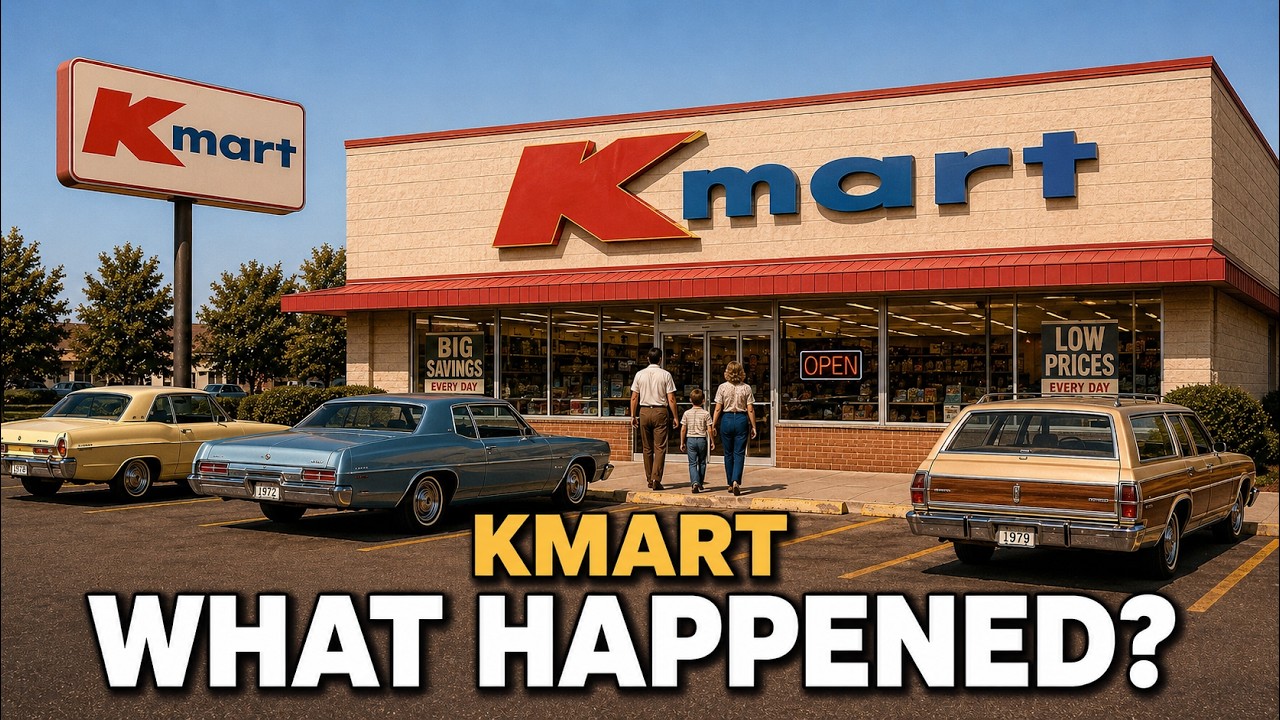
Not number one in discount retail, but number one, period. If you were shopping in America then, you were almost certainly closer to a Kmart than to any other store of its kind. It was the default, just there the way the sky is there. It had not always been that way, and it would not last.
The story began with a man named Sebastian Kresge, a farm kid out of Pennsylvania born just after the Civil War, whose relationship with money bordered on the religious. He bragged that he had never spent more than thirty cents on lunch in his entire life, wore his shoes until they fell apart, and reused the same envelope three or four times. He started as a traveling salesman hauling hardware and tinware around the Northeast, where he crossed paths with Frank Woolworth, who was building stores where everything cost five or ten cents. Kresge wanted in on that idea.
Woolworth turned him down flat as a partner, so Kresge went and did it himself. Around 1900, he opened a store on Woodward Avenue in downtown Detroit with a sign in the window reading, “Nothing over 10 cents in store. ” People poured in. For a working family, a place where everything on the shelf was genuinely affordable was close to a miracle.
By the time he was done, Kresge had built hundreds of these five-and-dime stores, lived to be a very old man, gave away a fortune, and stayed cheap to the very end. He built the foundation, but he did not build Kmart. The man who did that was Harry Cunningham. By the late 1950s, the old five-and-dime was getting tired, and a new idea was coming up fast: the discount store, a big box out by the highway selling everything under one roof for less.
Cunningham, who had worked his way up from assistant store manager, spent years quietly studying these new discounters, driving out to them, walking the aisles, counting the registers, taking notes. Then he did something that nearly cost him his career: he bet the entire company on the idea. The old guard was furious. Instead, on a spring day in 1962, the first real Kmart opened its doors in Garden City, Michigan.
It was 80,000 square feet, and everything inside was cheaper than the department store downtown. That same year, two other stores opened their very first locations: one was called Target, and the other was a small outfit down in Arkansas run by a man named Sam Walton. It was called Walmart. Three babies born the same year.
For a long, long time, Kmart was the big brother who won every single fight. Inside those stores, the experience was distinct. The first thing that hit a shopper coming through the doors was the size and the brightness, and the smell of popcorn and hot vinyl. Off to one side sat a little cafeteria with pizza, an ICEE machine, and a lunch counter where a parent could park a kid with a hot dog while shopping.
And then there was the layaway counter in the back. For families without a lot of money, that counter meant Christmas was actually going to happen. You could pick out a bike in October, they would hold it in the back, and your mom would come in every couple of weeks and put a few dollars down on it. Then, on some cold morning in December, that bike came home.
There were the racks, too. The actress Jaclyn Smith had her name on a whole line of clothes, one of the first times a real celebrity had ever done that. Years later, it would be Martha Stewart’s sheets and towels. Route 66 jeans.
This was the stuff that dressed the entire middle of the country. And over all of it, every so often, a voice crackled over the loudspeaker: “Attention Kmart shoppers. ” Somewhere three aisles over, a blue light started spinning on a metal pole. For the next fifteen minutes, whatever sat under that light was cheaper than it had any right to be.
That famous blue light was a total accident. In 1965, a store manager in Fort Wayne, Indiana had a pile of merchandise that just would not sell. On a whim, he grabbed one of those portable flashing police-style lights, stuck it up over the pile, and had somebody get on the intercom. People swarmed it.
It worked so well that the whole company stole the idea. Within a few years, that spinning blue light and that announcement were so famous that Johnny Carson was doing jokes about them on late-night television. The single most iconic thing Kmart ever did started because one guy needed to move some junk on a slow afternoon. That was the thing Kmart was really selling.
Not cheap stuff. Everybody sold cheap stuff. Kmart was selling the surprise, the hunt, that little jolt of maybe-today when the light started spinning. You did not drive to Kmart because it was the cheapest.
You drove because it was fun, because you just might win something. Meanwhile, Sam Walton was busy being ruthless about something nobody could see: the back end, the unglamorous machinery of getting a box off a truck and onto a shelf. Walton built enormous regional warehouses so that every single Walmart was within about a day’s drive of one. He put computers on his inventory before anybody else even thought it mattered.
He knew hour by hour what was selling and what was not, and he could refill a shelf almost before it went empty. Kmart’s back end was a mess. It ran two separate systems that did not even talk to each other, one for clothes and one for everything else. As late as the 1990s, it still could not produce one clean picture of what it had and what it needed.
So you would get the flashing blue light, the big sale, everybody comes running, and then the shelf is bare. The stuff is sitting in a box in the back and nobody knows it is there. The store that sold the surprise could not keep its own shelves full. By the 1980s, a company lifer named Joseph Antonini had climbed his way to the top of Kmart.
Sharp, confident, and running the whole show by 1987, he looked at his aging stores and at the scrappy little Walmart coming up fast behind him. He made a decision that sounded awfully smart at the time and turned out to be fatal. He decided he was not going to win by fixing Kmart. He was going to win by buying up everything else.
He bought the bookstore chains Walden Books and later Borders. He bought Sports Authority. He bought a big chunk of Office Max. He bought a home improvement chain, a warehouse club chain, and a drugstore chain.
For about a decade, Kmart’s attention and money went everywhere except the stores with the big red K on the sign. Almost none of it worked out. By the late 1990s, they had sold off basically every one of those companies, sometimes taking a real beating on the way out the door. They spent ten years and a mountain of cash buying everything except a future for their own business.
In 1995, the board pushed Antonini out the door. The man who bet the entire company on buying the future was gone before he ever got to see how the story ended. On the outside, Kmart still looked huge and healthy and famous. In 1988, the movie Rain Man featured Dustin Hoffman’s character insisting that his underwear had to come from Kmart, and the line “Kmart sucks” ended up in a best picture winner.
Kmart signed Martha Stewart, and soon her sheets and towels alone were doing something like a billion dollars a year inside the stores. But on the inside, the shelves were half empty, and the money was flying out the door. The first real blow landed in November of 1990. That was the month Walmart quietly passed Kmart in sales and became the biggest retailer in America.
Kmart did not collapse overnight. Nothing that big ever does. But the ground shifted underneath it. Kmart was now stuck in the single worst spot there is.
Walmart hammered it from below on price, always cheaper and always in stock. Target went after the shopper with a little more money from above, making discount feel almost stylish. Kmart was caught right in the middle, and the middle is where retailers go to die. Kmart tried to fight Walmart on price, tried to match it dollar for dollar, and just could not.
Its costs were higher, its backend was slower, its shelves were emptier. You show up, the light spins, and the surprise you came for is not there. Bit by bit, the fun leaked right out of the place. Once the fun was gone, all that was left was a store that was not quite as cheap as the one across the street.
Into all of this walked a new boss named Charles Conaway around the turn of the millennium. He brought in a crew of young executives that people inside the company started calling the frat boys. Big spenders, big talk. They made one huge bet: an all-out price war against Walmart.
To stock up for it, they massively overordered, hundreds of millions of dollars of stuff bought on borrowed money. It did not work. The stuff piled up. The cash ran out.
To keep the doors open, Kmart started stretching out its payments to the very companies that supplied it, holding back money it owed, all while telling the public that everything was fine. It was not fine. Later, the government would come after Conaway for misleading investors about how bad things really were, and a jury would find him on the hook for it. But in the moment, all anybody knew was that after a disappointing Christmas in 2001, the suppliers got spooked.
When the company that delivered Kmart’s food finally stopped delivering over a single missed payment, that was the end of the pretending. On January 22, 2002, Kmart filed for bankruptcy, the biggest retail bankruptcy in American history up to that point. The stock, which had once traded in the double digits, closed on the day of the filing at seventy cents. Within about a year, they closed 600 stores and cut tens of thousands of jobs.
Tens of thousands of people who just the year before had a place to go on Monday morning. Kmart did not actually die right there. What happened next was slower and, in a strange way, worse. Eddie Lampert, a hedge fund manager, quietly bought up huge amounts of Kmart’s debt for pennies on the dollar while it was drowning in bankruptcy.
When the dust settled, he controlled the company. And now the land came into play. A lot of Kmart’s real estate, the actual dirt, was worth a fortune, sometimes more than the store standing on top of it was even making. People watching Kmart’s stock suddenly climb back up were not betting on the stores at all.
They were betting on the dirt underneath them. In 2005, Lampert used Kmart to pull off something audacious: he bought Sears, the granddaddy of American retail, and bolted the two together into one company. On paper, it was the third biggest retailer in the country. Two wounded legends stitched into one.
But Lampert did not run it like a man trying to save two stores. He ran it like a man carving up an estate. He sold off the crown jewels one by one. Land’s End.
Gone. Craftsman tools. Gone. He spun off big piles of the real estate into a separate company.
And the stores themselves, he starved them. He famously did not want to spend money on fresh paint, new fixtures, or clean floors. You could feel it the second you walked in. The lights flickered overhead.
The carpet was worn right through. Half the shelves were empty, not because of some sale, but because nobody was refilling them. Whole sections were roped off. It stopped feeling like a treasure hunt and started feeling like walking through somebody’s house after they had already moved out.
And that was the murder weapon. Kmart sold the surprise. Kmart sold the light. You cannot sell surprise in a store with empty shelves and burned out bulbs.
They took the one thing that made Kmart special, the fun, the hunt, the maybe today, and quietly let it die in the dark to save a little money on carpet. The long slow bleed continued. Year after year, more closures. One hundred here, two hundred there.
Every January, another list. In 2018, the whole Sears and Kmart company filed for bankruptcy all over again. The number that was 2,400 stores at the peak dropped to a thousand, then to the hundreds, then lower. Every closing was somebody’s whole world.
One man named Josh Angler had worked at the Kmart in McMurray, Pennsylvania for nineteen years. He had started there as a sixteen-year-old running a register and worked his way up to running the whole store by his early twenties. When they finally closed his store, he got on that same intercom and made one last announcement. He did not try to sell anybody a thing.
He thanked them. He told them he was not there to move any more merchandise. He was there to thank them for a lifetime of memories. He called the store his second home, and the people who worked for him his second family.
People cried. He cried. Somebody filmed it, and it went all the way around the world. October 2024.
The last full-size Kmart on the American mainland, out in Bridgehampton, New York, spent its final day. People came from all over. One man drove four and a half hours just to be there because he had already missed the last Sears and swore he would not miss this one too. They walked the mostly empty aisles like it was a funeral, because it was.
Everything got marked down to almost nothing, a single penny on some items. And over the speakers on that last day, they were playing Avril Lavigne. Then the doors closed for good. What is left is that one little store in Miami, and it is not even really a Kmart anymore.
Most of the space was leased out to another chain, and what remains of Kmart got shoved into a couple of small rooms about the size of a drugstore, in what used to be the garden department. Sparse shelves, 80s music playing to no one, and a faded old sign still promising blue light specials to a store where almost nobody ever comes. But on the other side of the world, the story ended completely differently. In Australia, there is a whole chain of stores called Kmart, more than 300 of them, packed on the weekends, genuinely beloved.
A totally different company owns the name down there, and they ran it the way the original never quite could. The American Kmart did not die because a store with that name could not survive. It died because of what a small handful of people chose to do with it. Someone on the other side of the world took the exact same name and kept it alive.
And ours was just let go. Nobody killed Kmart with one clean blow. Walmart took a little with its warehouses and its low prices. The bosses took a little chasing all those companies they never should have bought.
The empty shelves took a little every single time that blue light spun over nothing. And Eddie Lampert took a little, stripping it down for the land underneath. Nobody killed Kmart. They each just took a little.
And one day, somebody looked underneath all of it, and there was nothing left holding it up.