On May 6, 1944, a bride walked down the steps of a London register office on her brother’s arm. America would remember it as a love story. Her church called it a mortal sin. So did her mother, who stayed home.
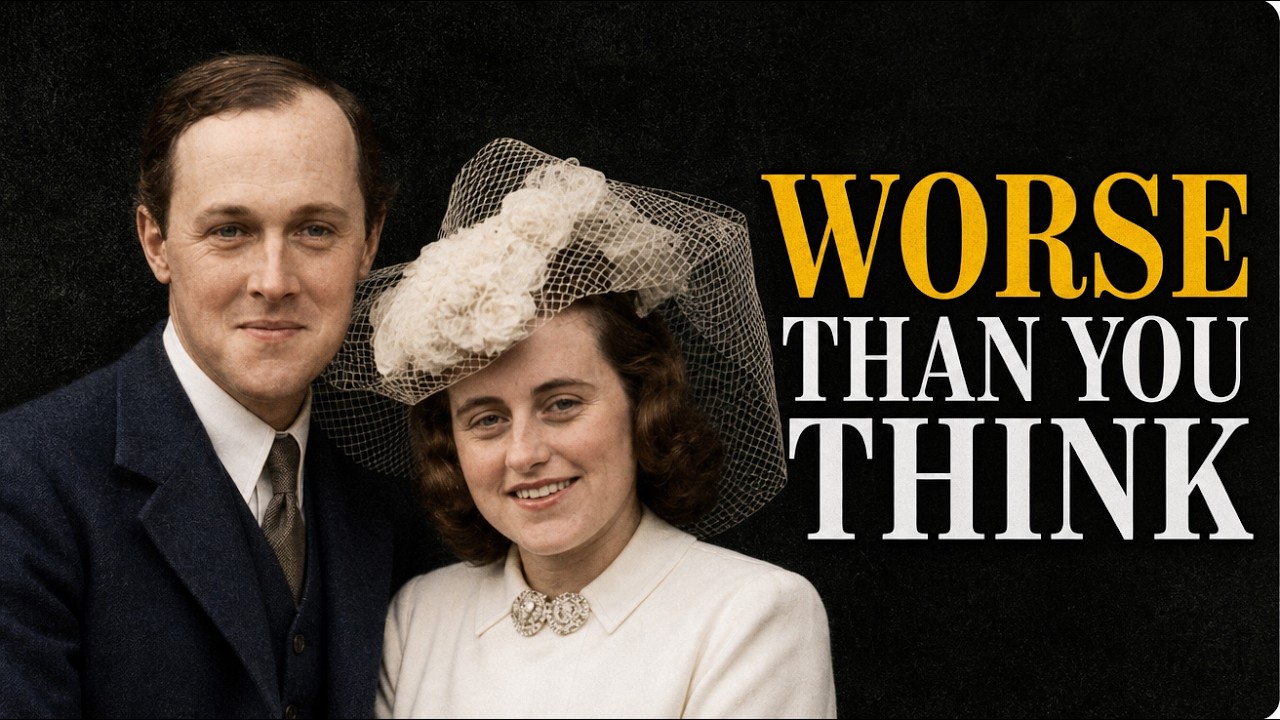
Of the nine Kennedy children, only one attended. He would be dead within fourteen weeks. And the groom, the man she risked damnation for, was offered a way out by his anti-Catholic father. He refused it.
Four years later, she would become a marchioness in London and her mother would threaten to disinherit her. It began at the London embassy in 1938. But to understand it, you have to start with the room itself, because the room tells you everything. A register office is a municipal window, the place the British go when the church rejects you, or when you cannot wait, or when someone objects.
The ceremony took about ten minutes. There was no Mass, no priest, no marriage blessing, and no father of the bride. For a woman raised as Kathleen Kennedy was raised, in convent schools, with daily rosary prayers, and a mother who considered faith the family’s true inheritance, a civil marriage was no wartime shortcut. According to the doctrine she had learned since she learned to read, it was a public and ongoing sin.
She knew that as she walked in. She smiled anyway, and the photographers got their shot. Look at the man holding her arm. That is Joe Jr.
, the eldest, the one being groomed for the presidency. He was the only member of her family inside the building, and he had spent weeks on leave defending her. He would be killed on a volunteer mission in August. So the question the photograph asks is not whether she was in love.
She was. The question is why the price was so high, who set it, and why she agreed to pay it. To understand that, you need to know what she had already seen happen to a Kennedy daughter who stepped out of line. Born in Brooklyn in February 1920, the fourth of nine children, she quickly became the family’s charm.
Joe Jr. had ambition. Jack had a sickly, sardonic wit. “Kick” had something you cannot manufacture: the ability to walk into a room full of strangers and leave with allies.
Her nickname came from her constant restlessness. Her mother’s approach to that restlessness was containment. Rose Kennedy ran her children on a strict system: index cards for medical records, weight checks, assigned reading, Mass, confession, meatless Fridays, and a line she loved to repeat from the Gospel of Luke: to whom much is given, much is expected. When Kick was sent to the Convent of the Sacred Heart in Noroton, Connecticut, she did well, topping her classes and making friends with everyone.
Then at fifteen, she was sent to the Holy Child convent in Neuilly outside Paris, where the nuns gave her a nickname that should have been a warning: Mademoiselle Pourquoi. Miss Why. She was not a rebel. She was a negotiator, endlessly asking where authority came from.
But there is a second fact in her childhood more important than the convents. Her older sister Rosemary had intellectual disabilities, and in 1941, when Rosemary was twenty-two, their father approved a lobotomy. The surgery failed catastrophically. Rosemary was placed in an institution and effectively removed from family life for decades.
No clear explanation was given to the younger children. She simply no longer existed, and family life continued as before. Kick was twenty-one. She had just witnessed what happened when a Kennedy daughter became a burden to the family’s ambition.
No one needed to explain the lesson. Now put her in London. Her father had been appointed United States ambassador to the Court of St. James’s, and the family arrived in the spring of 1938 to a country that found them wonderful and slightly ridiculous.
Kick was eighteen. She was presented at court. She chewed gum in the streets of Mayfair. She gave grown dukes silly nicknames.
And the English girls, trained from birth to be composed, watched her laugh at her own mistakes with no ability to compete. The press decided she was the “Deb of the Year” for 1938. That summer, she attended the important parties, and at one of them she met William Cavendish, known as Billy, Marquess of Hartington and heir to the Duke of Devonshire and Chatsworth. He was quiet.
She was not. Most stories end there. But this is the part that gets ignored. The Cavendish family was not merely Protestant.
They were institutionally, historically, and constitutionally Protestant. That family had helped place a Protestant king on the English throne in 1688 and spent the next two centuries on the anti-Catholic side of nearly every significant controversy. Billy’s father, the tenth duke, was by most accounts the most anti-Catholic Cavendish of his time. And Kick’s mother held a papal title.
Both families treated religion as a family project. Their love affair was never private, and everyone knew it within about a week. Then the war came. Her father brought the family home in 1939, and Kick spent four years in America suffering from homesickness, which is the version you usually hear.
But what she actually did in those four years was more interesting and more useful. She got a job at the Washington Times-Herald. She started as an assistant. She wrote short pieces and reviews.
And she spent her days inside a newspaper watching how stories were made, who got called, who got flattered, which detail became a headline, and how a person became just a paragraph. It is the least romantic chapter of her life, and it would finally pay off. She also could not return to England because civilians could not simply book a ticket to a war zone. So she found the way out.
The Red Cross was sending volunteers to run clubs for American soldiers in Britain. She applied. She used every connection she had. In June 1943, she arrived in London to manage recreational activities at a club on Hans Crescent, handing out doughnuts and organizing dances for soldiers who had no idea their hostess was the former ambassador’s daughter.
She engineered her own return. No one sent her. That distinction matters later. Billy was in the Coldstream Guards, and their relationship was soon fixed.
By autumn, both families understood this would become a procedural problem. The obstacle was not affection. The obstacle was a rule. Under Catholic law as it then stood, a Catholic marrying a Protestant needed a dispensation.
The dispensation required a written pledge to raise the children as Catholics. For most couples, that is a hard conversation. For the heir to a dukedom whose family had built its entire public identity on the Protestant establishment, having a Catholic firstborn son was structurally impossible. Billy would not agree.
And Kick could not agree without him. They spent months looking for a theological loophole, consulting priests and bishops, proposing compromises: sons Anglican, daughters Catholic. They were refused by Rome and by Westminster. In the middle of this, the marriage acquired a political price.
In February 1944, the member of parliament for West Derbyshire died. It was a Cavendish seat, the constituency next to Chatsworth, the kind of seat a family like this had treated as an inheritance since the eighteenth century. The duke nominated his son as the official coalition candidate. Several accounts suggest this was partly to keep him out of the fighting.
Kick threw herself into it. She loved the late-night strategy sessions. She canvassed door-to-door under a false name so her American accent and American surname would not lose votes. But it cost him votes anyway.
The independent candidate, Charles White, campaigned against inherited privilege in a country that had spent four years being bombed and was in no mood to be represented by a marquess. He also had a Kennedy name to use, and in Britain in 1944, the Kennedy name meant the ambassador, who had told an American newspaper that democracy was finished in England. On February 17, Billy lost by more than four thousand votes in a Cavendish seat, to a man who had run against the Cavendish family. That result did two things.
It humiliated a family that had never lost there. And it proved publicly, in numbers, that marrying an American Catholic had a concrete cost. If the duke had wanted an excuse to end the whole thing, he now had one. He did the exact opposite.
According to the account drawn from family papers and Devonshire circles, the tenth duke, the anti-Catholic and the strict man, told his son that if he married Kick and left her to her Catholicism, the family would not cut him off. No disinheritance. No exile. Take the girl and bear the consequences.
Billy said no, not to her, but to the exception. He felt the weight of the succession more than he could risk the dukedom on papal promises about his unborn children. If the marriage was to happen, she would be the one giving something up. And what she would give up was the sanctified standing of her soul.
His mother wanted the marriage. His father offered him a way to keep her faith. It was her fiancé who closed that door. And in Boston, her mother had already begun making calls.
Rose Kennedy’s campaign to stop the marriage was not just letters of disapproval. It was an operation. She wrote to Kick about what the family had always believed, and what the neighbors in the parish and the church would think. She used the word scandal.
She arranged for priests to intervene. According to biographers who examined the Kennedy and Devonshire materials, she contacted her contacts in the American hierarchy. The Kennedys were close to Archbishop Spellman in New York, and an archbishop was sent to persuade her daughter to back out. Rose also did something quieter and more effective.
She stalled. She had already succeeded earlier in the war in keeping the two of them on separate continents. Now she played with time, urging delay, more consultation, demanding Kick come home to think. There is a version of this story that portrays Rose simply as a cold woman.
That is too easy an explanation, and it makes the cruelty seem less than it was. Rose genuinely believed her daughter was about to commit an act that would separate her from God forever. From the perspective of that belief, everything she did was an attempt at rescue. The problem is that rescue and siege can look identical from the other side.
Kick spent the winter and spring of 1944 under pressure from two great families, each with its own representatives and theologians, and yet no one asked her what she actually wanted. The Duchess of Devonshire, whom everyone called Mou, decided early that this American girl was an asset and acted as if it were settled, inviting her for Christmas and treating her as family before any papers existed. The duke had made his offer, but it was his son who refused it. Rose was working the Boston, London, and Rome fronts.
Priests on one side, an ancient Protestant establishment on the other, and in the middle, a twenty-four-year-old woman being pushed to decide which of these people she was willing to lose. She talked to the priests. She talked to Joe Jr. , who was flying from Suffolk and came to London to tell her simply to go ahead.
She chose Billy. And she never claimed it was an easy or free choice. She did not convince herself the church was wrong. She simply decided she wanted this man more than she wanted to keep her religious standing.
She went into it fully aware, which is harder and lonelier than pure defiance. And so, on May 6, 1944, they married at the register office at Chelsea Town Hall on King’s Road. The Duke and Duchess of Devonshire were present. So were Cavendish relatives, London friends, Red Cross colleagues, and a crowd outside that required organizing.
Joe Jr. gave her away. He was the only Kennedy in the building, from a family of nine children with a natural gift for showing up. Rose did not come.
Joe Sr. did not come. Jack did not come. Her sisters did not come.
Whatever that marriage was, it took ten minutes behind a municipal desk before a registrar, followed by a reception, then the newsreel cameras and Fleet Street photographers who knew exactly what they were shooting. Nine days later, Time magazine ran the story in America under a headline about the Cavendish and Kennedy families. That is more or less the moment the legend was born. Two great families, a wartime love story, an American girl who became a noble.
It looked wonderful. The Kennedy family’s response was a telegram from Boston and weeks of silence. Rose’s own words, as recorded, were that she felt upset, horrified, and heartbroken, and stopped writing. Nearly two months of total silence at the very moment her daughter was starting her married life under aerial bombardment.
Joe Jr. sent a telegram home defending his sister and got, by most accounts, very little response. Now count the days they actually had. Five weeks.
Then Billy went to France with the 5th Battalion of the Coldstream Guards, part of the Guards Armoured Division, and Kick was alone in London under a new attack. The V-1 rockets began arriving in June. Londoners called them doodlebugs, and their particular horror was acoustic. You hear the engine, then it suddenly stops, and then there is a silence of about twelve seconds before the thing lands somewhere.
Kick wrote in her diary about this pattern, listening first for the rocket’s arrival and then for the silence that followed. She kept going. She kept the club running. She kept writing to him.
In August, she made her first public appearance as Lady Hartington at the Bakewell show in Derbyshire, the same constituency that had rejected her husband from parliament in February. She spoke, and the speech was a success. And it is worth noting who was watching. The duke’s political agent wrote about how useful she would be to the family after the war.
Six months earlier, she had been a liability in that constituency, canvassing under a false name. Now she was an asset with a title, being assessed for future use. Whatever the Cavendishes had initially thought about accepting an American Catholic girl, they were beginning to see the value of what they had gained. Four days later, on August 12, Joe Jr.
boarded a Liberator loaded with explosives. The mission was Operation Aphrodite, an experimental scheme to fly a bomb-laden aircraft toward a German launch site, with the crew bailing out before radio control took over. He had already completed his required missions. But he volunteered for this one.
The aircraft exploded over Blythburgh in Suffolk before anyone could bail out. His remains were never found. His name is on the wall of the missing at Cambridge. He was twenty-nine years old.
He was the one who had walked her into that register office three months earlier. And he was the only member of her family who had stood by her without condition. She flew home on the sixteenth. Jack met her.
According to one recent book, she collapsed in his arms at the airport, though that specific scene comes from a later account rather than a document written at the time. What is certain is that she was in Hyannisport with her family for the first time since the wedding, and that the reason they welcomed her back was that her brother had died. Grief did what the marriage could not. It brought her home.
She planned to stay until Billy returned. On September 9, Billy’s company entered the Belgian town of Heppen, which was held by Waffen-SS forces. Six days earlier, his unit had been among the first to enter Brussels. He had written to her about it, about the crowds, the flowers on the tanks, and his personal feeling that he, in his own words, did not deserve any of it, having spent the war in relative safety.
He wrote that he had a permanent lump in his throat and wished she had been there to see it. At Heppen, he was leading his men forward when a sniper shot him. He was twenty-six. He was buried in Leopoldsburg, Belgium, with the rest of the division’s dead.
The telegram arrived at the Kennedy apartment in New York on September 16. One month and four days after the other telegram. She had been married for four months and twelve days, only five weeks of which she had spent living with her husband. There is a family rule quoted in every Kennedy documentary, and her eldest niece still repeats it today.
Kennedys don’t cry. Kick was raised under that rule. She kept it. She went out to dinner.
She answered condolence letters. She wrote to Billy’s mother. Her friends that autumn described her as a young woman who was doing marvellously but had disappeared somewhere behind her own face. Her mother’s reaction is the part that is hardest to get past.
The harshest lines came from later biographers who wanted to prove a point, not from anything Rose wrote at the time. But the fact is undeniable. Rose had spent a year telling her daughter this marriage would cost her soul. The marriage was now over.
Within the framework Rose genuinely believed, the problem was solved. One biographer summarizes her position bluntly: she was not sorry. Here is what no one in that house seems to have said aloud. Widowhood did not fix anything theologically.
A civil marriage to a Protestant did not become retroactively acceptable because the Protestant had been killed in Belgium. Kick remained, in her mother’s eyes and her church’s, a woman who had married outside her faith. She had paid the full price and gotten four months of marriage without absolution. That is the cruelty the photograph hides.
Not the sniper. The sniper was war, and war killed hundreds of thousands of other husbands. What was done to Kick specifically was that the terms were never renegotiated. She bought something at a terrible cost.
The thing was destroyed, and the debt stayed on the books. She stayed in Hyannisport through the autumn. Then she made a decision that tells you exactly how she was reading her own situation. She returned to England.
Not to her mother’s house. Not to Boston. Not to the Kennedy compound where she had grown up and where she was now, once again, a daughter in good standing as long as no one mentioned the wedding. She went back to the country where she had no blood family, and she turned toward the people who had buried her husband.
The Devonshires embraced her as one of their own, because in the only way that mattered to them, she was. She had been married to the heir. The heir was dead. Mou, the duchess, had wanted her from the beginning, and now she had her permanently.
The surviving letters between the two women read as letters between a mother and daughter in a way Rose’s letters to Kick never did. Watch what Kick does with this situation, because this is where the passive-widow version of her collapses. She had a title now, and in postwar Britain, a title with an American accent and American financial backing was an unusual tool. She rented a house in London and filled it.
Politicians, journalists, writers, surviving members of the pre-war set, visiting Americans. She became a hostess in the specific English sense of the word, which is not just a woman who gives parties but a woman whose dinner table is a place where things get arranged. She was good at it because she had always been good with rooms, and because she had spent two years at a newspaper learning who to call. She was twenty-five years old and running her own institution with her own money in a foreign country.
Her sisters at that age were being married in Catholic ceremonies with the full family present. She also kept her faith. That part always gets lost. She was not a woman who abandoned her church for a duke’s son.
She was a woman who had been barred from a door she still wanted to enter. She went to Mass and talked to priests about her situation. She never seems to have stopped believing that her mother’s God was the true God. Then in 1946, she met Peter Wentworth-Fitzwilliam.
He was the 8th Earl Fitzwilliam. He had the Distinguished Service Order from the war. He owned Wentworth Woodhouse and a coal fortune underneath it. He was, by everyone’s testimony including his admirers’, a gambler, a charmer, and a man with a history.
He was also married to Olive Plunket and drinking heavily. By the time his relationship with Kick was serious, he was seeking a divorce. Lynne McTaggart, who wrote the first serious Kick biography in 1983, put it as plainly as any biographer does. He had a lot of money and was a lot of fun, and his chances of fidelity were zero.
That is her judgment, not an official document, and it is best treated with caution. What we have is Kick’s own explanation of why she acted as she did, which is that when you see too much death in a few years, you stop putting things off. She had seen her brother’s plane come apart over Suffolk and her husband killed in a Belgian street within five weeks of each other. She was not going to wait for a better offer.
In early 1948, she went home to tell her parents she intended to marry him once the divorce came through. For Rose, a civil marriage to a Protestant was a mortal sin. Marriage to a divorced Protestant was worse on every level: theologically, socially, and by 1948, politically, because Jack had just been elected to Congress from an Irish Catholic district in Boston and was already being seen as the family’s backup candidate for everything Joe Jr. was supposed to have been.
Rose threatened to disown her. It was not a metaphorical threat. Cut the connection. Disinheritance.
No name. No money. No family. Notice what that threat reveals.
It was no longer really about Kick’s soul, because Rose could not save a soul by cutting off an allowance. It was about what a divorce scandal attached to the Kennedy name would do in Boston. The family that had spent 1944 telling her the stakes were eternal had reached 1948, and the stakes were electoral. Joe Sr.
was different, and this is the moral complexity the story needs. He was a serial adulterer and had sanctioned a lobotomy on his own daughter, but he was also the parent who loved Kick the most and treated her as a person with an independent mind. He did not threaten her. He explored whether some accommodation with the church could be reached.
And when she asked him to, he agreed to meet her and Fitzwilliam in Paris at the Ritz on Saturday, May 15, 1948, to discuss it. That meeting meant everything to her. Joe’s blessing would mean the money survived, the family survived, and Rose could be managed. Kick knew it.
Two days before the appointment, she and Fitzwilliam decided to go to Cannes first. A side trip. A few days on the Riviera before the conversation that would decide her life. They chartered a De Havilland Dove and left Croydon on the thirteenth.
There was turbulence over the Rhône valley, a thunderstorm. Commercial flights were rerouting to avoid it. But they flew straight into it. The aircraft broke up over the Ardèche and crashed on a mountainside near Saint-Bauzile above Privas.
Kick, Fitzwilliam, the pilot Peter Townsend, and the radio operator Arthur Freeman were all killed. She was twenty-eight. Her father, who was in Europe, went to identify her body. Now watch how the machine moves.
No one else came. Not Rose. Not Jack. Not any of her sisters.
Joe Sr. was the only member of the Kennedy family who attended the funeral Mass in London, and the only one who attended the burial at Edensor, the estate village at Chatsworth, on May 20. Fitzwilliam had been buried at Wentworth the day before. The stated reasons vary, and most are later justifications.
Rose was said to have had a collapse. Travel to Europe in 1948 was not easy. But the result was unambiguous. It was the same result the family had produced in 1944 at the register office, and would reproduce with Rosemary for thirty years.
When a Kennedy daughter becomes a problem the family cannot solve, the family stops showing up. And so the Cavendishes buried her. It was their village, their churchyard, their stonecutter. A Protestant house gave a Catholic girl a Catholic requiem and then laid her to rest among dukes.
And the family chose the words carved on the stone. Read them. A sweet remembrance of Kathleen, 1920 to 1948, widow of Major the Marquess of Hartington, killed on active service. Daughter of the Honorable Joseph Kennedy, former United States ambassador to Great Britain.
She gave joy, and found joy. No surname is carved on the stone. No Kennedy. No Cavendish.
All that remained of her identity was two men, one she was married to for four months, and one who was her only family to show up. At home, the family closed the file completely. There had been a death, a plane, a tragedy. There was no Fitzwilliam, and there would be no Fitzwilliam for decades.
The story was too dangerous for a congressman’s constituency. Rose’s memoir, Times to Remember, published in 1974, is a warm and careful book, and it is also a carefully constructed work. What it constructs around Kick is a picture of the beloved daughter, the wartime marriage, and an accident in France. Rose lived past one hundred.
She outlived almost everyone who could have contradicted her account. She gave the interviews, and the tapes went to the presidential library that bears her son’s name. That should have been the end. But it was not.
The reason is the thing Kick had been quietly good at since she was eighteen. She kept people. She kept letters. She had spent her life inside the publicity machine, the newspaper job, the Red Cross posting, the by-election, the London dinner table where journalists ate.
And she left behind a vast documentary trail in the hands of people who had no reason to protect the Kennedy family’s narrative. The Devonshire papers at Chatsworth. Her own letters and diaries, which went to the library in Boston. English friends who talked to biographers in the 1980s and again in 2016, when McTaggart’s work was followed by the writings of Barbara Leaming and Paula Barnes, who drew on those archives.
Rose controlled what she could reach. But she could not reach Derbyshire. And there was one final act of quiet restoration, from her brother. On July 29, 1963, four days after the Irish trip that produced some of the most famous footage of his presidency, the President of the United States landed by helicopter in a field behind Edensor church.
Villagers came out in their shirtsleeves and house slippers to watch. He walked over a bridge the estate workers had built for him, stood at his sister’s grave for a few minutes with his sister Jean and the duke and duchess, and laid flowers he had carried with him from Ireland. He died four months later. Fifteen years after the family had refused to attend her funeral, the most powerful Kennedy alive had crossed the ocean to stand in an English churchyard, and about twenty-five people clapped politely as he got back in the car.
Go back to the photograph on the register office steps. You can still read it as a love story, and you would not be entirely wrong, because they did love each other and the letters prove it. But look at who was holding her arm and who was absent from the frame, and understand that the ten minutes inside that building were the most expensive ten minutes of her life. She paid for them to both sides.
To a husband who would not accept his father’s dispensation, and to a mother who never once, in the four years that followed, offered to reduce the price. The Kennedys kept the name and lost the story. Kick’s marriage lasted four months and twelve days.
The family she married into still tends her grave.