In the spring of 2021, a handful of men followed a coffin through the grounds of Windsor Castle and then stopped at the chapel door. They had dressed Prince Philip, managed his diary, and stood within arm’s reach of him for decades, some for nearly their entire working lives. The pandemic had limited the funeral to thirty mourners, and every one of those places went to family. The servants who had watched him most closely were not among them.
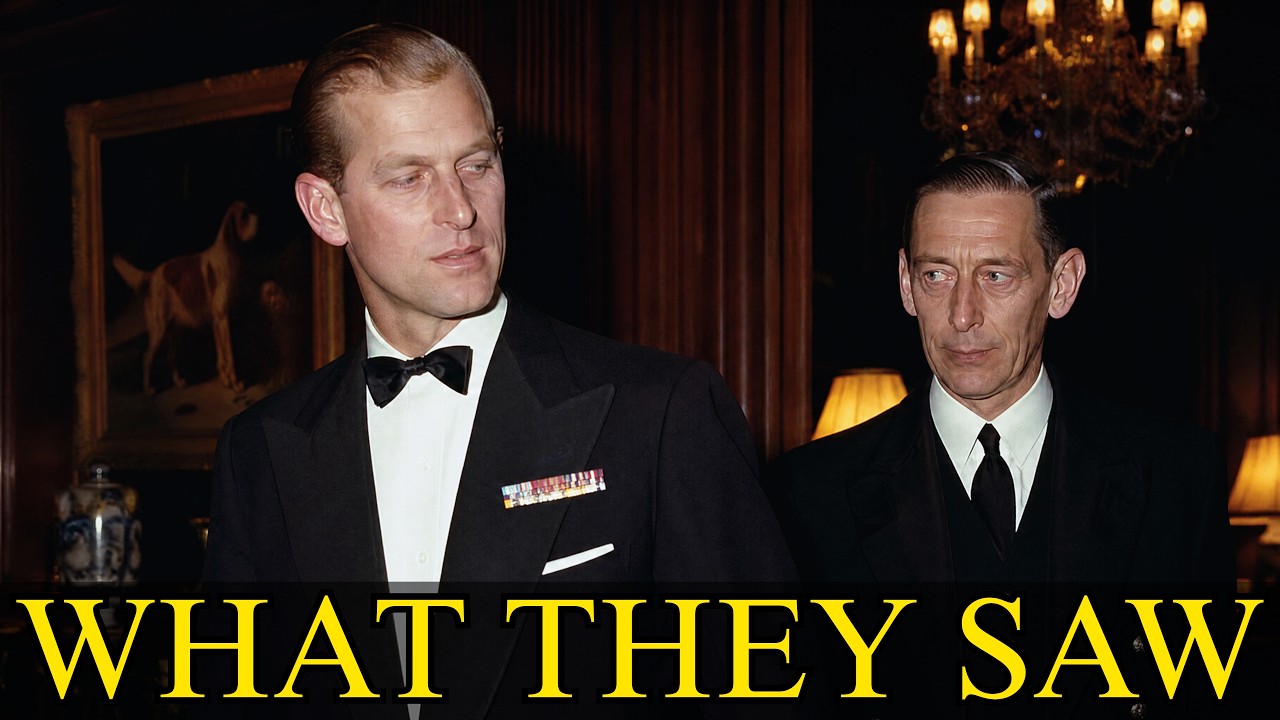
They walked in the procession, and at the door they halted while the family passed inside. What they had seen across a lifetime went with them into silence, just as it always had. That silence was the defining feature of Prince Philip’s household. For more than seventy years, a small rotation of valets, pages, equerries, and private secretaries saw him at a range almost no one else was ever granted, and almost none of them ever spoke about it.
In 1954, a valet named John Dean broke the unwritten rule by publishing a gentle, affectionate memoir of the young Duke of Edinburgh. It was the single exception. Every servant who came after him wrote nothing at all. The household’s code of discretion was not an accident.
It was enforced by contract, by the understanding that loyalty would be rewarded with honors in the sovereign’s personal gift, and by the sheer culture of the place. The contrast with other royal households was stark. At Clarence House, a few hundred yards away, the Queen Mother’s page, William Talon, known as Backstairs Billy, became a public character in his own right, the subject of gossip and eventually a biography. Nothing of the kind ever attached to Philip’s men.
His household was the disciplined extreme of that hidden world, buttoned and mute. What they were protecting was a genuinely two-sided man. In public, Philip was the model of ceremonial restraint, the consort who walked one step behind the queen. In private, the household saw a man of formidable temper and exacting standards, a restless technical mind that reorganized kitchens and swore at photographers.
And beneath the sharp edges, they saw a rough loyalty that ran in both directions. The proof came in his will. When Philip died, his estate, reported at around thirty million pounds, made specific bequests to three of his personal staff, his last private secretary, his page, and his valet, the men who had cared for him in his final years. He remembered every one of them by name.
To understand how that household formed, the story has to go back to its beginning. Philip was born on 10 June 1921 on the Greek island of Corfu, in a villa with no hot water. He was the fifth child and only son of Prince Andrew of Greece and Denmark and Princess Alice of Battenberg. Within eighteen months, the family collapsed.
Greece lost its war with Turkey, a military revolt swept the government, and Prince Andrew was arrested and court-martialled. King George V sent a warship to save him. In December 1922, the cruiser HMS Calypso carried the family away for good, with the infant Philip settled to sleep in a cot improvised from a fruit box. What followed was a childhood with no fixed ground beneath it.
The family settled on the edge of Paris, living on the generosity of relatives. His four sisters, all considerably older, married into German noble houses and moved away. His father drifted to Monte Carlo and out of the boy’s daily life. His mother, born deaf, suffered a severe mental breakdown and was placed in a sanatorium in Switzerland.
For years, effectively, Philip had no parents present at all. A child assembled from other people’s households would grow into a man who understood households from the inside. His schooling followed the same restless map. After an American-run school in Paris and a preparatory school in England, he was sent to Germany, to a school called Salem, run by a remarkable educator named Kurt Hahn.
Hahn, a German Jew, had built his theory of education on physical challenge, self-reliance, and service to others. When the Nazis forced him out of Germany, he fled to Scotland and founded a new school called Gordonstoun. Philip followed his teacher north. The school was Spartan to the point of severity, with cold showers before dawn and runs in the bitter North Sea wind.
It fitted him like a glove. He grew into a tall, confident young man, impatient with softness in himself and everyone around him. By the late 1930s, the shape of the man was set. He was clever, restless, physically fearless, and emotionally guarded.
He had learned to give his loyalty to institutions and individuals who earned it rather than to a family that had come apart. When the time came to choose a path, there was only one he wanted. He went into the Royal Navy. In the war that was about to break over Europe, the exactitude that would one day rule a palace was forged in something far more serious than ceremony.
In the spring of 1941, he was a midshipman aboard the battleship HMS Valiant. On the night of 28 March, the Mediterranean Fleet met the Italian Navy off Cape Matapan. Philip’s station was the searchlights. As the fleets closed to point-blank range, it was his job to hold the beams on the enemy cruisers so the British guns could find them.
He did it, and two heavy Italian cruisers were sunk in minutes. His commanding officer’s report read: “Thanks to his alertness and appreciation of the situation, the ship was able to sink in 5 minutes two Italian cruisers of 8in gun. ” He was mentioned in dispatches. He was nineteen years old.
The war made him fast and it made him serious. By twenty-one, he was first lieutenant of the destroyer HMS Wallace, one of the youngest officers in the Royal Navy to hold such a post. During the Allied invasion of Sicily in 1943, with the Wallace under night attack from the air, he is credited with a piece of quick thinking that likely saved her. He had a raft built and set adrift loaded with smoke floats.
When lit, it drew the enemy bombers away from the ship toward a decoy. The bombers went for the raft. The ship slipped away into the night. The same instinct to look hard at a system under stress and engineer a way through it never left him, not on a destroyer, not on a carriage course, not in a palace kitchen.
He ended the war in Tokyo Bay when the Japanese surrendered. What the Navy gave him was not only a profession but a whole philosophy of how the world should work. A warship is the purest possible expression of the values Gordonstoun had planted in him. Everything has a place and a purpose.
Time is kept to the minute. Standards are a matter of survival. Rank is clear, duty is clear, and sentiment is a luxury the sea does not permit. By 1950, still in his late twenties, he was given his own command, the frigate HMS Magpie.
Those who served under him remembered a hard-driving captain who pushed the ship to a high standard, and the crew took fierce pride in her. He was, by every sign, completely happy. A stateless boy carried out of Greece in a wooden box had become a decorated war hero, a captain before thirty, marked by his superiors as a potential future leader of the entire Royal Navy. He had built from nothing a self and a standing that belonged to him alone.
And that is precisely why the years just ahead would be so hard. The life he had made for himself was about to be taken away by a marriage, a crown, and a role no amount of seamanship could teach a man how to perform. He had met Princess Elizabeth before the war, and through the long years of the war they had written to one another. She had fallen for him early and firmly, and she held to that choice against quiet resistance from courtiers who thought the penniless, blunt-spoken naval officer an unsuitable match for the heir to the throne.
It moved her not in the slightest. They were married on 20 November 1947 at Westminster Abbey. The day before, Philip gave up his Greek and Danish titles, took the surname Mountbatten, was received into the Church of England, and was created Duke of Edinburgh. What he brought to the marriage in worldly terms was almost nothing at all.
At first the naval life continued, and those were, by his own later admission, among the happiest years of his existence. Posted to Malta, the couple lived something close to an ordinary life. It was in Malta in 1950 that he took command of the Magpie. For a brief golden window, the two halves of his life held together in balance.
But the king was not well. George VI’s health was failing faster than the public was allowed to know. Philip gave up active command in 1951. The couple returned to Britain and to a steadily heavier load of public duties.
On 6 February 1952, the Duke and Duchess of Edinburgh were in Kenya, standing in for the ailing king on a tour. They were staying at a lodge built high in the branches of a great fig tree when the news reached them. The king had died in the night. In a single morning, the young woman asleep in the treehouse became queen of a quarter of the earth, and the last of Philip’s own life fell quietly away.
His naval career was over, finished in that same moment. He was only thirty years old. Asked about it many years later, he said quite simply that he would much rather have stayed in the Navy. Worse than the loss of the Navy was the emptiness of what had replaced it.
A consort has no constitutional function whatsoever. No job, no department, no defined task. Philip described the vacuum himself in plain words: there was no precedent. If he asked anybody what they expected him to do, they all simply looked blank.
For a man of thirty, a decorated war hero used to command and purpose, it was very close to a sentence. He did not accept the emptiness. He seized the single territory that was actually available to him, the running of the royal households and estates. If he could not command a ship, then by God he would command this.
Within a year of the accession, he was handed real executive responsibility for the royal lands. At Sandringham, he oversaw the planting of more than five thousand trees every year and the creation of over a hundred miles of wildlife margins. At Balmoral, he drove through a hydroelectric scheme and a long program of forest regeneration. At Windsor, he opened a farm shop.
In 1956, working with his old schoolmaster Kurt Hahn, he founded the Duke of Edinburgh’s Award, a scheme to challenge and develop young people through service, skill, and physical endeavor. It would go on to touch millions of lives and remains his most enduring legacy. He turned the same reforming eye on the palace itself. As he found it in the early 1950s, messages between rooms were carried by hand by footmen, as they had been a century before.
Philip wanted telephones installed. There was resistance, in part from the Queen Mother’s corner of the household, where the older way was felt to be more dignified. Philip won. He was the first member of the royal family to use a computer in his own office.
He was the driving force behind allowing the 1953 coronation to be televised live, over the horror of an establishment that feared the camera would strip the sacred mystery from the ceremony. He was proved right. He pushed for the first ever television interview by a member of the royal family. He swept away the presentation of debutantes and broadened the palace garden parties.
The staff who served under him lived inside his measurements. He noticed things all the time. He wanted things done properly, promptly, and without fuss. He reorganized kitchens so hot food arrived hot.
The scale of the machine he was reforming was vast. Buckingham Palace alone holds 775 rooms. Across the reign, Philip personally undertook more than 22,000 solo engagements, made over 600 solo visits abroad, delivered close to 5,500 speeches, and served more than 780 organizations as patron or president. Every part of that output rested on the household he had reformed, staffed, and driven to his own exacting standard.
The temper was part of the daily texture. A writer who knew him for forty years described him as sullen and crabby for no reason anyone could detect, and said he would walk away from conversations that bored him mid-sentence. The writer who knew him best recalled being heckled by the Duke from the audience during charity speeches, cut off with a bark of “Get on with it. ” The most infamous instance came at a lunch marking the 75th anniversary of the Battle of Britain, when, out of patience with the fuss of arranging a group picture, he snapped at a photographer to “just take the bloody picture.
” It ran around the world within the hour. And yet the striking thing about the testimony of those who worked around him is not that they feared him but that they loved him. A royal butler who watched him for years admitted he was blunt and not to everyone’s taste. Then he said he adored Prince Philip.
“If he swore at you,” the butler said, “that was you getting to see the real man, and a great many people rather liked it. ” The sharpness was not cruelty. It was directness, honesty without a coat of polish. In the world of carriage driving, the verdicts were the same.
His own coachman said simply that he was “one hell of a man. ” Hard but fair, and the fairness was every bit as real as the temper. The single greatest test of the household’s code came in 1956. In the autumn of that year, Philip set out on an extraordinary solo voyage aboard the royal yacht Britannia, a tour that would carry him away from the Queen and his two young children for nearly four months.
The centerpiece was Australia, where he opened the Olympic Games in Melbourne. From there he visited New Zealand, and then the voyage turned south into the Antarctic, where he became the first member of the British royal family to cross the Antarctic Circle. At Gritviken on South Georgia, he stood at the grave of Ernest Shackleton. The journey was a triumph of endurance and duty.
At home in London, the marriage of the man standing at his shoulder was falling apart. Michael Parker, the Australian naval officer who had met Philip in 1942 when both were young men commanding escort ships in the northern seas, had joined the household after the wedding and risen to private secretary. He ran Philip’s office, managed the diary, and stood closer to the marriage than anyone outside it. His own marriage had been ground down by the years in which his entire life had been given over to the Duke.
On 5 February 1957, his wife announced through her solicitor that they were to separate. Parker learned of it as Britannia neared the final leg of the voyage home. He understood at once what it meant. A royal household in the 1950s could not carry a public divorce at its very heart.
On 6 February, at Gibraltar, he resigned as private secretary to spare the palace the embarrassment. Philip, Parker said afterward, was incandescent, very, very angry, and deeply hurt. He was losing the one companion in the world who understood him best, to the force he hated above all others, the press. The American press then printed a rumor that the Queen and the Duke were in a rift over a party girl.
No woman was named. No evidence was offered. It was rumor printed openly as rumor. But it struck at the very heart of the institution, and it was spreading quickly enough that silence was beginning to look like a confession.
So the palace broke its own rule. Through the Queen’s press secretary, Commander Richard Colville, it issued a formal statement: “It is quite untrue that there is any rift between the Queen and the Duke. ” A single flat sentence, and the very existence of the denial was an extraordinary event. On 22 February 1957, days after the reunion at Lisbon, where the Queen met Philip with a private joke about false beards, she issued letters patent granting her husband the style and titular dignity of a Prince of the United Kingdom.
To a watching world it read as an answer written in stone. In the very days when half the world was whispering that the marriage was in ruins, the sovereign had chosen to publicly elevate her husband and place him at the very center of the crown. After Parker came a line of men who served quietly for decades. There was Sir Brian McGrath, who joined the Duke’s office in the early 1980s and stayed for more than thirty years.
There was Brigadier Sir Miles Hunt-Davis, who ran the office for seventeen years. There was the last of the line, Brigadier Archie Miller-Bakewell, who served from 2010 until the end. The honors climbed in careful step with the years, the Royal Victorian Order advanced grade by grade until men like McGrath and Hunt-Davis held its highest ranks. Through the decades when other royal households leaked and produced tell-all books, from the Duke’s household there came almost nothing.
The men who had stood closest simply did not speak. In private, Philip revealed the man the public never saw. When age forced him to give up polo at around fifty, he took up carriage driving, competed for the British national team, and designed real innovations to the carriages, a new kind of driving pole, better wheels, quick-release harness fittings. He was a natural pilot who logged nearly 6,000 hours in the air across 59 different types of aircraft.
And at Balmoral, the central ritual of the summer was the outdoor barbecue, which was Philip’s own domain. The Queen set out the table. The Duke did the cooking. A royal chef described him as the most passionate of all cooks.
For roughly the last sixteen years of his life, beginning in 2003, Philip worked patiently with the engineers of a British carmaker on the strangest and most quietly moving of all his private projects. He was designing his own hearse. He took a Land Rover, had the color changed to a deep dark military green, specified an open top at the rear, and designed the rubber grips that would hold his coffin steady. He worked at it into his late nineties.
The boy who had been carried out of Greece as a baby, asleep in a wooden fruit box he did not choose, left the world in a vehicle he had built to the inch entirely for himself. In the spring of 2017, at the age of ninety-five, he simply stopped. His final solo engagement came on 2 August 2017, standing alone in the rain on the forecourt of Buckingham Palace to meet Royal Marines who had completed a grueling charity challenge. When told of the hardships the men had endured, he delivered one last public verdict in the purest Philip idiom: “You should all be locked up.
” Then he retired to Wood Farm, a modest farmhouse on the Sandringham estate, where the small staff did not even trouble to wear their uniforms. On 9 April 2021, he died at Windsor Castle, two months short of his hundredth birthday. He had been married to the Queen for 73 years. His funeral fell entirely under the shadow of the pandemic.
Only 30 mourners were permitted inside St. George’s Chapel, and every one of them went to family. The Queen sat entirely alone in the vast echoing space. The coffin was carried on the Land Rover hearse he had spent sixteen years designing.
Royal Marine buglers sounded the old calls of the sea service he had loved above all others, including the urgent summons of action stations from his wartime past. Those who understood noticed that three of the 30 places went to German princes, descendants of the sisters he had lost to history. The men who had served him, the private secretary, the page, the valet, the three he had remembered by name in his own will, were not among the 30. There was no room for servants, however close they had stood.
They walked in the procession behind the coffin through the cold spring air, and at the chapel door they stopped. The family passed inside. The servants remained without. They had watched him closely for a lifetime, and at the very last they stood and watched him go through a door they were not permitted to follow him through.
Years before, at a lunch marking their golden wedding, the Queen had tried to say in public what the man beside her had been to her across all the decades. “He is someone who does not take easily to compliments,” she said, “but he has quite simply been my strength and stay all these years. ” He was placed first in the royal vault, and when the Queen died the following year, they were brought together and laid side by side in a small side chapel at Windsor. The one valet who wrote his gentle little book back in 1954 was the single exception across seventy years.
All the rest kept the faith completely. The secretaries who served thirty years and said nothing. The page and the valet who cared for him to the last and said nothing. The men who followed his coffin to the chapel and stopped at the door and said nothing.
Every one of them carried what they had seen out of the corridors of his long life and away into their own silence. Straight-backed, silent, correct, exactly to the last, as he had always meant to be.