In 1997, a year before Google existed, a search engine launched from a small office in Berkeley, California, with a proposition that would not become the industry standard for another quarter century. You could type a question in plain English, as you would ask another human being, and a cartoon butler in a pinstriped suit would try to understand what you meant and hand you an answer. No Boolean operators, no keyword strings, no learning to think like a machine. Just a question in your own words.
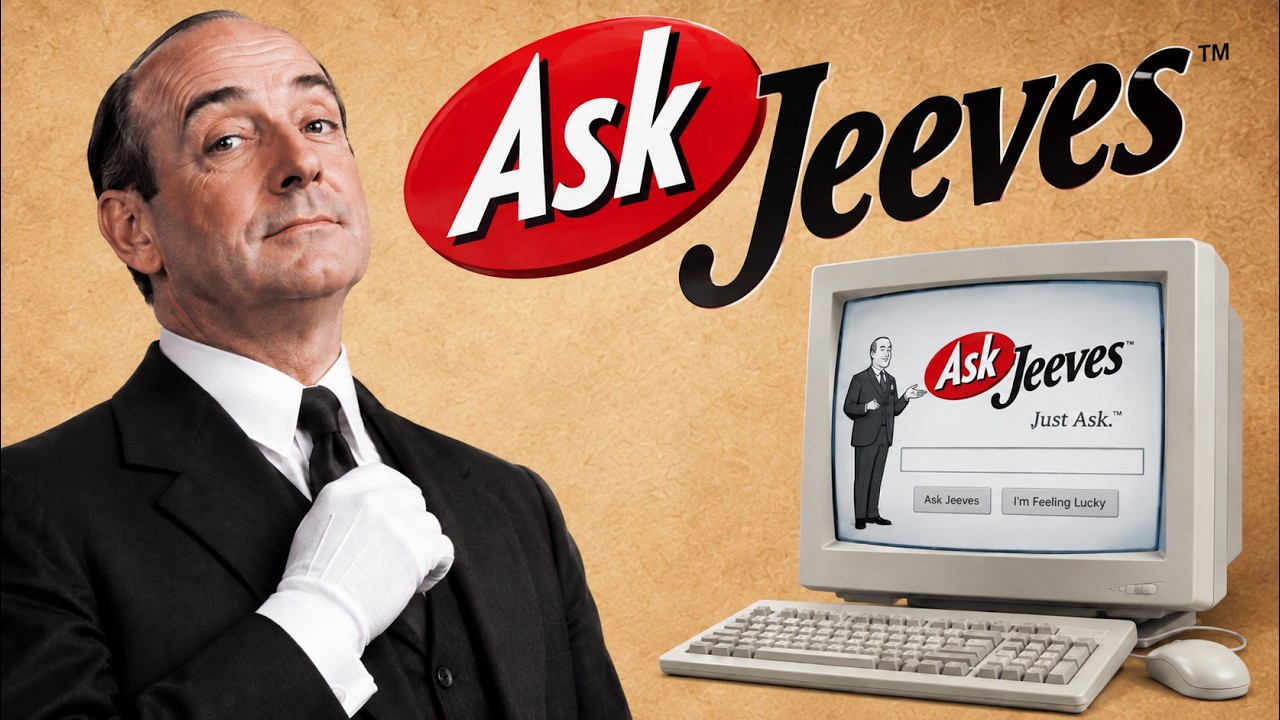
The company was called Ask Jeeves. Within two years it went public on the NASDAQ, its stock surging 364 percent on the first day of trading and later climbing to $190. 50 per share. In November 2000, the butler himself floated above Broadway as a giant balloon in the Macy’s Thanksgiving Day Parade, the first internet-born character ever immortalized that way.
For one brief American season, a cartoon butler was the most recognized face on the internet. By 2002 the stock was worth 86 cents. By 2006 the butler was fired. By 2010 the search engine was hollowed out and its engineers sent home.
On May 1, 2026, the homepage displayed a farewell message and went dark. Garrett Gruener graduated from the University of California, San Diego in 1976 and spent the next decade inside small technology companies. In 1982 he founded Virtual Micro Systems, a communications software company in the Bay Area. By 1992 he was a partner at a venture capital firm, where his job was to evaluate founders’ ideas.
He noticed a recurring pattern: nearly every internet company that walked through his door was building tools for engineers and hoping ordinary people would figure them out. What consumed him was the way people searched. In the early 1990s, finding something online meant learning a syntax no ordinary person spoke. AltaVista wanted keywords.
Lycos wanted keywords. WebCrawler wanted keywords. Gruener’s insight was simple and, as it turned out, about 25 years ahead of the industry. People do not naturally communicate in keywords.
They ask questions. What if a search engine simply let them? Gruener was not an engineer. He was a user, and that difference in perspective proved worth more than any algorithm.
Around 1992 he began sketching the concept. He recruited David Warthen, a computer science graduate from UC San Diego who had worked for him years earlier, to become co-founder and chief technology officer. Warthen understood that the natural language parsing was only as good as the systems underneath it, and that if servers could not return answers in under two seconds, the entire experience would feel broken. The person who built the core search technology was neither founder.
Gary Chevsky was born in 1972 in Odessa, then part of the Ukrainian Soviet Republic, and immigrated to the United States in 1988 at the age of sixteen. In 1992 Gruener hired the twenty-year-old to write the programming for a search engine concept that had no company, no name, no funding, and no revenue. Chevsky would eventually hold five patents in the field and earn a place in the Computer History Museum’s search engine exhibit. The founders got the magazine covers.
Chevsky built the machine that understood the question. Gruener and Warthen each invested more than $250,000 of their own money. They set up offices in Berkeley, hired roughly forty people, and incorporated the company in June 1996. The product needed a name.
Gruener settled on Jeeves, after the hyper-competent fictional valet in P. G. Wodehouse’s novels, and commissioned a cartoon butler in a pinstriped suit as mascot. The technology worked like this.
Chevsky’s natural language processing system parsed the intent behind a question typed in ordinary English. But the real backbone was something the company called knowledge capsules: pre-built answer packages assembled by human editors who anticipated common questions and curated the best available links for each one. It was half algorithm, half editorial department, a digital reference desk staffed by real people who thought like librarians and worked like journalists. The beta went live in mid-April 1997.
The official launch came on June 1. The Berkeley office felt more like a newsroom than a startup. Editors sat at desks researching common questions the way wire service reporters worked a beat, assembling authoritative answers before anyone had typed them. The goal was to have an answer waiting before the question arrived.
Revenue in 1997 was $23,000. In 1998 it climbed to $800,000. But the traffic told a different story. By October 1998, Ask Jeeves was processing 300,000 searches per day.
By May 1999, the count crossed one million. By October, two million. The numbers attracted the venture capitalists who had spent the late 1990s pouring money into anything with a . com in its address.
Ask Jeeves had something none of its competitors offered: personality and philosophy. But it also carried a problem none of them shared. The knowledge capsules did not scale. Every new question category required human editors to research, write, and curate a new capsule by hand.
The web was growing faster than any editorial team on Earth could map. One in five queries, by the company’s own assessment, involved people searching for nude photographs, and the editorial team had to build and maintain content filters around that reality every day. When the system encountered a query it could not match to a curated capsule, it returned results that felt arbitrary and random. By 1999, Google had already begun indexing more than thirty million pages.
Its results were generated in fractions of a second by machines that never needed lunch breaks or editorial meetings. Ask Jeeves was staffing up to keep pace with a web doubling in size every few months. Google was building a system that kept pace automatically. The difference was the difference between hiring more librarians and inventing the card catalog.
One scaled. The other did not. Revenue reached $22 million in 1999, but expenses were four and a half times that figure. In late 1999, the P.
G. Wodehouse estate formally challenged the company’s use of the Jeeves name. The dispute ended in a settlement on undisclosed terms. On July 1, 1999, Ask Jeeves went public under the ticker ASKJ at $14 per share.
By the close of the first day, the stock had surged 364 percent, making it the third most successful first-day IPO in American business history at the time. Within months the share price climbed to $190. 50. The company signed Hollywood agent Michael Ovitz to handle merchandising.
The butler appeared on produce stickers in supermarkets. And in November 2000, a 39-foot-tall helium balloon version of the butler floated down Broadway in the Macy’s parade, guided by more than fifty handlers. But in September 1998, two Stanford graduate students named Larry Page and Sergey Brin had launched a search engine called Google. It had no mascot, no knowledge capsules, no editors.
What it had was an algorithm called PageRank that read the architecture of the web itself, measuring not just which pages contained a search term but how many authoritative pages linked to each result. Google did not need to anticipate your question. It needed the web, because the web already contained the ranking signal in its own link structure. While Ask Jeeves was hiring editors to hand-build answers to anticipated questions, Google was building a machine that could answer questions nobody had anticipated.
Then the bubble burst. The NASDAQ began its collapse in March 2000, and the advertising market that had funded every search engine in America collapsed with it. Revenue fell from $58 million in 2000 to $32 million in 2001, a 45 percent decline in a single year. Net losses accumulated to $675 million by the end of 2001.
The stock cratered below a dollar. By 2002, a single share traded for 86 cents. Excite was sold for pennies on the dollar. Lycos was acquired by a Spanish media company.
AltaVista was passed between corporate owners. Infoseek was absorbed into Disney’s go. com, which Disney then shut down. The search engine industry was a graveyard by 2002, and Ask Jeeves was one of the few headstones that had not yet fallen over.
The company survived because its new leadership made a decision that deserves more credit than history usually gives it. Skip Battle became CEO in December 2000. Steve Berkowitz arrived in May 2001. On September 18, 2001, with the stock in the gutter, they acquired a small search technology company called Teoma out of Rutgers University for just over $1.
5 million. The technology, developed by professor Apostolos Gerasoulis and his colleague Tao Yang from UC Santa Barbara, worked on a principle genuinely different from PageRank. Teoma did not merely count links. It identified clusters of pages that were true authorities within specific subject areas and weighted their links by demonstrated expertise rather than raw popularity.
The team called the algorithm ExpertRank. By January 2002, the technology was integrated. Teoma-powered search grew 175 percent that year, making it the third most popular search engine in the United States. In the fourth quarter of 2002, Ask Jeeves posted its first quarterly profit: $2 million.
By 2003, revenue reached $107 million and net income hit $26 million. The stock climbed more than 500 percent from its lows. Fortune called it one of the most improbable turnarounds in technology history. In May 2004, Ask Jeeves purchased Interactive Search Holdings for $343 million, pushing its combined market share to roughly 7 percent.
It was not Google, which commanded 35 percent of the market and was still climbing. But Ask Jeeves was profitable, growing, and breathing. The original search experience was unlike anything else on the internet. You arrived at a page with a cartoon butler standing beside a search bar that did not ask for keywords.
It invited you to type a question. Where is the nearest Italian restaurant? How do I fix a leaking faucet? Who won the 1969 World Series?
The butler acknowledged your question with a small animation, tilting his head as if considering the problem. It felt less like querying a database and more like asking a librarian who happened to live inside your computer. Then there was Ask Jeeves for Kids, launched in 1998 at ajkids. com, one of the very first search engines designed specifically for children.
Children type the way they talk, and Ask Jeeves was built for exactly that. Teachers across the country added it to their classroom bookmark lists. For a generation of American school children, it was the first search engine they ever used. But here is the fact that sat in the middle of the balance sheet.
In July 2002, Ask Jeeves signed a $100 million three-year advertising deal with Google. Google supplied the sponsored listings that appeared alongside Ask Jeeves results, and that deal accounted for roughly 70 percent of Ask Jeeves’s total revenue. The company that was supposed to be competing with Google could not keep its own lights on without Google’s advertising money. In March 2005, Barry Diller’s IAC announced it would acquire Ask Jeeves for $1.
85 billion. Diller was a media executive who understood audiences, brands, and monetization. What he did not understand, and perhaps never tried to, was why Ask Jeeves worked. The editorial soul of the product, the butler, the natural language philosophy, the idea that search should feel like a conversation, interested him less than the queries flowing through the system and the advertising dollars attached to each one.
The human editors and the knowledge capsules were costs to be cut, not assets to be protected. On February 27, 2006, Ask Jeeves became ask. com. The butler was retired.
Fired is the more honest word. You can read the rebranding two ways. One reading says it was necessary modernization. The other says it was the moment Ask Jeeves surrendered the only advantage it had ever held.
The company’s edge was never its algorithm or its market share. It was its identity, the warmth, the approachability, the radical idea that a search engine should meet you where you were. Removing the butler did not turn Ask. com into Google.
It turned ask. com into a smaller, slower, less well-funded version of Google with no reason for any user to choose it over the original. The five years that followed proved which reading was closer to the truth. In July 2010, ask.
com shut down its in-house web crawler and laid off 130 search engineers. The people who had integrated ExpertRank into the platform and engineered the comeback were sent home. Ask. com would continue to exist as a website, but it would no longer build its own search technology.
Two months later, Barry Diller appeared on stage at TechCrunch Disrupt and was asked about Ask. com. His response was blunt: Ask has no value inside of IAC. What came after was worse than irrelevance.
Ask. com pivoted to a toolbar, bundled with Oracle’s Java software installer. The toolbar changed users’ default search engine without clear consent, displayed pop-up warnings when users tried to switch back, and could reinstall itself silently after Java updates. In June 2015, Microsoft classified older versions of the Ask Toolbar as malware and programmed Windows Defender to automatically detect and remove it.
A company acquired for $1. 85 billion, built on the premise that search should be human and friendly and conversational, was reduced to software that the world’s largest software company treated as a virus. And yet people kept coming. In 2012, ask.
com still counted 100 million global monthly users. The instinct Ask Jeeves had served, the simple human desire to ask a question in plain language and get a direct answer, had never gone away. Every voice assistant on every smartphone, every smart speaker on every kitchen counter, every customer service chatbot on every retail website was built on the same premise that a butler in a pinstriped suit had introduced to the American public in 1997. The premise was never wrong.
The execution had simply arrived a generation before the hardware and algorithms could support it. By 2023, ChatGPT became the fastest growing consumer application in history by doing the exact thing Ask Jeeves had tried to do in 1997: letting people type a question in natural English and receive a direct conversational answer. Google itself rebuilt its search engine around an AI chatbot. Microsoft embedded one in Bing.
Every major technology company on Earth was racing to build exactly what a small team in Berkeley had sketched on a whiteboard three decades earlier. On May 1, 2026, the ask. com homepage displayed its final message. Every great search must come to an end, it read.
As Ask continues to sharpen its focus, we have made the decision to discontinue our search business. And at the bottom, a single sentence carried more weight than perhaps anyone at IAC intended: Jeeves’s spirit endures. The 70-foot balloon that once floated above Broadway was deflated and stored in a warehouse after its final flight in 2004, when the golden keys of knowledge went missing from its left hand during the parade and the butler flew keyless over Manhattan for the last time. Ask Jeeves did not lose because it was wrong.
It lost because it was right too early, and it did not have the nerve to wait.